
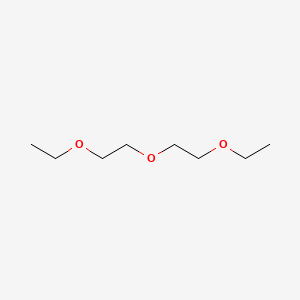
CAS 112-36-7PubChem CID 8179
Diethylene glycol diethyl ether
Diethylene glycol diethyl ether is a clear colorless viscous liquid. (NTP, 1992) — CAMEO Chemicals
- IUPAC 名称
- 1-ethoxy-2-(2-ethoxyethoxy)ethane
- 分子式
- C8H18O3
- 分子量
- 162.23 g/mol
- 精确质量
- 162.125594432 Da
- XLogP3
- 0.4
- 拓扑极性表面积
- 27.7 Ų
- 氢键供体
- 0
- 氢键受体
- 3
- 共价单元
- 1
- 已定义的立体中心
- 0
又称
2-Ethoxyethyl etherDiethyl carbitolBis(2-ethoxyethyl) etherDEGDEEEthane, 1,1'-oxybis[2-ethoxy-HSDB 68Ethane, 1,1'-oxybis(2-ethoxy-Glycol, diethylene-, diethyl ether
另有 16 个已报告名称
EINECS 203-963-7UNII-ZH086O935Zdiethoxydiglycoldiethyleneglycol diethyl etherBRN 1699259HISOLVE EDEAI3-19428ZH086O935Z1,1'-oxybis(2-ethoxy)ethaneCHEBI:44664EC 203-963-74-01-00-02394 (Beilstein Handbook Reference)DIETHYLENE GLYCOL DIETHYL ETHER [MI]DIETHYLENE GLYCOL DIETHYL ETHER [HSDB]bis(2-ethoxyethyl)ether3,6,9Trioxaundecane
外部数据库标识符
- ChEBI:CHEBI:44664
- ChEMBL:CHEMBL1235106
- EPA DTXSID:DTXSID3025047
- PubMed:12511205
来自其他科学数据库的证据
NIH PubChem PUG-View
标识符精确匹配8179
Attributed physical-property, hazard, environmental and use annotations.
- Autoignition Temperature: 401 °F (NTP, 1992) 来源: CAMEO Chemicals
- Autoignition Temperature: 174 °C 来源: ILO-WHO International Chemical Safety Cards (ICSCs)
- Boiling Point: 372 °F at 760 mmHg (NTP, 1992) 来源: CAMEO Chemicals
- Boiling Point: 188 °C 来源: Hazardous Substances Data Bank (HSDB)
- Boiling Point: 189 °C 来源: ILO-WHO International Chemical Safety Cards (ICSCs)
- Boiling Point: 189 °C @760 [mm Hg] 来源: PAC Chemical Database, U.S. Department of Energy
- Color/Form: Colorless liquid 来源: Hazardous Substances Data Bank (HSDB)
- Density: 0.9063 at 68 °F (NTP, 1992) - Less dense than water; will float 来源: CAMEO Chemicals
- Density: 0.907 at 20 °C/4 °C 来源: Hazardous Substances Data Bank (HSDB)
- Density: Relative density (water = 1): 0.91 来源: ILO-WHO International Chemical Safety Cards (ICSCs)
- Density: 0.9082 @ 20°C 来源: PAC Chemical Database, U.S. Department of Energy
- Flash Point: 130 °F (NTP, 1992) 来源: CAMEO Chemicals
- Flash Point: 180 °F (82 °C) (Open Cup) 来源: Hazardous Substances Data Bank (HSDB)
- Flash Point: 71 °C c.c. 来源: ILO-WHO International Chemical Safety Cards (ICSCs)
- LogP: log Kow = 0.39 来源: Hazardous Substances Data Bank (HSDB)
- LogP: 0.39 来源: ILO-WHO International Chemical Safety Cards (ICSCs)
- Melting Point: -47.7 °F (NTP, 1992) 来源: CAMEO Chemicals
- Melting Point: -45 °C 来源: Hazardous Substances Data Bank (HSDB)
- Melting Point: -44 °C 来源: ILO-WHO International Chemical Safety Cards (ICSCs)
- Melting Point: -44 °C 来源: PAC Chemical Database, U.S. Department of Energy
- Physical Description: Diethylene glycol diethyl ether is a clear colorless viscous liquid. (NTP, 1992) 来源: CAMEO Chemicals
- Physical Description: Liquid 来源: EPA Chemical Data Reporting (CDR)
- Physical Description: Colorless liquid; [Hawley] 来源: Haz-Map, Information on Hazardous Chemicals and Occupational Diseases
- Physical Description: COLOURLESS VISCOUS LIQUID. 来源: ILO-WHO International Chemical Safety Cards (ICSCs)
- Refractive Index: Index of refraction: 1.4115 at 20 °C/D 来源: Hazardous Substances Data Bank (HSDB)
- Solubility: greater than or equal to 100 mg/mL at 66 °F (NTP, 1992) 来源: CAMEO Chemicals
- Solubility: Very soluble in ethanol, organic solvents; soluble in ethyl ether 来源: Hazardous Substances Data Bank (HSDB)
- Solubility: Soluble in hydrocarbons 来源: Hazardous Substances Data Bank (HSDB)
- Solubility: Infinite /1.0X10+6 mg/L/ solubility water at 25 °C 来源: Hazardous Substances Data Bank (HSDB)
- Solubility: Solubility in water: very good 来源: ILO-WHO International Chemical Safety Cards (ICSCs)
- Vapor Pressure: 0.54 mmHg at 77 °F (NTP, 1992) 来源: CAMEO Chemicals
- Vapor Pressure: 0.52 [mmHg] 来源: Haz-Map, Information on Hazardous Chemicals and Occupational Diseases
- Vapor Pressure: 0.520 mm Hg at 25 °C 来源: Hazardous Substances Data Bank (HSDB)
- Vapor Pressure: Vapor pressure, Pa at 20 °C: 79 来源: ILO-WHO International Chemical Safety Cards (ICSCs)
- Vapor Pressure: 0.52 [mm Hg] @25 °C 来源: PAC Chemical Database, U.S. Department of Energy
- First Aid: EYES: First check the victim for contact lenses and remove if present. Flush victim's eyes with water or normal saline solution for 20 to 30 minutes while simultaneously calling a hospital or poison control center. Do not put any ointments, oils, or medication in the victim's eyes without specific instructions from a physician. IMMEDIATELY transport the victim after flushing eyes to a hospital even if no symptoms (such as redness or irritation) develop.; SKIN: IMMEDIATELY flood affected skin with water while removing and isolating all contaminated clothing. Gently wash all affected skin areas thoroughly with soap and water. If symptoms such as redness or irritation develop, IMMEDIATELY call a physician and be prepared to transport the victim to a hospital for treatment.; INHALATION: IMMEDIATELY leave the contaminated area; take deep breaths of fresh air. If symptoms (such as wheezing, coughing, shortness of breath, or burning in the mouth, throat, or chest) develop, call a physician and be prepared to transport the victim to a hospital. Provide proper respiratory protection to rescuers entering an unknown atmosphere. Whenever possible, Self-Contained Breathing Apparatus (SCBA) shou 来源: CAMEO Chemicals
- Note: This chemical does not meet GHS hazard criteria for 5.6% (21 of 374) of reports. 来源: European Chemicals Agency (ECHA)
- Signal: Warning 来源: European Chemicals Agency (ECHA)
- GHS Hazard Statements: H315 (42.8%): Causes skin irritation [Warning Skin corrosion/irritation]; H319 (51.3%): Causes serious eye irritation [Warning Serious eye damage/eye irritation] 来源: European Chemicals Agency (ECHA)
- Precautionary Statement Codes: P264, P264+P265, P280, P302+P352, P305+P351+P338, P321, P332+P317, P337+P317, and P362+P364 (click each P-code to see the statement) 来源: European Chemicals Agency (ECHA)
- ECHA C&L Notifications Summary: Aggregated GHS information provided per 374 reports by companies from 7 notifications to the ECHA C&L Inventory. Each notification may be associated with multiple companies.; Reported as not meeting GHS hazard criteria per 21 of 374 reports by companies.; There are 4 notifications provided by 353 of 374 reports by companies with hazard statement code(s).; Information may vary between notifications depending on impurities, additives, and other factors. The percentage value in parenthesis indicates the notified classification ratio from companies that provide hazard codes. Only hazard codes with percentage values above 10% are shown. For more detailed information, please visit ECHA C&L website. 来源: European Chemicals Agency (ECHA)
- Signal: Warning 来源: NITE-CMC
- GHS Hazard Statements: H227: Combustible liquid [Warning Flammable liquids]; H319: Causes serious eye irritation [Warning Serious eye damage/eye irritation] 来源: NITE-CMC
- Precautionary Statement Codes: P210, P264+P265, P280, P305+P351+P338, P337+P317, P370+P378, P403, and P501 (click each P-code to see the statement) 来源: NITE-CMC
- NFPA Health Rating: 1 - Materials that, under emergency conditions, can cause significant irritation. 来源: Hazardous Substances Data Bank (HSDB)
- NFPA Fire Rating: 2 - Materials that must be moderately heated or exposed to relatively high ambient temperatures before ignition can occur. Materials would not under normal conditions form hazardous atmospheres with air, but under high ambient temperatures or under moderate heating could release vapor in sufficient quantities to produce hazardous atmospheres with air. 来源: Hazardous Substances Data Bank (HSDB)
- NFPA Instability Rating: 1 - Materials that in themselves are normally stable but that can become unstable at elevated temperatures and pressures. 来源: Hazardous Substances Data Bank (HSDB)
- Environmental Bioconcentration: An estimated BCF of 3 was calculated in fish for diethylene glycol diethyl ether(SRC), using a log Kow of 0.39(1) and a regression-derived equation(2). According to a classification scheme(3), this BCF suggests the potential for bioconcentration in aquatic organisms is low(SRC). 来源: Hazardous Substances Data Bank (HSDB)
- Environmental Fate: TERRESTRIAL FATE: Based on a classification scheme(1), an estimated Koc value of 39(SRC), determined from a log Kow of 0.39(2) and a regression-derived equation(3), indicates that diethylene glycol diethyl ether is expected to have very high mobility in soil(SRC). Volatilization of diethylene glycol diethyl ether from moist soil surfaces is not expected to be an important fate process(SRC) given an estimated Henry's Law constant of 1.1X10⁻⁷ atm-cu m/mole(SRC), derived from Its vapor pressure, 0.52 mm Hg(4), and water solubility, 1X10+6 mg/L(5). Diethylene glycol diethyl ether may volatilize from dry soil surfaces(SRC) based upon its vapor pressure(4). Biodegradation of diethylene glycol diethyl ether is not expected to be an important fate process in soil based on biodegradation studies conducted with sewage seed(6-7). 来源: Hazardous Substances Data Bank (HSDB)
- Environmental Fate: AQUATIC FATE: Based on a classification scheme(1), an estimated Koc value of 39(SRC), determined from a log Kow of 0.39(2) and a regression-derived equation(3), indicates that diethylene glycol diethyl ether is not expected to adsorb to suspended solids and sediment(SRC). Volatilization from water surfaces is not expected(3) based upon an estimated Henry's Law constant of 1.1X10⁻⁷ atm-cu m/mole(SRC), derived from its vapor pressure, 0.52 mm Hg(4), and water solubility, 1X10+6 mg/L(5). According to a classification scheme(6), an estimated BCF of 3(SRC), from its log Kow(2) and a regression-derived equation(7), suggests the potential for bioconcentration in aquatic organisms is low(SRC). Biodegradation of diethylene glycol diethyl ether is not expected to be an important fate process in water based on biodegradation studies conducted with sewage seed(8-9). 来源: Hazardous Substances Data Bank (HSDB)
- Environmental Fate: ATMOSPHERIC FATE: According to a model of gas/particle partitioning of semivolatile organic compounds in the atmosphere(1), diethylene glycol diethyl ether, which has a vapor pressure of 0.52 mm Hg at 25 °C(2), is expected to exist solely as a vapor in the ambient atmosphere. Vapor-phase diethylene glycol diethyl ether is degraded in the atmosphere by reaction with photochemically-produced hydroxyl radicals(SRC); the half-life for this reaction in air is estimated to be 14 hours(SRC), calculated from its rate constant of 2.7X10⁻¹¹ cu cm/molecule-sec at 25 °C(3). 来源: Hazardous Substances Data Bank (HSDB)
- Consumer Uses: Not Known or Reasonably Ascertainable; Solvent; Other; Processing aids not otherwise specified 来源: EPA Chemical Data Reporting (CDR)
- Industry Uses: Not Known or Reasonably Ascertainable; Other; Solvent; Processing aids not otherwise specified 来源: EPA Chemical Data Reporting (CDR)
- Sources/Uses: Used as solvent for nitrocellulose, adhesives, sealants, plastic resins and compounds, rubber chemicals, lacquers, and organic synthesis; as high-boiling medium; [HSDB] 来源: Haz-Map, Information on Hazardous Chemicals and Occupational Diseases
- Industrial Processes with risk of exposure: Painting (Solvents) [Category: Paint]; Working with Glues and Adhesives [Category: Other]; Plastic Composites Manufacturing [Category: Industry] 来源: Haz-Map, Information on Hazardous Chemicals and Occupational Diseases
- Uses: Solvent; high boiling reaction medium 来源: Hazardous Substances Data Bank (HSDB)
- Uses: Solvent for nitrocellulose, resins, lacquers; high-boiling medium and solvent for organic synthesis 来源: Hazardous Substances Data Bank (HSDB)
- Uses: SOLVENT FOR ADHESIVES, SEALANTS, PLASTIC RESINS & CMPDS, RUBBER CHEMS 来源: Hazardous Substances Data Bank (HSDB)
- Uses: /Glycol ethers/ are used as coupling agents for preparing miscible organic-aqueous systems 来源: Hazardous Substances Data Bank (HSDB)
映射方: Existing checksum-valid CAS to unique PubChem CID match. 检索时间: 2026-08-31. 打开来源记录
科学分类和危害注释仅提供背景信息,不能取代上方所示针对具体市场的监管决定。
其他来源的覆盖范围和匹配状态
| 来源 | 结果 | 已检查 |
|---|---|---|
| NIH PubChem PUG-View | 精确匹配 | 2026-08-31 |
已记录的无匹配结果是该来源已被检查的有效证据;这并不表示该物质在别处不存在。
于 2026-08-31 通过校验和有效的 CAS 匹配从美国国立卫生研究院 (NIH) PubChem 检索。化学性质不能取代本页的监管决定。