
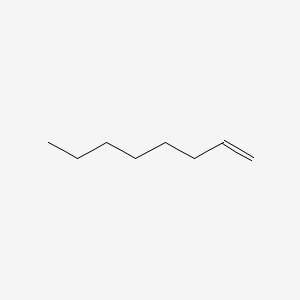
- IUPAC 名称
- oct-1-ene
- 分子式
- C8H16
- 分子量
- 112.21 g/mol
- 精确质量
- 112.125200510 Da
- XLogP3
- 4.6
- 拓扑极性表面积
- 0.0 Ų
- 氢键供体
- 0
- 氢键受体
- 0
- 共价单元
- 1
- 已定义的立体中心
- 0
又称
Caprylene1-Octylenen-1-Octene1-CapryleneOctylenealpha-Octenealpha-OctyleneE5VK21B9RC
另有 16 个已报告名称
NSC-8457CHEBI:46708RefChem:435206203-893-7OCTENE-1Octene.alpha.-Octene.alpha.-OctyleneNSC 8457Neodene 81-?Octene1-C8H161-Octene, 98%1-Octene, analytical standard1-n-octeneOctene, 1-
外部数据库标识符
- ChEBI:CHEBI:46708
- ChEMBL:CHEMBL1376677
- EPA DTXSID:DTXSID6025804
- PubMed:23072478
- PubMed:23023586
- PubMed:22988832
- PubMed:22927018
- PubMed:22847737
- PubMed:22747491
- PubMed:22658963
- PubMed:22611499
- PubMed:22591104
- PubMed:22556097
- PubMed:22519244
- PubMed:22505951
来自其他科学数据库的证据
NIH PubChem PUG-View
标识符精确匹配8125
Attributed physical-property, hazard, environmental and use annotations.
- Autoignition Temperature: 493 °F (USCG, 1999) 来源: CAMEO Chemicals
- Autoignition Temperature: 446 °F (230 °C) 来源: Hazardous Substances Data Bank (HSDB)
- Autoignition Temperature: 256 °C 来源: ILO-WHO International Chemical Safety Cards (ICSCs)
- Boiling Point: 250.3 °F at 760 mmHg (USCG, 1999) 来源: CAMEO Chemicals
- Boiling Point: 121.2 °C @ 760 mm Hg 来源: Hazardous Substances Data Bank (HSDB)
- Boiling Point: Boiling point: 121.2 °C /1-Octene/; 125 °C /2-Octene (E)/; 125.6 °C /2-Octene (Z)/; 123.3 °C /3-Octene (E)/; 122.9 °C /3-Octene (Z)/ 122.3 °C /4-Octene (E)/; 122.5 °C /4-Octene (Z)/ 来源: Hazardous Substances Data Bank (HSDB)
- Boiling Point: 123 °C 来源: ILO-WHO International Chemical Safety Cards (ICSCs)
- Boiling Point: 121 -122 °C 来源: Joint FAO/WHO Expert Committee on Food Additives (JECFA)
- Boiling Point: 121.2 °C @760 [mm Hg] 来源: PAC Chemical Database, U.S. Department of Energy
- Color/Form: Colorless liquid 来源: Hazardous Substances Data Bank (HSDB)
- Density: 0.715 at 68 °F (USCG, 1999) - Less dense than water; will float 来源: CAMEO Chemicals
- Density: 0.7149 @ 20 °C/4 °C 来源: Hazardous Substances Data Bank (HSDB)
- Density: Density: 0.7149 /1-Octene/; 0.7199 g/cu cm @ 20 °C /2-Octene (E)/; 0.7243 g/cu cm @ 20 °C /2-Octene (Z)/; 0.7152 g/cu cm @ 20 °C /3-Octene (E)/; 0.7159 g/cu cm @ 20 °C /3-Octene (Z)/; 0.7141 g/cu cm @ 20 °C /4-Octene (E)/; 0.7212 g/cu cm @ 20 °C /4-Octene (Z)/ 来源: Hazardous Substances Data Bank (HSDB)
- Density: Relative density (water = 1): 0.7 来源: ILO-WHO International Chemical Safety Cards (ICSCs)
- Density: 0.718-0.722 来源: Joint FAO/WHO Expert Committee on Food Additives (JECFA)
- Density: 0.71 @25 °C 来源: PAC Chemical Database, U.S. Department of Energy
- Flash Point: 70 °F (USCG, 1999) 来源: CAMEO Chemicals
- Flash Point: 10 °C 来源: Haz-Map, Information on Hazardous Chemicals and Occupational Diseases
- Flash Point: 70 °F (21 °C) (OPEN CUP) 来源: Hazardous Substances Data Bank (HSDB)
- Flash Point: 10 °C c.c. 来源: ILO-WHO International Chemical Safety Cards (ICSCs)
- LogP: log Kow= 4.57 来源: Hazardous Substances Data Bank (HSDB)
- LogP: 4.57 来源: Human Metabolome Database (HMDB)
- LogP: 3.5/4.6 来源: ILO-WHO International Chemical Safety Cards (ICSCs)
- Melting Point: -151 °F (USCG, 1999) 来源: CAMEO Chemicals
- Melting Point: -101.7 °C 来源: Hazardous Substances Data Bank (HSDB)
- Melting Point: Melting point: -101.7 °C /1-Octene/; -87.7 °C /2-Octene (E)/; -100.2 °C /2-Octene (Z)/; -110 °C /3-Octene (E)/; -126 °C /3-Octene (Z)/; -93.8 °C /4-Octene (E)/; -118.7 °C /4-Octene (Z)/ 来源: Hazardous Substances Data Bank (HSDB)
- Melting Point: -101.7 °C 来源: Human Metabolome Database (HMDB)
- Melting Point: -102 °C 来源: ILO-WHO International Chemical Safety Cards (ICSCs)
- Melting Point: -101.7 °C 来源: PAC Chemical Database, U.S. Department of Energy
- Physical Description: 1-octene appears as a colorless liquid. Flash point 70 °F. Insoluble in water and less dense (at about 6 lb / gal) than water. Hence floats on water. Vapors are heavier than air and may settle in depressions. Reported to biodegrade very slowly. Used in organic synthesis, surfactants, and plasticizers. 来源: CAMEO Chemicals
- Physical Description: Liquid 来源: EPA Chemical Data Reporting (CDR)
- Physical Description: Colorless liquid; [ICSC] 来源: Haz-Map, Information on Hazardous Chemicals and Occupational Diseases
- Physical Description: Colorless liquid; [HSDB] 来源: Haz-Map, Information on Hazardous Chemicals and Occupational Diseases
- Physical Description: Liquid 来源: Human Metabolome Database (HMDB)
- Physical Description: COLOURLESS LIQUID WITH CHARACTERISTIC ODOUR. 来源: ILO-WHO International Chemical Safety Cards (ICSCs)
- Physical Description: Colourless liquid, Petroleum-like aroma 来源: Joint FAO/WHO Expert Committee on Food Additives (JECFA)
- Refractive Index: Index of refraction: 1.4062 @ 25 °C 来源: Hazardous Substances Data Bank (HSDB)
- Refractive Index: Index of refraction: 1.4087 20 °C /1-Octene/; 1.4132 20 °C /2-Octene (E)/; 1.4150 20 °C /2-Octene (Z)/; 1.4126 20 °C /3-Octene (E)/; 1.4135 20 °C /3-Octene (Z)/; 1.4114 20 °C /4-Octene (E)/; 1.4148 20 °C /4-Octene (Z)/ 来源: Hazardous Substances Data Bank (HSDB)
- Refractive Index: 1.413-1.416 来源: Joint FAO/WHO Expert Committee on Food Additives (JECFA)
- Solubility: Miscible with ethanol, ether 来源: Hazardous Substances Data Bank (HSDB)
- Solubility: Miscible in ethanol; soluble in ethyl ether and acetone 来源: Hazardous Substances Data Bank (HSDB)
- Solubility: In water, 4.1 mg/l @ 25 °C 来源: Hazardous Substances Data Bank (HSDB)
- Solubility: 0.0041 mg/mL at 25 °C 来源: Human Metabolome Database (HMDB)
- Solubility: Solubility in water, g/100ml at 25 °C: 0.0004 来源: ILO-WHO International Chemical Safety Cards (ICSCs)
- Solubility: Practically insoluble to insoluble 来源: Joint FAO/WHO Expert Committee on Food Additives (JECFA)
- Solubility: Slightly soluble (in ethanol) 来源: Joint FAO/WHO Expert Committee on Food Additives (JECFA)
- Vapor Pressure: 17.4 [mmHg] 来源: Haz-Map, Information on Hazardous Chemicals and Occupational Diseases
- Vapor Pressure: 2.03 [mmHg] 来源: Haz-Map, Information on Hazardous Chemicals and Occupational Diseases
- Vapor Pressure: 17.4 mm Hg @ 25 °C 来源: Hazardous Substances Data Bank (HSDB)
- Vapor Pressure: Vapor pressure, kPa at 20 °C: 2 来源: ILO-WHO International Chemical Safety Cards (ICSCs)
- Vapor Pressure: 17.4 [mm Hg] @25 °C 来源: PAC Chemical Database, U.S. Department of Energy
- Viscosity: 0.656 cSt at 20 °C 来源: Hazardous Substances Data Bank (HSDB)
- Exposure Routes: The substance can be absorbed into the body by inhalation of its vapour. 来源: ILO-WHO International Chemical Safety Cards (ICSCs)
- First Aid: INHALATION: remove from exposure; support respiration.; INGESTION: do NOT induce vomiting. (USCG, 1999) 来源: CAMEO Chemicals
- Note: This chemical does not meet GHS hazard criteria for 5.1% (102 of 2014) of reports. 来源: European Chemicals Agency (ECHA)
- Signal: Danger 来源: European Chemicals Agency (ECHA)
- GHS Hazard Statements: H225 (94.9%): Highly Flammable liquid and vapor [Danger Flammable liquids]; H304 (94.8%): May be fatal if swallowed and enters airways [Danger Aspiration hazard]; H315 (17.7%): Causes skin irritation [Warning Skin corrosion/irritation]; H411 (17.7%): Toxic to aquatic life with long lasting effects [Hazardous to the aquatic environment, long-term hazard] 来源: European Chemicals Agency (ECHA)
- Precautionary Statement Codes: P210, P233, P240, P241, P242, P243, P264, P273, P280, P301+P316, P302+P352, P303+P361+P353, P321, P331, P332+P317, P362+P364, P370+P378, P391, P403+P235, P405, and P501 (click each P-code to see the statement) 来源: European Chemicals Agency (ECHA)
- ECHA C&L Notifications Summary: Aggregated GHS information provided per 2014 reports by companies from 23 notifications to the ECHA C&L Inventory. Each notification may be associated with multiple companies.; Reported as not meeting GHS hazard criteria per 102 of 2014 reports by companies.; There are 22 notifications provided by 1912 of 2014 reports by companies with hazard statement code(s).; Information may vary between notifications depending on impurities, additives, and other factors. The percentage value in parenthesis indicates the notified classification ratio from companies that provide hazard codes. Only hazard codes with percentage values above 10% are shown. For more detailed information, please visit ECHA C&L website. 来源: European Chemicals Agency (ECHA)
- Note: This chemical does not meet GHS hazard criteria for 3.5% (4 of 113) of reports. 来源: European Chemicals Agency (ECHA)
- GHS Hazard Statements: H225 (96.5%): Highly Flammable liquid and vapor [Danger Flammable liquids]; H304 (96.5%): May be fatal if swallowed and enters airways [Danger Aspiration hazard]; H400 (94.7%): Very toxic to aquatic life [Warning Hazardous to the aquatic environment, acute hazard]; H410 (94.7%): Very toxic to aquatic life with long lasting effects [Warning Hazardous to the aquatic environment, long-term hazard] 来源: European Chemicals Agency (ECHA)
- Precautionary Statement Codes: P210, P233, P240, P241, P242, P243, P273, P280, P301+P316, P303+P361+P353, P331, P370+P378, P391, P403+P235, P405, and P501 (click each P-code to see the statement) 来源: European Chemicals Agency (ECHA)
- ECHA C&L Notifications Summary: Aggregated GHS information provided per 113 reports by companies from 4 notifications to the ECHA C&L Inventory. Each notification may be associated with multiple companies.; Reported as not meeting GHS hazard criteria per 4 of 113 reports by companies.; There are 3 notifications provided by 109 of 113 reports by companies with hazard statement code(s).; Information may vary between notifications depending on impurities, additives, and other factors. The percentage value in parenthesis indicates the notified classification ratio from companies that provide hazard codes. Only hazard codes with percentage values above 10% are shown. For more detailed information, please visit ECHA C&L website. 来源: European Chemicals Agency (ECHA)
- Signal: Danger 来源: NITE-CMC
- GHS Hazard Statements: H225: Highly Flammable liquid and vapor [Danger Flammable liquids]; H304: May be fatal if swallowed and enters airways [Danger Aspiration hazard]; H315: Causes skin irritation [Warning Skin corrosion/irritation]; H332: Harmful if inhaled [Warning Acute toxicity, inhalation]; H336: May cause drowsiness or dizziness [Warning Specific target organ toxicity, single exposure; Narcotic effects] 来源: NITE-CMC
- Precautionary Statement Codes: P210, P233, P240, P241, P242, P243, P261, P264, P271, P280, P301+P316, P302+P352, P303+P361+P353, P304+P340, P317, P319, P321, P331, P332+P317, P362+P364, P370+P378, P403+P233, P403+P235, P405, and P501 (click each P-code to see the statement) 来源: NITE-CMC
- NFPA Health Rating: 1 - Materials that, under emergency conditions, can cause significant irritation. 来源: Hazardous Substances Data Bank (HSDB)
- NFPA Fire Rating: 3 - Liquids and solids that can be ignited under almost all ambient temperature conditions. Materials produce hazardous atmospheres with air under almost all ambient temperatures or, though unaffected by ambient temperatures, are readily ignited under almost all conditions. 来源: Hazardous Substances Data Bank (HSDB)
- NFPA Instability Rating: 0 - Materials that in themselves are normally stable, even under fire conditions. 来源: Hazardous Substances Data Bank (HSDB)
- Environmental Bioconcentration: An estimated BCF of 660 was calculated for 1-octene(SRC), using a log Kow of 4.57(1) and a regression-derived equation(2). According to a classification scheme(3), this BCF suggests the potential for bioconcentration in aquatic organisms is high. 来源: Hazardous Substances Data Bank (HSDB)
- Environmental Fate: TERRESTRIAL FATE: Based on a classification scheme(1), an estimated Koc value of 507(SRC), determined from a structure estimation method(2), indicates that 1-octene should have low to moderate mobility in soil(SRC). Volatilization of 1-octene from moist soil surfaces is expected to be an important fate process(SRC) given an estimated Henry's Law constant of 0.627 atm-cu m/mole(SRC) from its vapor pressure, 17.4 mm Hg(3), and water solubility, 4.1 mg/l(4). The potential for volatilization of 1-octene from dry soil surfaces may exist(SRC) based upon a vapor pressure of 17.4 mm Hg(3). However, adsorption to soil is expected to attenuate volatilization(SRC). Based on pure culture studies, 1-octene has the potential to biodegrade under aerobic conditions in soil(5,6). 来源: Hazardous Substances Data Bank (HSDB)
- Environmental Fate: AQUATIC FATE: Based on a classification scheme(1), an estimated Koc value of 510(SRC), determined from an estimation method(2), indicates that 1-octene should adsorb to suspended solids and sediment in water(SRC). Volatilization from water surfaces is expected(3) based upon an estimated Henry's Law constant of 0.627 atm-cu m/mole(SRC) from its vapor pressure, 17.4 mm Hg(4), and water solubility, 4.1 mg/l(5). Using this Henry's Law constant and an estimation method(3), volatilization half-lives for a model river and model lake are 3.1 hours and 4.2 days, respectively(SRC). The volatilization half-life from a model pond 2 m deep is estimated to be 37 hrs ignoring adsorption; when considering maximum adsorption, the volatilization half-life increases to 95 hrs(6). According to a classification scheme(7), a BCF of 660(SRC) estimated from its log Kow of 4.57(8) and a regression-derived equation(9), suggests the potential for bioconcentration in aquatic organisms is high. Based on pure culture studies, 1-octene has the potential to biodegrade under aerobic conditions in water(10,11). 来源: Hazardous Substances Data Bank (HSDB)
- Environmental Fate: ATMOSPHERIC FATE: According to a model of gas/particle partitioning of semivolatile organic compounds in the atmosphere(1), 1-octene, which has a vapor pressure of 17.4 mm Hg at 25 °C(2), is expected to exist solely as a vapor in the ambient atmosphere. Vapor-phase 1-octene is degraded in the atmosphere by reaction with photochemically-produced hydroxyl radicals(SRC); the half-life for this reaction in air is estimated to be 3.9 hrs(SRC), calculated from its rate constant of 3.X10-11 cu cm/molecule-sec at 25 °C(3) determined using a structure estimation method(3). Vapor-phase 1-octene is also degraded in the atmosphere by reaction with ozone molecules(SRC); the half-life for this reaction in air is estimated to be 23 hrs(SRC), calculated from its rate constant of 1.2X10⁻¹⁷ cu cm/molecule-sec at 25 °C(3) determined using a structure estimation method(3). 来源: Hazardous Substances Data Bank (HSDB)
- Consumer Uses: Lubricating agent; Monomers; Intermediate 来源: EPA Chemical Data Reporting (CDR)
- Industry Uses: Intermediate; Lubricating agent; Monomers 来源: EPA Chemical Data Reporting (CDR)
- Industry Uses: Fuel; Not Known or Reasonably Ascertainable 来源: EPA Chemical Data Reporting (CDR)
- Sources/Uses: Used as a plasticizer, in surfactants, and as a co-monomer in the production of polyethylene; [HSDB] 来源: Haz-Map, Information on Hazardous Chemicals and Occupational Diseases
- Sources/Uses: Present in gasoline and emitted in exhausts of automobiles, turbines, and breweries; Detected in food, e.g., hot cooking oils; Octene includes the following isomers: 1-Octene, 2-Octene (E), 2-Octene (Z), 3-Octene (E), 3-Octene (Z), 4-Octene (E), 4-Octene (Z); Used to make polymers, surfactants, and detergents; 1-Octene used as a chemical intermediate, plasticizer, surfactant, and comonomer to produce polyethylene; [HSDB] Di-n-butene (25377-83-7) is a mixture of octenes with boiling points in the range of 116-126 deg C; [Ullmann]. 来源: Haz-Map, Information on Hazardous Chemicals and Occupational Diseases
- Uses: Organic synthesis, plasticizer, surfactants 来源: Hazardous Substances Data Bank (HSDB)
- Uses: As a comonomer in the production of high density polyethylene and linear low density polyethylene. The addition of 1-octene is used to modify the density and other properties of the polymer. 来源: Hazardous Substances Data Bank (HSDB)
- Uses: Used in the polymer, surfactant and detergent industries 来源: Hazardous Substances Data Bank (HSDB)
映射方: Existing checksum-valid CAS to unique PubChem CID match. 检索时间: 2026-08-31. 打开来源记录
科学分类和危害注释仅提供背景信息,不能取代上方所示针对具体市场的监管决定。
其他来源的覆盖范围和匹配状态
| 来源 | 结果 | 已检查 |
|---|---|---|
| NIH PubChem PUG-View | 精确匹配 | 2026-08-31 |
已记录的无匹配结果是该来源已被检查的有效证据;这并不表示该物质在别处不存在。
于 2026-08-31 通过校验和有效的 CAS 匹配从美国国立卫生研究院 (NIH) PubChem 检索。化学性质不能取代本页的监管决定。