
CAS 110-13-4PubChem CID 8035
2,5-Hexanedione
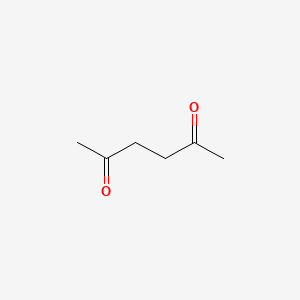
2,5-hexanedione is a diketone that is hexane substituted by oxo groups at positions 2 and 5. It is a toxic metabolite of hexane and of 2-hexanone. It has a role as a neurotoxin and a human xenobiotic metabolite. It is a diketone and a methyl ketone. It derives from a hydride of a hexane. — ChEBI
- IUPAC 名称
- hexane-2,5-dione
- 分子式
- C6H10O2
- 分子量
- 114.14 g/mol
- 精确质量
- 114.068079557 Da
- XLogP3
- -0.3
- 拓扑极性表面积
- 34.1 Ų
- 氢键供体
- 0
- 氢键受体
- 2
- 共价单元
- 1
- 已定义的立体中心
- 0
又称
Acetonylacetone1,2-Diacetylethane2,5-DiketohexaneDiacetonyl2,5-HexadioneAcetonyl acetone2,5-Dioxohexanealpha,beta-Diacetylethane
另有 16 个已报告名称
NSC 7621hexanedione, 2,5-NSC-7621C0Z8884J3PCHEBI:85014acetone, acetonylalpha, beta-diacetylethaneRefChem:83014203-738-3Acetone, acetonyl-2,5-Hexandione.alpha.,.beta.-DiacetylethaneCH3COCH2CH2COCH3CCRIS 2919EINECS 203-738-3acetonylaceton
外部数据库标识符
- ChEBI:CHEBI:85014
- ChEMBL:CHEMBL1564795
- EPA DTXSID:DTXSID8030138
- PubMed:33197454
- PubMed:32860822
- PubMed:32522579
- PubMed:31760062
- PubMed:27466211
- PubMed:22967723
- PubMed:22953206
- PubMed:22952946
- PubMed:22931767
- PubMed:22841600
- PubMed:22804983
- PubMed:22382377
来自其他科学数据库的证据
NIH PubChem PUG-View
标识符精确匹配8035
Attributed physical-property, hazard, environmental and use annotations.
- Autoignition Temperature: 920 °F (NTP, 1992) 来源: CAMEO Chemicals
- Boiling Point: 376 °F at 760 mmHg (NTP, 1992) 来源: CAMEO Chemicals
- Density: 0.9737 at 68 °F (NTP, 1992) - Less dense than water; will float 来源: CAMEO Chemicals
- Flash Point: 174 °F (NTP, 1992) 来源: CAMEO Chemicals
- Melting Point: 22.1 °F (NTP, 1992) 来源: CAMEO Chemicals
- Physical Description: 2,5-hexanedione is a clear colorless to amber liquid with a sweet aromatic odor. (NTP, 1992) 来源: CAMEO Chemicals
- Physical Description: Liquid 来源: EPA Chemical Data Reporting (CDR)
- Physical Description: Liquid that slowly turns yellow; [Merck Index] Colorless to amber liquid with a sweet odor; [CAMEO] Yellow liquid; [Alfa Aesar MSDS] 来源: Haz-Map, Information on Hazardous Chemicals and Occupational Diseases
- Solubility: greater than or equal to 100 mg/mL at 72 °F (NTP, 1992) 来源: CAMEO Chemicals
- Vapor Pressure: 0.43 mmHg at 68 °F ; 1.6 mmHg at 77 °F (NTP, 1992) 来源: CAMEO Chemicals
- Vapor Pressure: 2.93 [mmHg] 来源: Haz-Map, Information on Hazardous Chemicals and Occupational Diseases
- First Aid: EYES: First check the victim for contact lenses and remove if present. Flush victim's eyes with water or normal saline solution for 20 to 30 minutes while simultaneously calling a hospital or poison control center. Do not put any ointments, oils, or medication in the victim's eyes without specific instructions from a physician. IMMEDIATELY transport the victim after flushing eyes to a hospital even if no symptoms (such as redness or irritation) develop.; SKIN: IMMEDIATELY flood affected skin with water while removing and isolating all contaminated clothing. Gently wash all affected skin areas thoroughly with soap and water. If symptoms such as redness or irritation develop, IMMEDIATELY call a physician and be prepared to transport the victim to a hospital for treatment.; INHALATION: IMMEDIATELY leave the contaminated area; take deep breaths of fresh air. If symptoms (such as wheezing, coughing, shortness of breath, or burning in the mouth, throat, or chest) develop, call a physician and be prepared to transport the victim to a hospital. Provide proper respiratory protection to rescuers entering an unknown atmosphere. Whenever possible, Self-Contained Breathing Apparatus (SCBA) shou 来源: CAMEO Chemicals
- Signal: Warning 来源: European Chemicals Agency (ECHA)
- GHS Hazard Statements: H315 (97.9%): Causes skin irritation [Warning Skin corrosion/irritation]; H319 (99.3%): Causes serious eye irritation [Warning Serious eye damage/eye irritation]; H373 (97.2%): May causes damage to organs through prolonged or repeated exposure [Warning Specific target organ toxicity, repeated exposure] 来源: European Chemicals Agency (ECHA)
- Precautionary Statement Codes: P260, P264, P264+P265, P280, P302+P352, P305+P351+P338, P319, P321, P332+P317, P337+P317, P362+P364, and P501 (click each P-code to see the statement) 来源: European Chemicals Agency (ECHA)
- ECHA C&L Notifications Summary: Aggregated GHS information provided per 143 reports by companies from 14 notifications to the ECHA C&L Inventory. Each notification may be associated with multiple companies.; Information may vary between notifications depending on impurities, additives, and other factors. The percentage value in parenthesis indicates the notified classification ratio from companies that provide hazard codes. Only hazard codes with percentage values above 10% are shown. For more detailed information, please visit ECHA C&L website. 来源: European Chemicals Agency (ECHA)
- Signal: Danger 来源: NITE-CMC
- GHS Hazard Statements: H227: Combustible liquid [Warning Flammable liquids]; H302: Harmful if swallowed [Warning Acute toxicity, oral]; H319: Causes serious eye irritation [Warning Serious eye damage/eye irritation]; H335: May cause respiratory irritation [Warning Specific target organ toxicity, single exposure; Respiratory tract irritation]; H372: Causes damage to organs through prolonged or repeated exposure [Danger Specific target organ toxicity, repeated exposure]; H373: May causes damage to organs through prolonged or repeated exposure [Warning Specific target organ toxicity, repeated exposure] 来源: NITE-CMC
- Precautionary Statement Codes: P210, P260, P261, P264, P264+P265, P270, P271, P280, P301+P317, P304+P340, P305+P351+P338, P319, P330, P337+P317, P370+P378, P403, P403+P233, P405, and P501 (click each P-code to see the statement) 来源: NITE-CMC
- Industry Uses: Intermediate 来源: EPA Chemical Data Reporting (CDR)
- Sources/Uses: Used as a solvent for cellulose acetate, roll-coating inks, lacquers, and stains; as an intermediate for pharmaceuticals and photographic chemicals; and in electroplating; [NTP] 来源: Haz-Map, Information on Hazardous Chemicals and Occupational Diseases
- Industrial Processes with risk of exposure: Electroplating [Category: Plate]; Painting (Solvents) [Category: Paint]; Textiles (Printing, Dyeing, or Finishing) [Category: Industry] 来源: Haz-Map, Information on Hazardous Chemicals and Occupational Diseases
映射方: Existing checksum-valid CAS to unique PubChem CID match. 检索时间: 2026-08-31. 打开来源记录
科学分类和危害注释仅提供背景信息,不能取代上方所示针对具体市场的监管决定。
其他来源的覆盖范围和匹配状态
| 来源 | 结果 | 已检查 |
|---|---|---|
| NIH PubChem PUG-View | 精确匹配 | 2026-08-31 |
已记录的无匹配结果是该来源已被检查的有效证据;这并不表示该物质在别处不存在。
于 2026-08-31 通过校验和有效的 CAS 匹配从美国国立卫生研究院 (NIH) PubChem 检索。化学性质不能取代本页的监管决定。