
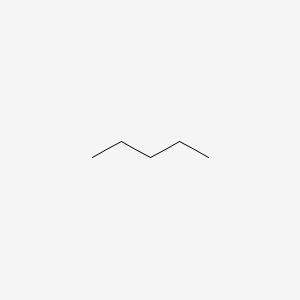
CAS 109-66-0PubChem CID 8003
Pentane
n-pentane has been reported in Calendula officinalis and Allium ampeloprasum with data available. — LOTUS - the natural products occurrence database
- IUPAC 名称
- pentane
- 分子式
- C5H12
- 分子量
- 72.15 g/mol
- 精确质量
- 72.093900383 Da
- XLogP3
- 3.4
- 拓扑极性表面积
- 0.0 Ų
- 氢键供体
- 0
- 氢键受体
- 0
- 共价单元
- 1
- 已定义的立体中心
- 0
又称
n-PentanePentanSkellysolve APentanenPentaniAmyl hydrideTetrafumeTetrakil
另有 16 个已报告名称
Tetraspot4FEX897A91NSC-72415CHEBI:37830RefChem:6667203-692-4PentanesnpentaneNormal PentaneNSC 72415Pentan [Polish]Pentanen [Dutch]Pentani [Italian]Caswell No. 642AAn-PentanCAS-109-66-0
外部数据库标识符
- ChEBI:CHEBI:37830
- ChEMBL:CHEMBL16102
- EPA DTXSID:DTXSID2025846
- PubMed:33064461
- PubMed:23033646
- PubMed:23019535
- PubMed:23018259
- PubMed:23004267
- PubMed:22984587
- PubMed:22965656
- PubMed:22952840
- PubMed:22902860
- PubMed:22900323
- PubMed:22897627
- PubMed:22895898
来自其他科学数据库的证据
NIH PubChem PUG-View
标识符精确匹配8003
Attributed physical-property, hazard, environmental and use annotations.
- Autoignition Temperature: 500 °F (USCG, 1999) 来源: CAMEO Chemicals
- Autoignition Temperature: 500 °F (260 °C) 来源: Hazardous Substances Data Bank (HSDB)
- Autoignition Temperature: 260 °C 来源: ILO-WHO International Chemical Safety Cards (ICSCs)
- Boiling Point: 97 °F at 760 mmHg (NTP, 1992) 来源: CAMEO Chemicals
- Boiling Point: 36.06 °C 来源: Hazardous Substances Data Bank (HSDB)
- Boiling Point: 36.00 to 37.00 °C. @ 760.00 mm Hg 来源: Human Metabolome Database (HMDB)
- Boiling Point: 36 °C 来源: ILO-WHO International Chemical Safety Cards (ICSCs)
- Boiling Point: 97 °F 来源: Occupational Safety and Health Administration (OSHA)
- Boiling Point: 36.1 °C @760 [mm Hg] 来源: PAC Chemical Database, U.S. Department of Energy
- Boiling Point: 97 °F 来源: The National Institute for Occupational Safety and Health (NIOSH)
- Color/Form: Colorless liquid [Note: A gas above 97 degrees F. May be utilized as a fuel]. 来源: Hazardous Substances Data Bank (HSDB)
- Density: 0.626 at 68 °F (USCG, 1999) - Less dense than water; will float 来源: CAMEO Chemicals
- Density: 0.6262 g/cu cm at 20 °C 来源: Hazardous Substances Data Bank (HSDB)
- Density: Relative density (water = 1): 0.63 来源: ILO-WHO International Chemical Safety Cards (ICSCs)
- Density: 0.63 来源: Occupational Safety and Health Administration (OSHA)
- Density: 0.62 @ 20°C 来源: PAC Chemical Database, U.S. Department of Energy
- Density: 0.63 来源: The National Institute for Occupational Safety and Health (NIOSH)
- Flash Point: -57 °F (NTP, 1992) 来源: CAMEO Chemicals
- Flash Point: -40 °C 来源: Haz-Map, Information on Hazardous Chemicals and Occupational Diseases
- Flash Point: <-40 °F (-40 °C) (Closed cup) 来源: Hazardous Substances Data Bank (HSDB)
- Flash Point: -49 °C c.c. 来源: ILO-WHO International Chemical Safety Cards (ICSCs)
- Flash Point: -57 °F 来源: Occupational Safety and Health Administration (OSHA)
- Flash Point: -57 °F 来源: The National Institute for Occupational Safety and Health (NIOSH)
- LogP: log Kow = 3.39 来源: Hazardous Substances Data Bank (HSDB)
- LogP: 3.39 来源: Human Metabolome Database (HMDB)
- LogP: 3.39 来源: ILO-WHO International Chemical Safety Cards (ICSCs)
- Melting Point: -202 °F (NTP, 1992) 来源: CAMEO Chemicals
- Melting Point: -129.67 °C 来源: Hazardous Substances Data Bank (HSDB)
- Melting Point: -129 °C 来源: Human Metabolome Database (HMDB)
- Melting Point: -129 °C 来源: ILO-WHO International Chemical Safety Cards (ICSCs)
- Melting Point: -202 °F 来源: Occupational Safety and Health Administration (OSHA)
- Melting Point: -129.8 °C 来源: PAC Chemical Database, U.S. Department of Energy
- Melting Point: -202 °F 来源: The National Institute for Occupational Safety and Health (NIOSH)
- Odor: Pleasant 来源: Hazardous Substances Data Bank (HSDB)
- Odor: Gasoline-like odor 来源: Hazardous Substances Data Bank (HSDB)
- Physical Description: N-pentane appears as a clear colorless liquid with a petroleum-like odor. Flash point -57 °F. Boiling point 97 °F. Less dense than water and insoluble in water. Hence floats on water. Vapors are heavier than air. 来源: CAMEO Chemicals
- Physical Description: Gas Vapor; Large Crystals; Liquid; Gas Vapor; Liquid 来源: EPA Chemical Data Reporting (CDR)
- Physical Description: Colorless liquid with a gasoline-like odor; Note: A gas above 97 degrees F. May be utilized as a fuel; [NIOSH] Clear colorless liquid; [Sigma-Aldrich MSDS] 来源: Haz-Map, Information on Hazardous Chemicals and Occupational Diseases
- Physical Description: Liquid 来源: Human Metabolome Database (HMDB)
- Physical Description: COLOURLESS LIQUID WITH CHARACTERISTIC ODOUR. 来源: ILO-WHO International Chemical Safety Cards (ICSCs)
- Physical Description: Colorless liquid with a gasoline-like odor. 来源: Occupational Safety and Health Administration (OSHA)
- Physical Description: Colorless liquid with a gasoline-like odor. [Note: A gas above 97 °F. May be utilized as a fuel.] 来源: The National Institute for Occupational Safety and Health (NIOSH)
- Refractive Index: Index of refraction: 1.3575 at 20 °C/D 来源: Hazardous Substances Data Bank (HSDB)
- Solubility: less than 1 mg/mL at 70 °F (NTP, 1992) 来源: CAMEO Chemicals
- Solubility: In water, 38 mg/L at 25 °C 来源: Hazardous Substances Data Bank (HSDB)
- Solubility: Miscible with ethanol, ethyl ether, acetone, benzene, chloroform; soluble in carbon tetrachloride 来源: Hazardous Substances Data Bank (HSDB)
- Solubility: 0.038 mg/mL at 25 °C 来源: Human Metabolome Database (HMDB)
- Solubility: Solubility in water, g/100ml at 20 °C: 0.004 (very poor) 来源: ILO-WHO International Chemical Safety Cards (ICSCs)
- Solubility: 0.04% 来源: The National Institute for Occupational Safety and Health (NIOSH)
- Vapor Pressure: 400 mmHg at 65.3 °F ; 426 mmHg at 68 °F (NTP, 1992) 来源: CAMEO Chemicals
- Vapor Pressure: 514.0 [mmHg] 来源: Haz-Map, Information on Hazardous Chemicals and Occupational Diseases
- Vapor Pressure: 514 mm Hg at 25 °C 来源: Hazardous Substances Data Bank (HSDB)
- Vapor Pressure: Vapor pressure, kPa at 18.5 °C: 53.3 来源: ILO-WHO International Chemical Safety Cards (ICSCs)
- Vapor Pressure: 420 mmHg 来源: Occupational Safety and Health Administration (OSHA)
- Vapor Pressure: 514 [mm Hg] @25 °C 来源: PAC Chemical Database, U.S. Department of Energy
- Vapor Pressure: 420 mmHg 来源: The National Institute for Occupational Safety and Health (NIOSH)
- Viscosity: 0.2224 mPa.sec at 25 °C (liquid) 来源: Hazardous Substances Data Bank (HSDB)
- Viscosity: 0,36 mm²/s 来源: ILO-WHO International Chemical Safety Cards (ICSCs)
- Carcinogen Classification: Pentane is found in gasoline, which is possibly carcinogenic to humans (Group 2B). (L135) 来源: Toxin and Toxin Target Database (T3DB)
- Exposure Routes: inhalation, ingestion, skin and/or eye contact 来源: The National Institute for Occupational Safety and Health (NIOSH)
- Exposure Routes: Oral (T29) ; inhalation (T29) ; dermal (T29) 来源: Toxin and Toxin Target Database (T3DB)
- First Aid: EYES: First check the victim for contact lenses and remove if present. Flush victim's eyes with water or normal saline solution for 20 to 30 minutes while simultaneously calling a hospital or poison control center. Do not put any ointments, oils, or medication in the victim's eyes without specific instructions from a physician. IMMEDIATELY transport the victim after flushing eyes to a hospital even if no symptoms (such as redness or irritation) develop.; SKIN: IMMEDIATELY flood affected skin with water while removing and isolating all contaminated clothing. Gently wash all affected skin areas thoroughly with soap and water. If symptoms such as redness or irritation develop, IMMEDIATELY call a physician and be prepared to transport the victim to a hospital for treatment.; INHALATION: IMMEDIATELY leave the contaminated area; take deep breaths of fresh air. If symptoms (such as wheezing, coughing, shortness of breath, or burning in the mouth, throat, or chest) develop, call a physician and be prepared to transport the victim to a hospital. Provide proper respiratory protection to rescuers entering an unknown atmosphere. Whenever possible, Self-Contained Breathing Apparatus (SCBA) shou 来源: CAMEO Chemicals
- ERG2024, Guide 128 (Pentanes): General First Aid:; · Call 911 or emergency medical service.; · Ensure that medical personnel are aware of the material(s) involved, take precautions to protect themselves and avoid contamination.; · Move victim to fresh air if it can be done safely.; · Administer oxygen if breathing is difficult.; · If victim is not breathing:; -- DO NOT perform mouth-to-mouth resuscitation; the victim may have ingested or inhaled the substance.; -- If equipped and pulse detected, wash face and mouth, then give artificial respiration using a proper respiratory medical device (bag-valve mask, pocket mask equipped with a one-way valve or other device).; -- If no pulse detected or no respiratory medical device available, provide continuous compressions. Conduct a pulse check every two minutes or monitor for any signs of spontaneous respirations.; · Remove and isolate contaminated clothing and shoes.; · For minor skin contact, avoid spreading material on unaffected skin.; · In case of contact with substance, remove immediately by flushing skin or eyes with running water for at least 20 minutes.; · For severe burns, immediate medical attention is required.; · Effects of exposure (inhalation, ingestion, 来源: Emergency Response Guidebook (ERG)
- First Aid: (General first aid procedures); Eye: Irrigate immediately - If this chemical contacts the eyes, immediately wash (irrigate) the eyes with large amounts of water, occasionally lifting the lower and upper lids. Get medical attention immediately.; Skin: Water wash promptly - If this chemical contacts the skin, promptly wash the contaminated skin with water. If this chemical penetrates the clothing, promptly remove the clothing and wash the skin with water. If irritation persists after washing, get medical attention.; Breathing: Respiratory support; Swallow: Medical attention immediately - If this chemical has been swallowed, get medical attention immediately. 来源: The National Institute for Occupational Safety and Health (NIOSH)
- Signal: Danger 来源: Regulation (EC) No 1272/2008 of the European Parliament and of the Council
- GHS Hazard Statements: H225: Highly Flammable liquid and vapor [Danger Flammable liquids]; H304: May be fatal if swallowed and enters airways [Danger Aspiration hazard]; H336: May cause drowsiness or dizziness [Warning Specific target organ toxicity, single exposure; Narcotic effects]; H411: Toxic to aquatic life with long lasting effects [Hazardous to the aquatic environment, long-term hazard] 来源: Regulation (EC) No 1272/2008 of the European Parliament and of the Council
- Precautionary Statement Codes: P210, P233, P240, P241, P242, P243, P261, P271, P273, P280, P301+P316, P303+P361+P353, P304+P340, P319, P331, P370+P378, P391, P403+P233, P403+P235, P405, and P501 (click each P-code to see the statement) 来源: Regulation (EC) No 1272/2008 of the European Parliament and of the Council
- Note: This chemical does not meet GHS hazard criteria for 0.8% (11 of 1378) of reports. 来源: European Chemicals Agency (ECHA)
- Signal: Danger 来源: European Chemicals Agency (ECHA)
- GHS Hazard Statements: H224 (16.4%): Extremely flammable liquid and vapor [Danger Flammable liquids]; H225 (82.8%): Highly Flammable liquid and vapor [Danger Flammable liquids]; H304 (99.2%): May be fatal if swallowed and enters airways [Danger Aspiration hazard]; H336 (99.1%): May cause drowsiness or dizziness [Warning Specific target organ toxicity, single exposure; Narcotic effects]; H411 (99.2%): Toxic to aquatic life with long lasting effects [Hazardous to the aquatic environment, long-term hazard] 来源: European Chemicals Agency (ECHA)
- Precautionary Statement Codes: P210, P233, P240, P241, P242, P243, P261, P271, P273, P280, P301+P316, P303+P361+P353, P304+P340, P319, P331, P370+P378, P391, P403+P233, P403+P235, P405, and P501 (click each P-code to see the statement) 来源: European Chemicals Agency (ECHA)
- ECHA C&L Notifications Summary: Aggregated GHS information provided per 1378 reports by companies from 43 notifications to the ECHA C&L Inventory. Each notification may be associated with multiple companies.; Reported as not meeting GHS hazard criteria per 11 of 1378 reports by companies.; There are 42 notifications provided by 1367 of 1378 reports by companies with hazard statement code(s).; Information may vary between notifications depending on impurities, additives, and other factors. The percentage value in parenthesis indicates the notified classification ratio from companies that provide hazard codes. Only hazard codes with percentage values above 10% are shown. For more detailed information, please visit ECHA C&L website. 来源: European Chemicals Agency (ECHA)
- Signal: Danger 来源: NITE-CMC
- GHS Hazard Statements: H225: Highly Flammable liquid and vapor [Danger Flammable liquids]; H304: May be fatal if swallowed and enters airways [Danger Aspiration hazard]; H320: Causes eye irritation [Warning Serious eye damage/eye irritation]; H335: May cause respiratory irritation [Warning Specific target organ toxicity, single exposure; Respiratory tract irritation]; H336: May cause drowsiness or dizziness [Warning Specific target organ toxicity, single exposure; Narcotic effects]; H401: Toxic to aquatic life [Hazardous to the aquatic environment, acute hazard] 来源: NITE-CMC
- Precautionary Statement Codes: P210, P233, P240, P241, P242, P243, P261, P264+P265, P271, P273, P280, P301+P316, P303+P361+P353, P304+P340, P305+P351+P338, P319, P331, P337+P317, P370+P378, P403+P233, P403+P235, P405, and P501 (click each P-code to see the statement) 来源: NITE-CMC
- GHS Hazard Statements: H225: Highly Flammable liquid and vapor [Danger Flammable liquids]; H304: May be fatal if swallowed and enters airways [Danger Aspiration hazard]; H320: Causes eye irritation [Warning Serious eye damage/eye irritation]; H335: May cause respiratory irritation [Warning Specific target organ toxicity, single exposure; Respiratory tract irritation]; H336: May cause drowsiness or dizziness [Warning Specific target organ toxicity, single exposure; Narcotic effects] 来源: NITE-CMC
- Health Effects: Pentane is a central nervous system depressant and can cause loss of consciousness and coma at high doses. Ingestion may cause pulmonary toxicity due to pentane aspiration, including chemical pneumonitis, acute lung injury, and hemorrhage. Cardiovascular effects may include ventricular dysrhythmias and sudden death. (T29, A600) 来源: Toxin and Toxin Target Database (T3DB)
- NFPA Health Rating: 1 - Materials that, under emergency conditions, can cause significant irritation. 来源: Hazardous Substances Data Bank (HSDB)
- NFPA Fire Rating: 4 - Materials that rapidly or completely vaporize at atmospheric pressure and normal ambient temperature or that are readily dispersed in air and burn readily. 来源: Hazardous Substances Data Bank (HSDB)
- NFPA Instability Rating: 0 - Materials that in themselves are normally stable, even under fire conditions. 来源: Hazardous Substances Data Bank (HSDB)
- Target Organs: Eyes, skin, respiratory system, central nervous system 来源: The National Institute for Occupational Safety and Health (NIOSH)
- Toxicity Summary: Pentane is a central nervous system depressant. It affects the peripheral nervous system through demyelinization and axonal degeneration. (T29) 来源: Toxin and Toxin Target Database (T3DB)
- Environmental Bioconcentration: An estimated BCF of 80 was calculated for n-pentane(SRC), using a log Kow of 3.39(1) and a regression-derived equation(2). According to a classification scheme(3), this BCF suggests the potential for bioconcentration in aquatic organisms is moderate(SRC). 来源: Hazardous Substances Data Bank (HSDB)
- Environmental Fate: TERRESTRIAL FATE: Based on a classification scheme(1), an estimated Koc value of 72(SRC), determined from a structure estimation method(2), indicates that n-pentane is expected to have high mobility in soil(SRC). Volatilization of n-pentane from moist soil surfaces is expected to be an important fate process(SRC) given a Henry's Law constant of 1.25 atm-cu m/mole(3). n-Pentane is expected to volatilize from dry soil surfaces(SRC) based upon a vapor pressure of 514 mm Hg at 25 °C(4). Screening studies have shown that n-pentane is biodegradable under aerobic conditions(5,6), and these studies suggest that this compound will biodegrade in soil; however, volatilization from soil is expected to be the dominant environmental fate process of n-pentane(SRC). 来源: Hazardous Substances Data Bank (HSDB)
- Environmental Fate: AQUATIC FATE: Based on a classification scheme(1), an estimated Koc value of 72(SRC), determined from a structure estimation method(2), indicates that n-pentane is not expected to adsorb to suspended solids and sediment(SRC). Volatilization from water surfaces is expected(3) based upon a Henry's Law constant of 1.25 atm-cu m/mole(4). Using this Henry's Law constant and an estimation method(3), volatilization half-lives for a model river and model lake are 2.5 hrs and 3.4 days, respectively(SRC). According to a classification scheme(5), an estimated BCF of 80(SRC), from its log Kow of 3.39(6) and a regression-derived equation(2), suggests the potential for bioconcentration in aquatic organisms is moderate(SRC). Screening studies have shown that n-pentane is biodegradable under aerobic conditions(8,9), and these studies suggest that this compound will biodegrade in water; however, volatilization from water surfaces is expected to be the dominant environmental fate process of n-pentane(SRC). 来源: Hazardous Substances Data Bank (HSDB)
- Environmental Fate: ATMOSPHERIC FATE: According to a model of gas/particle partitioning of semivolatile organic compounds in the atmosphere(1), n-pentane, which has a vapor pressure of 514 mm Hg at 25 °C(2), is expected to exist solely as a vapor in the ambient atmosphere. Vapor-phase n-pentane is degraded in the atmosphere by reaction with photochemically-produced hydroxyl radicals(SRC); the half-life for this reaction in air is estimated to be 3 days(3), calculated from its rate constant of 3.94X10⁻¹² cu cm/molecule-sec at 25 °C(4). n-Pentane does not contain chromophores that absorb at wavelengths >290 nm(5) and, therefore, is not expected to be susceptible to direct photolysis by sunlight(SRC). 来源: Hazardous Substances Data Bank (HSDB)
- Consumer Uses: Soil amendments (fertilizers); Not Known or Reasonably Ascertainable; Propellants, non-motive (blowing agents); Intermediate; Flotation agent; Other; Swelling agent; Insulators; Fuel agents; Fuel 来源: EPA Chemical Data Reporting (CDR)
- Industry Uses: Intermediate; Propellants, non-motive (blowing agents); Soil amendments (fertilizers); Not Known or Reasonably Ascertainable; Fuel agents; Fuel; Other; Swelling agent 来源: EPA Chemical Data Reporting (CDR)
- Sources/Uses: Used as a chemical raw material and in lighter fluids, blowtorch fuels, laboratory solvents, blowing agents for plastics, gasoline additives, and aerosol propellants; [HSDB] Used as foaming agent for expanded polystyrene (EPS) and polyurethane, process diluent/carrier for polymerizations, formulation solvent in adhesives, and for other minor uses (pharmaceuticals, degreasing agents, lubricants, stain removers, and cleaning agents); [ExPub: CPS&Q: RARs - Final Risk Assessment Report] 来源: Haz-Map, Information on Hazardous Chemicals and Occupational Diseases
- Industrial Processes with risk of exposure: Working with Glues and Adhesives [Category: Other]; Plastic Composites Manufacturing [Category: Industry] 来源: Haz-Map, Information on Hazardous Chemicals and Occupational Diseases
- Uses: For pentane (USEPA/OPP Pesticide Code: 098001) there are 0 labels match. /SRP: Not registered for current use in the U.S., but approved pesticide uses may change periodically and so federal, state and local authorities must be consulted for currently approved uses./ 来源: Hazardous Substances Data Bank (HSDB)
- Uses: Constituent in motor and aviation fuel; in solvent extraction processes, as a general laboratory solvent, and as a medium solvent for polymerization reactions; as raw material for production of olefins and other industrial chemicals like amyl chloride. Pentane is used in the manufacture of ice and low-temperature thermometers. 来源: Hazardous Substances Data Bank (HSDB)
- Uses: Additive in automotive, aviation and farm fuels. 来源: Hazardous Substances Data Bank (HSDB)
- Uses: Artificial ice manufacture, low-temperature thermometers, solvent extraction processes, blowing agent in plastics (e.g. expandable polystyrene), pesticide. 来源: Hazardous Substances Data Bank (HSDB)
- Uses: For more Uses (Complete) data for n-Pentane (8 total), please visit the HSDB record page. 来源: Hazardous Substances Data Bank (HSDB)
- Uses: Pentanes are components of some fuels, such as gasoline, and are also used as specialty solvents in the laboratory. (L1287) 来源: Toxin and Toxin Target Database (T3DB)
映射方: Existing checksum-valid CAS to unique PubChem CID match. 检索时间: 2026-08-31. 打开来源记录
科学分类和危害注释仅提供背景信息,不能取代上方所示针对具体市场的监管决定。
其他来源的覆盖范围和匹配状态
| 来源 | 结果 | 已检查 |
|---|---|---|
| NIH PubChem PUG-View | 精确匹配 | 2026-08-31 |
已记录的无匹配结果是该来源已被检查的有效证据;这并不表示该物质在别处不存在。
于 2026-08-31 通过校验和有效的 CAS 匹配从美国国立卫生研究院 (NIH) PubChem 检索。化学性质不能取代本页的监管决定。