
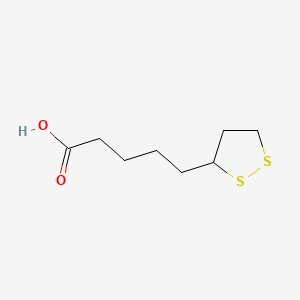
CAS 1077-28-7PubChem CID 864
alpha Lipoic acid
Lipoic acid is a heterocyclic thia fatty acid comprising pentanoic acid with a 1,2-dithiolan-3-yl group at the 5-position. It has a role as a geroprotector and a fundamental metabolite. It is a member of dithiolanes, a heterocyclic fatty acid and a thia fatty acid. It is functionally related to an octanoic acid. It is a conjugate acid of a lipoate. — ChEBI
- IUPAC 名称
- 5-(dithiolan-3-yl)pentanoic acid
- 分子式
- C8H14O2S2
- 分子量
- 206.3 g/mol
- 精确质量
- 206.04352203 Da
- XLogP3
- 1.7
- 拓扑极性表面积
- 87.9 Ų
- 氢键供体
- 1
- 氢键受体
- 4
- 共价单元
- 1
- 已定义的立体中心
- 0
又称
thioctic acidalpha-Lipoic acid6,8-Thioctic acidBiletanDL-6,8-Thioctic acidThioctsanthioctateThiocacid
另有 16 个已报告名称
ThioctanTioctic AcidAcidum thiocticumA-lipoicum acidumLipoic acid, dl-Lipoic acid, alphabiomoliponAlphaLipogammabiomo liponespa liponAlpha LipogammaPleomix AlphaVerla LiponAlphaLipon StadaAlpha Lippon ALAlpha Lipon Stada
外部数据库标识符
- ChEBI:CHEBI:16494
- ChEMBL:CHEMBL33864
- EPA DTXSID:DTXSID7025508
- PubMed:22654724
- PubMed:22448096
- PubMed:22384101
- PubMed:22374556
- PubMed:22363901
- PubMed:22272085
- PubMed:22242957
- PubMed:22163871
- PubMed:22163517
- PubMed:22146387
- PubMed:22125679
- PubMed:22125537
来自其他科学数据库的证据
NIH PubChem PUG-View
标识符精确匹配864
Attributed physical-property, hazard, environmental and use annotations.
- Color/Form: Forms yellowish flakes 来源: Hazardous Substances Data Bank (HSDB)
- Dissociation Constants: pKa = 5.10 来源: Hazardous Substances Data Bank (HSDB)
- Melting Point: 47.5-48 °C 来源: Hazardous Substances Data Bank (HSDB)
- Solubility: Yellow powder; solubility in ethanol: 50 mg/mL /Synthetic, oxidized form/ 来源: Hazardous Substances Data Bank (HSDB)
- Solubility: Soluble in methanol, ethanol, diethyl ether and chloroform 来源: Hazardous Substances Data Bank (HSDB)
- Carcinogen Classification: No indication of carcinogenicity to humans (not listed by IARC). 来源: Toxin and Toxin Target Database (T3DB)
- Note: This chemical does not meet GHS hazard criteria for 6.5% (28 of 430) of reports. 来源: European Chemicals Agency (ECHA)
- Signal: Warning 来源: European Chemicals Agency (ECHA)
- GHS Hazard Statements: H302 (93.5%): Harmful if swallowed [Warning Acute toxicity, oral]; H315 (48.6%): Causes skin irritation [Warning Skin corrosion/irritation]; H317 (46.5%): May cause an allergic skin reaction [Warning Sensitization, Skin]; H319 (47%): Causes serious eye irritation [Warning Serious eye damage/eye irritation]; H411 (46.5%): Toxic to aquatic life with long lasting effects [Hazardous to the aquatic environment, long-term hazard] 来源: European Chemicals Agency (ECHA)
- Precautionary Statement Codes: P261, P264, P264+P265, P270, P272, P273, P280, P301+P317, P302+P352, P305+P351+P338, P321, P330, P332+P317, P333+P317, P337+P317, P362+P364, P391, and P501 (click each P-code to see the statement) 来源: European Chemicals Agency (ECHA)
- ECHA C&L Notifications Summary: Aggregated GHS information provided per 430 reports by companies from 16 notifications to the ECHA C&L Inventory. Each notification may be associated with multiple companies.; Reported as not meeting GHS hazard criteria per 28 of 430 reports by companies.; There are 14 notifications provided by 402 of 430 reports by companies with hazard statement code(s).; Information may vary between notifications depending on impurities, additives, and other factors. The percentage value in parenthesis indicates the notified classification ratio from companies that provide hazard codes. Only hazard codes with percentage values above 10% are shown. For more detailed information, please visit ECHA C&L website. 来源: European Chemicals Agency (ECHA)
- Note: This chemical does not meet GHS hazard criteria for 42.3% (52 of 123) of reports. 来源: European Chemicals Agency (ECHA)
- GHS Hazard Statements: H302 (57.7%): Harmful if swallowed [Warning Acute toxicity, oral]; H315 (31.7%): Causes skin irritation [Warning Skin corrosion/irritation]; H319 (31.7%): Causes serious eye irritation [Warning Serious eye damage/eye irritation]; H335 (31.7%): May cause respiratory irritation [Warning Specific target organ toxicity, single exposure; Respiratory tract irritation]; H412 (19.5%): Harmful to aquatic life with long lasting effects [Hazardous to the aquatic environment, long-term hazard] 来源: European Chemicals Agency (ECHA)
- Precautionary Statement Codes: P261, P264, P264+P265, P270, P271, P273, P280, P301+P317, P302+P352, P304+P340, P305+P351+P338, P319, P321, P330, P332+P317, P337+P317, P362+P364, P403+P233, P405, and P501 (click each P-code to see the statement) 来源: European Chemicals Agency (ECHA)
- ECHA C&L Notifications Summary: Aggregated GHS information provided per 123 reports by companies from 8 notifications to the ECHA C&L Inventory. Each notification may be associated with multiple companies.; Reported as not meeting GHS hazard criteria per 52 of 123 reports by companies.; There are 7 notifications provided by 71 of 123 reports by companies with hazard statement code(s).; Information may vary between notifications depending on impurities, additives, and other factors. The percentage value in parenthesis indicates the notified classification ratio from companies that provide hazard codes. Only hazard codes with percentage values above 10% are shown. For more detailed information, please visit ECHA C&L website. 来源: European Chemicals Agency (ECHA)
- Health Effects: Acute exposure to cholinesterase inhibitors can cause a cholinergic crisis characterized by severe nausea/vomiting, salivation, sweating, bradycardia, hypotension, collapse, and convulsions. Increasing muscle weakness is a possibility and may result in death if respiratory muscles are involved. Accumulation of ACh at motor nerves causes overstimulation of nicotinic expression at the neuromuscular junction. When this occurs symptoms such as muscle weakness, fatigue, muscle cramps, fasciculation, and paralysis can be seen. When there is an accumulation of ACh at autonomic ganglia this causes overstimulation of nicotinic expression in the sympathetic system. Symptoms associated with this are hypertension, and hypoglycemia. Overstimulation of nicotinic acetylcholine receptors in the central nervous system, due to accumulation of ACh, results in anxiety, headache, convulsions, ataxia, depression of respiration and circulation, tremor, general weakness, and potentially coma. When there is expression of muscarinic overstimulation due to excess acetylcholine at muscarinic acetylcholine receptors symptoms of visual disturbances, tightness in chest, wheezing due to bronchoconstriction, incre 来源: Toxin and Toxin Target Database (T3DB)
- Toxicity Summary: ALA is generally considered a safe drug. A daily dose of 200 mg/day to 2400 mg/day of ALA is deemed safe without significant adverse effects. However, there is no reported safe dose in children.; A notable case in literature demonstrated status epilepticus (SE) that subsided within a few days. The seizures were treated per normal standards for SE.; In the last 2 decades, there have been few reported cases of ALA toxicity in humans. Most of these cases occur in children and are treatable. Though there is no established lethal dosage of ALA for humans, studies have shown that a high dose of 121 mg/kg body weight/day was associated with alterations in liver enzymes and liver function. Therefore, there are potentially harmful adverse effects from overdosing on ALA, and more studies are necessary to determine the toxicity. 来源: StatPearls
- Toxicity Summary: (R)-lipoic acid is a cholinesterase or acetylcholinesterase (AChE) inhibitor. A cholinesterase inhibitor (or 'anticholinesterase') suppresses the action of acetylcholinesterase. Because of its essential function, chemicals that interfere with the action of acetylcholinesterase are potent neurotoxins, causing excessive salivation and eye-watering in low doses, followed by muscle spasms and ultimately death. Nerve gases and many substances used in insecticides have been shown to act by binding a serine in the active site of acetylcholine esterase, inhibiting the enzyme completely. Acetylcholine esterase breaks down the neurotransmitter acetylcholine, which is released at nerve and muscle junctions, in order to allow the muscle or organ to relax. The result of acetylcholine esterase inhibition is that acetylcholine builds up and continues to act so that any nerve impulses are continually transmitted and muscle contractions do not stop. Among the most common acetylcholinesterase inhibitors are phosphorus-based compounds, which are designed to bind to the active site of the enzyme. The structural requirements are a phosphorus atom bearing two lipophilic groups, a leaving group (such as 来源: Toxin and Toxin Target Database (T3DB)
- Uses: Nutrition, biochemical research /Thioctic acid, dl-form/ 来源: Hazardous Substances Data Bank (HSDB)
- Uses: THERAPEUTIC CATEGORY: Treatment of liver disease; antidote to poisonous mushrooms (Amanita species). 来源: Hazardous Substances Data Bank (HSDB)
- Uses: Use (kg; approx.) in Germany (2009): >7500; Consumption (g per capita; approx.) in Germany (2009): 0.0916; Calculated removal (%): 96.4 来源: NORMAN Suspect List Exchange
- Uses: For nutritional supplementation, also for treating dietary shortage or imbalance. 来源: Toxin and Toxin Target Database (T3DB)
映射方: Existing checksum-valid CAS to unique PubChem CID match. 检索时间: 2026-08-31. 打开来源记录
科学分类和危害注释仅提供背景信息,不能取代上方所示针对具体市场的监管决定。
其他来源的覆盖范围和匹配状态
| 来源 | 结果 | 已检查 |
|---|---|---|
| NIH PubChem PUG-View | 精确匹配 | 2026-08-31 |
已记录的无匹配结果是该来源已被检查的有效证据;这并不表示该物质在别处不存在。
于 2026-09-02 通过校验和有效的 CAS 匹配从美国国立卫生研究院 (NIH) PubChem 检索。化学性质不能取代本页的监管决定。