
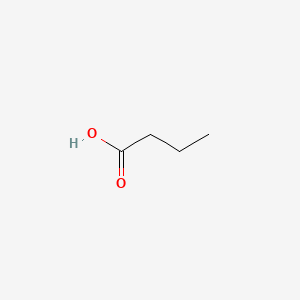
Butyric Acid
Butyric acid is a straight-chain saturated fatty acid that is butane in which one of the terminal methyl groups has been oxidised to a carboxy group. It has a role as a Mycoplasma genitalium metabolite and a human urinary metabolite. It is a fatty acid 4:0 and a straight-chain saturated fatty acid. It is a conjugate acid of a butyrate. — ChEBI
- IUPAC 名称
- butanoic acid
- 分子式
- C4H8O2
- 分子量
- 88.11 g/mol
- 精确质量
- 88.052429494 Da
- XLogP3
- 0.8
- 拓扑极性表面积
- 37.3 Ų
- 氢键供体
- 1
- 氢键受体
- 2
- 共价单元
- 1
- 已定义的立体中心
- 0
又称
另有 16 个已报告名称
外部数据库标识符
- ChEBI:CHEBI:30772
- ChEMBL:CHEMBL14227
- EPA DTXSID:DTXSID8021515
- PubMed:32020584
- PubMed:29584955
- PubMed:24631185
- PubMed:23113274
- PubMed:23093384
- PubMed:23091128
- PubMed:23077563
- PubMed:23075791
- PubMed:23069883
- PubMed:23064206
- PubMed:23060857
- PubMed:23029553
来自其他科学数据库的证据
EMBL-EBI ChEBI
butyric acid
A straight-chain saturated fatty acid that is butane in which one of the terminal methyl groups has been oxidised to a carboxy group.
- 配方
- C4H8O2
- 平均质量
- 88.106 g/mol
- 单同位素质量
- 88.05243 Da
- 形式电荷
- 0
- straight-chain saturated fatty acid — is a (CHEBI:39418)
- fatty acid 4:0 — is a (CHEBI:140601)
- Mycoplasma genitalium metabolite — has role (CHEBI:131604)
- human urinary metabolite — has role (CHEBI:84087)
- anti-inflammatory agent — has role (CHEBI:67079)
- Mycoplasma genitalium metabolite — has role (CHEBI:131604)
- human urinary metabolite — has role (CHEBI:84087)
- anti-inflammatory agent — has role (CHEBI:67079)
- straight-chain saturated fatty acid — is a (CHEBI:39418)
- fatty acid 4:0 — is a (CHEBI:140601)
- butyrate — is conjugate acid of (CHEBI:17968)
- 10560743 来源: PubMed
- 10579682 来源: PubMed
- 10736622 来源: PubMed
- 10836148 来源: PubMed
- 10956204 来源: PubMed
- 10956204 来源: PubMed
- 11201044 来源: PubMed
- 11208715 来源: PubMed
- 11238216 来源: PubMed
- 11305323 来源: PubMed
- 12068484 来源: PubMed
- 12668014 来源: PubMed
- 13678314 来源: PubMed
- 14962641 来源: PubMed
- 1542095 来源: PubMed
- 1542095 来源: PubMed
- 15809727 来源: PubMed
- 15810631 来源: PubMed
- 15857133 来源: PubMed
- 15938880 来源: PubMed
- 17553798 来源: PubMed
- 18571290 来源: PubMed
- 18942826 来源: PubMed
- 19007111 来源: PubMed
其他整理的名称
来自此来源的交叉引用
- CAS: 107-92-6 — ChemIDplus
- CAS: 107-92-6 — NIST Chemistry WebBook
- CAS: 107-92-6 — KEGG COMPOUND
- REGISTRY_NUMBER: 26242 — Gmelin
- REGISTRY_NUMBER: 906770 — Reaxys
- MANUAL_X_REF: BUA — PDBeChem
- MANUAL_X_REF: Butyric_acid — Wikipedia
- MANUAL_X_REF: BUTYRIC_ACID — MetaCyc
- MANUAL_X_REF: C00001180 — KNApSAcK
- MANUAL_X_REF: C00246 — KEGG COMPOUND
- MANUAL_X_REF: DB03568 — DrugBank
- MANUAL_X_REF: HMDB0000039 — HMDB
- MANUAL_X_REF: LMFA01010004 — LIPID MAPS
映射方: Exact CAS cross-reference in the ChEBI compound record. 来源更新: 2020-01-23. 检索时间: 2026-08-31. 打开来源记录
NIH PubChem PUG-View
Attributed physical-property, hazard, environmental and use annotations.
- Autoignition Temperature: 842 °F (USCG, 1999) 来源: CAMEO Chemicals
- Autoignition Temperature: 830 °F (443 °C) 来源: Hazardous Substances Data Bank (HSDB)
- Autoignition Temperature: 452 °C 来源: ILO-WHO International Chemical Safety Cards (ICSCs)
- Boiling Point: 326.3 °F at 760 mmHg (NTP, 1992) 来源: CAMEO Chemicals
- Boiling Point: 163.7 °C 来源: DrugBank
- Boiling Point: 163.5 °C 来源: Hazardous Substances Data Bank (HSDB)
- Boiling Point: 164 °C 来源: ILO-WHO International Chemical Safety Cards (ICSCs)
- Boiling Point: 164 °C 来源: Joint FAO/WHO Expert Committee on Food Additives (JECFA)
- Boiling Point: 163.5 °C @760 [mm Hg] 来源: PAC Chemical Database, U.S. Department of Energy
- Color/Form: Oily liquid 来源: Hazardous Substances Data Bank (HSDB)
- Color/Form: Colorless liquid 来源: Hazardous Substances Data Bank (HSDB)
- Density: 0.958 at 68 °F (USCG, 1999) - Less dense than water; will float 来源: CAMEO Chemicals
- Density: 0.959 at 20 °C/4 °C 来源: Hazardous Substances Data Bank (HSDB)
- Density: Relative density (water = 1): 0.96 来源: ILO-WHO International Chemical Safety Cards (ICSCs)
- Density: 0.952-0.956 来源: Joint FAO/WHO Expert Committee on Food Additives (JECFA)
- Density: 0.959 @25 °C 来源: PAC Chemical Database, U.S. Department of Energy
- pKa: 4.82 (at 25 °C) 来源: DrugBank
- Dissociation Constants: pKa = 4.82 at 25 °C 来源: Hazardous Substances Data Bank (HSDB)
- Flash Point: 170 °F (NTP, 1992) 来源: CAMEO Chemicals
- Flash Point: 72 °C 来源: Haz-Map, Information on Hazardous Chemicals and Occupational Diseases
- Flash Point: 161 °F (72 °C) (Closed cup) 来源: Hazardous Substances Data Bank (HSDB)
- Flash Point: 72 °C c.c. 来源: ILO-WHO International Chemical Safety Cards (ICSCs)
- LogP: 0.79 来源: DrugBank
- LogP: log Kow= 0.79 来源: Hazardous Substances Data Bank (HSDB)
- LogP: 0.79 来源: Human Metabolome Database (HMDB)
- LogP: 0.79 来源: ILO-WHO International Chemical Safety Cards (ICSCs)
- Melting Point: 17.8 °F (NTP, 1992) 来源: CAMEO Chemicals
- Melting Point: -5.7 °C 来源: DrugBank
- Melting Point: -7.9 °C 来源: Hazardous Substances Data Bank (HSDB)
- Melting Point: -5.7 °C 来源: Human Metabolome Database (HMDB)
- Melting Point: -7.9 °C 来源: ILO-WHO International Chemical Safety Cards (ICSCs)
- Melting Point: -5.1 °C 来源: PAC Chemical Database, U.S. Department of Energy
- Odor: Unpleasant, rancid odor 来源: Hazardous Substances Data Bank (HSDB)
- Odor: Penetrating and obnoxious odor 来源: Hazardous Substances Data Bank (HSDB)
- Physical Description: Butyric acid appears as a colorless liquid with a penetrating and unpleasant odor. Flash point 170 °F. Corrosive to metals and tissue. Density 8.0 lb /gal. 来源: CAMEO Chemicals
- Physical Description: Liquid; CBI 来源: EPA Chemical Data Reporting (CDR)
- Physical Description: Colorless, oily liquid with an unpleasant, rancid odor; [HSDB] 来源: Haz-Map, Information on Hazardous Chemicals and Occupational Diseases
- Physical Description: Liquid 来源: Human Metabolome Database (HMDB)
- Physical Description: COLOURLESS OILY LIQUID WITH CHARACTERISTIC ODOUR. 来源: ILO-WHO International Chemical Safety Cards (ICSCs)
- Physical Description: colourless liquid/strong, rancid, butterlike odour 来源: Joint FAO/WHO Expert Committee on Food Additives (JECFA)
- Refractive Index: Index of refraction: 1.3991 at 20 °C/D 来源: Hazardous Substances Data Bank (HSDB)
- Refractive Index: 1.397-1.399 来源: Joint FAO/WHO Expert Committee on Food Additives (JECFA)
- Solubility: greater than or equal to 100 mg/mL at 66 °F (NTP, 1992) 来源: CAMEO Chemicals
- Solubility: 60000 mg/L (at 25 °C) 来源: DrugBank
- Solubility: Miscible with ethanol, ether; slightly soluble in carbon tetrachloride 来源: Hazardous Substances Data Bank (HSDB)
- Solubility: In water, 6.00X10+4 mg/L at 25 °C 来源: Hazardous Substances Data Bank (HSDB)
- Solubility: 60.0 mg/mL 来源: Human Metabolome Database (HMDB)
- Solubility: Solubility in water: miscible 来源: ILO-WHO International Chemical Safety Cards (ICSCs)
- Solubility: miscible with alcohol, most fixed oils, propylene glycol, water 来源: Joint FAO/WHO Expert Committee on Food Additives (JECFA)
- Solubility: (in ethanol) 来源: Joint FAO/WHO Expert Committee on Food Additives (JECFA)
- Vapor Pressure: 0.43 mmHg at 68 °F ; 1.4 mmHg at 86 °F (NTP, 1992) 来源: CAMEO Chemicals
- Vapor Pressure: 1.65 [mmHg] 来源: Haz-Map, Information on Hazardous Chemicals and Occupational Diseases
- Vapor Pressure: 1.65 mm Hg at 25 °C 来源: Hazardous Substances Data Bank (HSDB)
- Vapor Pressure: Vapor pressure, Pa at 20 °C: 57 来源: ILO-WHO International Chemical Safety Cards (ICSCs)
- Vapor Pressure: 1.65 [mm Hg] @25 °C 来源: PAC Chemical Database, U.S. Department of Energy
- Viscosity: 1.426 mPa-s at 25 °C 来源: Hazardous Substances Data Bank (HSDB)
- Carcinogen Classification: No indication of carcinogenicity to humans (not listed by IARC). 来源: Toxin and Toxin Target Database (T3DB)
- Exposure Routes: The substance can be absorbed into the body by inhalation of its vapour. 来源: ILO-WHO International Chemical Safety Cards (ICSCs)
- First Aid: EYES: First check the victim for contact lenses and remove if present. Flush victim's eyes with water or normal saline solution for 20 to 30 minutes while simultaneously calling a hospital or poison control center. Do not put any ointments, oils, or medication in the victim's eyes without specific instructions from a physician. IMMEDIATELY transport the victim after flushing eyes to a hospital even if no symptoms (such as redness or irritation) develop.; SKIN: IMMEDIATELY flood affected skin with water while removing and isolating all contaminated clothing. Gently wash all affected skin areas thoroughly with soap and water. IMMEDIATELY call a hospital or poison control center even if no symptoms (such as redness or irritation) develop. IMMEDIATELY transport the victim to a hospital for treatment after washing the affected areas.; INHALATION: IMMEDIATELY leave the contaminated area; take deep breaths of fresh air. If symptoms (such as wheezing, coughing, shortness of breath, or burning in the mouth, throat, or chest) develop, call a physician and be prepared to transport the victim to a hospital. Provide proper respiratory protection to rescuers entering an unknown atmosphere. Whene 来源: CAMEO Chemicals
- ERG2024, Guide 153 (Butyric acid): General First Aid:; · Call 911 or emergency medical service.; · Ensure that medical personnel are aware of the material(s) involved, take precautions to protect themselves and avoid contamination.; · Move victim to fresh air if it can be done safely.; · Administer oxygen if breathing is difficult.; · If victim is not breathing:; -- DO NOT perform mouth-to-mouth resuscitation; the victim may have ingested or inhaled the substance.; -- If equipped and pulse detected, wash face and mouth, then give artificial respiration using a proper respiratory medical device (bag-valve mask, pocket mask equipped with a one-way valve or other device).; -- If no pulse detected or no respiratory medical device available, provide continuous compressions. Conduct a pulse check every two minutes or monitor for any signs of spontaneous respirations.; · Remove and isolate contaminated clothing and shoes.; · For minor skin contact, avoid spreading material on unaffected skin.; · In case of contact with substance, remove immediately by flushing skin or eyes with running water for at least 20 minutes.; · For severe burns, immediate medical attention is required.; · Effects of exposure (inhalation, ingestion, 来源: Emergency Response Guidebook (ERG)
- Signal: Danger 来源: Regulation (EC) No 1272/2008 of the European Parliament and of the Council
- GHS Hazard Statements: H314: Causes severe skin burns and eye damage [Danger Skin corrosion/irritation] 来源: Regulation (EC) No 1272/2008 of the European Parliament and of the Council
- Precautionary Statement Codes: P260, P264, P280, P301+P330+P331, P302+P361+P354, P304+P340, P305+P354+P338, P316, P321, P363, P405, and P501 (click each P-code to see the statement) 来源: Regulation (EC) No 1272/2008 of the European Parliament and of the Council
- Signal: Danger 来源: European Chemicals Agency (ECHA)
- GHS Hazard Statements: H302 (15.5%): Harmful if swallowed [Warning Acute toxicity, oral]; H314 (99%): Causes severe skin burns and eye damage [Danger Skin corrosion/irritation]; H318 (14.2%): Causes serious eye damage [Danger Serious eye damage/eye irritation] 来源: European Chemicals Agency (ECHA)
- Precautionary Statement Codes: P260, P264, P264+P265, P270, P280, P301+P317, P301+P330+P331, P302+P361+P354, P304+P340, P305+P354+P338, P316, P317, P321, P330, P363, P405, and P501 (click each P-code to see the statement) 来源: European Chemicals Agency (ECHA)
- ECHA C&L Notifications Summary: Aggregated GHS information provided per 2131 reports by companies from 16 notifications to the ECHA C&L Inventory. Each notification may be associated with multiple companies.; Information may vary between notifications depending on impurities, additives, and other factors. The percentage value in parenthesis indicates the notified classification ratio from companies that provide hazard codes. Only hazard codes with percentage values above 10% are shown. For more detailed information, please visit ECHA C&L website. 来源: European Chemicals Agency (ECHA)
- Signal: Danger 来源: NITE-CMC
- GHS Hazard Statements: H227: Combustible liquid [Warning Flammable liquids]; H311: Toxic in contact with skin [Danger Acute toxicity, dermal]; H314: Causes severe skin burns and eye damage [Danger Skin corrosion/irritation]; H318: Causes serious eye damage [Danger Serious eye damage/eye irritation]; H371: May cause damage to organs [Warning Specific target organ toxicity, single exposure] 来源: NITE-CMC
- Precautionary Statement Codes: P210, P260, P262, P264, P264+P265, P270, P280, P301+P330+P331, P302+P352, P302+P361+P354, P304+P340, P305+P354+P338, P308+P316, P316, P317, P321, P361+P364, P363, P370+P378, P403, P405, and P501 (click each P-code to see the statement) 来源: NITE-CMC
- Signal: Danger 来源: Hazardous Chemical Information System (HCIS), Safe Work Australia
- GHS Hazard Statements: H314: Causes severe skin burns and eye damage [Danger Skin corrosion/irritation] 来源: Hazardous Chemical Information System (HCIS), Safe Work Australia
- Health Effects: Acute exposure to cholinesterase inhibitors can cause a cholinergic crisis characterized by severe nausea/vomiting, salivation, sweating, bradycardia, hypotension, collapse, and convulsions. Increasing muscle weakness is a possibility and may result in death if respiratory muscles are involved. Accumulation of ACh at motor nerves causes overstimulation of nicotinic expression at the neuromuscular junction. When this occurs symptoms such as muscle weakness, fatigue, muscle cramps, fasciculation, and paralysis can be seen. When there is an accumulation of ACh at autonomic ganglia this causes overstimulation of nicotinic expression in the sympathetic system. Symptoms associated with this are hypertension, and hypoglycemia. Overstimulation of nicotinic acetylcholine receptors in the central nervous system, due to accumulation of ACh, results in anxiety, headache, convulsions, ataxia, depression of respiration and circulation, tremor, general weakness, and potentially coma. When there is expression of muscarinic overstimulation due to excess acetylcholine at muscarinic acetylcholine receptors symptoms of visual disturbances, tightness in chest, wheezing due to bronchoconstriction, incre 来源: Toxin and Toxin Target Database (T3DB)
- NFPA Health Rating: 3 - Materials that, under emergency conditions, can cause serious or permanent injury. 来源: Hazardous Substances Data Bank (HSDB)
- NFPA Fire Rating: 2 - Materials that must be moderately heated or exposed to relatively high ambient temperatures before ignition can occur. Materials would not under normal conditions form hazardous atmospheres with air, but under high ambient temperatures or under moderate heating could release vapor in sufficient quantities to produce hazardous atmospheres with air. 来源: Hazardous Substances Data Bank (HSDB)
- NFPA Instability Rating: 0 - Materials that in themselves are normally stable, even under fire conditions. 来源: Hazardous Substances Data Bank (HSDB)
- Toxicity Summary: Butyric acid is a cholinesterase or acetylcholinesterase (AChE) inhibitor. A cholinesterase inhibitor (or 'anticholinesterase') suppresses the action of acetylcholinesterase. Because of its essential function, chemicals that interfere with the action of acetylcholinesterase are potent neurotoxins, causing excessive salivation and eye-watering in low doses, followed by muscle spasms and ultimately death. Nerve gases and many substances used in insecticides have been shown to act by binding a serine in the active site of acetylcholine esterase, inhibiting the enzyme completely. Acetylcholine esterase breaks down the neurotransmitter acetylcholine, which is released at nerve and muscle junctions, in order to allow the muscle or organ to relax. The result of acetylcholine esterase inhibition is that acetylcholine builds up and continues to act so that any nerve impulses are continually transmitted and muscle contractions do not stop. Among the most common acetylcholinesterase inhibitors are phosphorus-based compounds, which are designed to bind to the active site of the enzyme. The structural requirements are a phosphorus atom bearing two lipophilic groups, a leaving group (such as a h 来源: Toxin and Toxin Target Database (T3DB)
- Environmental Bioconcentration: An estimated BCF of 3.2 was calculated for n-butanoic acid(SRC), using a log Kow of 0.79(1) and a regression-derived equation(2). According to a classification scheme(3), this BCF suggests the potential for bioconcentration in aquatic organisms is low(SRC). 来源: Hazardous Substances Data Bank (HSDB)
- Environmental Fate: TERRESTRIAL FATE: Based on a classification scheme(1), an estimated Koc value of 64(SRC), determined from a log Kow of 0.79(2) and a regression-derived equation(3), and experimental values of 19.1, 27.6, and 14.7 in mud, muddy sand, and sand(4), indicate that n-butanoic acid is expected to have very high to high mobility in soil(SRC). The pKa of n-butanoic acid is 4.82(5), indicating that this compound will primarily exist in the anion form in the environment and anions generally do not adsorb more strongly to soils containing organic carbon and clay than their neutral counterparts(6). Volatilization of butyric acid from moist soil surfaces is expected to be slow(SRC) given a Henry's Law constant of 5.35X10⁻⁷ atm-cu m/mole(7). n-Butanoic acid is expected to volatilize from dry soil surfaces(SRC) based upon a vapor pressure of 1.65 mm Hg(8). N-butanoic acid may be susceptible to biodegradation in terrestrial environments based on the observed degradation of 72% after 5 hours when incubated with activated sludge(9,10). 来源: Hazardous Substances Data Bank (HSDB)
- Environmental Fate: AQUATIC FATE: Based on a classification scheme(1), experimental Koc values of 19.1, 27.6, and 14.7 on a clastic mud (3.5% organic carbon), a lateritic muddy sand (1.3% organic carbon), and a fine carbonate sand (0.17% organic carbon), respectively(2), indicate that n-butanoic acid is not expected to adsorb to suspended solids and sediment(SRC). The pKa of n-butanoic acid is 4.82(5), indicating that this compound will primarily exist in the anion form in the environment and anions generally do not adsorb more strongly to soils containing organic carbon and clay than their neutral counterparts(6). Volatilization from water surfaces is expected to be slow(3) based upon a Henry's Law constant of 5.35X10⁻⁷ atm-cu m/mole(4). Using this Henry's Law constant and an estimation method(3), volatilization half-lives for a model river and model lake are 64 and 471 days, respectively(SRC). According to a classification scheme(7), an estimated BCF of 3.2(SRC), from a log Kow of 0.79(8) and a regression-derived equation(9), suggests the potential for bioconcentration in aquatic organisms is low(SRC). n-Butanoic acid may be susceptible to biodegradation in aquatic environments based on the observed 来源: Hazardous Substances Data Bank (HSDB)
- Environmental Fate: ATMOSPHERIC FATE: According to a model of gas/particle partitioning of semivolatile organic compounds in the atmosphere(1), n-butanoic acid, which has a vapor pressure of 1.65 mm Hg at 25 °C(2), is expected to exist solely as a vapor in the ambient atmosphere. Vapor-phase butyric acid is degraded in the atmosphere by reaction with photochemically-produced hydroxyl radicals(SRC); the half-life for this reaction in air is estimated to be 7 days(SRC), calculated from its rate constant of 2.40X10⁻¹² cu cm/molecule-sec at 25 °C(3). n-Butanoic acid does not contain chromophores that absorb at wavelengths >290 nm and therefore is not expected to be susceptible to direct photolysis by sunlight(4). 来源: Hazardous Substances Data Bank (HSDB)
- Industry Uses: Other; Lubricating agent; Intermediate; Fragrance 来源: EPA Chemical Data Reporting (CDR)
- Sources/Uses: Used as a flavoring agent (foods, perfumes, drugs) and chemical intermediate; also used in leather tanning (deliming hides) and as an additive to disinfectants, gasoline, and varnishes; [HSDB] 来源: Haz-Map, Information on Hazardous Chemicals and Occupational Diseases
- Industrial Processes with risk of exposure: Painting (Pigments, Binders, and Biocides) [Category: Paint]; Leather Tanning and Processing [Category: Industry]; Fur Dressing and Dyeing [Category: Industry] 来源: Haz-Map, Information on Hazardous Chemicals and Occupational Diseases
- Uses: Mesh Heading: histamine antagonists 来源: Hazardous Substances Data Bank (HSDB)
- Uses: Chem int for cellulose derivatives in lacquers and plastics, for pharmaceuticals, emulsifiers and disinfectants; leather tanning agent for deliming and swelling hides, sweetening agent in gasolines. 来源: Hazardous Substances Data Bank (HSDB)
- Uses: Synthesis of butyrate ester perfume and flavor ingredients... 来源: Hazardous Substances Data Bank (HSDB)
- Uses: Butyric acid is used for body in butter, cheese, butterscotch, caramel, fruit, and nut flavors. 来源: Hazardous Substances Data Bank (HSDB)
- Uses: For more Uses (Complete) data for n-BUTYRIC ACID (8 total), please visit the HSDB record page. 来源: Hazardous Substances Data Bank (HSDB)
- Uses: This is an endogenously produced metabolite found in the human body. It is used in metabolic reactions, catabolic reactions or waste generation. 来源: Toxin and Toxin Target Database (T3DB)
映射方: Existing checksum-valid CAS to unique PubChem CID match. 检索时间: 2026-08-31. 打开来源记录
科学分类和危害注释仅提供背景信息,不能取代上方所示针对具体市场的监管决定。
其他来源的覆盖范围和匹配状态
| 来源 | 结果 | 已检查 |
|---|---|---|
| EMBL-EBI ChEBI | 精确匹配 | 2026-08-31 |
| NIH PubChem PUG-View | 精确匹配 | 2026-08-31 |
已记录的无匹配结果是该来源已被检查的有效证据;这并不表示该物质在别处不存在。
于 2026-08-31 通过校验和有效的 CAS 匹配从美国国立卫生研究院 (NIH) PubChem 检索。化学性质不能取代本页的监管决定。