
CAS 107-39-1PubChem CID 7868
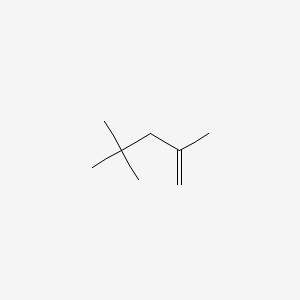
2,4,4-Trimethyl-1-pentene
2,4,4,-Trimethyl-1-pentene is a hydrocarbon and component of gasoline. — Toxin and Toxin Target Database (T3DB)
- IUPAC 名称
- 2,4,4-trimethylpent-1-ene
- 分子式
- C8H16
- 分子量
- 112.21 g/mol
- 精确质量
- 112.125200510 Da
- XLogP3
- 3.7
- 拓扑极性表面积
- 0.0 Ų
- 氢键供体
- 0
- 氢键受体
- 0
- 共价单元
- 1
- 已定义的立体中心
- 0
又称
Diisobutylene1-Pentene, 2,4,4-trimethyl-2,2,4-Trimethyl-4-pentene1-Methyl-1-neopentylethyleneNSC-87012,4,4-trimethylpentene-1N69L73ADVFNSC-73942
另有 16 个已报告名称
alpha-DiisobutyleneRefChem:9086782,4,4,-trimethyl-1-pentene203-486-42,4,4-TRIMETHYLPENTENE2,4-Trimethyl-1-pentene2,4-Trimethyl-4-pentene1-Pentene,4,4-trimethyl-HSDB 1442EINECS 203-486-4NSC 73942UNII-N69L73ADVFBRN 1098309a-DiisobutyleneAI3-300491-Methyl-1-neopentylethylene; 2,2,4-Trimethyl-4-pentene; NSC 73942; NSC 8701
外部数据库标识符
- ChEMBL:CHEMBL3186786
- EPA DTXSID:DTXSID4026765
- PubMed:22268561
- PubMed:20812708
- PubMed:17522040
- PubMed:16356615
来自其他科学数据库的证据
NIH PubChem PUG-View
标识符精确匹配7868
Attributed physical-property, hazard, environmental and use annotations.
- Autoignition Temperature: 736 °F (391 °C). 来源: Hazardous Substances Data Bank (HSDB)
- Autoignition Temperature: 391 °C 来源: ILO-WHO International Chemical Safety Cards (ICSCs)
- Boiling Point: 101.4 °C 来源: Hazardous Substances Data Bank (HSDB)
- Boiling Point: 101 °C 来源: ILO-WHO International Chemical Safety Cards (ICSCs)
- Boiling Point: 101.4 °C @760 [mm Hg] 来源: PAC Chemical Database, U.S. Department of Energy
- Color/Form: Colorless liquid 来源: Hazardous Substances Data Bank (HSDB)
- Density: 0.7150 @ 20 °C/4 °C 来源: Hazardous Substances Data Bank (HSDB)
- Density: Relative density (water = 1): 0.7 来源: ILO-WHO International Chemical Safety Cards (ICSCs)
- Density: 0.715 @ 20°C 来源: PAC Chemical Database, U.S. Department of Energy
- Flash Point: -5 °C 来源: Haz-Map, Information on Hazardous Chemicals and Occupational Diseases
- Flash Point: 23 °F (-5 °C) 来源: Hazardous Substances Data Bank (HSDB)
- Flash Point: -5 °C 来源: ILO-WHO International Chemical Safety Cards (ICSCs)
- LogP: log Kow= 4.55 来源: Hazardous Substances Data Bank (HSDB)
- LogP: 4.55 来源: ILO-WHO International Chemical Safety Cards (ICSCs)
- Melting Point: -93.5 °C 来源: Hazardous Substances Data Bank (HSDB)
- Melting Point: -93 °C 来源: ILO-WHO International Chemical Safety Cards (ICSCs)
- Melting Point: -93.5 °C 来源: PAC Chemical Database, U.S. Department of Energy
- Odor: GASOLINE-LIKE ODOR 来源: Hazardous Substances Data Bank (HSDB)
- Physical Description: CBI; Liquid 来源: EPA Chemical Data Reporting (CDR)
- Physical Description: Colorless liquid with an odor of gasoline; [HSDB] 来源: Haz-Map, Information on Hazardous Chemicals and Occupational Diseases
- Physical Description: COLOURLESS LIQUID WITH CHARACTERISTIC ODOUR. 来源: ILO-WHO International Chemical Safety Cards (ICSCs)
- Refractive Index: Index of refraction: 1.4096 @ 20 °C/D 来源: Hazardous Substances Data Bank (HSDB)
- Solubility: Insoluble in water. Soluble in ethyl ether, benzene, carbon tetrachloride 来源: Hazardous Substances Data Bank (HSDB)
- Solubility: Solubility in water: none 来源: ILO-WHO International Chemical Safety Cards (ICSCs)
- Vapor Pressure: 44.7 [mmHg] 来源: Haz-Map, Information on Hazardous Chemicals and Occupational Diseases
- Vapor Pressure: 44.7 mm Hg @ 25 °C 来源: Hazardous Substances Data Bank (HSDB)
- Vapor Pressure: Vapor pressure, kPa at 38 °C: 10 来源: ILO-WHO International Chemical Safety Cards (ICSCs)
- Vapor Pressure: 44.7 [mm Hg] @25 °C 来源: PAC Chemical Database, U.S. Department of Energy
- Carcinogen Classification: 2,4,4,-Trimethyl-1-pentene is found in gasoline, which is possibly carcinogenic to humans (Group 2B). (L135) 来源: Toxin and Toxin Target Database (T3DB)
- Exposure Routes: The substance can be absorbed into the body by inhalation. 来源: ILO-WHO International Chemical Safety Cards (ICSCs)
- Exposure Routes: Oral (L400) ; inhalation (L400) ; dermal (L400) 来源: Toxin and Toxin Target Database (T3DB)
- Signal: Danger 来源: Regulation (EC) No 1272/2008 of the European Parliament and of the Council
- GHS Hazard Statements: H225: Highly Flammable liquid and vapor [Danger Flammable liquids]; H411: Toxic to aquatic life with long lasting effects [Hazardous to the aquatic environment, long-term hazard] 来源: Regulation (EC) No 1272/2008 of the European Parliament and of the Council
- Precautionary Statement Codes: P210, P233, P240, P241, P242, P243, P273, P280, P303+P361+P353, P370+P378, P391, P403+P235, and P501 (click each P-code to see the statement) 来源: Regulation (EC) No 1272/2008 of the European Parliament and of the Council
- GHS Hazard Statements: H225: Highly Flammable liquid and vapor [Danger Flammable liquids]; H304: May be fatal if swallowed and enters airways [Danger Aspiration hazard]; H336: May cause drowsiness or dizziness [Warning Specific target organ toxicity, single exposure; Narcotic effects] 来源: Regulation (EC) No 1272/2008 of the European Parliament and of the Council
- Precautionary Statement Codes: P210, P233, P240, P241, P242, P243, P261, P271, P280, P301+P316, P303+P361+P353, P304+P340, P319, P331, P370+P378, P403+P233, P403+P235, P405, and P501 (click each P-code to see the statement) 来源: Regulation (EC) No 1272/2008 of the European Parliament and of the Council
- Signal: Danger 来源: European Chemicals Agency (ECHA)
- GHS Hazard Statements: H225 (100%): Highly Flammable liquid and vapor [Danger Flammable liquids]; H304 (12.6%): May be fatal if swallowed and enters airways [Danger Aspiration hazard]; H336 (12.6%): May cause drowsiness or dizziness [Warning Specific target organ toxicity, single exposure; Narcotic effects]; H400 (11.6%): Very toxic to aquatic life [Warning Hazardous to the aquatic environment, acute hazard]; H411 (100%): Toxic to aquatic life with long lasting effects [Hazardous to the aquatic environment, long-term hazard] 来源: European Chemicals Agency (ECHA)
- Precautionary Statement Codes: P210, P233, P240, P241, P242, P243, P261, P271, P273, P280, P301+P316, P303+P361+P353, P304+P340, P319, P331, P370+P378, P391, P403+P233, P403+P235, P405, and P501 (click each P-code to see the statement) 来源: European Chemicals Agency (ECHA)
- ECHA C&L Notifications Summary: Aggregated GHS information provided per 795 reports by companies from 6 notifications to the ECHA C&L Inventory. Each notification may be associated with multiple companies.; Information may vary between notifications depending on impurities, additives, and other factors. The percentage value in parenthesis indicates the notified classification ratio from companies that provide hazard codes. Only hazard codes with percentage values above 10% are shown. For more detailed information, please visit ECHA C&L website. 来源: European Chemicals Agency (ECHA)
- Note: This chemical does not meet GHS hazard criteria for 17.2% (66 of 384) of reports. 来源: European Chemicals Agency (ECHA)
- GHS Hazard Statements: H225 (82.8%): Highly Flammable liquid and vapor [Danger Flammable liquids]; H304 (79.2%): May be fatal if swallowed and enters airways [Danger Aspiration hazard]; H336 (78.9%): May cause drowsiness or dizziness [Warning Specific target organ toxicity, single exposure; Narcotic effects]; H400 (74.2%): Very toxic to aquatic life [Warning Hazardous to the aquatic environment, acute hazard]; H410 (74.2%): Very toxic to aquatic life with long lasting effects [Warning Hazardous to the aquatic environment, long-term hazard] 来源: European Chemicals Agency (ECHA)
- ECHA C&L Notifications Summary: Aggregated GHS information provided per 384 reports by companies from 16 notifications to the ECHA C&L Inventory. Each notification may be associated with multiple companies.; Reported as not meeting GHS hazard criteria per 66 of 384 reports by companies.; There are 15 notifications provided by 318 of 384 reports by companies with hazard statement code(s).; Information may vary between notifications depending on impurities, additives, and other factors. The percentage value in parenthesis indicates the notified classification ratio from companies that provide hazard codes. Only hazard codes with percentage values above 10% are shown. For more detailed information, please visit ECHA C&L website. 来源: European Chemicals Agency (ECHA)
- Health Effects: Petroleum distillates are aspiration hazards and may cause pulmonary damage, central nervous system depression, and cardiac effects such as cardiac arrhythmias. They may also affect the blood, immune system, liver, and kidney. (A600, L1297) 来源: Toxin and Toxin Target Database (T3DB)
- NFPA Health Rating: 2 - Materials that, under emergency conditions, can cause temporary incapacitation or residual injury. 来源: Hazardous Substances Data Bank (HSDB)
- NFPA Fire Rating: 3 - Liquids and solids that can be ignited under almost all ambient temperature conditions. Materials produce hazardous atmospheres with air under almost all ambient temperatures or, though unaffected by ambient temperatures, are readily ignited under almost all conditions. 来源: Hazardous Substances Data Bank (HSDB)
- NFPA Instability Rating: 0 - Materials that in themselves are normally stable, even under fire conditions. 来源: Hazardous Substances Data Bank (HSDB)
- Toxicity Summary: Petroleum distillates are central nervous system depressants and cause pulmonary damage. (A600) 来源: Toxin and Toxin Target Database (T3DB)
- Environmental Bioconcentration: An estimated log BCF of 2.80 was calculated for 2,4,4-trimethyl-1-pentene(SRC), using an estimated log Kow of 4.55(1) and a regression-derived equation(2). According to a classification scheme(3), this BCF suggests the potential for bioconcentration in aquatic organisms is high. 来源: Hazardous Substances Data Bank (HSDB)
- Environmental Fate: TERRESTRIAL FATE: Based on a classification scheme(1), an estimated Koc value of 275(SRC), determined from a structure estimation method(2), indicates that 2,4,4-trimethyl-1-pentene is expected to have moderate mobility in soil(SRC). Volatilization of 2,4,4-trimethyl-1-pentene from moist soil surfaces is expected to be an important fate process(SRC) given an estimated Henry's Law constant of 0.75 atm-cu m/mole(SRC), using a fragment constant estimation method(3). The potential for volatilization of 2,4,4-trimethyl-1-pentene from dry soil surfaces may exist based upon a vapor pressure of 44.7 mm Hg(4). 2,2,4-Trimethyl-1-pentene is expected to biodegrade slowly in soil based upon no biodegradation in the Japanese MITI test(5). 来源: Hazardous Substances Data Bank (HSDB)
- Environmental Fate: AQUATIC FATE: Based on a classification scheme(1), an estimated Koc value of 275(SRC), determined from a structure estimation method(2), indicates that 2,4,4-trimethyl-1-pentene is not expected to adsorb to suspended solids and sediment in water(SRC). Volatilization from water surfaces is expected(3) based upon an estimated Henry's Law constant of 0.75 atm-cu m/mole(SRC), developed using a fragment constant estimation method(4). Using this Henry's Law constant and an estimation method(3), volatilization half-lives for a model river and model lake are 1.08 hr and 4.19 days, respectively(SRC). 2,2,4-Trimethyl-1-pentene is expected to biodegrade slowly in water based upon no biodegradation in the Japanese MITI test(7). According to a classification scheme(5), an estimated log BCF of 2.80(SRC), from a log Kow of 4.55(7) and a regression-derived equation(6), suggests the potential for bioconcentration in aquatic organisms is high. 来源: Hazardous Substances Data Bank (HSDB)
- Environmental Fate: ATMOSPHERIC FATE: According to a model of gas/particle partitioning of semivolatile organic compounds in the atmosphere(1), 2,4,4-trimethyl-1-pentene, which has a vapor pressure of 44.7 mm Hg at 25 °C(2), is expected to exist solely in a vapor-phase in the ambient atmosphere. Vapor-phase 2,4,4-trimethyl-1-pentene is degraded in the atmosphere by reaction with photochemically-produced hydroxyl radicals(SRC); the half-life for this reaction in air is estimated to be 0.3 hr(SRC), calculated from its estimated rate constant of 53.19X10⁻¹² cu cm/molecule-sec at 25 °C(SRC), determined using a structure estimation method(3). The rate constant for the vapor-phase reaction of 2,2,4-trimethyl-1-pentene with ozone has been estimated as 1.2X10⁻¹⁷ cu cm/molecule-sec at 25 °C(3). This corresponds to an atmospheric half-life of about 23 hrs at an atmospheric concentration of 7X10+11 ozone molecules per cu cm(3). 来源: Hazardous Substances Data Bank (HSDB)
- Consumer Uses: Fuel agents; Not Known or Reasonably Ascertainable 来源: EPA Chemical Data Reporting (CDR)
- Industry Uses: Intermediate; Flotation agent; Not Known or Reasonably Ascertainable; Fuel agents 来源: EPA Chemical Data Reporting (CDR)
- Sources/Uses: Used in organic synthesis and in antioxidants, surfactants, lube additives, plasticizers, and rubber chemicals; Also used as a dispersant (co-monomer with maleic anhydride); [HSDB] Used in organic synthesis and to improve paper coatability; [AIHA] 来源: Haz-Map, Information on Hazardous Chemicals and Occupational Diseases
- Industrial Processes with risk of exposure: Pulp and Paper Processing [Category: Industry] 来源: Haz-Map, Information on Hazardous Chemicals and Occupational Diseases
- Uses: CHEM INT FOR OCTYLPHENOL, OCTYLDIPHENYLAMINE USED AS RUBBER CHEM, TERT-OCTYLAMINE, & ISONONYL ALCOHOL; COMONOMER WITH MALEIC ANHYDRIDE USED AS DISPERSANT 来源: Hazardous Substances Data Bank (HSDB)
- Uses: Organic synthesis; motor fuel synthesis, particularly isooctane; peroxide reactions 来源: Hazardous Substances Data Bank (HSDB)
- Uses: Alkylation; intermediates; antioxidants, surfactants; lube additives; plasticizers; rubber chemicals. /Diisobutylene- including 2,4,4-trimethyl-1-pentene isomer/ 来源: Hazardous Substances Data Bank (HSDB)
- Uses: 2,4,4,-Trimethyl-1-pentene is a component of gasoline. 来源: Toxin and Toxin Target Database (T3DB)
映射方: Existing checksum-valid CAS to unique PubChem CID match. 检索时间: 2026-08-31. 打开来源记录
科学分类和危害注释仅提供背景信息,不能取代上方所示针对具体市场的监管决定。
其他来源的覆盖范围和匹配状态
| 来源 | 结果 | 已检查 |
|---|---|---|
| EMBL-EBI ChEBI | 无精确记录 | 2026-08-31 |
| NIH PubChem PUG-View | 精确匹配 | 2026-08-31 |
已记录的无匹配结果是该来源已被检查的有效证据;这并不表示该物质在别处不存在。
于 2026-08-31 通过校验和有效的 CAS 匹配从美国国立卫生研究院 (NIH) PubChem 检索。化学性质不能取代本页的监管决定。