
CAS
1 条记录
CAS 106-91-2
CAS 106-91-2 与法规 1223/2009 附件 II–VI 中的 1 条欧盟附件记录相匹配。
CAS 106-91-2 的记录
1 共化学身份与性质
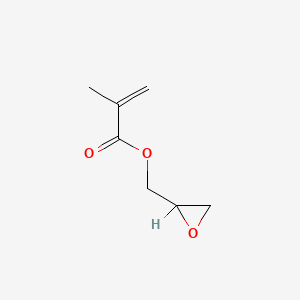
CAS 106-91-2PubChem CID 7837
Glycidyl methacrylate
Glycidyl methacrylate is an enoate ester obtained by formal condensation of the carboxy group of methacrylic acid with the hydroxy group of glycidol. It is an epoxide and an enoate ester. It is functionally related to a methacrylic acid and a glycidol. — ChEBI
- IUPAC 名称
- oxiran-2-ylmethyl 2-methylprop-2-enoate
- 分子式
- C7H10O3
- 分子量
- 142.15 g/mol
- 精确质量
- 142.062994177 Da
- XLogP3
- 0.8
- 拓扑极性表面积
- 38.8 Ų
- 氢键供体
- 0
- 氢键受体
- 3
- 共价单元
- 1
- 已定义的立体中心
- 0
又称
2,3-Epoxypropyl methacrylateGlycidol methacrylateSY-Monomer GBlemmer GAcriester GBlemmer GMALight Ester GMethacrylic acid, 2,3-epoxypropyl ester
另有 16 个已报告名称
2-((Methacryloxy)methyl)oxirane2-Propenoic acid, 2-methyl-, oxiranylmethyl esterGlycidyl alpha-methylacrylateCP 105Glycidyl alpha-methyl acrylate1-Propanol, 2,3-epoxy-, methacrylateR8WN29J8VFSR 379NSC-241562-Propenoic acid, 2-methyl-, 2-oxiranylmethyl esterCHEBI:132844monomethacrylate propylene oxideRefChem:663607203-441-9oxiran-2-ylmethyl methacrylateglycidylmethacrylate
外部数据库标识符
- ChEBI:CHEBI:132844
- ChEMBL:CHEMBL1333073
- EPA DTXSID:DTXSID0025361
- PubMed:36641056
- PubMed:26686995
- PubMed:23035465
- PubMed:22987317
- PubMed:22931820
- PubMed:22899268
- PubMed:22877136
- PubMed:22840004
- PubMed:22769012
- PubMed:22766469
- PubMed:22619525
- PubMed:22615600
来自其他科学数据库的证据
EMBL-EBI ChEBI
标识符精确匹配CHEBI:132844
glycidyl methacrylate
An enoate ester obtained by formal condensation of the carboxy group of methacrylic acid with the hydroxy group of glycidol.
- 配方
- C7H10O3
- 平均质量
- 142.154 g/mol
- 单同位素质量
- 142.06299 Da
- 形式电荷
- 0
- enoate ester — is a (CHEBI:51702)
- epoxide — is a (CHEBI:32955)
- methacrylic acid — has functional parent (CHEBI:25219)
- glycidol — has functional parent (CHEBI:30966)
- enoate ester — is a (CHEBI:51702)
- epoxide — is a (CHEBI:32955)
- 27394038 来源: PubMed
其他整理的名称
(oxiran-2-yl)methyl 2-methylprop-2-enoate2,3-Epoxypropanol methacrylate2,3-Epoxypropyl methacrylate2-((Methacryloxy)methyl)oxiraneGlycidol methacrylateGlycidyl alpha-methylacrylateMethacrylic acid, 2,3-epoxypropyl ester
来自此来源的交叉引用
- CAS: 106-91-2 — ChemIDplus
- CAS: 106-91-2 — NIST Chemistry WebBook
- REGISTRY_NUMBER: 2506 — Reaxys
- MANUAL_X_REF: Glycidyl_methacrylate — Wikipedia
映射方: Exact CAS cross-reference in the ChEBI compound record. 来源更新: 2017-01-27. 检索时间: 2026-08-31. 打开来源记录
NIH PubChem PUG-View
标识符精确匹配7837
Attributed physical-property, hazard, environmental and use annotations.
- Boiling Point: 372 °F at 760 mmHg (NTP, 1992) 来源: CAMEO Chemicals
- Boiling Point: 189 °C 来源: Hazardous Substances Data Bank (HSDB)
- Boiling Point: 189 °C 来源: ILO-WHO International Chemical Safety Cards (ICSCs)
- Color/Form: Colorless liquid 来源: Hazardous Substances Data Bank (HSDB)
- Density: 1.073 at 68 °F (USCG, 1999) - Denser than water; will sink 来源: CAMEO Chemicals
- Density: 1.07 g/cu cm @ 25 °C 来源: Hazardous Substances Data Bank (HSDB)
- Density: Relative density (water = 1): 1.08 来源: ILO-WHO International Chemical Safety Cards (ICSCs)
- Flash Point: 181 °F (NTP, 1992) 来源: CAMEO Chemicals
- Flash Point: 84 °C (Tag open cup) 来源: Hazardous Substances Data Bank (HSDB)
- LogP: 0.96 来源: ILO-WHO International Chemical Safety Cards (ICSCs)
- Melting Point: freezing pt: -41.5 °C 来源: Hazardous Substances Data Bank (HSDB)
- Odor: Fruity odor 来源: Hazardous Substances Data Bank (HSDB)
- Physical Description: Glycidyl methacrylate is a colorless liquid with a fruity odor. Floats on water. (USCG, 1999) 来源: CAMEO Chemicals
- Physical Description: Liquid 来源: EPA Chemical Data Reporting (CDR)
- Physical Description: Colorless liquid with a fruity odor; [HSDB] 来源: Haz-Map, Information on Hazardous Chemicals and Occupational Diseases
- Physical Description: COLOURLESS LIQUID WITH CHARACTERISTIC ODOUR. 来源: ILO-WHO International Chemical Safety Cards (ICSCs)
- Refractive Index: Index of refraction: 1.448 @ 25 °C/D 来源: Hazardous Substances Data Bank (HSDB)
- Refractive Index: Index of refraction: 1.4494 at 20 °C 来源: Hazardous Substances Data Bank (HSDB)
- Solubility: 5 to 10 mg/mL at 68 °F (NTP, 1992) 来源: CAMEO Chemicals
- Solubility: Very soluble in benzene, ethyl ether, ethyl alcohol 来源: Hazardous Substances Data Bank (HSDB)
- Solubility: Solubility in water, g/100ml at 25 °C: 5 (moderate) 来源: ILO-WHO International Chemical Safety Cards (ICSCs)
- Vapor Pressure: 3.15 [mmHg] 来源: Haz-Map, Information on Hazardous Chemicals and Occupational Diseases
- Vapor Pressure: Vapor pressure, kPa at 25 °C: 0.42 来源: ILO-WHO International Chemical Safety Cards (ICSCs)
- Viscosity: 5.481 cP at 70 °F 来源: Hazardous Substances Data Bank (HSDB)
- IARC Carcinogenic Agent: Glycidyl methacrylate 来源: International Agency for Research on Cancer (IARC)
- IARC Carcinogenic Classes: Group 2A: Probably carcinogenic to humans 来源: International Agency for Research on Cancer (IARC)
- IARC Monographs: Volume 125: (2020) Some Industrial Chemical Intermediates and Solvents 来源: International Agency for Research on Cancer (IARC)
- Publication Year: 2020 online 来源: International Agency for Research on Cancer (IARC)
- Evaluation Year: 2019 来源: International Agency for Research on Cancer (IARC)
- Exposure Routes: The substance can be absorbed into the body by inhalation, through the skin and by ingestion. 来源: ILO-WHO International Chemical Safety Cards (ICSCs)
- First Aid: EYES: First check the victim for contact lenses and remove if present. Flush victim's eyes with water or normal saline solution for 20 to 30 minutes while simultaneously calling a hospital or poison control center. Do not put any ointments, oils, or medication in the victim's eyes without specific instructions from a physician. IMMEDIATELY transport the victim after flushing eyes to a hospital even if no symptoms (such as redness or irritation) develop.; SKIN: IMMEDIATELY flood affected skin with water while removing and isolating all contaminated clothing. Gently wash all affected skin areas thoroughly with soap and water. If symptoms such as redness or irritation develop, IMMEDIATELY call a physician and be prepared to transport the victim to a hospital for treatment.; INHALATION: IMMEDIATELY leave the contaminated area; take deep breaths of fresh air. If symptoms (such as wheezing, coughing, shortness of breath, or burning in the mouth, throat, or chest) develop, call a physician and be prepared to transport the victim to a hospital. Provide proper respiratory protection to rescuers entering an unknown atmosphere. Whenever possible, Self-Contained Breathing Apparatus (SCBA) shou 来源: CAMEO Chemicals
- Signal: Danger 来源: Regulation (EC) No 1272/2008 of the European Parliament and of the Council
- GHS Hazard Statements: H302: Harmful if swallowed [Warning Acute toxicity, oral]; H311: Toxic in contact with skin [Danger Acute toxicity, dermal]; H314: Causes severe skin burns and eye damage [Danger Skin corrosion/irritation]; H317: May cause an allergic skin reaction [Warning Sensitization, Skin]; H318: Causes serious eye damage [Danger Serious eye damage/eye irritation]; H335: May cause respiratory irritation [Warning Specific target organ toxicity, single exposure; Respiratory tract irritation]; H341: Suspected of causing genetic defects [Warning Germ cell mutagenicity]; H350: May cause cancer [Danger Carcinogenicity]; H360F: May damage fertility [Danger Reproductive toxicity]; H372: Causes damage to organs through prolonged or repeated exposure [Danger Specific target organ toxicity, repeated exposure] 来源: Regulation (EC) No 1272/2008 of the European Parliament and of the Council
- Precautionary Statement Codes: P203, P260, P261, P262, P264, P264+P265, P270, P271, P272, P280, P301+P317, P301+P330+P331, P302+P352, P302+P361+P354, P304+P340, P305+P354+P338, P316, P317, P318, P319, P321, P330, P333+P317, P361+P364, P362+P364, P363, P403+P233, P405, and P501 (click each P-code to see the statement) 来源: Regulation (EC) No 1272/2008 of the European Parliament and of the Council
- Note: This chemical does not meet GHS hazard criteria for < 0.1% (1 of 1165) of reports. 来源: European Chemicals Agency (ECHA)
- Signal: Danger 来源: European Chemicals Agency (ECHA)
- GHS Hazard Statements: H302+H332 (37.9%): Harmful if swallowed or if inhaled [Warning Acute toxicity, oral; acute toxicity, inhalation]; H302 (98%): Harmful if swallowed [Warning Acute toxicity, oral]; H311 (74.8%): Toxic in contact with skin [Danger Acute toxicity, dermal]; H312 (25.2%): Harmful in contact with skin [Warning Acute toxicity, dermal]; H314 (22.3%): Causes severe skin burns and eye damage [Danger Skin corrosion/irritation]; H315 (77.7%): Causes skin irritation [Warning Skin corrosion/irritation]; H317 (> 99.9%): May cause an allergic skin reaction [Warning Sensitization, Skin]; H318 (22.2%): Causes serious eye damage [Danger Serious eye damage/eye irritation]; H319 (77.7%): Causes serious eye irritation [Warning Serious eye damage/eye irritation]; H332 (81.5%): Harmful if inhaled [Warning Acute toxicity, inhalation]; H335 (17.2%): May cause respiratory irritation [Warning Specific target organ toxicity, single exposure; Respiratory tract irritation]; H341 (35.8%): Suspected of causing genetic defects [Warning Germ cell mutagenicity]; H350 (35.7%): May cause cancer [Danger Carcinogenicity]; H360 (27%): May damage fertility or the unborn child [Danger Reproductive toxicity]; H370 (19.8%): Ca 来源: European Chemicals Agency (ECHA)
- Precautionary Statement Codes: P203, P260, P261, P262, P264, P264+P265, P270, P271, P272, P280, P301+P317, P301+P330+P331, P302+P352, P302+P361+P354, P304+P340, P305+P351+P338, P305+P354+P338, P308+P316, P316, P317, P318, P319, P321, P330, P332+P317, P333+P317, P337+P317, P361+P364, P362+P364, P363, P403+P233, P405, and P501 (click each P-code to see the statement) 来源: European Chemicals Agency (ECHA)
- ECHA C&L Notifications Summary: Aggregated GHS information provided per 1165 reports by companies from 32 notifications to the ECHA C&L Inventory. Each notification may be associated with multiple companies.; Reported as not meeting GHS hazard criteria per 1 of 1165 reports by companies.; There are 31 notifications provided by 1164 of 1165 reports by companies with hazard statement code(s).; Information may vary between notifications depending on impurities, additives, and other factors. The percentage value in parenthesis indicates the notified classification ratio from companies that provide hazard codes. Only hazard codes with percentage values above 10% are shown. For more detailed information, please visit ECHA C&L website. 来源: European Chemicals Agency (ECHA)
- Signal: Danger 来源: NITE-CMC
- GHS Hazard Statements: H227: Combustible liquid [Warning Flammable liquids]; H302: Harmful if swallowed [Warning Acute toxicity, oral]; H311: Toxic in contact with skin [Danger Acute toxicity, dermal]; H314: Causes severe skin burns and eye damage [Danger Skin corrosion/irritation]; H317: May cause an allergic skin reaction [Warning Sensitization, Skin]; H318: Causes serious eye damage [Danger Serious eye damage/eye irritation]; H341: Suspected of causing genetic defects [Warning Germ cell mutagenicity]; H350: May cause cancer [Danger Carcinogenicity]; H360: May damage fertility or the unborn child [Danger Reproductive toxicity]; H370: Causes damage to organs [Danger Specific target organ toxicity, single exposure]; H372: Causes damage to organs through prolonged or repeated exposure [Danger Specific target organ toxicity, repeated exposure]; H401: Toxic to aquatic life [Hazardous to the aquatic environment, acute hazard]; H412: Harmful to aquatic life with long lasting effects [Hazardous to the aquatic environment, long-term hazard] 来源: NITE-CMC
- Precautionary Statement Codes: P203, P210, P260, P261, P262, P264, P264+P265, P270, P272, P273, P280, P301+P317, P301+P330+P331, P302+P352, P302+P361+P354, P304+P340, P305+P354+P338, P308+P316, P316, P317, P318, P319, P321, P330, P333+P317, P361+P364, P362+P364, P363, P370+P378, P403, P405, and P501 (click each P-code to see the statement) 来源: NITE-CMC
- GHS Hazard Statements: H227: Combustible liquid [Warning Flammable liquids]; H302: Harmful if swallowed [Warning Acute toxicity, oral]; H311: Toxic in contact with skin [Danger Acute toxicity, dermal]; H314: Causes severe skin burns and eye damage [Danger Skin corrosion/irritation]; H317: May cause an allergic skin reaction [Warning Sensitization, Skin]; H318: Causes serious eye damage [Danger Serious eye damage/eye irritation]; H341: Suspected of causing genetic defects [Warning Germ cell mutagenicity]; H350: May cause cancer [Danger Carcinogenicity]; H361: Suspected of damaging fertility or the unborn child [Warning Reproductive toxicity]; H370: Causes damage to organs [Danger Specific target organ toxicity, single exposure]; H372: Causes damage to organs through prolonged or repeated exposure [Danger Specific target organ toxicity, repeated exposure]; H401: Toxic to aquatic life [Hazardous to the aquatic environment, acute hazard]; H412: Harmful to aquatic life with long lasting effects [Hazardous to the aquatic environment, long-term hazard] 来源: NITE-CMC
- Environmental Bioconcentration: An estimated BCF of 3 was calculated for glycidyl methacrylate(SRC), using an estimated log Kow of 0.81(1,SRC) and a regression-derived equation(2). According to a classification scheme(3), this BCF suggests the potential for bioconcentration in aquatic organisms is low. 来源: Hazardous Substances Data Bank (HSDB)
- Environmental Fate: TERRESTRIAL FATE: Based on a classification scheme(1), an estimated Koc value of 10(SRC), determined from a structure estimation method(2), indicates that glycidyl methacrylate is expected to have very high mobility in soil(SRC). Volatilization of glycidyl methacrylate from moist soil surfaces is expected to occur slowly(SRC) given an estimated Henry's Law constant of 3.1X10⁻⁷ atm-cu m/mole(SRC), using a fragment constant estimation method(3). Glycidyl methacrylate is not expected to volatilize from dry soil surfaces(SRC) based upon an estimated vapor pressure of 0.62 mm Hg(SRC), determined from a fragment constant method(4). Screening tests indicate that glycidyl methacrylate is readily biodegradable; it reached 93-94% of its theoretical BOD in 4 weeks using an activated sludge inoculum(5). 来源: Hazardous Substances Data Bank (HSDB)
- Environmental Fate: AQUATIC FATE: Based on a classification scheme(1), an estimated Koc value of 10(SRC), determined from a structure estimation method(2), indicates that glycidyl methacrylate is not expected to adsorb to suspended solids and sediment in water(SRC). Volatilization from water surfaces is expected to occur slowly(3) based upon an estimated Henry's Law constant of 3.1X10⁻⁷ atm-cu m/mole(SRC), developed using a fragment constant estimation method(4). Volatilization half-lives for a model river and model lake are 140 days and 1000 days, respectively(SRC), using an estimation method(3). According to a classification scheme(5), an estimated BCF of 3(3), from an estimated log Kow of 0.81(6), suggests the potential for bioconcentration in aquatic organisms is low. A base-catalyzed second-order hydrolysis rate constant of 7X10⁻³ L/mole-sec(SRC) was estimated using a structure estimation method(7); this corresponds to half-lives of 31 yrs and 3 yrs at pH values of 7 and 8, respectively(7). The rate constant estimated for the epoxide does not include neutral hydrolysis rate constant. For some epoxides, the neutral rate constant is the dominant hydrolysis rate at environmental pHs. If the neutral 来源: Hazardous Substances Data Bank (HSDB)
- Environmental Fate: ATMOSPHERIC FATE: According to a model of gas/particle partitioning of semivolatile organic compounds in the atmosphere(1), glycidyl methacrylate, which has an estimated vapor pressure of 0.62 mm Hg at 25 °C(2), is expected to exist solely as a vapor in the ambient atmosphere. Vapor-phase glycidyl methacrylate is degraded in the atmosphere by reaction with photochemically-produced hydroxyl radicals(SRC); the half-life for this reaction in air is estimated to be 17 hours(SRC) from its estimated rate constant of 3.1X10⁻⁷ cu cm/molecule-sec at 25 °C(3). Because the structurally similar ethyl methacrylate does not absorb light in the environmental spectrum above 290 nm(4), direct photolysis of glycidyl methacrylate is not expected to occur(SRC). 来源: Hazardous Substances Data Bank (HSDB)
- Industry Uses: Filler; Not Known or Reasonably Ascertainable; Surface modifier; Other; Monomers 来源: EPA Chemical Data Reporting (CDR)
- Sources/Uses: Chemical intermediate for polymers; monomer and diluent in epoxy resin formulations; [HSDB] Used in Japan as an intermediate for resins and other chemicals; Also used in emulsions for impregnating paper and textiles, in paint coatings, and adhesive applications; [OECD SIDS: Glycidyl methacrylate - 1999] 来源: Haz-Map, Information on Hazardous Chemicals and Occupational Diseases
- Industrial Processes with risk of exposure: Pulp and Paper Processing [Category: Industry]; Painting (Pigments, Binders, and Biocides) [Category: Paint]; Working with Glues and Adhesives [Category: Other]; Textiles (Printing, Dyeing, or Finishing) [Category: Industry] 来源: Haz-Map, Information on Hazardous Chemicals and Occupational Diseases
- Uses: CHEM INT FOR POLYMERS; MONOMER & DILUENT IN EPOXY RESIN FORMULATIONS. 来源: Hazardous Substances Data Bank (HSDB)
- Uses: In hydrogel lenses. 来源: Hazardous Substances Data Bank (HSDB)
- Uses: In BIS-GMA dental resin. 来源: Hazardous Substances Data Bank (HSDB)
- Uses: Adhesion promotion/crosslinking comonomer (acrylic/vinyl resins) 来源: Hazardous Substances Data Bank (HSDB)
映射方: Existing checksum-valid CAS to unique PubChem CID match. 检索时间: 2026-08-31. 打开来源记录
科学分类和危害注释仅提供背景信息,不能取代上方所示针对具体市场的监管决定。
其他来源的覆盖范围和匹配状态
| 来源 | 结果 | 已检查 |
|---|---|---|
| EMBL-EBI ChEBI | 精确匹配 | 2026-08-31 |
| NIH PubChem PUG-View | 精确匹配 | 2026-08-31 |
已记录的无匹配结果是该来源已被检查的有效证据;这并不表示该物质在别处不存在。
于 2026-09-02 通过校验和有效的 CAS 匹配从美国国立卫生研究院 (NIH) PubChem 检索。化学性质不能取代本页的监管决定。
本站如何使用 CAS 106-91-2
CAS 106-91-2 是化学文摘社 (Chemical Abstracts Service) 的标识符,用于将本页对应到特定物质。在当前数据集中,有 1 条欧盟附件记录共用该标识符,可帮助您交叉核对同一物质是出现在一种还是多种监管情境中。
当供应商规格书、SDS 或原料档案给出 CAS 106-91-2,而您需要在一处查看所有关联的附件 II–VI 记录时,请使用本页。上方的条目卡片是查看浓度限值、警示语、附件归属和产品类型条件的最快途径。
常见问题
以 CAS 106-91-2 标识的物质,如果在不同情境下适用不同条件,可能出现在欧盟化妆品法规的多个附件中。例如,某物质可能在附件 III 中按特定条件受到限制,同一 CAS 也可能在附件 IV 中作为准用着色剂按另行规定的条件出现。每个条目都必须单独审查。
将 CAS 编号与您的原料规格书和 CoA 文件进行交叉核对。当该 CAS 出现在附件 II 时,应核实其不存在。当其出现在附件 III 时,应核实您的配方满足浓度限值和产品类型条件。共用此 CAS 编号的所有附件条目均列于上方。
CAS 编号由美国化学文摘社 (Chemical Abstracts Service) 分配,全球通用。EC 编号是来自 EINECS、ELINCS 或 NLP 清单等名录的欧盟委员会标识符。两种标识符都可能出现在欧盟化妆品附件条目中。有些物质两者都有,有些只有其一,一些较旧的条目可能两者都没有。
INCI 检查器接受成分名称、CAS 编号和 EC 编号。可直接检查此 CAS 编号,然后对照供应商规格书和所有关联的附件条件核实结果。