
CAS
1 条记录
CAS 105-41-9
CAS 105-41-9 与法规 1223/2009 附件 II–VI 中的 1 条欧盟附件记录相匹配。
CAS 105-41-9 的记录
1 共化学身份与性质
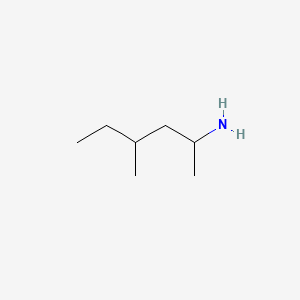
- IUPAC 名称
- 4-methylhexan-2-amine
- 分子式
- C7H17N
- 分子量
- 115.22 g/mol
- 精确质量
- 115.136099547 Da
- XLogP3
- 1.9
- 拓扑极性表面积
- 26.0 Ų
- 氢键供体
- 1
- 氢键受体
- 1
- 共价单元
- 1
- 已定义的立体中心
- 0
又称
1,3-DimethylpentylamineMethylhexaneamineForthane2-Amino-4-methylhexane4-Methyl-2-hexanamineForthan4-Methyl-2-hexylamineDimethylamylamine
另有 16 个已报告名称
Geranaminefloradrene1,3-DMAAX49C572YQONSC-1106RefChem:818621203-296-1Methylhexanamine2-Hexanamine, 4-methyl-NSC 1106PENTYLAMINE, 1,3-DIMETHYL-AI3-16556EINECS 203-296-1DMAA [Dietary Supplement]BRN 1731697UNII-X49C572YQO
外部数据库标识符
来自其他科学数据库的证据
EMBL-EBI ChEBI
标识符精确匹配CHEBI:134754
methylhexaneamine
- 配方
- C7H17N
- 平均质量
- 115.220 g/mol
- 单同位素质量
- 115.13610 Da
- 形式电荷
- 0
- alkylamine — is a (CHEBI:13759)
- alkylamine — is a (CHEBI:13759)
其他整理的名称
1,3-dimethylpentylamine2-amino-4-methylhexane4-methyl-2-hexylamineforthanforthane
来自此来源的交叉引用
- CAS: 105-41-9 — DrugCentral
- MANUAL_X_REF: 3353 — DrugCentral
映射方: Exact CAS cross-reference in the ChEBI compound record. 来源更新: 2017-02-23. 检索时间: 2026-08-31. 打开来源记录
NIH PubChem PUG-View
标识符精确匹配7753
Attributed physical-property, hazard, environmental and use annotations.
- Boiling Point: 132.5 °C 来源: Hazardous Substances Data Bank (HSDB)
- Color/Form: Liquid 来源: Hazardous Substances Data Bank (HSDB)
- Density: 0.7655 g/cu cm at 20 °C 来源: Hazardous Substances Data Bank (HSDB)
- Odor: Amine odor 来源: Hazardous Substances Data Bank (HSDB)
- Refractive Index: Index of Refraction: 1.4150 at 25 °C 来源: Hazardous Substances Data Bank (HSDB)
- Solubility: Slightly soluble in water; very soluble in ethanol, ether, chloroform and dilute acid 来源: Hazardous Substances Data Bank (HSDB)
- Signal: Danger 来源: European Chemicals Agency (ECHA)
- GHS Hazard Statements: H226 (100%): Flammable liquid and vapor [Warning Flammable liquids]; H302 (100%): Harmful if swallowed [Warning Acute toxicity, oral]; H314 (100%): Causes severe skin burns and eye damage [Danger Skin corrosion/irritation]; H335 (100%): May cause respiratory irritation [Warning Specific target organ toxicity, single exposure; Respiratory tract irritation] 来源: European Chemicals Agency (ECHA)
- Precautionary Statement Codes: P210, P233, P240, P241, P242, P243, P260, P261, P264, P270, P271, P280, P301+P317, P301+P330+P331, P302+P361+P354, P303+P361+P353, P304+P340, P305+P354+P338, P316, P319, P321, P330, P363, P370+P378, P403+P233, P403+P235, P405, and P501 (click each P-code to see the statement) 来源: European Chemicals Agency (ECHA)
- ECHA C&L Notifications Summary: Aggregated GHS information provided per 39 reports by companies from 2 notifications to the ECHA C&L Inventory. Each notification may be associated with multiple companies.; Information may vary between notifications depending on impurities, additives, and other factors. The percentage value in parenthesis indicates the notified classification ratio from companies that provide hazard codes. Only hazard codes with percentage values above 10% are shown. For more detailed information, please visit ECHA C&L website. 来源: European Chemicals Agency (ECHA)
- Environmental Bioconcentration: An estimated BCF of 12 was calculated in fish for 1,3-dimethylamylamine(SRC), using an estimated log Kow of 2.16(1) and a regression-derived equation(1). According to a classification scheme(2), this BCF suggests the potential for bioconcentration in aquatic organisms is low(SRC). 来源: Hazardous Substances Data Bank (HSDB)
- Environmental Fate: TERRESTRIAL FATE: Based on a classification scheme(1), an estimated Koc value of 200(SRC), determined from a structure estimation method(2), indicates that 1,3-dimethylamylamine is expected to have moderate mobility in soil(SRC). The pKa of 1,3-dimethylamylamine is estimated to be 10.6(SRC) based on analogy to similar amines(3), indicating that this compound will exist primarily in cation form in the environment and cations generally adsorb more strongly to soils containing organic carbon and clay than their neutral counterparts(4). Volatilization of 1,3-dimethylamylamine from moist soil surfaces may occur(SRC) given an estimated Henry's Law constant of 4.2X10⁻⁵ atm-cu m/mole(SRC), using a fragment constant estimation method(2). 1,3-Dimethylamylamine is expected to volatilize from dry soil surfaces(SRC) based upon an estimated vapor pressure of 8.9 mm Hg at 25 °C(SRC), determined from a fragment constant method(2). Environmental biodegradation data specific to 1,3-dimethylamylamine were not available(SRC, 2014). However, similar aliphatic amines (such as amylamine and sec-butylamine) have been classified as readily biodegradable using the Japanese MITI test where these aliphatic am 来源: Hazardous Substances Data Bank (HSDB)
- Environmental Fate: AQUATIC FATE: Based on a classification scheme(1), an estimated Koc value of 200(SRC), determined from a structure estimation method(2), indicates that 1,3-dimethylamylamine may have moderate adsorption to suspended solids and sediment(SRC). Volatilization from water surfaces is expected(3) based upon an estimated Henry's Law constant of 4.2X10⁻⁵ atm-cu m/mole(SRC), developed using a fragment constant estimation method(2). Using this Henry's Law constant and an estimation method(3), volatilization half-lives for a model river and model lake are 1.1 and 11.1 days, respectively(SRC). According to a classification scheme(4), an estimated BCF of 12(SRC), from an estimated log Kow of 2.16(2) and a regression-derived equation(2), suggests the potential for bioconcentration in aquatic organisms is low. 1,3-Dimethylamylamine is not expected to undergo hydrolysis in the environment due to the lack of functional groups that hydrolyze under environmental conditions(3). Environmental biodegradation data specific to 1,3-dimethylamylamine were not available(SRC, 2014). However, similar aliphatic amines (such as amylamine and sec-butylamine) have been classified as readily biodegradable using the 来源: Hazardous Substances Data Bank (HSDB)
- Environmental Fate: ATMOSPHERIC FATE: According to a model of gas/particle partitioning of semivolatile organic compounds in the atmosphere(1), 1,3-dimethylamylamine, which has an estimated vapor pressure of 8.9 mm Hg at 25 °C(SRC), determined from a fragment constant method(2), is expected to exist solely as a vapor in the ambient atmosphere. Vapor-phase 1,3-dimethylamylamine is degraded in the atmosphere by reaction with photochemically-produced hydroxyl radicals(SRC); the half-life for this reaction in air is estimated to be about 8 hours(SRC), calculated from its rate constant of 4.9X10⁻¹¹ cu cm/molecule-sec at 25 °C(SRC) that was derived using a structure estimation method(2). 1,3-Dimethylamylamine does not contain chromophores that absorb at wavelengths >290 nm(3) and, therefore, is not expected to be susceptible to direct photolysis by sunlight(SRC). 来源: Hazardous Substances Data Bank (HSDB)
- Uses: DMAA (1,3-dimethylamylamine) is an amphetamine derivative that has been widely used in sports supplements sold in the United States. Also known as methylhexanamine or geranium extract, DMAA is often touted as a "natural" stimulant, with many claimed functional uses including a body-building aid, an athletic performance enhancer, and a weight-loss aid. Although DMAA at one time was approved as a drug for nasal decongestion, no medical use of DMAA is recognized today. FDA is not aware of any reliable science indicating that DMAA exists naturally in plants. 来源: Hazardous Substances Data Bank (HSDB)
- Uses: THERAPEUTIC CATEGORY: Adrenergic 来源: Hazardous Substances Data Bank (HSDB)
- Uses: /Former Use/ MEDICATION 来源: Hazardous Substances Data Bank (HSDB)
映射方: Existing checksum-valid CAS to unique PubChem CID match. 检索时间: 2026-08-31. 打开来源记录
科学分类和危害注释仅提供背景信息,不能取代上方所示针对具体市场的监管决定。
其他来源的覆盖范围和匹配状态
| 来源 | 结果 | 已检查 |
|---|---|---|
| EMBL-EBI ChEBI | 精确匹配 | 2026-08-31 |
| NIH PubChem PUG-View | 精确匹配 | 2026-08-31 |
已记录的无匹配结果是该来源已被检查的有效证据;这并不表示该物质在别处不存在。
于 2026-08-31 通过校验和有效的 CAS 匹配从美国国立卫生研究院 (NIH) PubChem 检索。化学性质不能取代本页的监管决定。
本站如何使用 CAS 105-41-9
CAS 105-41-9 是化学文摘社 (Chemical Abstracts Service) 的标识符,用于将本页对应到特定物质。在当前数据集中,有 1 条欧盟附件记录共用该标识符,可帮助您交叉核对同一物质是出现在一种还是多种监管情境中。
当供应商规格书、SDS 或原料档案给出 CAS 105-41-9,而您需要在一处查看所有关联的附件 II–VI 记录时,请使用本页。上方的条目卡片是查看浓度限值、警示语、附件归属和产品类型条件的最快途径。
常见问题
以 CAS 105-41-9 标识的物质,如果在不同情境下适用不同条件,可能出现在欧盟化妆品法规的多个附件中。例如,某物质可能在附件 III 中按特定条件受到限制,同一 CAS 也可能在附件 IV 中作为准用着色剂按另行规定的条件出现。每个条目都必须单独审查。
将 CAS 编号与您的原料规格书和 CoA 文件进行交叉核对。当该 CAS 出现在附件 II 时,应核实其不存在。当其出现在附件 III 时,应核实您的配方满足浓度限值和产品类型条件。共用此 CAS 编号的所有附件条目均列于上方。
CAS 编号由美国化学文摘社 (Chemical Abstracts Service) 分配,全球通用。EC 编号是来自 EINECS、ELINCS 或 NLP 清单等名录的欧盟委员会标识符。两种标识符都可能出现在欧盟化妆品附件条目中。有些物质两者都有,有些只有其一,一些较旧的条目可能两者都没有。
INCI 检查器接受成分名称、CAS 编号和 EC 编号。可直接检查此 CAS 编号,然后对照供应商规格书和所有关联的附件条件核实结果。