
CAS 104206-82-8
CAS 104206-82-8 与法规 1223/2009 附件 II–VI 中的 1 条欧盟附件记录相匹配。
CAS 104206-82-8 的记录
1 共化学身份与性质
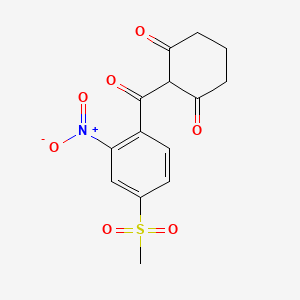
Mesotrione
Mesotrione is an aromatic ketone that is cyclohexa-1,3-dione in which one of the hydrogens at position 2 is substituted by a 4-(methanesulfonyl)-2-nitrobenzoyl group. It has a role as a carotenoid biosynthesis inhibitor, a herbicide, a xenobiotic, an EC 1.13.11.27 (4-hydroxyphenylpyruvate dioxygenase) inhibitor and an environmental contaminant. It is a beta-triketone, a C-nitro compound, a sulfone and an aromatic ketone. It is functionally related to a benzophenone. — ChEBI
- IUPAC 名称
- 2-(4-methylsulfonyl-2-nitrobenzoyl)cyclohexane-1,3-dione
- 分子式
- C14H13NO7S
- 分子量
- 339.32 g/mol
- 精确质量
- 339.04127293 Da
- XLogP3
- 0.7
- 拓扑极性表面积
- 140.0 Ų
- 氢键供体
- 0
- 氢键受体
- 7
- 共价单元
- 1
- 已定义的立体中心
- 0
又称
另有 16 个已报告名称
外部数据库标识符
- ChEBI:CHEBI:38321
- ChEMBL:CHEMBL1873440
- EPA DTXSID:DTXSID7032424
- PubMed:40759372
- PubMed:36914009
- PubMed:34516295
- PubMed:27384423
- PubMed:22718431
- PubMed:22696959
- PubMed:22615921
- PubMed:22463948
- PubMed:22398691
- PubMed:22319325
- PubMed:22278807
- PubMed:22245060
来自其他科学数据库的证据
EMBL-EBI ChEBI
mesotrione
An aromatic ketone that is cyclohexa-1,3-dione in which one of the hydrogens at position 2 is substituted by a 4-(methanesulfonyl)-2-nitrobenzoyl group.
- 配方
- C14H13NO7S
- 平均质量
- 339.325 g/mol
- 单同位素质量
- 339.04127 Da
- 形式电荷
- 0
- β-triketone — is a (CHEBI:140323)
- aromatic ketone — is a (CHEBI:76224)
- sulfone — is a (CHEBI:35850)
- C-nitro compound — is a (CHEBI:35716)
- EC 1.13.11.27 (4-hydroxyphenylpyruvate dioxygenase) inhibitor — has role (CHEBI:38317)
- herbicide — has role (CHEBI:24527)
- environmental contaminant — has role (CHEBI:78298)
- xenobiotic — has role (CHEBI:35703)
- carotenoid biosynthesis inhibitor — has role (CHEBI:138208)
- benzophenone — has functional parent (CHEBI:41308)
- EC 1.13.11.27 (4-hydroxyphenylpyruvate dioxygenase) inhibitor — has role (CHEBI:38317)
- herbicide — has role (CHEBI:24527)
- environmental contaminant — has role (CHEBI:78298)
- xenobiotic — has role (CHEBI:35703)
- carotenoid biosynthesis inhibitor — has role (CHEBI:138208)
- β-triketone — is a (CHEBI:140323)
- aromatic ketone — is a (CHEBI:76224)
- sulfone — is a (CHEBI:35850)
- C-nitro compound — is a (CHEBI:35716)
其他整理的名称
来自此来源的交叉引用
- CAS: 104206-82-8 — ChemIDplus
- MANUAL_X_REF: 442 — PPDB
- MANUAL_X_REF: mesotrione — Alan Wood's Pesticides
- MANUAL_X_REF: Mesotrione — Wikipedia
- MANUAL_X_REF: WO2011016018 — Patent
- REGISTRY_NUMBER: 8999656 — Reaxys
映射方: Exact CAS cross-reference in the ChEBI compound record. 来源更新: 2018-03-04. 检索时间: 2026-08-31. 打开来源记录
NIH PubChem PUG-View
Attributed physical-property, hazard, environmental and use annotations.
- Color/Form: Pale yellow solid 来源: Hazardous Substances Data Bank (HSDB)
- Color/Form: Opaque solid 来源: Hazardous Substances Data Bank (HSDB)
- Dissociation Constants: pKa = 3.12 at 20 °C; 0.6503 (associated) and 0.3404 (dissociated) 来源: Hazardous Substances Data Bank (HSDB)
- LogP: log Kow (at 20 °C): 0.11 (unbuffered water), 0.90 (pH 5), <-1.0 (pH 7 and pH 9) 来源: Hazardous Substances Data Bank (HSDB)
- Melting Point: 165 °C 来源: Hazardous Substances Data Bank (HSDB)
- Odor: Faint pleasant odor 来源: Hazardous Substances Data Bank (HSDB)
- Physical Description: Opaque solid; [Merck Index] Solid; [MSDSonline] 来源: Haz-Map, Information on Hazardous Chemicals and Occupational Diseases
- Solubility: In water, (g/L at 20 °C): 2.2 (pH 4.8); 15 (pH 6.9); 22 (pH 9); 0.16 (unbuffered water) 来源: Hazardous Substances Data Bank (HSDB)
- Solubility: Solubility in g/L at 20 °C): in acetonitrile 117.0, acetone 93.3, 1,2-dichloroethane 66.3, ethyl acetate 18.6, methanol 4.6, toluene 3.1, xylene 1.6, n-heptane <0.5 来源: Hazardous Substances Data Bank (HSDB)
- Vapor Pressure: 0.00000004 [mmHg] 来源: Haz-Map, Information on Hazardous Chemicals and Occupational Diseases
- Vapor Pressure: <5.69X10⁻³ mPa /<4.27X10-8 mm Hg)/ at 20 °C 来源: Hazardous Substances Data Bank (HSDB)
- Signal: Warning 来源: Regulation (EC) No 1272/2008 of the European Parliament and of the Council
- GHS Hazard Statements: H361d: Suspected of damaging the unborn child [Warning Reproductive toxicity]; H373: May causes damage to organs through prolonged or repeated exposure [Warning Specific target organ toxicity, repeated exposure]; H400: Very toxic to aquatic life [Warning Hazardous to the aquatic environment, acute hazard]; H410: Very toxic to aquatic life with long lasting effects [Warning Hazardous to the aquatic environment, long-term hazard] 来源: Regulation (EC) No 1272/2008 of the European Parliament and of the Council
- Precautionary Statement Codes: P203, P260, P273, P280, P318, P319, P391, P405, and P501 (click each P-code to see the statement) 来源: Regulation (EC) No 1272/2008 of the European Parliament and of the Council
- Signal: Warning 来源: European Chemicals Agency (ECHA)
- GHS Hazard Statements: H361 (19.3%): Suspected of damaging fertility or the unborn child [Warning Reproductive toxicity]; H361d (46.2%): Suspected of damaging the unborn child [Warning Reproductive toxicity]; H373 (64.5%): May causes damage to organs through prolonged or repeated exposure [Warning Specific target organ toxicity, repeated exposure]; H400 (100%): Very toxic to aquatic life [Warning Hazardous to the aquatic environment, acute hazard]; H410 (100%): Very toxic to aquatic life with long lasting effects [Warning Hazardous to the aquatic environment, long-term hazard] 来源: European Chemicals Agency (ECHA)
- Precautionary Statement Codes: P203, P260, P273, P280, P318, P319, P391, P405, and P501 (click each P-code to see the statement) 来源: European Chemicals Agency (ECHA)
- ECHA C&L Notifications Summary: Aggregated GHS information provided per 197 reports by companies from 13 notifications to the ECHA C&L Inventory. Each notification may be associated with multiple companies.; Information may vary between notifications depending on impurities, additives, and other factors. The percentage value in parenthesis indicates the notified classification ratio from companies that provide hazard codes. Only hazard codes with percentage values above 10% are shown. For more detailed information, please visit ECHA C&L website. 来源: European Chemicals Agency (ECHA)
- Signal: Warning 来源: Hazardous Chemical Information System (HCIS), Safe Work Australia
- GHS Hazard Statements: H361d: Suspected of damaging the unborn child [Warning Reproductive toxicity]; H373: May causes damage to organs through prolonged or repeated exposure [Warning Specific target organ toxicity, repeated exposure]; H410: Very toxic to aquatic life with long lasting effects [Warning Hazardous to the aquatic environment, long-term hazard] 来源: Hazardous Chemical Information System (HCIS), Safe Work Australia
- Precautionary Statement Codes: P203, P260, P273, P280, P318, P319, P391, P405, and P501 (click each P-code to see the statement) 来源: Hazardous Chemical Information System (HCIS), Safe Work Australia
- Signal: Warning 来源: Hazardous Substances Data Bank (HSDB)
- GHS Hazard Statements: H400: Very toxic to aquatic life [Warning Hazardous to the aquatic environment, acute hazard]; H410: Very toxic to aquatic life with long lasting effects [Warning Hazardous to the aquatic environment, long-term hazard] 来源: Hazardous Substances Data Bank (HSDB)
- Toxicity Summary: IDENTIFICATION AND USE: Mesotrione is a pale yellow solid with a faint pleasant odor. Mesotrione is an herbicide used on field corn, seed corn, sweet corn, yellow popcorn, and grain sorghum. Registered for use in the U.S. but approved pesticide uses may change periodically and so federal, state and local authorities must be consulted for currently approved uses. HUMAN EXPOSURE AND TOXICITY: Limited information is available on the effects of exposure to mesotrione on humans. Administration of mesotrione to volunteers resulted in an increase in plasma tyrosine concentrations, which reached a maximum of approximately 300 nmol/mL following a dose of 4 mg/kg body weight. Concentrations returned to background levels within 2 days of dosing. Urinary excretion of tyrosine metabolites was increased during the 24 hr immediately following a dose of 4 mg/kg, but returned to background levels during the following 24 hr period. Thus, the minimal and transient effects of mesotrione minimize the likelihood of a clinical effect in the event of systemic exposure occurring during occupational use. Mesotrione is not likely to be carcinogenic to humans. ANIMAL STUDIES: In animals, mesotrione is a mild 来源: Hazardous Substances Data Bank (HSDB)
- Environmental Bioconcentration: An estimated BCF of 3 was calculated for mesotrione(SRC), using a measured log Kow range of 0.90 at pH 5 to <-1.0 at pH 9(1) and a regression-derived equation(2). According to a classification scheme(3), this BCF suggests the potential for bioconcentration in aquatic organisms is low(SRC). 来源: Hazardous Substances Data Bank (HSDB)
- Environmental Fate: TERRESTRIAL FATE: Based on a classification scheme(1), Koc values measured in 19 soils from the US and Europe ranging from 15 to 390(2,3), indicate that mesotrione is expected to have very high to moderate mobility in soil(SRC). Mesotrione is a weak acid with a pKa of 3.12(4) which indicates mesotrione will primarily exist in anion form in the environment and anions generally do not adsorb more strongly to organic carbon and clay than their neutral counterparts(5). The anionic form of mesotrione is a resonance enol-tautomer of the undissociated keto-tautomer(2). The Koc is inversely correlated with pH; as the pH increases, the Koc decreases(2,3). Volatilization of mesotrione from moist soil surfaces is not expected to be an important fate process(SRC) given an estimated Henry's Law constant of <1.2X10⁻¹⁰ atm-cu m/mole(SRC) derived from its vapor pressure, <4.27X10⁻⁸ mm Hg(6), and water solubility, 160 mg/L(6). Mesotrione is not expected to volatilize from dry soil surfaces(SRC) based upon its vapor pressure. The direct photolysis half-life on soil surfaces has been estimated to be 24 days at a latitude of 37-50 deg north(4). Degradation studies in active versus sterilized soils hav 来源: Hazardous Substances Data Bank (HSDB)
- Environmental Fate: AQUATIC FATE: Based on a classification scheme(1), Koc values measured in 19 soils from the US and Europe ranging from 15 to 390(2,3), indicate that mesotrione is not expected to adsorb to suspended solids and sediment(SRC). In water-sediment distribution tests, mesotrione was predominantly found in the water phase (>82%) with a maximum of 3.8% partitioning to sediment(4). Mesotrione is a weak acid with a pKa of 3.12(4) which indicates mesotrione will primarily exist in anion form in the environment and the anionic form of mesotrione is a resonance enol-tautomer of the undissociated keto-tautomer(2). Volatilization from water surfaces is not expected(5) based upon an estimated Henry's Law constant of <1.2X10⁻¹⁰ atm-cu m/mole(SRC), derived from its vapor pressure, <4.27X10⁻⁸ mm Hg(6), and water solubility, 160 mg/L(6). According to a classification scheme(7), an estimated BCF of 3(SRC), from its log Kow of 0.90 at pH 5(4) and a regression-derived equation(8), suggests the potential for bioconcentration in aquatic organisms is low. Mesotrione is stable to hydrolysis at pH 4-9(4). Mesotrione is susceptible to direct photolysis in water with estimated half-lives of 81-97 days under sum 来源: Hazardous Substances Data Bank (HSDB)
- Environmental Fate: ATMOSPHERIC FATE: According to a model of gas/particle partitioning of semivolatile organic compounds in the atmosphere(1), mesotrione, which has a vapor pressure of <4.27X10⁻⁸ mm Hg at 20 °C(2), is expected to exist solely in the particulate phase in the ambient atmosphere. Particulate-phase mesotrione may be removed from the air by wet and dry deposition(SRC). Mesotrione absorbs at wavelengths >290 nm(3) and, therefore, may be susceptible to direct photolysis by sunlight(SRC). 来源: Hazardous Substances Data Bank (HSDB)
- Sources/Uses: Synthetic form of leptospermone (natural herbicide from the bottlebrush plant); Used as herbicide for maize; [Merck Index] 来源: Haz-Map, Information on Hazardous Chemicals and Occupational Diseases
- Industrial Processes with risk of exposure: Farming (Pesticides) [Category: Industry] 来源: Haz-Map, Information on Hazardous Chemicals and Occupational Diseases
- Uses: For mesotrione (USEPA/OPP Pesticide Code: 122990) ACTIVE products with label matches. /SRP: Registered for use in the U.S. but approved pesticide uses may change periodically and so federal, state and local authorities must be consulted for currently approved uses./ 来源: Hazardous Substances Data Bank (HSDB)
- Uses: Mesotrione is a selective herbicide registered for use to control broadleaf weeds in many agricultural and non-agricultural use sites. 来源: Hazardous Substances Data Bank (HSDB)
- Uses: Herbicide; For use on field corn, seed corn, sweet corn, yellow popcorn, and grain sorghum. 来源: Hazardous Substances Data Bank (HSDB)
- Uses: For pre-emergence and post-emergence control of broad-leaved weeds, such as Xanthium strumarium, Ambrosia trifida, Abutilon theophrasti, and Chenopodium, Amaranthus and Polygonum spp., and some grass weeds, in maize. 来源: Hazardous Substances Data Bank (HSDB)
映射方: Existing checksum-valid CAS to unique PubChem CID match. 检索时间: 2026-08-31. 打开来源记录
科学分类和危害注释仅提供背景信息,不能取代上方所示针对具体市场的监管决定。
其他来源的覆盖范围和匹配状态
| 来源 | 结果 | 已检查 |
|---|---|---|
| EMBL-EBI ChEBI | 精确匹配 | 2026-08-31 |
| NIH PubChem PUG-View | 精确匹配 | 2026-08-31 |
已记录的无匹配结果是该来源已被检查的有效证据;这并不表示该物质在别处不存在。
于 2026-09-02 通过校验和有效的 CAS 匹配从美国国立卫生研究院 (NIH) PubChem 检索。化学性质不能取代本页的监管决定。
本站如何使用 CAS 104206-82-8
CAS 104206-82-8 是化学文摘社 (Chemical Abstracts Service) 的标识符,用于将本页对应到特定物质。在当前数据集中,有 1 条欧盟附件记录共用该标识符,可帮助您交叉核对同一物质是出现在一种还是多种监管情境中。
当供应商规格书、SDS 或原料档案给出 CAS 104206-82-8,而您需要在一处查看所有关联的附件 II–VI 记录时,请使用本页。上方的条目卡片是查看浓度限值、警示语、附件归属和产品类型条件的最快途径。