
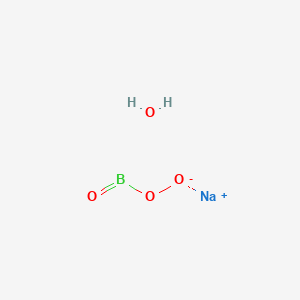
CAS 10332-33-9PubChem CID 23695970
Sodium Perborate Monohydrate
- IUPAC 名称
- sodium;oxidooxy(oxo)borane;hydrate
- 分子式
- BH2NaO4
- 分子量
- 99.82 g/mol
- 精确质量
- 99.9943830 Da
- 拓扑极性表面积
- 50.4 Ų
- 氢键供体
- 1
- 氢键受体
- 4
- 共价单元
- 3
- 已定义的立体中心
- 0
又称
Caswell No. 784ASodium borate, monohydrateY9UKD0XE6FUNII-Y9UKD0XE6FEPA Pesticide Chemical Code 011105SODIUM BORATE MONOHYDRATESODIUM PERBORATE MONOHYDRATE (MART.)SODIUM PERBORATE MONOHYDRATE [MART.]
另有 11 个已报告名称
Amosan Wound CleanserRefChem:56246Amosan Oral Wound CleanserAmosan Wound CleanserCherry FlavourPerboric acid, sodium salt, monohydrateSodium perborate monohydrate [USAN]Sodium perborate monohydrate (USAN)Perboric acid sodium salt monohydrateSodium oxoboraneperoxolate--water (1/1/1)SODIUM PERBORATE MONOHYDRATE [WHO-DD]Perboric acid (HBO(O2)), sodium salt, monohydrate
外部数据库标识符
- EPA DTXSID:DTXSID9035676
来自其他科学数据库的证据
NIH PubChem PUG-View
标识符精确匹配23695970
Attributed physical-property, hazard, environmental and use annotations.
- Physical Description: Dry Powder 来源: EPA Chemical Data Reporting (CDR)
- ERG2024, Guide 140 (Sodium perborate monohydrate): General First Aid:; · Call 911 or emergency medical service.; · Ensure that medical personnel are aware of the material(s) involved, take precautions to protect themselves and avoid contamination.; · Move victim to fresh air if it can be done safely.; · Administer oxygen if breathing is difficult.; · If victim is not breathing:; -- DO NOT perform mouth-to-mouth resuscitation; the victim may have ingested or inhaled the substance.; -- If equipped and pulse detected, wash face and mouth, then give artificial respiration using a proper respiratory medical device (bag-valve mask, pocket mask equipped with a one-way valve or other device).; -- If no pulse detected or no respiratory medical device available, provide continuous compressions. Conduct a pulse check every two minutes or monitor for any signs of spontaneous respirations.; · Remove and isolate contaminated clothing and shoes.; · For minor skin contact, avoid spreading material on unaffected skin.; · In case of contact with substance, remove immediately by flushing skin or eyes with running water for at least 20 minutes.; · For severe burns, immediate medical attention is required.; · Effects of exposure (inhalation, ingestion, 来源: Emergency Response Guidebook (ERG)
- Note: This chemical does not meet GHS hazard criteria for 2.6% (5 of 192) of reports. 来源: European Chemicals Agency (ECHA)
- Signal: Danger 来源: European Chemicals Agency (ECHA)
- GHS Hazard Statements: H272 (97.4%): May intensify fire; oxidizer [Danger Oxidizing liquids; Oxidizing solids]; H302+H332 (19.3%): Harmful if swallowed or if inhaled [Warning Acute toxicity, oral; acute toxicity, inhalation]; H302 (97.4%): Harmful if swallowed [Warning Acute toxicity, oral]; H318 (97.4%): Causes serious eye damage [Danger Serious eye damage/eye irritation]; H331 (20.3%): Toxic if inhaled [Danger Acute toxicity, inhalation]; H332 (22.9%): Harmful if inhaled [Warning Acute toxicity, inhalation]; H335 (97.4%): May cause respiratory irritation [Warning Specific target organ toxicity, single exposure; Respiratory tract irritation]; H360 (97.4%): May damage fertility or the unborn child [Danger Reproductive toxicity] 来源: European Chemicals Agency (ECHA)
- Precautionary Statement Codes: P203, P210, P220, P261, P264, P264+P265, P270, P271, P280, P301+P317, P304+P340, P305+P354+P338, P316, P317, P318, P319, P321, P330, P370+P378, P403+P233, P405, and P501 (click each P-code to see the statement) 来源: European Chemicals Agency (ECHA)
- ECHA C&L Notifications Summary: Aggregated GHS information provided per 192 reports by companies from 6 notifications to the ECHA C&L Inventory. Each notification may be associated with multiple companies.; Reported as not meeting GHS hazard criteria per 5 of 192 reports by companies.; There are 5 notifications provided by 187 of 192 reports by companies with hazard statement code(s).; Information may vary between notifications depending on impurities, additives, and other factors. The percentage value in parenthesis indicates the notified classification ratio from companies that provide hazard codes. Only hazard codes with percentage values above 10% are shown. For more detailed information, please visit ECHA C&L website. 来源: European Chemicals Agency (ECHA)
- Signal: Danger 来源: NITE-CMC
- GHS Hazard Statements: H272: May intensify fire; oxidizer [Danger Oxidizing liquids; Oxidizing solids]; H302: Harmful if swallowed [Warning Acute toxicity, oral]; H318: Causes serious eye damage [Danger Serious eye damage/eye irritation]; H331: Toxic if inhaled [Danger Acute toxicity, inhalation]; H361: Suspected of damaging fertility or the unborn child [Warning Reproductive toxicity] 来源: NITE-CMC
- Precautionary Statement Codes: P203, P210, P220, P261, P264, P264+P265, P270, P271, P280, P301+P317, P304+P340, P305+P354+P338, P316, P317, P318, P321, P330, P370+P378, P403+P233, P405, and P501 (click each P-code to see the statement) 来源: NITE-CMC
- Signal: Danger 来源: Hazardous Chemical Information System (HCIS), Safe Work Australia
- GHS Hazard Statements: H272: May intensify fire; oxidizer [Danger Oxidizing liquids; Oxidizing solids]; H302: Harmful if swallowed [Warning Acute toxicity, oral]; H318: Causes serious eye damage [Danger Serious eye damage/eye irritation]; H335: May cause respiratory irritation [Warning Specific target organ toxicity, single exposure; Respiratory tract irritation]; H360Df: May damage the unborn child; Suspected of damaging fertility [Danger Reproductive toxicity] 来源: Hazardous Chemical Information System (HCIS), Safe Work Australia
- Precautionary Statement Codes: P203, P210, P220, P261, P264, P264+P265, P270, P271, P280, P301+P317, P304+P340, P305+P354+P338, P317, P318, P319, P330, P370+P378, P403+P233, P405, and P501 (click each P-code to see the statement) 来源: Hazardous Chemical Information System (HCIS), Safe Work Australia
- GHS Hazard Statements: H272: May intensify fire; oxidizer [Danger Oxidizing liquids; Oxidizing solids]; H302: Harmful if swallowed [Warning Acute toxicity, oral]; H318: Causes serious eye damage [Danger Serious eye damage/eye irritation]; H331: Toxic if inhaled [Danger Acute toxicity, inhalation]; H335: May cause respiratory irritation [Warning Specific target organ toxicity, single exposure; Respiratory tract irritation]; H360Df: May damage the unborn child; Suspected of damaging fertility [Danger Reproductive toxicity] 来源: Hazardous Chemical Information System (HCIS), Safe Work Australia
- Consumer Uses: Not Known or Reasonably Ascertainable; Oxidizing agent 来源: EPA Chemical Data Reporting (CDR)
- Industry Uses: Not Known or Reasonably Ascertainable 来源: EPA Chemical Data Reporting (CDR)
映射方: Existing checksum-valid CAS to unique PubChem CID match. 检索时间: 2026-08-31. 打开来源记录
科学分类和危害注释仅提供背景信息,不能取代上方所示针对具体市场的监管决定。
其他来源的覆盖范围和匹配状态
| 来源 | 结果 | 已检查 |
|---|---|---|
| EMBL-EBI ChEBI | 无精确记录 | 2026-08-31 |
| NIH PubChem PUG-View | 精确匹配 | 2026-08-31 |
已记录的无匹配结果是该来源已被检查的有效证据;这并不表示该物质在别处不存在。
于 2026-09-02 通过校验和有效的 CAS 匹配从美国国立卫生研究院 (NIH) PubChem 检索。化学性质不能取代本页的监管决定。