CAS 103-41-3PubChem CID 5273469
Benzyl Cinnamate
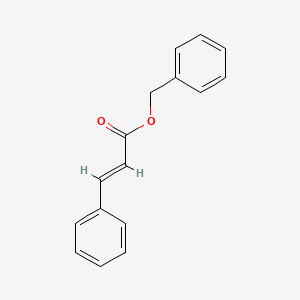
Benzyl cinnamate is the cinnamate ester derived from cinnamic acid and benzyl alcohol. Occuring in Balsam of Peru and Tolu balsam, in Sumatra and Penang benzoin, and as the main constituent of copaiba balsam, it is used in heavy oriental perfumes, as a fixative and as a flavouring agent. It has a role as a flavouring agent, a fragrance, a fixative, an epitope and an antigen.
— ChEBI
- IUPAC 名称
- benzyl (E)-3-phenylprop-2-enoate
- 分子式
- C16H14O2
- 分子量
- 238.28 g/mol
- 精确质量
- 238.099379685 Da
- XLogP3
- 3.8
- 拓扑极性表面积
- 26.3 Ų
- 氢键供体
- 0
- 氢键受体
- 2
- 共价单元
- 1
- 已定义的立体中心
- 0
又称
CinnameinBenzyl 3-phenylpropenoatetrans-Cinnamic acid benzyl esterCinnamic acid, benzyl esterBenzylcinnamateBenzyl alcohol, cinnamic esterFEMA No. 2142Benzyl-3-phenylpropenoate
另有 16 个已报告名称
Benzyl gamma-phenylacrylateBenzylester kyseliny skoricove3-Phenyl-2-propenoic acid phenylmethyl esterV67O3RO97UCHEBI:146174NSC-11780NSC-44403benzyl (2Z)-3-phenylprop-2-enoateRefChem:566743203-109-3Cinnamic acid benzyl esterNSC 11780benzyl (2E)-3-phenylprop-2-enoateBenzyl cinnamate (Standard)Benzyl cinnamate, >=98%3-Phenyl-2-propenoic acid benzyl ester
外部数据库标识符
来自其他科学数据库的证据
NIH PubChem PUG-View
标识符精确匹配5273469
Attributed physical-property, hazard, environmental and use annotations.
- Signal:
Warning
来源: European Chemicals Agency (ECHA)
- GHS Hazard Statements:
H317 (99.8%): May cause an allergic skin reaction [Warning Sensitization, Skin]; H411 (99.5%): Toxic to aquatic life with long lasting effects [Hazardous to the aquatic environment, long-term hazard]
来源: European Chemicals Agency (ECHA)
- Precautionary Statement Codes:
P261, P272, P273, P280, P302+P352, P321, P333+P317, P362+P364, P391, and P501 (click each P-code to see the statement)
来源: European Chemicals Agency (ECHA)
- ECHA C&L Notifications Summary:
Aggregated GHS information provided per 1794 reports by companies from 13 notifications to the ECHA C&L Inventory. Each notification may be associated with multiple companies.; Information may vary between notifications depending on impurities, additives, and other factors. The percentage value in parenthesis indicates the notified classification ratio from companies that provide hazard codes. Only hazard codes with percentage values above 10% are shown. For more detailed information, please visit ECHA C&L website.
来源: European Chemicals Agency (ECHA)
- Environmental Bioconcentration:
An estimated BCF of 270 was calculated for benzyl cinnamate(SRC), using an estimated log Kow of 4.1(1) and a regression-derived equation(2). According to a classification scheme(3), this BCF suggests the potential for bioconcentration in aquatic organisms is high(SRC).
来源: Hazardous Substances Data Bank (HSDB)
- Environmental Fate:
TERRESTRIAL FATE: Based on a classification scheme(1), an estimated Koc value of 10,400(SRC), determined from a structure estimation method(2), indicates that benzyl cinnamate is expected to be immobile in soil(SRC). Volatilization of benzyl cinnamate from moist soil surfaces is not expected to be an important fate process(SRC) given an estimated Henry's Law constant of 3.3X10⁻⁷ atm-cu m/mole(SRC), using a fragment constant estimation method(3). Benzyl cinnamate is not expected to volatilize from dry soil surfaces(SRC) based upon an estimated vapor pressure of 1X10⁻⁵ mm Hg(4).
来源: Hazardous Substances Data Bank (HSDB)
- Environmental Fate:
AQUATIC FATE: Based on a classification scheme(1), an estimated Koc value of 10,390(SRC), determined from a structure estimation method(2), indicates that benzyl cinnamate is expected to adsorb to suspended solids and sediment(SRC). Volatilization from water surfaces is not expected(3) based upon an estimated Henry's Law constant of 3.3X10⁻⁷ atm-cu m/mole(SRC), developed using a fragment constant estimation method(4). A base-catalyzed second-order hydrolysis rate constant of 3.8X10⁻² L/mole-sec(SRC) was estimated using a structure estimation method(5); this corresponds to half-lives of 6 years and 211 days at pH values of 7 and 8, respectively(5). According to a classification scheme(6), an estimated BCF of 269(SRC), from an estimated log Kow of 4.06(7) and a regression derived equation(8), suggests the potential for bioconcentration in aquatic organisms is high(SRC).
来源: Hazardous Substances Data Bank (HSDB)
- Environmental Fate:
ATMOSPHERIC FATE: According to a model of gas/particle partitioning of semivolatile organic compounds in the atmosphere(1), benzyl cinnamate, which has an estimated vapor pressure of 1X10⁻⁵ mm Hg at 25 °C(2), will exist in both the vapor and particulate phases in the ambient atmosphere. Vapor-phase benzyl cinnamate is degraded in the atmosphere by reaction with photochemically-produced hydroxyl radicals(SRC); the half-life for this reaction in air is estimated to be 14 hours for the cis-isomer and 13 hours for the trans-isomer of benzyl cinnamate(SRC), calculated from their rate constants of 28X10-12 and 31X10-12 cu cm/molecule-sec at 25 °C, respectively(SRC), determined using a structure estimation method(3). Particulate-phase benzyl cinnamate may be removed from the air by wet and dry deposition(SRC).
来源: Hazardous Substances Data Bank (HSDB)
映射方: Existing checksum-valid CAS to unique PubChem CID match.
检索时间: 2026-08-31.
打开来源记录
科学分类和危害注释仅提供背景信息,不能取代上方所示针对具体市场的监管决定。
其他来源的覆盖范围和匹配状态
| 来源 | 结果 | 已检查 |
|---|
| EMBL-EBI ChEBI | 无精确记录 | 2026-08-31 |
|---|
| NIH PubChem PUG-View | 精确匹配 | 2026-08-31 |
|---|
已记录的无匹配结果是该来源已被检查的有效证据;这并不表示该物质在别处不存在。
于 2026-09-02 通过校验和有效的 CAS 匹配从美国国立卫生研究院 (NIH) PubChem 检索。化学性质不能取代本页的监管决定。