
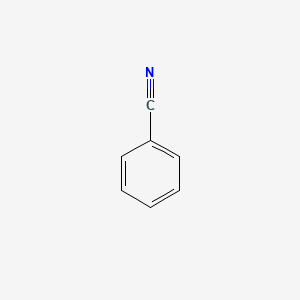
CAS 100-47-0PubChem CID 7505
Benzonitrile
Benzonitrile is a nitrile that is hydrogen cyanide in which the hydrogen has been replaced by a phenyl group. It is a nitrile and a member of benzenes. — ChEBI
- IUPAC 名称
- benzonitrile
- 分子式
- C7H5N
- 分子量
- 103.12 g/mol
- 精确质量
- 103.042199164 Da
- XLogP3
- 1.6
- 拓扑极性表面积
- 23.8 Ų
- 氢键供体
- 0
- 氢键受体
- 1
- 共价单元
- 1
- 已定义的立体中心
- 0
又称
Phenyl cyanideCyanobenzeneBenzenenitrileBenzoic acid nitrileBenzene, cyano-BenzenecarbonitrilePhenylcyanideFenylkyanid
另有 16 个已报告名称
9V9APP5H5SC6H5-CNNSC-8039CHEBI:27991RefChem:5590benzonitrile;phenyl cyanide202-855-7Fenylkyanid [Czech]NSC 8039UN2224AI3-24184Benzonitrile [UN2224] [Poison]4-cyanobenzeneCAS-100-47-0HSDB 45CCRIS 3184
外部数据库标识符
- ChEBI:CHEBI:27991
- ChEMBL:CHEMBL15819
- EPA DTXSID:DTXSID7021491
- PubMed:23125756
- PubMed:23093029
- PubMed:23072464
- PubMed:23031640
- PubMed:23025345
- PubMed:23000928
- PubMed:22998499
- PubMed:22989069
- PubMed:22913673
- PubMed:22871485
- PubMed:22807724
- PubMed:22798886
来自其他科学数据库的证据
EMBL-EBI ChEBI
标识符精确匹配CHEBI:27991
benzonitrile
A nitrile that is hydrogen cyanide in which the hydrogen has been replaced by a phenyl group.
- 配方
- C7H5N
- 平均质量
- 103.124 g/mol
- 单同位素质量
- 103.04220 Da
- 形式电荷
- 0
- nitrile — is a (CHEBI:18379)
- benzenes — is a (CHEBI:22712)
- nitrile — is a (CHEBI:18379)
- benzenes — is a (CHEBI:22712)
- 24129580 来源: PubMed
其他整理的名称
benzonitrilephenyl cyanidebenzenenitrilebenzoic acid nitrileBenzonitrileC6H5-CNCyanobenzenePhenyl cyanide
来自此来源的交叉引用
- CAS: 100-47-0 — KEGG COMPOUND
- CAS: 100-47-0 — ChemIDplus
- CAS: 100-47-0 — NIST Chemistry WebBook
- REGISTRY_NUMBER: 2653 — Gmelin
- REGISTRY_NUMBER: 506893 — Beilstein
- MANUAL_X_REF: Benzonitrile — Wikipedia
- MANUAL_X_REF: c0367 — UM-BBD
- MANUAL_X_REF: C09814 — KEGG COMPOUND
- MANUAL_X_REF: C09814 — KEGG COMPOUND
- MANUAL_X_REF: CPD-15582 — MetaCyc
映射方: Exact CAS cross-reference in the ChEBI compound record. 来源更新: 2025-06-24. 检索时间: 2026-08-31. 打开来源记录
NIH PubChem PUG-View
标识符精确匹配7505
Attributed physical-property, hazard, environmental and use annotations.
- Autoignition Temperature: 550 °C 来源: Hazardous Substances Data Bank (HSDB)
- Autoignition Temperature: 550 °C 来源: ILO-WHO International Chemical Safety Cards (ICSCs)
- Boiling Point: 375.3 °F at 760 mmHg (NTP, 1992) 来源: CAMEO Chemicals
- Boiling Point: 190.7 °C at 760 mm Hg 来源: Hazardous Substances Data Bank (HSDB)
- Boiling Point: BP: 123.5 °C at 100 mm Hg; 69.2 °C at 10 mm Hg; 28.2 °C at 1 mm Hg 来源: Hazardous Substances Data Bank (HSDB)
- Boiling Point: 190.7 °C 来源: ILO-WHO International Chemical Safety Cards (ICSCs)
- Boiling Point: 191 °C @760 [mm Hg] 来源: PAC Chemical Database, U.S. Department of Energy
- Color/Form: Liquid 来源: Hazardous Substances Data Bank (HSDB)
- Color/Form: Colorless oil 来源: Hazardous Substances Data Bank (HSDB)
- Density: 1.01 at 77 °F (USCG, 1999) - Denser than water; will sink 来源: CAMEO Chemicals
- Density: 1.0093 g/cu cm at 15 °C 来源: Hazardous Substances Data Bank (HSDB)
- Density: Relative density (water = 1): 1.0 来源: ILO-WHO International Chemical Safety Cards (ICSCs)
- Density: 1.01 @ 15°C 来源: PAC Chemical Database, U.S. Department of Energy
- Flash Point: 161 °F (NTP, 1992) 来源: CAMEO Chemicals
- Flash Point: 167 °F 来源: Haz-Map, Information on Hazardous Chemicals and Occupational Diseases
- Flash Point: 70 °C (158 def F) (Closed cup) 来源: Hazardous Substances Data Bank (HSDB)
- Flash Point: 75 °C c.c. 来源: ILO-WHO International Chemical Safety Cards (ICSCs)
- LogP: log Kow = 1.56 来源: Hazardous Substances Data Bank (HSDB)
- LogP: 1.56 来源: ILO-WHO International Chemical Safety Cards (ICSCs)
- Melting Point: 9 °F (NTP, 1992) 来源: CAMEO Chemicals
- Melting Point: -12.82 °C 来源: Hazardous Substances Data Bank (HSDB)
- Melting Point: -12.8 °C 来源: ILO-WHO International Chemical Safety Cards (ICSCs)
- Melting Point: -12.8 °C 来源: PAC Chemical Database, U.S. Department of Energy
- Odor: Odor of volatile oil of almond 来源: Hazardous Substances Data Bank (HSDB)
- Physical Description: Benzonitrile appears as a clear colorless liquid with an almond-like odor. Flash point 161 °F. Denser (at 8.4 lb / gal) than water and slightly soluble in water. Used as a specialty solvent and to make other chemicals. 来源: CAMEO Chemicals
- Physical Description: Colorless oil with almond odor; [HSDB] 来源: Haz-Map, Information on Hazardous Chemicals and Occupational Diseases
- Physical Description: COLOURLESS LIQUID WITH CHARACTERISTIC ODOUR. 来源: ILO-WHO International Chemical Safety Cards (ICSCs)
- Refractive Index: Index of refraction: 1.5289 at 20 °C/D 来源: Hazardous Substances Data Bank (HSDB)
- Solubility: 1 to 5 mg/mL at 73 °F (NTP, 1992) 来源: CAMEO Chemicals
- Solubility: In water, 2000 mg/L at 25 °C 来源: Hazardous Substances Data Bank (HSDB)
- Solubility: Miscible with common organic solvents 来源: Hazardous Substances Data Bank (HSDB)
- Solubility: Miscible with ethanol; very soluble in acetone, benzene; soluble in carbon tetrachloride 来源: Hazardous Substances Data Bank (HSDB)
- Solubility: Solubility in water, g/100ml at 22 °C: 0.1-0.5 (poor) 来源: ILO-WHO International Chemical Safety Cards (ICSCs)
- Vapor Pressure: 1 mmHg at 82.8 °F ; 5 mmHg at 131.5 °F; 10 mmHg at 156.6 °F (NTP, 1992) 来源: CAMEO Chemicals
- Vapor Pressure: 0.76 [mmHg] 来源: Haz-Map, Information on Hazardous Chemicals and Occupational Diseases
- Vapor Pressure: 0.768 mm Hg at 25 °C 来源: Hazardous Substances Data Bank (HSDB)
- Vapor Pressure: Vapor pressure, Pa at 25 °C: 102 来源: ILO-WHO International Chemical Safety Cards (ICSCs)
- Vapor Pressure: 0.768 [mm Hg] @25 °C 来源: PAC Chemical Database, U.S. Department of Energy
- Viscosity: 1.054 centistokes at 100 °F 来源: Hazardous Substances Data Bank (HSDB)
- Carcinogen Classification: No indication of carcinogenicity to humans (not listed by IARC). 来源: Toxin and Toxin Target Database (T3DB)
- Exposure Routes: The substance can be absorbed into the body by inhalation, through the skin and by ingestion. 来源: ILO-WHO International Chemical Safety Cards (ICSCs)
- Exposure Routes: Oral (L96) ; inhalation (L96) ; dermal (L96) 来源: Toxin and Toxin Target Database (T3DB)
- First Aid: EYES: First check the victim for contact lenses and remove if present. Flush victim's eyes with water or normal saline solution for 20 to 30 minutes while simultaneously calling a hospital or poison control center. Do not put any ointments, oils, or medication in the victim's eyes without specific instructions from a physician. IMMEDIATELY transport the victim after flushing eyes to a hospital even if no symptoms (such as redness or irritation) develop.; SKIN: IMMEDIATELY flood affected skin with water while removing and isolating all contaminated clothing. Gently wash all affected skin areas thoroughly with soap and water. If symptoms such as redness or irritation develop, IMMEDIATELY call a physician and be prepared to transport the victim to a hospital for treatment.; INHALATION: IMMEDIATELY leave the contaminated area; take deep breaths of fresh air. If symptoms (such as wheezing, coughing, shortness of breath, or burning in the mouth, throat, or chest) develop, call a physician and be prepared to transport the victim to a hospital. Provide proper respiratory protection to rescuers entering an unknown atmosphere. Whenever possible, Self-Contained Breathing Apparatus (SCBA) shou 来源: CAMEO Chemicals
- ERG2024, Guide 152 (Benzonitrile): General First Aid:; · Call 911 or emergency medical service.; · Ensure that medical personnel are aware of the material(s) involved, take precautions to protect themselves and avoid contamination.; · Move victim to fresh air if it can be done safely.; · Administer oxygen if breathing is difficult.; · If victim is not breathing:; -- DO NOT perform mouth-to-mouth resuscitation; the victim may have ingested or inhaled the substance.; -- If equipped and pulse detected, wash face and mouth, then give artificial respiration using a proper respiratory medical device (bag-valve mask, pocket mask equipped with a one-way valve or other device).; -- If no pulse detected or no respiratory medical device available, provide continuous compressions. Conduct a pulse check every two minutes or monitor for any signs of spontaneous respirations.; · Remove and isolate contaminated clothing and shoes.; · For minor skin contact, avoid spreading material on unaffected skin.; · In case of contact with substance, remove immediately by flushing skin or eyes with running water for at least 20 minutes.; · For severe burns, immediate medical attention is required.; · Effects of exposure (inhalation, ingestion, 来源: Emergency Response Guidebook (ERG)
- Signal: Warning 来源: Regulation (EC) No 1272/2008 of the European Parliament and of the Council
- GHS Hazard Statements: H302: Harmful if swallowed [Warning Acute toxicity, oral]; H312: Harmful in contact with skin [Warning Acute toxicity, dermal] 来源: Regulation (EC) No 1272/2008 of the European Parliament and of the Council
- Precautionary Statement Codes: P264, P270, P280, P301+P317, P302+P352, P317, P321, P330, P362+P364, and P501 (click each P-code to see the statement) 来源: Regulation (EC) No 1272/2008 of the European Parliament and of the Council
- Note: This chemical does not meet GHS hazard criteria for 1.9% (11 of 575) of reports. 来源: European Chemicals Agency (ECHA)
- Signal: Warning 来源: European Chemicals Agency (ECHA)
- GHS Hazard Statements: H302 (98.1%): Harmful if swallowed [Warning Acute toxicity, oral]; H312 (98.1%): Harmful in contact with skin [Warning Acute toxicity, dermal] 来源: European Chemicals Agency (ECHA)
- Precautionary Statement Codes: P264, P270, P280, P301+P317, P302+P352, P317, P321, P330, P362+P364, and P501 (click each P-code to see the statement) 来源: European Chemicals Agency (ECHA)
- ECHA C&L Notifications Summary: Aggregated GHS information provided per 575 reports by companies from 6 notifications to the ECHA C&L Inventory. Each notification may be associated with multiple companies.; Reported as not meeting GHS hazard criteria per 11 of 575 reports by companies.; There are 5 notifications provided by 564 of 575 reports by companies with hazard statement code(s).; Information may vary between notifications depending on impurities, additives, and other factors. The percentage value in parenthesis indicates the notified classification ratio from companies that provide hazard codes. Only hazard codes with percentage values above 10% are shown. For more detailed information, please visit ECHA C&L website. 来源: European Chemicals Agency (ECHA)
- Signal: Danger 来源: NITE-CMC
- GHS Hazard Statements: H227: Combustible liquid [Warning Flammable liquids]; H302: Harmful if swallowed [Warning Acute toxicity, oral]; H312: Harmful in contact with skin [Warning Acute toxicity, dermal]; H331: Toxic if inhaled [Danger Acute toxicity, inhalation]; H370: Causes damage to organs [Danger Specific target organ toxicity, single exposure]; H373: May causes damage to organs through prolonged or repeated exposure [Warning Specific target organ toxicity, repeated exposure] 来源: NITE-CMC
- Precautionary Statement Codes: P210, P260, P261, P264, P270, P271, P280, P301+P317, P302+P352, P304+P340, P308+P316, P316, P317, P319, P321, P330, P362+P364, P370+P378, P403, P403+P233, P405, and P501 (click each P-code to see the statement) 来源: NITE-CMC
- GHS Hazard Statements: H402: Harmful to aquatic life [Hazardous to the aquatic environment, acute hazard] 来源: NITE-CMC
- Health Effects: Exposure to high levels of cyanide for a short time harms the brain and heart and can even cause coma, seizures, apnea, cardiac arrest and death. Chronic inhalation of cyanide causes breathing difficulties, chest pain, vomiting, blood changes, headaches, and enlargement of the thyroid gland. Skin contact with cyanide salts can irritate and produce sores. (L96, L97) 来源: Toxin and Toxin Target Database (T3DB)
- Toxicity Summary: IDENTIFICATION AND USE: Benzonitrile is a colorless liquid. It is used as intermediate for rubber chemicals; solvent for nitrile rubber, specialty lacquers, and many resins and polymers, and for many anhydrous metallic salts. HUMAN EXPOSURE AND TOXICITY: Benzonitrile was tested at a concentration of 2% in petrolatum on 27 volunteers in a mixed panel, and was found to produce no sensitization reactions after 48 hr close patch test. Extensive reddening and blister formation resulted from accidental exposure of human skin to benzonitrile. Following an occupational accident in which a worker's head and clothing were drenched with benzonitrile, the worker suffered severe respiratory distress and tonic convulsions between periods of unconsciousness which lasted for 75 min. Thereafter he gradually recovered, but several years later he experienced episodes of unconsciousness which might have been related to the benzonitrile exposure. ANIMAL STUDIES: CNS depression signs and changes in blood cholinesterase activity were observed in rats and mice in an inhalation study with benzonitrile. Indication of cumulative effects of benzonitrile were reported. Toxic signs included sluggishness, unstea 来源: Hazardous Substances Data Bank (HSDB)
- Toxicity Summary: Organic nitriles decompose into cyanide ions both in vivo and in vitro. Consequently the primary mechanism of toxicity for organic nitriles is their production of toxic cyanide ions or hydrogen cyanide. Cyanide is an inhibitor of cytochrome c oxidase in the fourth complex of the electron transport chain (found in the membrane of the mitochondria of eukaryotic cells). It complexes with the ferric iron atom in this enzyme. The binding of cyanide to this cytochrome prevents transport of electrons from cytochrome c oxidase to oxygen. As a result, the electron transport chain is disrupted and the cell can no longer aerobically produce ATP for energy. Tissues that mainly depend on aerobic respiration, such as the central nervous system and the heart, are particularly affected. Cyanide is also known produce some of its toxic effects by binding to catalase, glutathione peroxidase, methemoglobin, hydroxocobalamin, phosphatase, tyrosinase, ascorbic acid oxidase, xanthine oxidase, succinic dehydrogenase, and Cu/Zn superoxide dismutase. Cyanide binds to the ferric ion of methemoglobin to form inactive cyanmethemoglobin. (L97) 来源: Toxin and Toxin Target Database (T3DB)
- Environmental Bioconcentration: An estimated BCF of 5 was calculated in fish for benzonitrile(SRC), using a measured log Kow of 1.56(1) and a regression-derived equation(2). According to a classification scheme(3), this BCF suggests the potential for bioconcentration in aquatic organisms is low(SRC). 来源: Hazardous Substances Data Bank (HSDB)
- Environmental Fate: TERRESTRIAL FATE: Based on a classification scheme(1), an estimated Koc value of 150(SRC), determined from a log Kow of 1.56(2) and a regression-derived equation(3), indicates that benzonitrile is expected to have moderate mobility in soil(SRC). Volatilization of benzonitrile from moist soil surfaces is expected to be an important fate process(SRC) given an estimated Henry's Law constant of 5.21X10⁻⁵ atm-cu m/mole (SRC), derived from its vapor pressure, 0.768 mm Hg(4), and water solubility of 2000 mg/L(5). Benzonitrile is not expected to volatilize from dry soil surfaces(SRC) based upon its vapor pressure(4). Benzonitrile achieved 88% degradation after 8, 10, and 12.5 hours in char-amended soil, soil and washed-char-amended soil slurries, respectively(6), indicating that biodegradation may be an important environmental fate process in soil(SRC). 来源: Hazardous Substances Data Bank (HSDB)
- Environmental Fate: AQUATIC FATE: Based on a classification scheme(1), an estimated Koc value of 150(SRC), determined from a log Kow of 1.56(2) and a regression-derived equation(3), indicates that benzonitrile is not expected to adsorb to suspended solids and sediment(SRC). Volatilization from water surfaces is expected(4) based upon an estimated Henry's Law constant of 5.21X10⁻⁵ atm-cu m/mole(SRC), derived from its vapor pressure, 0.768 mm Hg(5), and water solubility of 2000 mg/L(6). Using this Henry's Law constant and an estimation method(4), volatilization half-lives for a model river and model lake are 20 and 9 days, respectively(SRC). According to a classification scheme(7), an estimated BCF of 5(SRC), from its log Kow(2) and a regression-derived equation(3), suggests the potential for bioconcentration in aquatic organisms is low(SRC). Utilizing the Japanese MITI test, 63% of the Theoretical BOD was reached in 2 weeks(8) indicating that biodegradation is an important environmental fate process in water(SRC). 来源: Hazardous Substances Data Bank (HSDB)
- Environmental Fate: ATMOSPHERIC FATE: According to a model of gas/particle partitioning of semivolatile organic compounds in the atmosphere(1), benzonitrile, which has a measured vapor pressure of 0.768 mm Hg at 25 °C(2), is expected to exist solely as a vapor in the ambient atmosphere(SRC). Vapor-phase benzonitrile is degraded in the atmosphere by reaction with photochemically-produced hydroxyl radicals(SRC); the half-life for this reaction in air is estimated to be 31 days(SRC), calculated from its rate constant of 3.30X10⁻¹³ cu cm/molecule-sec at 25 °C(3). Benzonitrile absorbs light at wavelengths >290 nm(4) and, therefore, may be susceptible to direct photolysis by sunlight(SRC). 来源: Hazardous Substances Data Bank (HSDB)
- Sources/Uses: Used as a solvent and intermediate in industries making drugs, perfumes, dyes, rubber, textiles, resins, and specialty lacquers; [HSDB] 来源: Haz-Map, Information on Hazardous Chemicals and Occupational Diseases
- Industrial Processes with risk of exposure: Textiles (Fiber & Fabric Manufacturing) [Category: Industry]; Plastic Composites Manufacturing [Category: Industry] 来源: Haz-Map, Information on Hazardous Chemicals and Occupational Diseases
- Uses: Synthesis of benzoquanamine; additive in nickel-plating baths; for separating naphthalene and alkylphthalenes from non-aromatics by azetropic distillation; as jet-fuel additive; in cotton bleaching baths; as a drying additive for acrylic fibers; in the removal of titanium tetrachloride and vanadium oxytrichloride from silicon tetrachloride. 来源: Hazardous Substances Data Bank (HSDB)
- Uses: Intermediate for rubber chemicals; solvent for nitrile rubber, specialty lacquers, and many resins and polymers, and for many anhydrous metallic salts. 来源: Hazardous Substances Data Bank (HSDB)
- Uses: In perfumes at a maximum level of 0.2% in the final product 来源: Hazardous Substances Data Bank (HSDB)
- Uses: Solvent 来源: Hazardous Substances Data Bank (HSDB)
- Uses: Benzonitrile is a useful solvent and a versatile precursor to many derivatives, thus it is often used in organic chemistry. (L588) 来源: Toxin and Toxin Target Database (T3DB)
映射方: Existing checksum-valid CAS to unique PubChem CID match. 检索时间: 2026-08-31. 打开来源记录
科学分类和危害注释仅提供背景信息,不能取代上方所示针对具体市场的监管决定。
其他来源的覆盖范围和匹配状态
| 来源 | 结果 | 已检查 |
|---|---|---|
| EMBL-EBI ChEBI | 精确匹配 | 2026-08-31 |
| NIH PubChem PUG-View | 精确匹配 | 2026-08-31 |
已记录的无匹配结果是该来源已被检查的有效证据;这并不表示该物质在别处不存在。
于 2026-08-31 通过校验和有效的 CAS 匹配从美国国立卫生研究院 (NIH) PubChem 检索。化学性质不能取代本页的监管决定。