
Hexamethylindanopyran
1,3,4,6,7,8-Hexahydro-4,6,6,7,8,8-hexamethylcyclopenta-γ-2-benzopyran
Hexamethylindanopyran 列于附件 III,只能在本记录所示条件下使用。
记录详情
其他限制
The presence of the substance shall be indicated in the list of ingredients referred to in Article 19(1), point (g), when its concentration exceeds:
— 0,001 % in leave-on products
— 0,01 % in rinse-off products
INCI 词汇表名称
Hexamethylindanopyran
化学名称
1,3,4,6,7,8-Hexahydro-4,6,6,7,8,8-hexamethylcyclopenta-γ-2-benzopyran
监管信息
已识别的成分
关键数据
化学身份与性质
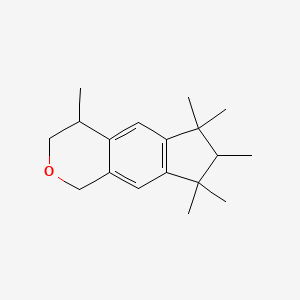
Galaxolide
Galaxolide is an organic heterotricyclic compound that is 1,3,4,6,7,8-hexahydrocyclopenta[g]isochromene substituted by methyl groups at positions 4, 6, 6, 7, 8 and 8 respectively. It is a synthetic musk used as a fragrance in cosmetics. It has a role as a fragrance. It is an organic heterotricyclic compound and a member of isochromenes. — ChEBI
- IUPAC 名称
- 4,6,6,7,8,8-hexamethyl-1,3,4,7-tetrahydrocyclopenta[g]isochromene
- 分子式
- C18H26O
- 分子量
- 258.4 g/mol
- 精确质量
- 258.198365449 Da
- XLogP3
- 4.8
- 拓扑极性表面积
- 9.2 Ų
- 氢键供体
- 0
- 氢键受体
- 1
- 共价单元
- 1
- 已定义的立体中心
- 0
又称
另有 16 个已报告名称
外部数据库标识符
- ChEBI:CHEBI:83784
- ChEMBL:CHEMBL1883305
- EPA DTXSID:DTXSID8027373
- PubMed:37797914
- PubMed:34687775
- PubMed:29427707
- PubMed:23084589
- PubMed:22967629
- PubMed:22813076
- PubMed:22779714
- PubMed:22733515
- PubMed:22709983
- PubMed:22699026
- PubMed:22540536
- PubMed:22489002
来自其他科学数据库的证据
NIH PubChem PUG-View
Attributed physical-property, hazard, environmental and use annotations.
- Boiling Point: BP: 128 °C at 0.8 mm Hg 来源: Hazardous Substances Data Bank (HSDB)
- Color/Form: Colorless crystals from ethanol 来源: Hazardous Substances Data Bank (HSDB)
- Color/Form: Viscous liquid[ECHA; Search for Chemicals. 1,3,4,6,7,8-hexahydro-4,6,6,7,8,8-hexmethylindeno 来源: Hazardous Substances Data Bank (HSDB)
- Color/Form: Almost colorless viscous liquid 来源: Hazardous Substances Data Bank (HSDB)
- Density: 1.0054 at 20 °C/4 °C 来源: Hazardous Substances Data Bank (HSDB)
- Density: Density: 0.99 to 1.017 g/cu cm at 20 °C 来源: Hazardous Substances Data Bank (HSDB)
- Density: Crystal density: 1.087 g/cu cm 来源: Hazardous Substances Data Bank (HSDB)
- LogP: log Kow = 5.90 来源: Hazardous Substances Data Bank (HSDB)
- Melting Point: 57-58 °C 来源: Hazardous Substances Data Bank (HSDB)
- Melting Point: MP: -10 to 0 °C (mixture of isomers) 来源: Hazardous Substances Data Bank (HSDB)
- Odor: Strong musk odor 来源: Hazardous Substances Data Bank (HSDB)
- Odor: Odor type: Musk 来源: Hazardous Substances Data Bank (HSDB)
- Physical Description: Liquid; CBI; Other Solid 来源: EPA Chemical Data Reporting (CDR)
- Physical Description: Colorless solid with a strong odor of musk; mp = 57-58 deg C; [Merck Index] Nearly colorless viscous liquid; [HSDB] Viscous liquid with a musk-like odor; mp = -5 deg C; [CHEMINFO] Viscous liquid; mp = -10-0 deg C; [eChemPortal: ESIS: RAR] 来源: Haz-Map, Information on Hazardous Chemicals and Occupational Diseases
- Refractive Index: Index of refraction: 1.5342 at 20 °C/D 来源: Hazardous Substances Data Bank (HSDB)
- Solubility: In water, 1.75 mg/L at 25 °C 来源: Hazardous Substances Data Bank (HSDB)
- Solubility: In water, 1.65-1.99 mg/L at 25 °C and pH 5-9[ECHA; Search for Chemicals. 1,3,4,6,7,8-hexahydro-4,6,6,7,8,8-hexmethylindeno 来源: Hazardous Substances Data Bank (HSDB)
- Vapor Pressure: 0.00054 [mmHg] 来源: Haz-Map, Information on Hazardous Chemicals and Occupational Diseases
- Vapor Pressure: 5.45X10⁻⁴ mm Hg at 25 °C 来源: Hazardous Substances Data Bank (HSDB)
- Viscosity: Dynamic viscosity: 12,914 mPa.s[ECHA; Search for Chemicals. 1,3,4,6,7,8-hexahydro-4,6,6,7,8,8-hexmethylindeno 来源: Hazardous Substances Data Bank (HSDB)
- Signal: Warning 来源: Regulation (EC) No 1272/2008 of the European Parliament and of the Council
- GHS Hazard Statements: H400: Very toxic to aquatic life [Warning Hazardous to the aquatic environment, acute hazard]; H410: Very toxic to aquatic life with long lasting effects [Warning Hazardous to the aquatic environment, long-term hazard] 来源: Regulation (EC) No 1272/2008 of the European Parliament and of the Council
- Precautionary Statement Codes: P273, P391, and P501 (click each P-code to see the statement) 来源: Regulation (EC) No 1272/2008 of the European Parliament and of the Council
- Signal: Warning 来源: European Chemicals Agency (ECHA)
- GHS Hazard Statements: H400 (97.9%): Very toxic to aquatic life [Warning Hazardous to the aquatic environment, acute hazard]; H410 (100%): Very toxic to aquatic life with long lasting effects [Warning Hazardous to the aquatic environment, long-term hazard] 来源: European Chemicals Agency (ECHA)
- Precautionary Statement Codes: P273, P391, and P501 (click each P-code to see the statement) 来源: European Chemicals Agency (ECHA)
- ECHA C&L Notifications Summary: Aggregated GHS information provided per 2093 reports by companies from 18 notifications to the ECHA C&L Inventory. Each notification may be associated with multiple companies.; Information may vary between notifications depending on impurities, additives, and other factors. The percentage value in parenthesis indicates the notified classification ratio from companies that provide hazard codes. Only hazard codes with percentage values above 10% are shown. For more detailed information, please visit ECHA C&L website. 来源: European Chemicals Agency (ECHA)
- Signal: Danger 来源: NITE-CMC
- GHS Hazard Statements: H360: May damage fertility or the unborn child [Danger Reproductive toxicity]; H400: Very toxic to aquatic life [Warning Hazardous to the aquatic environment, acute hazard]; H410: Very toxic to aquatic life with long lasting effects [Warning Hazardous to the aquatic environment, long-term hazard] 来源: NITE-CMC
- Precautionary Statement Codes: P203, P273, P280, P318, P391, P405, and P501 (click each P-code to see the statement) 来源: NITE-CMC
- Signal: Warning 来源: NITE-CMC
- GHS Hazard Statements: H361: Suspected of damaging fertility or the unborn child [Warning Reproductive toxicity]; H400: Very toxic to aquatic life [Warning Hazardous to the aquatic environment, acute hazard]; H410: Very toxic to aquatic life with long lasting effects [Warning Hazardous to the aquatic environment, long-term hazard] 来源: NITE-CMC
- Toxicity Summary: IDENTIFICATION AND USE: Galaxolide (HHCB) is an almost colorless viscous liquid. It is a synthetic, artificial musk fragrance, which is used as a laundry detergent fragrance, as well as an ingredient in perfumes, soaps, and cosmetics. HUMAN STUDIES: No irritation was observed in any of the 42 subjects tested in human repeated insult patch test even after repeated occlusive applications of undiluted material. High concentrations of HHCB can affect steroidogenesis in vitro using the H295R cell line. HHCB was not genotoxic in the micronucleus test with human lymphocytes in vitro in the presence and absence of metabolic activation. ANIMAL STUDIES: HHCB was added to the diet of rats at levels calculated to result in mean daily doses of 5, 15, 50 or 150 mg HHCB/kg. On completion of the 90-day treatment period, three males and three females from the high dose and control groups were maintained for a treatment free period of 4 weeks. No adverse effects were revealed from clinical examination or following extensive histopathological examinations. There were no significant findings at any dose level. Developmental study in rats described axial skeletal malformations at 500 mg/kg per day. In 来源: Hazardous Substances Data Bank (HSDB)
- Environmental Bioconcentration: A BCF of 1,584 was measured in fish for galaxolide(SRC), using bluegill sunfish (Lepomis macrochirus) which were exposed to concentrations of 1 and 10 mg/L over an 28-day period(1). According to a classification scheme(2), this BCF suggests the potential for bioconcentration in aquatic organisms is very high(SRC). A polar metabolite accounting for 9-24% of the total radioactivity in tissue was detected(1). 来源: Hazardous Substances Data Bank (HSDB)
- Environmental Fate: TERRESTRIAL FATE: Based on a classification scheme(1), an estimated Koc value of 2.0X10+4(SRC), determined from a structure estimation method(2), indicates that galaxolide is expected to be immobile in soil(SRC). Volatilization of galaxolide from moist soil surfaces is expected to be an important fate process(SRC) given an estimated Henry's Law constant of 1.1X10⁻⁴ atm-cu m/mole(SRC), based upon its vapor pressure, 5.45X10⁻⁴ mm Hg(3), and water solubility, 1.75 mg/L(3). However, adsorption to soil is expected to attenuate volatilization(SRC).) Galaxolide is not expected to volatilize from dry soil surfaces(SRC) based upon its vapor pressure(4). A biodegradation half-life in soil of 4 months(3) indicates that biodegradation is not an important environmental fate process in soil(SRC). 来源: Hazardous Substances Data Bank (HSDB)
- Environmental Fate: AQUATIC FATE: Based on a classification scheme(1), an estimated Koc value of 2.0X10+4(SRC), determined from a structure estimation method(2), indicates that galaxolide is expected to adsorb to suspended solids and sediment(SRC). Volatilization from water surfaces is expected(3) based upon an estimated Henry's Law constant of 1.1X10⁻⁴ atm-cu m/mole(SRC), derived from its vapor pressure, 5.45X10⁻⁴ mm Hg(4), and water solubility, 1.75 mg/L(4). Using this Henry's Law constant and an estimation method(3), volatilization half-lives for a model river and model lake are 18 hrs and 10 days, respectively(SRC). However, volatilization from water surfaces is expected to be attenuated by adsorption to suspended solids and sediment in the water column. The estimated volatilization half-life from a model pond is 31 months if adsorption is considered(5). According to a classification scheme(6), a BCF of 1584(4) suggests the potential for bioconcentration in aquatic organisms is very high(SRC). A release of 0% CO2 in four weeks using an effluent from a semi-continuous activated sludge (SCAS) in the OECD 302 test(4) indicates that biodegradation is not an important environmental fate process in wate 来源: Hazardous Substances Data Bank (HSDB)
- Environmental Fate: ATMOSPHERIC FATE: According to a model of gas/particle partitioning of semivolatile organic compounds in the atmosphere(1), galaxolide, which has a vapor pressure of 5.45X10⁻⁴ mm Hg at 25 °C((SRC), determined from a fragment constant method(2)), will exist in both the vapor and particulate phases in the ambient atmosphere. Vapor-phase galaxolide is degraded in the atmosphere by reaction with photochemically-produced hydroxyl radicals(SRC); the half-life for this reaction in air is estimated to be approximately 10 hrs(SRC), calculated from its rate constant of 2.60X10⁻¹¹ cu cm/molecule-sec at 25 °C(3). Particulate-phase galaxolide may be removed from the air by wet and dry deposition(SRC). Galaxolide does not contain chromophores that absorb at wavelengths >290 nm(4) and, therefore, is not expected to be susceptible to direct photolysis by sunlight(SRC). 来源: Hazardous Substances Data Bank (HSDB)
- Consumer Uses: Fragrance 来源: EPA Chemical Data Reporting (CDR)
- Industry Uses: Fragrance 来源: EPA Chemical Data Reporting (CDR)
- Sources/Uses: Used as fragrance agent in perfumes, soaps, cosmetics, and detergents; [Merck Index] 来源: Haz-Map, Information on Hazardous Chemicals and Occupational Diseases
- Uses: Synthetic, artificial musk fragrance. 来源: Hazardous Substances Data Bank (HSDB)
- Uses: Fragrance ingredient in perfumes, soaps, cosmetics, and detergents. 来源: Hazardous Substances Data Bank (HSDB)
- Uses: HHCB is used to make a fragrance long lasting and have a positive technical effect on its balance bringing the initial and residual smell into harmony. 来源: Hazardous Substances Data Bank (HSDB)
映射方: Existing checksum-valid CAS to unique PubChem CID match. 检索时间: 2026-08-31. 打开来源记录
科学分类和危害注释仅提供背景信息,不能取代上方所示针对具体市场的监管决定。
其他来源的覆盖范围和匹配状态
| 来源 | 结果 | 已检查 |
|---|---|---|
| NIH PubChem PUG-View | 精确匹配 | 2026-08-31 |
已记录的无匹配结果是该来源已被检查的有效证据;这并不表示该物质在别处不存在。
于 2026-09-02 通过校验和有效的 CAS 匹配从美国国立卫生研究院 (NIH) PubChem 检索。化学性质不能取代本页的监管决定。
Hexamethylindanopyran 的清单链接
Hexamethylindanopyran 的相关记录
该记录的直接匹配结果有限,因此同时显示附件 III 中的相邻条目。
Menthol
Carvone
Camphor
Santalol
附件 III 对 Hexamethylindanopyran 意味着什么
Hexamethylindanopyran 是欧盟化妆品法规 1223/2009 附件 III 中的限用物质。其在化妆品中的使用仅限于上方条目所列的特定条件,包括适用的浓度限值、产品类型限制和必须标示的警示语。
在配方中使用该物质时,必须同时满足所有条件——最大浓度、产品范围和警示标签。满足其中一项条件并不能免除其他条件。
本记录与 1 个 CosIng 清单成分相关联,便于名称和标识符的交叉引用。 本页还显示 12 条相关附件记录,其标识符、附件逻辑或命名模式存在重叠。
合规核查清单
- 将使用条件记录在产品信息档案 (PIF) 中。