
4,4'-Bi-o-toluidine (ortho-Tolidine)
4,4'-Bi-o-toluidine (ortho-Tolidine) 在附件 II 中被列为在欧盟市场上市的化妆品的禁用物质。
记录详情
化学名称
4,4'-Bi-o-toluidine (ortho-Tolidine)
化学名称 / IUPAC 名称
o-Tolidine
监管信息
SCCS 意见
- Opinion concerning Chemical Ingredients in Cosmetic Products classified as Carcinogenic, Mutagenic or Toxic to Reproduction according to the Chemicals Directive 67/548/EECC
- Opinion concerning Chemical Ingredients in Cosmetic Products classified as Carcinogenic, Mutagenic or Toxic to Reproduction according to the Chemicals Directive 67/548/EEC
CMR
| 类别 | Carcinogenic | Mutagenic | Reprotoxic |
|---|---|---|---|
| Cat. 1B | ✓ | — | — |
关键数据
化学身份与性质
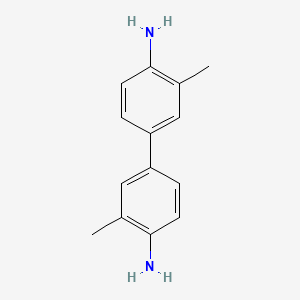
o-Tolidine
3,3'-dimethylbenzidine appears as white to reddish crystals or crystalline powder or a light tan powder. (NTP, 1992) — CAMEO Chemicals
- IUPAC 名称
- 4-(4-amino-3-methylphenyl)-2-methylaniline
- 分子式
- C14H16N2
- 分子量
- 212.29 g/mol
- 精确质量
- 212.131348519 Da
- XLogP3
- 2.3
- 拓扑极性表面积
- 52.0 Ų
- 氢键供体
- 2
- 氢键受体
- 2
- 共价单元
- 1
- 已定义的立体中心
- 0
又称
另有 16 个已报告名称
外部数据库标识符
- ChEBI:CHEBI:34320
- ChEMBL:CHEMBL85109
- EPA DTXSID:DTXSID5024059
- PubMed:40449632
- PubMed:33049310
- PubMed:22751261
- PubMed:21852829
- PubMed:21837136
- PubMed:21089866
- PubMed:19750402
- PubMed:16497524
- PubMed:15962942
- PubMed:15450435
- PubMed:15323047
- PubMed:15177655
来自其他科学数据库的证据
NIH PubChem PUG-View
Attributed physical-property, hazard, environmental and use annotations.
- Autoignition Temperature: 526 °C 来源: ILO-WHO International Chemical Safety Cards (ICSCs)
- Boiling Point: 392 °F at 760 mmHg (NTP, 1992) 来源: CAMEO Chemicals
- Boiling Point: 300 °C 来源: Hazardous Substances Data Bank (HSDB)
- Boiling Point: 300 °C 来源: ILO-WHO International Chemical Safety Cards (ICSCs)
- Boiling Point: 392 °F 来源: Occupational Safety and Health Administration (OSHA)
- Boiling Point: 300 °C @760 [mm Hg] 来源: PAC Chemical Database, U.S. Department of Energy
- Boiling Point: 572 °F 来源: The National Institute for Occupational Safety and Health (NIOSH)
- Color/Form: Colorless; in technical grades also brownish flakes 来源: Hazardous Substances Data Bank (HSDB)
- Color/Form: White to reddish crystals or powder [Note: Darkens on exposure to air] 来源: Hazardous Substances Data Bank (HSDB)
- Density: 1 (NTP, 1992) 来源: CAMEO Chemicals
- Density: 1.234 g/cu cm 来源: Hazardous Substances Data Bank (HSDB)
- Density: 1.2 g/cm³ 来源: ILO-WHO International Chemical Safety Cards (ICSCs)
- Density: 1 来源: Occupational Safety and Health Administration (OSHA)
- Dissociation Constants: pKa1 = 4.5; pKa2 = 3.3 (conjugate acid) 来源: Hazardous Substances Data Bank (HSDB)
- Flash Point: 137 °C 来源: Haz-Map, Information on Hazardous Chemicals and Occupational Diseases
- Flash Point: 244 °C 来源: ILO-WHO International Chemical Safety Cards (ICSCs)
- Flash Point: 471 °F 来源: Occupational Safety and Health Administration (OSHA)
- LogP: log Kow = 2.34 来源: Hazardous Substances Data Bank (HSDB)
- LogP: 2.34 来源: ILO-WHO International Chemical Safety Cards (ICSCs)
- Melting Point: 264 to 268 °F (NTP, 1992) 来源: CAMEO Chemicals
- Melting Point: 129-131 °C 来源: Hazardous Substances Data Bank (HSDB)
- Melting Point: MP: 264 °F 来源: Hazardous Substances Data Bank (HSDB)
- Melting Point: 131-132 °C 来源: ILO-WHO International Chemical Safety Cards (ICSCs)
- Melting Point: 264 °F 来源: Occupational Safety and Health Administration (OSHA)
- Melting Point: 131 °C 来源: PAC Chemical Database, U.S. Department of Energy
- Melting Point: 264 °F 来源: The National Institute for Occupational Safety and Health (NIOSH)
- Physical Description: 3,3'-dimethylbenzidine appears as white to reddish crystals or crystalline powder or a light tan powder. (NTP, 1992) 来源: CAMEO Chemicals
- Physical Description: White to reddish crystals or powder. [Note: Darkens on exposure to air. Often used in paste or wet cake form. Used as a basis for many dyes.]; [NIOSH] 来源: Haz-Map, Information on Hazardous Chemicals and Occupational Diseases
- Physical Description: COLOURLESS CRYSTALS OR RED-TO-BROWN FLAKES. 来源: ILO-WHO International Chemical Safety Cards (ICSCs)
- Physical Description: White to reddish crystals or powder. 来源: Occupational Safety and Health Administration (OSHA)
- Physical Description: White to reddish crystals or powder. [Note: Darkens on exposure to air. Often used in paste or wet cake form. Used as a basis for many dyes.] 来源: The National Institute for Occupational Safety and Health (NIOSH)
- Solubility: less than 1 mg/mL at 66 °F (NTP, 1992) 来源: CAMEO Chemicals
- Solubility: In water, 1,300 mg/L at 25 °C 来源: Hazardous Substances Data Bank (HSDB)
- Solubility: Soluble in alcohol, ether, dilute acids 来源: Hazardous Substances Data Bank (HSDB)
- Solubility: Solubility in water, g/100ml at 25 °C: 0.13 (poor) 来源: ILO-WHO International Chemical Safety Cards (ICSCs)
- Solubility: 0.1% 来源: The National Institute for Occupational Safety and Health (NIOSH)
- Vapor Pressure: 0.000001 [mmHg] 来源: Haz-Map, Information on Hazardous Chemicals and Occupational Diseases
- Vapor Pressure: 1x10⁻⁶ mmHg (est) 来源: Occupational Safety and Health Administration (OSHA)
- IARC Carcinogenic Agent: 3,3'-Dimethylbenzidine (ortho-Tolidine) 来源: International Agency for Research on Cancer (IARC)
- IARC Carcinogenic Classes: Group 2B: Possibly carcinogenic to humans 来源: International Agency for Research on Cancer (IARC)
- IARC Monographs: Volume 1: (1972) Some Inorganic Substances, Chlorinated Hydrocarbons, Aromatic Amines, N-Nitroso Compounds, and Natural Products; Volume Sup 7: Overall Evaluations of Carcinogenicity: An Updating of IARC Monographs Volumes 1 to 42, 1987; 440 pages; ISBN 92-832-1411-0 (out of print) 来源: International Agency for Research on Cancer (IARC)
- Publication Year: 1987 来源: International Agency for Research on Cancer (IARC)
- Evaluation Year: 1987 来源: International Agency for Research on Cancer (IARC)
- Exposure Routes: The substance can be absorbed into the body through the skin and by ingestion. 来源: ILO-WHO International Chemical Safety Cards (ICSCs)
- Exposure Routes: inhalation, skin absorption, ingestion, skin and/or eye contact 来源: The National Institute for Occupational Safety and Health (NIOSH)
- First Aid: EYES: First check the victim for contact lenses and remove if present. Flush victim's eyes with water or normal saline solution for 20 to 30 minutes while simultaneously calling a hospital or poison control center. Do not put any ointments, oils, or medication in the victim's eyes without specific instructions from a physician. IMMEDIATELY transport the victim after flushing eyes to a hospital even if no symptoms (such as redness or irritation) develop.; SKIN: IMMEDIATELY flood affected skin with water while removing and isolating all contaminated clothing. Gently wash all affected skin areas thoroughly with soap and water. IMMEDIATELY call a hospital or poison control center even if no symptoms (such as redness or irritation) develop. IMMEDIATELY transport the victim to a hospital for treatment after washing the affected areas.; INHALATION: IMMEDIATELY leave the contaminated area; take deep breaths of fresh air. IMMEDIATELY call a physician and be prepared to transport the victim to a hospital even if no symptoms (such as wheezing, coughing, shortness of breath, or burning in the mouth, throat, or chest) develop. Provide proper respiratory protection to rescuers entering an unknow 来源: CAMEO Chemicals
- First Aid: (General first aid procedures); Eye: Irrigate immediately - If this chemical contacts the eyes, immediately wash (irrigate) the eyes with large amounts of water, occasionally lifting the lower and upper lids. Get medical attention immediately.; Skin: Soap flush immediately - If this chemical contacts the skin, immediately flush the contaminated skin with soap and water. If this chemical penetrates the clothing, immediately remove the clothing and flush the skin with water. If irritation persists after washing, get medical attention.; Breathing: Respiratory support; Swallow: Medical attention immediately - If this chemical has been swallowed, get medical attention immediately. 来源: The National Institute for Occupational Safety and Health (NIOSH)
- Signal: Danger 来源: Regulation (EC) No 1272/2008 of the European Parliament and of the Council
- GHS Hazard Statements: H302: Harmful if swallowed [Warning Acute toxicity, oral]; H350: May cause cancer [Danger Carcinogenicity]; H411: Toxic to aquatic life with long lasting effects [Hazardous to the aquatic environment, long-term hazard] 来源: Regulation (EC) No 1272/2008 of the European Parliament and of the Council
- Precautionary Statement Codes: P203, P264, P270, P273, P280, P301+P317, P318, P330, P391, P405, and P501 (click each P-code to see the statement) 来源: Regulation (EC) No 1272/2008 of the European Parliament and of the Council
- Signal: Danger 来源: European Chemicals Agency (ECHA)
- GHS Hazard Statements: H302 (100%): Harmful if swallowed [Warning Acute toxicity, oral]; H350 (100%): May cause cancer [Danger Carcinogenicity]; H411 (100%): Toxic to aquatic life with long lasting effects [Hazardous to the aquatic environment, long-term hazard] 来源: European Chemicals Agency (ECHA)
- Precautionary Statement Codes: P203, P264, P270, P273, P280, P301+P317, P318, P330, P391, P405, and P501 (click each P-code to see the statement) 来源: European Chemicals Agency (ECHA)
- ECHA C&L Notifications Summary: Aggregated GHS information provided per 53 reports by companies from 4 notifications to the ECHA C&L Inventory. Each notification may be associated with multiple companies.; Information may vary between notifications depending on impurities, additives, and other factors. The percentage value in parenthesis indicates the notified classification ratio from companies that provide hazard codes. Only hazard codes with percentage values above 10% are shown. For more detailed information, please visit ECHA C&L website. 来源: European Chemicals Agency (ECHA)
- Signal: Danger 来源: NITE-CMC
- GHS Hazard Statements: H372: Causes damage to organs through prolonged or repeated exposure [Danger Specific target organ toxicity, repeated exposure]; H373: May causes damage to organs through prolonged or repeated exposure [Warning Specific target organ toxicity, repeated exposure] 来源: NITE-CMC
- Precautionary Statement Codes: P260, P264, P270, P319, and P501 (click each P-code to see the statement) 来源: NITE-CMC
- GHS Hazard Statements: H302: Harmful if swallowed [Warning Acute toxicity, oral]; H341: Suspected of causing genetic defects [Warning Germ cell mutagenicity]; H350: May cause cancer [Danger Carcinogenicity]; H373: May causes damage to organs through prolonged or repeated exposure [Warning Specific target organ toxicity, repeated exposure]; H401: Toxic to aquatic life [Hazardous to the aquatic environment, acute hazard]; H411: Toxic to aquatic life with long lasting effects [Hazardous to the aquatic environment, long-term hazard] 来源: NITE-CMC
- Precautionary Statement Codes: P203, P260, P264, P270, P273, P280, P301+P317, P318, P319, P330, P391, P405, and P501 (click each P-code to see the statement) 来源: NITE-CMC
- Target Organs: Eyes, respiratory system, liver, kidneys 来源: The National Institute for Occupational Safety and Health (NIOSH)
- Environmental Bioconcentration: Using carp (Cyprinus carpio) which were exposed over an 8-week period in a continuous flow system and 3,3'-dimethylbenzidine concentrations of 0.02 and 0.2 mg/L, a 3,3'-dimethylbenzidine BCF range of 4.8 to 83 was measured(1). According to a classification scheme(2), these BCF values suggest bioconcentration in aquatic organisms is low to moderate(SRC). 来源: Hazardous Substances Data Bank (HSDB)
- Environmental Fate: TERRESTRIAL FATE: Based on a classification scheme(1), an estimated Koc value of 3190(SRC), determined from a structure estimation method(2), indicates that 3,3'-dimethylbenzidine is expected to have slight mobility in soil(SRC). The pKa values of 3,3'-dimethylbenzidine are 4.50 and 3.3(3), indicating that this compound will exist partially in the cation form in the environment and cations generally adsorb more strongly to soils containing organic carbon and clay than their neutral counterparts(4). In sediment studies, sorption measurements over the pH range of 5 to 9 saw an increase in sorption as the pH decreased suggesting that the protonated form of 3,3'-dimethylbenzidine was more strongly bound than the neutral form(5). Volatilization of 3,3'-dimethylbenzidine from moist soil surfaces is not expected to be an important fate process(SRC) given an estimated Henry's Law constant of 6.3X10⁻¹¹ atm-cu m/mole(SRC), using a fragment constant estimation method(2). 3,3'-Dimethylbenzidine is not expected to volatilize from dry soil surfaces(SRC) based upon an estimated vapor pressure of 1.0X10⁻⁶ mm Hg at 25 °C(SRC), determined from a fragment constant method(2). 3,3'-Dimethylbenzidine, p 来源: Hazardous Substances Data Bank (HSDB)
- Environmental Fate: AQUATIC FATE: Based on a classification scheme(1), an estimated Koc value of 3190(SRC), determined from a structure estimation method(2), indicates that 3,3'-dimethylbenzidine is expected to adsorb to suspended solids and sediment(SRC). Volatilization from water surfaces is not expected(3) based upon an estimated Henry's Law constant of 6.3X10⁻¹¹ atm-cu m/mole(SRC), developed using a fragment constant estimation method(2). According to a classification scheme(7), BCF values in the range of 4.8 to 83(4), measured in carp (Cyprinus carpio), suggest bioconcentration in aquatic organisms is low to moderate(SRC). 3,3'-Dimethylbenzidine, present at 100 mg/L, reached 3% of its theoretical BOD in 4 weeks using an activated sludge inoculum at 30 mg/L and the Japanese MITI test(6), indicating the compound is not readily biodegradable(5). 3,3'-Dimethylbenzidine absorbs light >290 nm(6) and may be susceptible to direct photolysis. When aerated solutions of benzidine were exposed to a light from a xenon lamp (300-400 nm) complete degradation of benzidine was observed in 12 hours(7); photodegradation of 3,3'-dimethylbenzidine may be similar(SRC). Aromatic amines are susceptible to photooxidation 来源: Hazardous Substances Data Bank (HSDB)
- Environmental Fate: ATMOSPHERIC FATE: According to a model of gas/particle partitioning of semivolatile organic compounds in the atmosphere(1), 3,3'-dimethylbenzidine, which has an estimated vapor pressure of 1.0X10⁻⁶ mm Hg at 25 °C(SRC), determined from a fragment constant method(2), is expected to exist in both the vapor and particulate phases in the ambient atmosphere. Vapor-phase 3,3'-dimethylbenzidine is degraded in the atmosphere by reaction with photochemically-produced hydroxyl radicals(SRC); the half-life for this reaction in air is estimated to be 2 hours(SRC), calculated from its rate constant of 1.9X10⁻¹⁰ cu cm/molecule-sec at 25 °C (SRC)determined using a structure estimation method(2). 3,3'-Dimethylbenzidine absorbs light >290 nm(3), therefore, it may be susceptible to direct photolysis(SRC). Particulate-phase 3,3'-dimethylbenzidine may be removed from the air by wet and dry deposition(SRC). 来源: Hazardous Substances Data Bank (HSDB)
- Uses: 3,3'-Dimethylbenzidine is used as an intermediate for the production of dyes and pigments. 来源: EPA Hazardous Air Pollutants
- Sources/Uses: Used as an intermediate in the production of dyes and pigments; used as a curing agent for polyurethane elastomers, coatings, and rigid foams; [HSDB] 来源: Haz-Map, Information on Hazardous Chemicals and Occupational Diseases
- Industrial Processes with risk of exposure: Plastic Composites Manufacturing [Category: Industry] 来源: Haz-Map, Information on Hazardous Chemicals and Occupational Diseases
- Uses: Manufacture of dyes; also as very sensitive reagent for gold (1:10 million detectable); and for free chlorine in water. 来源: Hazardous Substances Data Bank (HSDB)
- Uses: Intermediate in the production of the azo dyes Direct Red 2 and Acid Red 114 来源: Hazardous Substances Data Bank (HSDB)
- Uses: ... Curing agent for urethane resins. 来源: Hazardous Substances Data Bank (HSDB)
- Uses: o-Tolidine and its salts are widely used in the dye industry & in some analytical chemistry procedures. 来源: Hazardous Substances Data Bank (HSDB)
- Uses: For more Uses (Complete) data for 3,3'-DIMETHYLBENZIDINE (6 total), please visit the HSDB record page. 来源: Hazardous Substances Data Bank (HSDB)
- Uses: Substance listed with specific concentration in tattoo ink and/or permanent make up according to EU Commission Regulation 2020/2081. The concentration limit (by weight) is 0.0005%. 来源: NORMAN Suspect List Exchange
映射方: Existing checksum-valid CAS to unique PubChem CID match. 检索时间: 2026-08-31. 打开来源记录
科学分类和危害注释仅提供背景信息,不能取代上方所示针对具体市场的监管决定。
其他来源的覆盖范围和匹配状态
| 来源 | 结果 | 已检查 |
|---|---|---|
| NIH PubChem PUG-View | 精确匹配 | 2026-08-31 |
已记录的无匹配结果是该来源已被检查的有效证据;这并不表示该物质在别处不存在。
于 2026-09-02 通过校验和有效的 CAS 匹配从美国国立卫生研究院 (NIH) PubChem 检索。化学性质不能取代本页的监管决定。
4,4'-Bi-o-toluidine (ortho-Tolidine) 的相关记录
该记录的直接匹配结果有限,因此同时显示附件 II 中的相邻条目。
[3,3'-Dimethyl[1,1'-biphenyl]-4,4'-diyl]diammonium bis(hydrogen sulphate)
附件 II 对 4,4'-Bi-o-toluidine (ortho-Tolidine) 意味着什么
4,4'-Bi-o-toluidine (ortho-Tolidine) 被列为欧盟化妆品法规 1223/2009 附件 II 中的禁用物质,不得有意添加。第 17 条另行规定了在良好生产规范下技术上不可避免、且符合第 3 条安全要求的非有意微量存在的情形。
配方师必须筛查其成分和原料,确保均不含该物质。供应商应在被要求时提供证明不含该物质的文件。
本页还显示 12 条相关附件记录,其标识符、附件逻辑或命名模式存在重叠。
合规核查清单
- 核实该物质不存在于所有原料和成品配方中。
- 向原料供应商索取不含该物质的确认函或 CoA。
- 将筛查结果记录在产品信息档案 (PIF) 中。
- 该物质具有 CMR 分类。使用前请查看上方的 CMR 表,并核实现行附件 II/III 状态。