
Pyrocatechol (Catechol)
Pyrocatechol (Catechol) 在附件 II 中被列为在欧盟市场上市的化妆品的禁用物质。
记录详情
化学名称
Pyrocatechol (Catechol)
监管信息
已识别的成分
关键数据
化学身份与性质
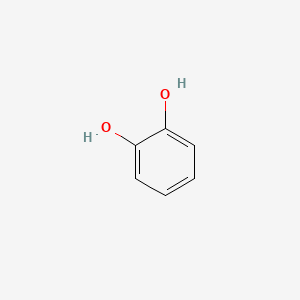
Catechol
Catechol is a benzenediol comprising of a benzene core carrying two hydroxy substituents ortho to each other. It has a role as a genotoxin, an allelochemical and a plant metabolite. It is a conjugate acid of a catecholate(1-). — ChEBI
- IUPAC 名称
- benzene-1,2-diol
- 分子式
- C6H6O2
- 分子量
- 110.11 g/mol
- 精确质量
- 110.036779430 Da
- XLogP3
- 0.9
- 拓扑极性表面积
- 40.5 Ų
- 氢键供体
- 2
- 氢键受体
- 2
- 共价单元
- 1
- 已定义的立体中心
- 0
又称
另有 16 个已报告名称
外部数据库标识符
- ChEBI:CHEBI:18135
- ChEMBL:CHEMBL280998
- EPA DTXSID:DTXSID3020257
- PubMed:23122078
- PubMed:23107737
- PubMed:23101658
- PubMed:23084066
- PubMed:23081836
- PubMed:23079526
- PubMed:23071683
- PubMed:23071628
- PubMed:23054709
- PubMed:23035942
- PubMed:23022512
- PubMed:23022412
来自其他科学数据库的证据
NIH PubChem PUG-View
Attributed physical-property, hazard, environmental and use annotations.
- Autoignition Temperature: 510 °C 来源: Hazardous Substances Data Bank (HSDB)
- Autoignition Temperature: 510 °C 来源: ILO-WHO International Chemical Safety Cards (ICSCs)
- Boiling Point: 473 °F at 760 mmHg (sublimes) (NTP, 1992) 来源: CAMEO Chemicals
- Boiling Point: 245 °C 来源: DrugBank
- Boiling Point: 245.5 °C at 760 mm Hg; sublimes 来源: Hazardous Substances Data Bank (HSDB)
- Boiling Point: BP: 221.5 °C at 400 mm Hg; 197.7 °C at 200 mm Hg; 176 °C at 100 mm Hg; 161.7 °C at 60 mm Hg; 134 °C at 20 mm Hg; 118.3 °C at 10 mm Hg; 104 °C at 5 mm Hg ... Volatile with steam 来源: Hazardous Substances Data Bank (HSDB)
- Boiling Point: 245.5 °C 来源: ILO-WHO International Chemical Safety Cards (ICSCs)
- Boiling Point: 474 °F 来源: Occupational Safety and Health Administration (OSHA)
- Boiling Point: 245 °C @760 [mm Hg] 来源: PAC Chemical Database, U.S. Department of Energy
- Boiling Point: 474 °F 来源: The National Institute for Occupational Safety and Health (NIOSH)
- Color/Form: Monoclinic tablets, prisms from toluene ... its aqueous solutions soon turn brown 来源: Hazardous Substances Data Bank (HSDB)
- Color/Form: Colorless crystals, discolors to brown on exposure to air and light, especially when moist 来源: Hazardous Substances Data Bank (HSDB)
- Density: 1.344 at 68 °F (USCG, 1999) - Denser than water; will sink 来源: CAMEO Chemicals
- Density: 1.344 来源: Hazardous Substances Data Bank (HSDB)
- Density: Density: 1.371 来源: Hazardous Substances Data Bank (HSDB)
- Density: Relative density (water = 1): 1.3 来源: ILO-WHO International Chemical Safety Cards (ICSCs)
- Density: 1.34 来源: Occupational Safety and Health Administration (OSHA)
- Density: 1.344 @ 20°C 来源: PAC Chemical Database, U.S. Department of Energy
- Density: 1.34 来源: The National Institute for Occupational Safety and Health (NIOSH)
- pKa: 9.45 (at 25 °C) 来源: DrugBank
- Dissociation Constants: pKa1 = 9.45; pKa2 = 12.8 来源: Hazardous Substances Data Bank (HSDB)
- Flash Point: 261 °F (NTP, 1992) 来源: CAMEO Chemicals
- Flash Point: 127 °C 来源: Haz-Map, Information on Hazardous Chemicals and Occupational Diseases
- Flash Point: 260 °F (127 °C) (Closed cup) 来源: Hazardous Substances Data Bank (HSDB)
- Flash Point: 127.2 °C (open cup) 来源: Hazardous Substances Data Bank (HSDB)
- Flash Point: 127 °C (261 °F) (Closed cup) 来源: Hazardous Substances Data Bank (HSDB)
- Flash Point: 127 °C c.c. 来源: ILO-WHO International Chemical Safety Cards (ICSCs)
- Flash Point: 261 °F 来源: Occupational Safety and Health Administration (OSHA)
- Flash Point: 261 °F 来源: The National Institute for Occupational Safety and Health (NIOSH)
- LogP: 0.88 来源: DrugBank
- LogP: log Kow = 0.88 来源: Hazardous Substances Data Bank (HSDB)
- LogP: 0.88 来源: Human Metabolome Database (HMDB)
- LogP: 0.88 来源: ILO-WHO International Chemical Safety Cards (ICSCs)
- Melting Point: 221 °F (NTP, 1992) 来源: CAMEO Chemicals
- Melting Point: 105 °C 来源: DrugBank
- Melting Point: 105 °C 来源: Hazardous Substances Data Bank (HSDB)
- Melting Point: 105 °C 来源: Human Metabolome Database (HMDB)
- Melting Point: 105 °C 来源: ILO-WHO International Chemical Safety Cards (ICSCs)
- Melting Point: 221 °F 来源: Occupational Safety and Health Administration (OSHA)
- Melting Point: 104.6 °C 来源: PAC Chemical Database, U.S. Department of Energy
- Melting Point: 221 °F 来源: The National Institute for Occupational Safety and Health (NIOSH)
- Odor: Faint characteristic odor 来源: Hazardous Substances Data Bank (HSDB)
- Odor: Phenolic odor 来源: Hazardous Substances Data Bank (HSDB)
- Physical Description: Solid; white; odorless. Sinks and mixes with water. (USCG, 1999) 来源: CAMEO Chemicals
- Physical Description: Large Crystals; Other Solid 来源: EPA Chemical Data Reporting (CDR)
- Physical Description: Colorless, crystalline solid with a faint odor; Note: Discolors to brown in air & light; [NIOSH] 来源: Haz-Map, Information on Hazardous Chemicals and Occupational Diseases
- Physical Description: Solid 来源: Human Metabolome Database (HMDB)
- Physical Description: COLOURLESS CRYSTALS WITH CHARACTERISTIC ODOUR. TURNS BROWN ON EXPOSURE TO AIR AND LIGHT. 来源: ILO-WHO International Chemical Safety Cards (ICSCs)
- Physical Description: Colorless, crystalline solid with a faint odor. 来源: Occupational Safety and Health Administration (OSHA)
- Physical Description: Colorless, crystalline solid with a faint odor. [Note: Discolors to brown in air & light.] 来源: The National Institute for Occupational Safety and Health (NIOSH)
- Refractive Index: Index of refraction: 1.604 at 25 °C 来源: Hazardous Substances Data Bank (HSDB)
- Solubility: greater than or equal to 100 mg/mL at 70.7 °F (NTP, 1992) 来源: CAMEO Chemicals
- Solubility: 461000 mg/L (at 25 °C) 来源: DrugBank
- Solubility: In water, 4.61X10+5 mg/L at 25 °C 来源: Hazardous Substances Data Bank (HSDB)
- Solubility: Soluble in chloroform, ether; very soluble in pyridine, aqueous alkalis 来源: Hazardous Substances Data Bank (HSDB)
- Solubility: Very soluble in alcohol, ethyl ether, acetate 来源: Hazardous Substances Data Bank (HSDB)
- Solubility: 461.0 mg/mL 来源: Human Metabolome Database (HMDB)
- Solubility: Solubility in water, g/100ml at 20 °C: 43 来源: ILO-WHO International Chemical Safety Cards (ICSCs)
- Solubility: 44% 来源: The National Institute for Occupational Safety and Health (NIOSH)
- Vapor Pressure: 5 mmHg at 219 °F ; 10 mmHg at 244.9 °F (NTP, 1992) 来源: CAMEO Chemicals
- Vapor Pressure: 0.03 [mmHg] 来源: Haz-Map, Information on Hazardous Chemicals and Occupational Diseases
- Vapor Pressure: VP: 10 mm Hg at 118.3 °C 来源: Hazardous Substances Data Bank (HSDB)
- Vapor Pressure: 3X10⁻² mm Hg at 20 °C (extrapolated) 来源: Hazardous Substances Data Bank (HSDB)
- Vapor Pressure: Vapor pressure, Pa at 20 °C: 3 (negligible) 来源: ILO-WHO International Chemical Safety Cards (ICSCs)
- Vapor Pressure: 10 mmHg at 245 °F 来源: Occupational Safety and Health Administration (OSHA)
- Vapor Pressure: (244 °F): 10 mmHg 来源: The National Institute for Occupational Safety and Health (NIOSH)
- IARC Carcinogenic Agent: Catechol 来源: International Agency for Research on Cancer (IARC)
- IARC Carcinogenic Classes: Group 2B: Possibly carcinogenic to humans 来源: International Agency for Research on Cancer (IARC)
- IARC Monographs: Volume 15: (1977) Some Fumigants, the Herbicides 2,4-D and 2,4,5-T, Chlorinated Dibenzodioxins and Miscellaneous Industrial Chemicals; Volume Sup 7: Overall Evaluations of Carcinogenicity: An Updating of IARC Monographs Volumes 1 to 42, 1987; 440 pages; ISBN 92-832-1411-0 (out of print); Volume 71: (1999) Re-evaluation of Some Organic Chemicals, Hydrazine and Hydrogen Peroxide (Part 1, Part 2, Part 3) 来源: International Agency for Research on Cancer (IARC)
- Publication Year: 1999 来源: International Agency for Research on Cancer (IARC)
- Evaluation Year: 1998 来源: International Agency for Research on Cancer (IARC)
- Carcinogen Classification: 2B, possibly carcinogenic to humans. (L135) 来源: Toxin and Toxin Target Database (T3DB)
- Exposure Routes: The substance can be absorbed into the body by inhalation of its aerosol, through the skin and by ingestion. 来源: ILO-WHO International Chemical Safety Cards (ICSCs)
- Exposure Routes: inhalation, skin absorption, ingestion, skin and/or eye contact 来源: The National Institute for Occupational Safety and Health (NIOSH)
- First Aid: EYES: First check the victim for contact lenses and remove if present. Flush victim's eyes with water or normal saline solution for 20 to 30 minutes while simultaneously calling a hospital or poison control center. Do not put any ointments, oils, or medication in the victim's eyes without specific instructions from a physician. IMMEDIATELY transport the victim after flushing eyes to a hospital even if no symptoms (such as redness or irritation) develop.; SKIN: IMMEDIATELY flood affected skin with water while removing and isolating all contaminated clothing. Gently wash all affected skin areas thoroughly with soap and water. IMMEDIATELY call a hospital or poison control center even if no symptoms (such as redness or irritation) develop. IMMEDIATELY transport the victim to a hospital for treatment after washing the affected areas.; INHALATION: IMMEDIATELY leave the contaminated area; take deep breaths of fresh air. If symptoms (such as wheezing, coughing, shortness of breath, or burning in the mouth, throat, or chest) develop, call a physician and be prepared to transport the victim to a hospital. Provide proper respiratory protection to rescuers entering an unknown atmosphere. Whene 来源: CAMEO Chemicals
- First Aid: (General first aid procedures); Eye: Irrigate immediately - If this chemical contacts the eyes, immediately wash (irrigate) the eyes with large amounts of water, occasionally lifting the lower and upper lids. Get medical attention immediately.; Skin: Water wash immediately - If this chemical contacts the skin, immediately wash the contaminated skin with water. If this chemical penetrates the clothing, immediately remove the clothing and wash the skin with water. If symptoms occur after washing, get medical attention immediately.; Breathing: Respiratory support; Swallow: Medical attention immediately - If this chemical has been swallowed, get medical attention immediately. 来源: The National Institute for Occupational Safety and Health (NIOSH)
- Signal: Danger 来源: Regulation (EC) No 1272/2008 of the European Parliament and of the Council
- GHS Hazard Statements: H301: Toxic if swallowed [Danger Acute toxicity, oral]; H311: Toxic in contact with skin [Danger Acute toxicity, dermal]; H315: Causes skin irritation [Warning Skin corrosion/irritation]; H319: Causes serious eye irritation [Warning Serious eye damage/eye irritation]; H341: Suspected of causing genetic defects [Warning Germ cell mutagenicity]; H350: May cause cancer [Danger Carcinogenicity] 来源: Regulation (EC) No 1272/2008 of the European Parliament and of the Council
- Precautionary Statement Codes: P203, P262, P264, P264+P265, P270, P280, P301+P316, P302+P352, P305+P351+P338, P316, P318, P321, P330, P332+P317, P337+P317, P361+P364, P362+P364, P405, and P501 (click each P-code to see the statement) 来源: Regulation (EC) No 1272/2008 of the European Parliament and of the Council
- Signal: Danger 来源: European Chemicals Agency (ECHA)
- GHS Hazard Statements: H301 (16.4%): Toxic if swallowed [Danger Acute toxicity, oral]; H302 (83.6%): Harmful if swallowed [Warning Acute toxicity, oral]; H311 (16.4%): Toxic in contact with skin [Danger Acute toxicity, dermal]; H312 (83.6%): Harmful in contact with skin [Warning Acute toxicity, dermal]; H315 (> 99.9%): Causes skin irritation [Warning Skin corrosion/irritation]; H317 (12.6%): May cause an allergic skin reaction [Warning Sensitization, Skin]; H319 (94.6%): Causes serious eye irritation [Warning Serious eye damage/eye irritation]; H341 (16.4%): Suspected of causing genetic defects [Warning Germ cell mutagenicity]; H350 (11.4%): May cause cancer [Danger Carcinogenicity] 来源: European Chemicals Agency (ECHA)
- Precautionary Statement Codes: P203, P261, P262, P264, P264+P265, P270, P272, P280, P301+P316, P301+P317, P302+P352, P305+P351+P338, P316, P317, P318, P321, P330, P332+P317, P333+P317, P337+P317, P361+P364, P362+P364, P405, and P501 (click each P-code to see the statement) 来源: European Chemicals Agency (ECHA)
- ECHA C&L Notifications Summary: Aggregated GHS information provided per 2962 reports by companies from 34 notifications to the ECHA C&L Inventory. Each notification may be associated with multiple companies.; Information may vary between notifications depending on impurities, additives, and other factors. The percentage value in parenthesis indicates the notified classification ratio from companies that provide hazard codes. Only hazard codes with percentage values above 10% are shown. For more detailed information, please visit ECHA C&L website. 来源: European Chemicals Agency (ECHA)
- Signal: Warning 来源: European Chemicals Agency (ECHA)
- GHS Hazard Statements: H317 (100%): May cause an allergic skin reaction [Warning Sensitization, Skin]; H412 (100%): Harmful to aquatic life with long lasting effects [Hazardous to the aquatic environment, long-term hazard] 来源: European Chemicals Agency (ECHA)
- Precautionary Statement Codes: P261, P272, P273, P280, P302+P352, P321, P333+P317, P362+P364, and P501 (click each P-code to see the statement) 来源: European Chemicals Agency (ECHA)
- ECHA C&L Notifications Summary: The GHS information provided by 1 company from 1 notification to the ECHA C&L Inventory. 来源: European Chemicals Agency (ECHA)
- GHS Hazard Statements: H315 (100%): Causes skin irritation [Warning Skin corrosion/irritation]; H319 (100%): Causes serious eye irritation [Warning Serious eye damage/eye irritation]; H412 (100%): Harmful to aquatic life with long lasting effects [Hazardous to the aquatic environment, long-term hazard] 来源: European Chemicals Agency (ECHA)
- NFPA Health Rating: 3 - Materials that, under emergency conditions, can cause serious or permanent injury. 来源: Hazardous Substances Data Bank (HSDB)
- NFPA Fire Rating: 1 - Materials that must be preheated before ignition can occur. Materials require considerable preheating, under all ambient temperature conditions, before ignition and combustion can occur. 来源: Hazardous Substances Data Bank (HSDB)
- NFPA Instability Rating: 0 - Materials that in themselves are normally stable, even under fire conditions. 来源: Hazardous Substances Data Bank (HSDB)
- Target Organs: Eyes, skin, respiratory system, central nervous system, kidneys 来源: The National Institute for Occupational Safety and Health (NIOSH)
- Cosmetic Ingredient Review Conclusion: The CIR Expert Panel concludes that Pyrocatechol is unsafe for use in leave-on products, and that the available data are insufficient to support the safety of Pyrocatechol as used in hair dyes. 来源: Cosmetic Ingredient Review (CIR)
- Cosmetic Ingredient Review Finding(s): The ingredient is unsafe for use in cosmetics; Ingredients for which the data are insufficient and their use in cosmetics is not supported 来源: Cosmetic Ingredient Review (CIR)
- Toxicity Summary: IDENTIFICATION AND USE: Catechol is a tablet or colorless crystal, prism or aqueous solution, which discolors to brown on exposure to air and light. It has a faint characteristic odor. It is used as antioxidant in the rubber, chemical, photographic, dye, fat, and oil industries. It was formerly used as an antiseptic. Catechol was found unsafe for use in cosmetics. HUMAN EXPOSURE AND TOXICITY: Catechol contact with the skin has been known to cause an eczematous dermatitis. It is highly irritating upon direct contact; severe eye and deep skin burns result. Well absorbed by skin. Systemic toxicity similar to that of phenol however, catechol may be more likely to cause convulsions and hypertension. At high doses, renal and liver injury may occur. Absorption through the skin, in a few instances, has resulted in symptoms of illness resembling closely those induced by phenol, except for certain central effects (convulsions) that were more marked. Death apparently is initiated by respiratory failure. Catechol was found to be a more harmful toxin than phenol in human blood cells in vitro, since it provokes statistically significant changes in the function of erythrocytes even at low doses. 来源: Hazardous Substances Data Bank (HSDB)
- Environmental Bioconcentration: An estimated BCF of 3 was calculated for catechol(SRC), using a log Kow of 0.88(1) and a regression-derived equation(2). According to a classification scheme(3), this BCF suggests the potential for bioconcentration in aquatic organisms is low(SRC). 来源: Hazardous Substances Data Bank (HSDB)
- Environmental Fate: TERRESTRIAL FATE: Based on a classification scheme(1), a Koc value of 118(2), indicates that catechol is expected to have high mobility in soil(SRC). Volatilization of catechol from moist soil surfaces is not expected to be an important fate process(SRC) given an estimated Henry's Law constant of 1.2X10⁻⁹ atm-cu m/mole(SRC), based upon its vapor pressure, 3.66X10⁻³ mm Hg(3), and water solubility, 4.61X10+5 mg/L(4). Catechol is not expected to volatilize from dry soil surfaces(SRC) based upon its vapor pressure(3). The percent biodegradation after 6 months in various loam soils ranged from 24 to 50%(5), indicating that biodegradation is a moderate environmental fate process in soil(SRC). 来源: Hazardous Substances Data Bank (HSDB)
- Environmental Fate: AQUATIC FATE: Based on a classification scheme(1), a Koc value of 118(2), indicates that catechol is not expected to adsorb to suspended solids and sediment(SRC). Volatilization from water surfaces is not expected(3) based upon an estimated Henry's Law constant of 1.20X10⁻⁹ atm-cu m/mole(SRC), derived from its vapor pressure, 3.66X10⁻³ mm Hg(4), and water solubility, 4.61X10+5 mg/L(5). According to a classification scheme(6), an estimated BCF of 3(SRC), from its log Kow of 0.88(7) and a regression-derived equation(8), suggests the potential for bioconcentration in aquatic organisms is low(SRC). Utilizing the Japanese MITI test, 83% of the Theoretical BOD was reached in 2 weeks(9) indicating that biodegradation is an important environmental fate process in water(SRC). 来源: Hazardous Substances Data Bank (HSDB)
- Environmental Fate: ATMOSPHERIC FATE: According to a model of gas/particle partitioning of semivolatile organic compounds in the atmosphere(1), catechol, which has a vapor pressure of 3.66X10⁻³ mm Hg at 25 °C(2), is expected to exist solely as a vapor in the ambient atmosphere. Vapor-phase catechol is degraded in the atmosphere by reaction with photochemically-produced hydroxyl radicals(SRC); the half-life for this reaction in air is estimated to be 2.8 hrs(SRC), calculated from its rate constant of 1.04X10⁻¹⁰ cu cm/molecule-sec at 25 °C(3). Catechol in its nonionized form will not be subject to direct photolysis since this form does not absorb light above 300 nm in methanol solution(4). Reaction of catechol with nitrate radicals during nighttime may be an important removal process based on a rate constant of 3.8X10⁻¹² cu cm/molecule sec for the reaction of phenol with nitrate radicals(2) which corresponds to a half-life of 15 minutes at an atmospheric concentration of 2X10+8 nitrate radicals per cu cm(SRC). The ionized form of catechol may photolyze based on an absorption maximum at 313 nm in basic aqueous solution(6) and at 289 nm in basic methanol solution(4). Therefore, catechol may be susceptible 来源: Hazardous Substances Data Bank (HSDB)
- Consumer Uses: Intermediate 来源: EPA Chemical Data Reporting (CDR)
- Industry Uses: Intermediate 来源: EPA Chemical Data Reporting (CDR)
- Cosmetic Ingredient Review Link: CIR ingredient: Pyrocatechol 来源: Cosmetic Ingredient Review (CIR)
- Uses: Catechol is used as a photographic developer, a developer for fur dyes, as an intermediate for antioxidants in rubber and lubricating oils, in polymerization inhibitors, and in pharmaceuticals. 来源: EPA Hazardous Air Pollutants
- Sources/Uses: Used in the photography, rubber, dye, and oil industries as an antioxidant; also used to produce cosmetics and pharmaceuticals; [ACGIH] 来源: Haz-Map, Information on Hazardous Chemicals and Occupational Diseases
- Industrial Processes with risk of exposure: Photographic Processing [Category: Other] 来源: Haz-Map, Information on Hazardous Chemicals and Occupational Diseases
- Activities with risk of exposure: Smoking cigarettes [Category: Food & Drugs] 来源: Haz-Map, Information on Hazardous Chemicals and Occupational Diseases
- Uses: Antiseptic /former US/, photography, dyestuffs, electroplating, specialty inks, antioxidants and light stabilizers, organic synthesis. 来源: Hazardous Substances Data Bank (HSDB)
- Uses: Antioxidant in the rubber, chemical, photographic, dye, fat, and oil industries. It is also employed in cosmetics as couplers in oxidative hair dyes, but is no longer used as an antiseptic. 来源: Hazardous Substances Data Bank (HSDB)
- Uses: Synthesis of food, pharmaceutical and agricultural products 来源: Hazardous Substances Data Bank (HSDB)
- Uses: The Cosmetic Ingredient Review Panel concludes that pyrocatechol is unsafe for use in leave-on products and that the available data are insufficient to support the safety of pyrocatechol as used in hair dyes. This conclusion supersedes the earlier conclusion issued by the Expert Panel in 1985. 来源: Hazardous Substances Data Bank (HSDB)
- Uses: For more Uses (Complete) data for CATECHOL (7 total), please visit the HSDB record page. 来源: Hazardous Substances Data Bank (HSDB)
- Uses: This is a man-made compound that is used as a pesticide. 来源: Toxin and Toxin Target Database (T3DB)
映射方: Existing checksum-valid CAS to unique PubChem CID match. 检索时间: 2026-08-31. 打开来源记录
科学分类和危害注释仅提供背景信息,不能取代上方所示针对具体市场的监管决定。
其他来源的覆盖范围和匹配状态
| 来源 | 结果 | 已检查 |
|---|---|---|
| NIH PubChem PUG-View | 精确匹配 | 2026-08-31 |
已记录的无匹配结果是该来源已被检查的有效证据;这并不表示该物质在别处不存在。
于 2026-08-31 通过校验和有效的 CAS 匹配从美国国立卫生研究院 (NIH) PubChem 检索。化学性质不能取代本页的监管决定。
Pyrocatechol (Catechol) 的清单链接
Pyrocatechol (Catechol) 的相关记录
该记录的直接匹配结果有限,因此同时显示附件 II 中的相邻条目。
4-Ethoxy-m-phenylenediamine and its salts
Nitrosamines e.g. Dimethylnitrosoamine; Nitrosodipropylamine; 2,2'-(Nitrosoimino)bisethanol
Secondary alkyl- and alkanolamines and their salts
4-tert.-Butyl-3-methoxy-2,6-dinitrotoluene (Musk ambrette)
附件 II 对 Pyrocatechol (Catechol) 意味着什么
Pyrocatechol (Catechol) 被列为欧盟化妆品法规 1223/2009 附件 II 中的禁用物质,不得有意添加。第 17 条另行规定了在良好生产规范下技术上不可避免、且符合第 3 条安全要求的非有意微量存在的情形。
配方师必须筛查其成分和原料,确保均不含该物质。供应商应在被要求时提供证明不含该物质的文件。
本记录与 1 个 CosIng 清单成分相关联,便于名称和标识符的交叉引用。 本页还显示 12 条相关附件记录,其标识符、附件逻辑或命名模式存在重叠。
合规核查清单
- 核实该物质不存在于所有原料和成品配方中。
- 向原料供应商索取不含该物质的确认函或 CoA。
- 将筛查结果记录在产品信息档案 (PIF) 中。