
difenoconazole (ISO); 1-({2-[2-chloro-4-(4-chlorophenoxy)phenyl]-4-methyl-1,3-dioxolan-2-yl}methyl)-1H-1,2,4-triazole; 3-chloro-4-[(2RS,4RS;2RS,4SR)-4-methyl-2-(1H-1,2,4-triazol-1-ylmethyl)-1,3-dioxolan-2-yl]phenyl 4-chlorophenyl ether
difenoconazole (ISO); 1-({2-[2-chloro-4-(4-chlorophenoxy)phenyl]-4-methyl-1,3-dioxolan-2-yl}methyl)-1H-1,2,4-triazole; 3-chloro-4-[(2RS,4RS;2RS,4SR)-4-methyl-2-(1H-1,2,4-triazol-1-ylmethyl)-1,3-dioxolan-2-yl]phenyl 4-chlorophenyl ether 在附件 II 中被列为在欧盟市场上市的化妆品的禁用物质。
记录详情
化学名称
difenoconazole (ISO); 1-({2-[2-chloro-4-(4-chlorophenoxy)phenyl]-4-methyl-1,3-dioxolan-2-yl}methyl)-1H-1,2,4-triazole; 3-chloro-4-[(2RS,4RS;2RS,4SR)-4-methyl-2-(1H-1,2,4-triazol-1-ylmethyl)-1,3-dioxolan-2-yl]phenyl 4-chlorophenyl ether
监管信息
关键数据
化学身份与性质
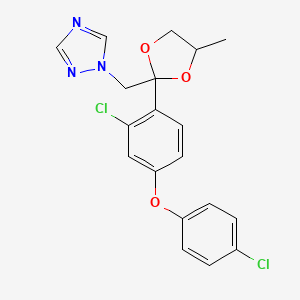
Difenoconazole
Difenoconazole is a member of the class of dioxolanes that is 1,3-dioxolane substituted at position 2 by 2-chloro-4-(4-chlorophenoxy)phenyl and 1,2,4-triazol-1-ylmethyl groups. A broad spectrum fungicide with novel broad-range activity used as a spray or seed treatment. It is moderately toxic to humans, mammals, birds and most aquatic organisms. It has a role as a xenobiotic, an EC 1.14.13.70 (sterol 14alpha-demethylase) inhibitor, an environmental contaminant and an antifungal agrochemical. It is an aromatic ether, a member of triazoles, a dioxolane, a cyclic ketal, a conazole fungicide and a triazole fungicide. — ChEBI
- IUPAC 名称
- 1-[[2-[2-chloro-4-(4-chlorophenoxy)phenyl]-4-methyl-1,3-dioxolan-2-yl]methyl]-1,2,4-triazole
- 分子式
- C19H17Cl2N3O3
- 分子量
- 406.3 g/mol
- 精确质量
- 405.0646968 Da
- XLogP3
- 4.0
- 拓扑极性表面积
- 58.4 Ų
- 氢键供体
- 0
- 氢键受体
- 5
- 共价单元
- 1
- 已定义的立体中心
- 0
又称
另有 16 个已报告名称
外部数据库标识符
- ChEBI:CHEBI:81760
- ChEMBL:CHEMBL466426
- EPA DTXSID:DTXSID4032372
- PubMed:39365753
- PubMed:39137466
- PubMed:36965607
- PubMed:36403845
- PubMed:34519103
- PubMed:34425431
- PubMed:33575850
- PubMed:32278787
- PubMed:32194361
- PubMed:30763314
- PubMed:29621561
- PubMed:29337257
来自其他科学数据库的证据
NIH PubChem PUG-View
Attributed physical-property, hazard, environmental and use annotations.
- Boiling Point: 100.8 °C (3.7 mPa) 来源: Hazardous Substances Data Bank (HSDB)
- Color/Form: White crystalline solid 来源: Hazardous Substances Data Bank (HSDB)
- Color/Form: White to light beige crystals 来源: Hazardous Substances Data Bank (HSDB)
- Color/Form: Beige-grayish crystalline solid 来源: Hazardous Substances Data Bank (HSDB)
- Density: 1.5 g/cu cm at 20 °C 来源: Hazardous Substances Data Bank (HSDB)
- Dissociation Constants: pKa = 1.1 at 20 °C 来源: Hazardous Substances Data Bank (HSDB)
- LogP: log Kow = 4.4 at 25 °C 来源: Hazardous Substances Data Bank (HSDB)
- Melting Point: 78.6 °C 来源: Hazardous Substances Data Bank (HSDB)
- Odor: Odorless 来源: Hazardous Substances Data Bank (HSDB)
- Odor: Sweetish odor 来源: Hazardous Substances Data Bank (HSDB)
- Solubility: In water, 15 mg/L at 25 °C 来源: Hazardous Substances Data Bank (HSDB)
- Solubility: In water, 5 mg/L at 20 °C 来源: Hazardous Substances Data Bank (HSDB)
- Solubility: Very soluble in most organic solvents 来源: Hazardous Substances Data Bank (HSDB)
- Solubility: Soluble in acetone, dichloromethane, toluene, methanol and ethyl acetate >500 g/L, hexane 3 g/L, octanol 110 g/L (at 25 °C) 来源: Hazardous Substances Data Bank (HSDB)
- Vapor Pressure: VP: 1.2X10⁻⁷ Pa at 20 °C (9.0X10⁻¹⁰ mm Hg) 来源: Hazardous Substances Data Bank (HSDB)
- Vapor Pressure: 2.5X10⁻¹⁰ mm Hg at 25 °C (3.3X10⁻⁵ mPa) 来源: Hazardous Substances Data Bank (HSDB)
- Viscosity: 529 cP at 25 °C 来源: Hazardous Substances Data Bank (HSDB)
- Carcinogen Classification: No indication of carcinogenicity to humans (not listed by IARC). 来源: Toxin and Toxin Target Database (T3DB)
- Signal: Warning 来源: Regulation (EC) No 1272/2008 of the European Parliament and of the Council
- GHS Hazard Statements: H302: Harmful if swallowed [Warning Acute toxicity, oral]; H319: Causes serious eye irritation [Warning Serious eye damage/eye irritation]; H351: Suspected of causing cancer [Warning Carcinogenicity]; H400: Very toxic to aquatic life [Warning Hazardous to the aquatic environment, acute hazard]; H410: Very toxic to aquatic life with long lasting effects [Warning Hazardous to the aquatic environment, long-term hazard] 来源: Regulation (EC) No 1272/2008 of the European Parliament and of the Council
- Precautionary Statement Codes: P203, P264, P264+P265, P270, P273, P280, P301+P317, P305+P351+P338, P318, P330, P337+P317, P391, P405, and P501 (click each P-code to see the statement) 来源: Regulation (EC) No 1272/2008 of the European Parliament and of the Council
- Signal: Warning 来源: European Chemicals Agency (ECHA)
- GHS Hazard Statements: H302+H332 (29.5%): Harmful if swallowed or if inhaled [Warning Acute toxicity, oral; acute toxicity, inhalation]; H302 (100%): Harmful if swallowed [Warning Acute toxicity, oral]; H319 (52.7%): Causes serious eye irritation [Warning Serious eye damage/eye irritation]; H332 (31%): Harmful if inhaled [Warning Acute toxicity, inhalation]; H400 (96.9%): Very toxic to aquatic life [Warning Hazardous to the aquatic environment, acute hazard]; H410 (96.9%): Very toxic to aquatic life with long lasting effects [Warning Hazardous to the aquatic environment, long-term hazard] 来源: European Chemicals Agency (ECHA)
- Precautionary Statement Codes: P261, P264, P264+P265, P270, P271, P273, P280, P301+P317, P304+P340, P305+P351+P338, P317, P330, P337+P317, P391, and P501 (click each P-code to see the statement) 来源: European Chemicals Agency (ECHA)
- ECHA C&L Notifications Summary: Aggregated GHS information provided per 129 reports by companies from 16 notifications to the ECHA C&L Inventory. Each notification may be associated with multiple companies.; Information may vary between notifications depending on impurities, additives, and other factors. The percentage value in parenthesis indicates the notified classification ratio from companies that provide hazard codes. Only hazard codes with percentage values above 10% are shown. For more detailed information, please visit ECHA C&L website. 来源: European Chemicals Agency (ECHA)
- Signal: Warning 来源: NITE-CMC
- GHS Hazard Statements: H302: Harmful if swallowed [Warning Acute toxicity, oral]; H320: Causes eye irritation [Warning Serious eye damage/eye irritation]; H351: Suspected of causing cancer [Warning Carcinogenicity]; H371: May cause damage to organs [Warning Specific target organ toxicity, single exposure]; H373: May causes damage to organs through prolonged or repeated exposure [Warning Specific target organ toxicity, repeated exposure]; H400: Very toxic to aquatic life [Warning Hazardous to the aquatic environment, acute hazard]; H410: Very toxic to aquatic life with long lasting effects [Warning Hazardous to the aquatic environment, long-term hazard] 来源: NITE-CMC
- Precautionary Statement Codes: P203, P260, P264, P264+P265, P270, P273, P280, P301+P317, P305+P351+P338, P308+P316, P318, P319, P330, P337+P317, P391, P405, and P501 (click each P-code to see the statement) 来源: NITE-CMC
- GHS Hazard Statements: H302: Harmful if swallowed [Warning Acute toxicity, oral]; H320: Causes eye irritation [Warning Serious eye damage/eye irritation]; H332: Harmful if inhaled [Warning Acute toxicity, inhalation] 来源: NITE-CMC
- Precautionary Statement Codes: P261, P264, P264+P265, P270, P271, P301+P317, P304+P340, P305+P351+P338, P317, P330, P337+P317, and P501 (click each P-code to see the statement) 来源: NITE-CMC
- Toxicity Summary: IDENTIFICATION AND USE: Difenoconazole is a white crystalline solid. It is used as fungicide, insecticide, seed treatment/protectant. HUMAN EXPOSURE AND TOXICITY: Harmful if inhaled or absorbed through skin. Causes moderate eye irritation. It did not cause chromosomal aberrations in human lymphocytes. One case of allergic reaction to a formulated product was reported. ANIMAL STUDIES: Difenoconazole was moderately and transiently irritating to the eyes of rabbits. It was very slightly and transiently irritating to the skin of rabbits. Difenoconazole was considered to be essentially non-toxic when applied topically under occlusion to intact rabbit skin. In rats treated dermally for 28 days there was an increased incidence of minimal centrilobular hepatocellular hypertrophy in males and females at 1000 mg/kg bw. In the thyroid, the incidence of minimal to moderate severity grades of hypertrophy of the follicular epithelium was slightly increased in the group of rats at 1000 mg/kg bw. The liver appeared to be the target organ for toxicity. There was no evidence for carcinogenicity or oncogenicity in rats. There were no indications of embryotoxicity, fetotoxicity or teratogenicity at a 来源: Hazardous Substances Data Bank (HSDB)
- Environmental Bioconcentration: Following an EPA guideline study, a whole body BCF of 330 was reported for difenoconazole in bluegill fish (Lepomic macrochirus) exposed for 28 days(1), this BCF suggests that bioconcentration in aquatic organisms is high(SRC). 来源: Hazardous Substances Data Bank (HSDB)
- Environmental Fate: TERRESTRIAL FATE: Based on a classification scheme(1), reported Koc values ranging from 3200 to 7734(2,3) indicate that difenoconazole is expected to be slightly mobile to immobile in soil(SRC). Volatilization of difenoconazole from moist soil surfaces is not expected to be an important fate process(SRC) given an estimated Henry's Law constant of 8.9X10⁻¹² atm-cu m/mole(SRC), based upon its vapor pressure, 2.5X10⁻¹⁰ mm Hg(4), and water solubility, 15 mg/L(4). Difenoconazole is not expected to volatilize from dry soil surfaces(SRC) based upon its vapor pressure(4). Slow biodegradation of difenoconazole may occur under certain conditions; however, may be limited by its bioavailability(4,5). 来源: Hazardous Substances Data Bank (HSDB)
- Environmental Fate: AQUATIC FATE: Based on a classification scheme(1), reported Koc values ranging from 3200 to 7734(2,3) indicate that difenoconazole is not expected to adsorb to suspended solids and sediment(SRC). Volatilization from water surfaces is not expected(4) based upon an estimated Henry's Law constant of 8.9X10⁻¹² atm-cu m/mole(SRC) derived from its vapor pressure, 2.5X10⁻¹⁰ mm Hg(5), and water solubility, 15 mg/L(5). According to a classification scheme(6), a BCF of 330(7), suggests that bioconcentration in aquatic organisms is high(SRC). Slow biodegradation of difenoconazole may occur under certain conditions; however, may be limited by its bioavailability(5,8). 来源: Hazardous Substances Data Bank (HSDB)
- Environmental Fate: ATMOSPHERIC FATE: According to a model of gas/particle partitioning of semivolatile organic compounds in the atmosphere(1), difenoconazole, which has a vapor pressure of 2.5X10⁻¹⁰ mm Hg at 25 °C(2), is expected to exist solely in the particulate phase in the ambient atmosphere. Particulate-phase difenoconazole may be removed from the air by wet and dry deposition(SRC). Difenoconazole contains chromophores that absorb at wavelengths >290 nm(3) and, therefore, may be susceptible to direct photolysis by sunlight(SRC). 来源: Hazardous Substances Data Bank (HSDB)
- Uses: For difenoconazole (USEPA/OPP Pesticide Code: 128847) ACTIVE products with label matches. /SRP: Registered for use in the USA but approved pesticide uses may change periodically and so federal, state and local authorities must be consulted for currently approved uses./[ 来源: Hazardous Substances Data Bank (HSDB)
- Uses: Difenoconazole... is a systemic triazole fungicide that controls a broad spectrum of foliar, seed and soil-borne diseases caused by Ascomycetes, Basidiomycetes and Deuteromycetes in cereals, soya, rice, grapes, pome fruit, stone fruit, potatoes, sugar beet and several vegetable and ornamental crops. 来源: Hazardous Substances Data Bank (HSDB)
- Uses: Fungicide, insecticide, seed treatment/protectant. 来源: Hazardous Substances Data Bank (HSDB)
- Uses: This is a man-made compound that is used as a pesticide. 来源: Toxin and Toxin Target Database (T3DB)
映射方: Existing checksum-valid CAS to unique PubChem CID match. 检索时间: 2026-08-31. 打开来源记录
科学分类和危害注释仅提供背景信息,不能取代上方所示针对具体市场的监管决定。
其他来源的覆盖范围和匹配状态
| 来源 | 结果 | 已检查 |
|---|---|---|
| NIH PubChem PUG-View | 精确匹配 | 2026-08-31 |
已记录的无匹配结果是该来源已被检查的有效证据;这并不表示该物质在别处不存在。
于 2026-09-02 通过校验和有效的 CAS 匹配从美国国立卫生研究院 (NIH) PubChem 检索。化学性质不能取代本页的监管决定。
difenoconazole (ISO); 1-({2-[2-chloro-4-(4-chlorophenoxy)phenyl]-4-methyl-1,3-dioxolan-2-yl}methyl)-1H-1,2,4-triazole; 3-chloro-4-[(2RS,4RS;2RS,4SR)-4-methyl-2-(1H-1,2,4-triazol-1-ylmethyl)-1,3-dioxolan-2-yl]phenyl 4-chlorophenyl ether 的相关记录
该记录的直接匹配结果有限,因此同时显示附件 II 中的相邻条目。
1,4-Benzenediamine, N,N’-mixed Ph and tolyl derivs.
foramsulfuron (ISO); 2-{[(4,6-dimethoxypyrimidin-2-yl)carbamoyl]sulfamoyl}-4-formamido-N,N-dimeth...
benfluralin (ISO); N-butyl-N-ethyl-α,α,α-trifluoro-2,6-dinitro-p-toluidine
4,4'-[2,2,2-trifluoro-1-(trifluoromethyl)ethylidene]diphenol; bisphenol AF
附件 II 对 difenoconazole (ISO); 1-({2-[2-chloro-4-(4-chlorophenoxy)phenyl]-4-methyl-1,3-dioxolan-2-yl}methyl)-1H-1,2,4-triazole; 3-chloro-4-[(2RS,4RS;2RS,4SR)-4-methyl-2-(1H-1,2,4-triazol-1-ylmethyl)-1,3-dioxolan-2-yl]phenyl 4-chlorophenyl ether 意味着什么
difenoconazole (ISO); 1-({2-[2-chloro-4-(4-chlorophenoxy)phenyl]-4-methyl-1,3-dioxolan-2-yl}methyl)-1H-1,2,4-triazole; 3-chloro-4-[(2RS,4RS;2RS,4SR)-4-methyl-2-(1H-1,2,4-triazol-1-ylmethyl)-1,3-dioxolan-2-yl]phenyl 4-chlorophenyl ether 被列为欧盟化妆品法规 1223/2009 附件 II 中的禁用物质,不得有意添加。第 17 条另行规定了在良好生产规范下技术上不可避免、且符合第 3 条安全要求的非有意微量存在的情形。
配方师必须筛查其成分和原料,确保均不含该物质。供应商应在被要求时提供证明不含该物质的文件。
本页还显示 12 条相关附件记录,其标识符、附件逻辑或命名模式存在重叠。
合规核查清单
- 核实该物质不存在于所有原料和成品配方中。
- 向原料供应商索取不含该物质的确认函或 CoA。
- 将筛查结果记录在产品信息档案 (PIF) 中。
常见问题
附件 II 记录 difenoconazole (ISO); 1-({2-[2-chloro-4-(4-chlorophenoxy)phenyl]-4-methyl-1,3-dioxolan-2-yl}methyl)-1H-1,2,4-triazole; 3-chloro-4-[(2RS,4RS;2RS,4SR)-4-methyl-2-(1H-1,2,4-triazol-1-ylmethyl)-1,3-dioxolan-2-yl]phenyl 4-chlorophenyl ether 的来源说明
本页概述欧盟委员会公开化妆品资料中 difenoconazole (ISO); 1-({2-[2-chloro-4-(4-chlorophenoxy)phenyl]-4-methyl-1,3-dioxolan-2-yl}methyl)-1H-1,2,4-triazole; 3-chloro-4-[(2RS,4RS;2RS,4SR)-4-methyl-2-(1H-1,2,4-triazol-1-ylmethyl)-1,3-dioxolan-2-yl]phenyl 4-chlorophenyl ether 的一条附件 II 记录,并在可用时补充关联的清单或标识符匹配。
请使用本记录页面查看 difenoconazole (ISO); 1-({2-[2-chloro-4-(4-chlorophenoxy)phenyl]-4-methyl-1,3-dioxolan-2-yl}methyl)-1H-1,2,4-triazole; 3-chloro-4-[(2RS,4RS;2RS,4SR)-4-methyl-2-(1H-1,2,4-triazol-1-ylmethyl)-1,3-dioxolan-2-yl]phenyl 4-chlorophenyl ether 的附件 II 条件,但任何最终监管决定都应对照现行官方附件措辞和来源文件确认。
工具与后续步骤
检查您的配方
粘贴完整的 INCI 成分表,一次性检出 difenoconazole (ISO); 1-({2-[2-chloro-4-(4-chlorophenoxy)phenyl]-4-methyl-1,3-dioxolan-2-yl}methyl)-1H-1,2,4-triazole; 3-chloro-4-[(2RS,4RS;2RS,4SR)-4-methyl-2-(1H-1,2,4-triazol-1-ylmethyl)-1,3-dioxolan-2-yl]phenyl 4-chlorophenyl ether 及其他被标记的欧盟附件记录。
INCI 检查器条目对比
将 difenoconazole (ISO); 1-({2-[2-chloro-4-(4-chlorophenoxy)phenyl]-4-methyl-1,3-dioxolan-2-yl}methyl)-1H-1,2,4-triazole; 3-chloro-4-[(2RS,4RS;2RS,4SR)-4-methyl-2-(1H-1,2,4-triazol-1-ylmethyl)-1,3-dioxolan-2-yl]phenyl 4-chlorophenyl ether 与另一条附件记录并排对比,查看限制、浓度和附件归属的差异。
对比