
PERFLUOROPROPYLENE
1,1,2,3,3,3-Hexafluoroprop-1-ene; 1,1,2,3,3,3-Hexafluoropropene; Hexafluoroprop-1-ene; Hexafluoropropene; HEXAFLUOROPROPENE (HFP); hexafluoropropylene; Hexafluorpropen
PERFLUOROPROPYLENE은(는) EU CosIng 목록에 등재되어 있지만, 이 페이지에는 아직 직접 연결된 부속서 기록이 없습니다.
시장별 규제 근거
여기에서 추적하는 시장 13곳 중 어느 곳에도 이 원료의 규칙이 가져와지지 않았습니다.
이는 이 목록에 관한 설명이지 법에 관한 설명이 아닙니다. 가져온 규칙이 없다는 것이 원료가 허용된다는 근거는 아닙니다. 규칙은 다른 명칭이나 식별자로, 또는 아직 이곳에 가져오지 않은 데이터세트에 존재할 수 있습니다.
PERFLUOROPROPYLENE의 목록 세부 정보
INCI 명칭
PERFLUOROPROPYLENE
설명
1,1,2,3,3,3-Hexafluoroprop-1-ene; 1,1,2,3,3,3-Hexafluoropropene; Hexafluoroprop-1-ene; Hexafluoropropene; HEXAFLUOROPROPENE (HFP); hexafluoropropylene; Hexafluorpropen
PERFLUOROPROPYLENE의 부속서 기록
주요 데이터
화학적 정체 및 특성
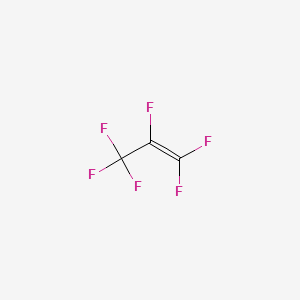
Hexafluoropropylene
Hexafluoropropylene is an odorless, colorless gas. It is noncombustible. It can asphyxiate by the displacement of air. Exposure of the container to prolonged heat or fire can cause it to rupture violently and rocket. — CAMEO Chemicals
- IUPAC 명칭
- 1,1,2,3,3,3-hexafluoroprop-1-ene
- 분자식
- C3F6
- 분자량
- 150.02 g/mol
- 정확한 질량
- 149.99041897 Da
- XLogP3
- 1.9
- 위상 극성 표면적
- 0.0 Ų
- 수소 결합 공여체
- 0
- 수소 결합 수용체
- 6
- 공유결합 단위
- 1
- 정의된 입체중심
- 0
다른 이름
보고된 명칭 16개 더 보기
외부 데이터베이스 식별자
추가 과학 데이터베이스의 근거
NIH PubChem PUG-View
Attributed physical-property, hazard, environmental and use annotations.
- Boiling Point: -29.6 °C 출처: Hazardous Substances Data Bank (HSDB)
- Boiling Point: -29.6 °C @760 [mm Hg] 출처: PAC Chemical Database, U.S. Department of Energy
- Color/Form: Colorless gas 출처: Hazardous Substances Data Bank (HSDB)
- Density: 1.583 AT -40 °C/4 °C 출처: Hazardous Substances Data Bank (HSDB)
- Density: 1.583 @ -40°C 출처: PAC Chemical Database, U.S. Department of Energy
- Melting Point: -156.5 °C 출처: Hazardous Substances Data Bank (HSDB)
- Melting Point: -156.5 °C 출처: PAC Chemical Database, U.S. Department of Energy
- Odor: Odorless gas 출처: Hazardous Substances Data Bank (HSDB)
- Physical Description: Hexafluoropropylene is an odorless, colorless gas. It is noncombustible. It can asphyxiate by the displacement of air. Exposure of the container to prolonged heat or fire can cause it to rupture violently and rocket. 출처: CAMEO Chemicals
- Physical Description: Liquid; Gas Vapor 출처: EPA Chemical Data Reporting (CDR)
- Physical Description: An odorless, colorless, noncombustible gas that can act as a simple asphyxiant; [CAMEO] 출처: Haz-Map, Information on Hazardous Chemicals and Occupational Diseases
- Vapor Pressure: 4900.0 [mmHg] 출처: Haz-Map, Information on Hazardous Chemicals and Occupational Diseases
- Vapor Pressure: 4.9X10+3 mm Hg at 25 °C /from experimentally derived coefficients/ 출처: Hazardous Substances Data Bank (HSDB)
- Vapor Pressure: 750 [mm Hg] @-30.6 °C 출처: PAC Chemical Database, U.S. Department of Energy
- First Aid: Excerpt from ERG Guide 126 [Gases - Compressed or Liquefied (Including Refrigerant Gases)]:; Refer to the "General First Aid" section. Specific First Aid: In case of contact with liquefied gas, only medical personnel should attempt thawing frosted parts. (ERG, 2024) 출처: CAMEO Chemicals
- ERG2024, Guide 126 (Refrigerant gas R-1216): General First Aid:; · Call 911 or emergency medical service.; · Ensure that medical personnel are aware of the material(s) involved, take precautions to protect themselves and avoid contamination.; · Move victim to fresh air if it can be done safely.; · Administer oxygen if breathing is difficult.; · If victim is not breathing:; -- DO NOT perform mouth-to-mouth resuscitation; the victim may have ingested or inhaled the substance.; -- If equipped and pulse detected, wash face and mouth, then give artificial respiration using a proper respiratory medical device (bag-valve mask, pocket mask equipped with a one-way valve or other device).; -- If no pulse detected or no respiratory medical device available, provide continuous compressions. Conduct a pulse check every two minutes or monitor for any signs of spontaneous respirations.; · Remove and isolate contaminated clothing and shoes.; · For minor skin contact, avoid spreading material on unaffected skin.; · In case of contact with substance, remove immediately by flushing skin or eyes with running water for at least 20 minutes.; · For severe burns, immediate medical attention is required.; · Effects of exposure (inhalation, ingestion, 출처: Emergency Response Guidebook (ERG)
- ERG2024, Guide 126 (Hexafluoropropylene; Hexafluoropropylene, compressed): General First Aid:; · Call 911 or emergency medical service.; · Ensure that medical personnel are aware of the material(s) involved, take precautions to protect themselves and avoid contamination.; · Move victim to fresh air if it can be done safely.; · Administer oxygen if breathing is difficult.; · If victim is not breathing:; -- DO NOT perform mouth-to-mouth resuscitation; the victim may have ingested or inhaled the substance.; -- If equipped and pulse detected, wash face and mouth, then give artificial respiration using a proper respiratory medical device (bag-valve mask, pocket mask equipped with a one-way valve or other device).; -- If no pulse detected or no respiratory medical device available, provide continuous compressions. Conduct a pulse check every two minutes or monitor for any signs of spontaneous respirations.; · Remove and isolate contaminated clothing and shoes.; · For minor skin contact, avoid spreading material on unaffected skin.; · In case of contact with substance, remove immediately by flushing skin or eyes with running water for at least 20 minutes.; · For severe burns, immediate medical attention is required.; · Effects of exposure (inhalation, ingestion, 출처: Emergency Response Guidebook (ERG)
- Signal: Warning 출처: Regulation (EC) No 1272/2008 of the European Parliament and of the Council
- GHS Hazard Statements: H332: Harmful if inhaled [Warning Acute toxicity, inhalation]; H335: May cause respiratory irritation [Warning Specific target organ toxicity, single exposure; Respiratory tract irritation] 출처: Regulation (EC) No 1272/2008 of the European Parliament and of the Council
- Precautionary Statement Codes: P261, P271, P304+P340, P317, P319, P403+P233, P405, and P501 (click each P-code to see the statement) 출처: Regulation (EC) No 1272/2008 of the European Parliament and of the Council
- Signal: Warning 출처: European Chemicals Agency (ECHA)
- GHS Hazard Statements: H280 (89.5%): Contains gas under pressure; may explode if heated [Warning Gases under pressure]; H332 (100%): Harmful if inhaled [Warning Acute toxicity, inhalation]; H335 (100%): May cause respiratory irritation [Warning Specific target organ toxicity, single exposure; Respiratory tract irritation]; H351 (48.6%): Suspected of causing cancer [Warning Carcinogenicity]; H371 (34.6%): May cause damage to organs [Warning Specific target organ toxicity, single exposure]; H373 (38.1%): May causes damage to organs through prolonged or repeated exposure [Warning Specific target organ toxicity, repeated exposure]; H412 (26.3%): Harmful to aquatic life with long lasting effects [Hazardous to the aquatic environment, long-term hazard] 출처: European Chemicals Agency (ECHA)
- Precautionary Statement Codes: P203, P260, P261, P264, P270, P271, P273, P280, P304+P340, P308+P316, P317, P318, P319, P403+P233, P405, P410+P403, and P501 (click each P-code to see the statement) 출처: European Chemicals Agency (ECHA)
- ECHA C&L Notifications Summary: Aggregated GHS information provided per 457 reports by companies from 20 notifications to the ECHA C&L Inventory. Each notification may be associated with multiple companies.; Information may vary between notifications depending on impurities, additives, and other factors. The percentage value in parenthesis indicates the notified classification ratio from companies that provide hazard codes. Only hazard codes with percentage values above 10% are shown. For more detailed information, please visit ECHA C&L website. 출처: European Chemicals Agency (ECHA)
- Signal: Danger 출처: NITE-CMC
- GHS Hazard Statements: H280: Contains gas under pressure; may explode if heated [Warning Gases under pressure]; H332: Harmful if inhaled [Warning Acute toxicity, inhalation]; H370: Causes damage to organs [Danger Specific target organ toxicity, single exposure]; H372: Causes damage to organs through prolonged or repeated exposure [Danger Specific target organ toxicity, repeated exposure] 출처: NITE-CMC
- Precautionary Statement Codes: P260, P261, P264, P270, P271, P304+P340, P308+P316, P317, P319, P321, P405, P410+P403, and P501 (click each P-code to see the statement) 출처: NITE-CMC
- Signal: Warning 출처: Hazardous Chemical Information System (HCIS), Safe Work Australia
- GHS Hazard Statements: H332: Harmful if inhaled [Warning Acute toxicity, inhalation]; H335: May cause respiratory irritation [Warning Specific target organ toxicity, single exposure; Respiratory tract irritation] 출처: Hazardous Chemical Information System (HCIS), Safe Work Australia
- Environmental Bioconcentration: An estimated BCF value of 24 was calculated for hexafluoropropene(SRC), using an estimated log Kow of 2.12(1,SRC) and a recommended regression-derived equation(2). According to a classification scheme(3), this BCF value suggests that bioconcentration in aquatic organisms is low(SRC). 출처: Hazardous Substances Data Bank (HSDB)
- Environmental Fate: TERRESTRIAL FATE: Based on a recommended classification scheme(1), an estimated Koc value of 470(SRC), determined from a structure estimation method(2), indicates that hexafluoropropene is expected to have moderate mobility in soil(SRC). Volatilization of hexafluoropropene is expected from moist soil surfaces(SRC) given an estimated Henry's Law constant of 5.34 atm-cu m/mole(SRC), developed using a fragment constant estimation method(3). Hexafluoropropene is expected to rapidly volatilize from dry soil surfaces based on a vapor pressure of 4.9X10+3 mm Hg(SRC), determined from a fragment constant method(4). Highly chlorinated/fluorinated compounds are not expected to biodegrade rapidly(5). 출처: Hazardous Substances Data Bank (HSDB)
- Environmental Fate: AQUATIC FATE: Based on a recommended classification scheme(1), an estimated Koc value of 470(SRC), determined from a structure estimation method(2), indicates that hexafluoropropene is expected to adsorb to suspended solids and sediment in water(SRC). Hexafluoropropene is expected to volatilize rapidly from water surfaces(3,SRC) based on an estimated Henry's Law constant of 5.34 atm-cu m/mole(SRC), developed using a fragment constant estimation method(4). Estimated half-lives for a model river and model lake are 4 and 116 hours, respectively(3,SRC). According to a classification scheme(5), an estimated BCF value of 24(3,SRC), from an estimated log Kow of 2.12(6,SRC), suggests that bioconcentration in aquatic organisms is low(SRC). Highly chlorinated/fluorinated compounds are not expected to biodegrade rapidly(7). 출처: Hazardous Substances Data Bank (HSDB)
- Environmental Fate: ATMOSPHERIC FATE: According to a model of gas/particle partitioning of semivolatile organic compounds in the atmosphere(1), hexafluoropropene, which has a vapor pressure of 4.9X10+3 mm Hg at 25 °C(2), is expected to exist solely as a vapor in the ambient atmosphere. Vapor-phase hexafluoropropene is degraded in the atmosphere by reaction with photochemically-produced hydroxyl radicals and ozone molecules(SRC); the half-lives for these reactions in air are estimated to be about 21(3,SRC) and 95(4,SRC) days, respectively. 출처: Hazardous Substances Data Bank (HSDB)
- Consumer Uses: Monomers 출처: EPA Chemical Data Reporting (CDR)
- Industry Uses: Intermediate; Monomers 출처: EPA Chemical Data Reporting (CDR)
- Sources/Uses: About 90% is used as a monomer in closed systems to produce fluoropolymers, fluoroelastomers, and fluorolubricants; About 10% is used to produce replacement chlorofluorocarbons; [ACGIH] 출처: Haz-Map, Information on Hazardous Chemicals and Occupational Diseases
- Uses: MONOMER FOR FLUORINATED ETHYLENE-PROPYLENE COPOLYMERS 출처: Hazardous Substances Data Bank (HSDB)
- Uses: COMONOMER FOR VINYLIDENE FLUORIDE ELASTOMERS 출처: Hazardous Substances Data Bank (HSDB)
- Uses: CHEM INT FOR PERFLUOROALKYL POLYETHER FLUIDS 출처: Hazardous Substances Data Bank (HSDB)
- Uses: Production of copolymers and hexafluoropropylene oxide. 출처: Hazardous Substances Data Bank (HSDB)
매핑 기준: Existing checksum-valid CAS to unique PubChem CID match. 가져온 시각: 2026-08-31. 출처 기록 열기
과학적 분류와 유해성 주석은 맥락을 제공할 뿐이며, 위에 표시된 시장별 규제 판단을 대체하지 않습니다.
추가 출처 적용 범위 및 일치 상태
| 출처 | 결과 | 확인됨 |
|---|---|---|
| NIH PubChem PUG-View | 정확히 일치 | 2026-08-31 |
기록된 불일치는 출처를 확인했다는 유용한 근거이며, 해당 물질이 다른 곳에 존재하지 않는다는 주장이 아닙니다.
체크섬이 유효한 CAS 일치를 통해 2026-08-31에 NIH PubChem에서 가져왔습니다. 화학적 특성은 이 페이지의 규제 판단을 대체하지 않습니다.
관련 목록 근거
처방 기능이 겹치는 원료
추가 공식 및 과학 출처
이 정체를 확인할 외부 데이터베이스 11개
각 링크는 해당 출처에서 이 정체를 검색합니다. 각 출처의 성격과 법적 비중
CosIng 목록에서 PERFLUOROPROPYLENE이(가) 나타나는 방식
CosIng 목록은 PERFLUOROPROPYLENE을(를) 화장품 원료로 나열하며, 이 페이지는 이를 부속서 기록 0건과 연결합니다. 목록 항목은 명칭과 식별자를 담고 있으며, 부속서 기록은 해당 물질이 EU 화장품 법령에서 사용금지, 사용제한 또는 허용 목록(포지티브 리스트)에 있는 위치를 보여 줍니다.
PERFLUOROPROPYLENE은(는) 공식 데이터에서 화장품 기능 1개로도 태그되어 있습니다. 기능 표시는 의도된 용도를 설명하지만, 처방 또는 표시 작업 전에 연결된 부속서 기록에 대한 규제 검토를 대체하지 않습니다.