
AMYL ETHYL KETONE
Octan-3-one
AMYL ETHYL KETONE은(는) EU CosIng 목록에 등재되어 있지만, 이 페이지에는 아직 직접 연결된 부속서 기록이 없습니다.
시장별 규제 근거
여기에서 추적하는 시장 13곳 중 어느 곳에도 이 원료의 규칙이 가져와지지 않았습니다.
이는 이 목록에 관한 설명이지 법에 관한 설명이 아닙니다. 가져온 규칙이 없다는 것이 원료가 허용된다는 근거는 아닙니다. 규칙은 다른 명칭이나 식별자로, 또는 아직 이곳에 가져오지 않은 데이터세트에 존재할 수 있습니다.
AMYL ETHYL KETONE의 목록 세부 정보
INCI 명칭
AMYL ETHYL KETONE
설명
Octan-3-one
AMYL ETHYL KETONE의 부속서 기록
주요 데이터
화학적 정체 및 특성
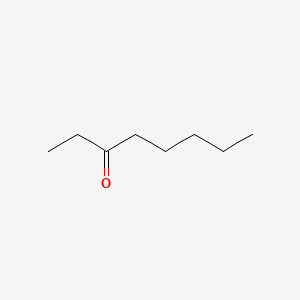
3-Octanone
3-octanone is a dialkyl ketone that is octane in which the two methylene protons at position 3 have been replaced by an oxo group. It has a role as an antifeedant, an insect attractant, a toxin, a biomarker, a plant metabolite, a fungal metabolite and a human urinary metabolite. It derives from a hydride of an octane. — ChEBI
- IUPAC 명칭
- octan-3-one
- 분자식
- C8H16O
- 분자량
- 128.21 g/mol
- 정확한 질량
- 128.120115130 Da
- XLogP3
- 2.3
- 위상 극성 표면적
- 17.1 Ų
- 수소 결합 공여체
- 0
- 수소 결합 수용체
- 1
- 공유결합 단위
- 1
- 정의된 입체중심
- 0
다른 이름
보고된 명칭 16개 더 보기
외부 데이터베이스 식별자
- ChEBI:CHEBI:80946
- ChEMBL:CHEMBL2269087
- EPA DTXSID:DTXSID3041954
- PubMed:27829300
- PubMed:22506397
- PubMed:22396667
- PubMed:22259435
- PubMed:22169393
- PubMed:22075025
- PubMed:22072908
- PubMed:21961006
- PubMed:21876772
- PubMed:21823126
- PubMed:21799756
- PubMed:21720824
추가 과학 데이터베이스의 근거
EMBL-EBI ChEBI
3-octanone
A dialkyl ketone that is octane in which the two methylene protons at position 3 have been replaced by an oxo group.
- 처방
- C8H16O
- 평균 질량
- 128.215 g/mol
- 단일 동위원소 질량
- 128.12012 Da
- 형식 전하
- 0
- dialkyl ketone — is a (CHEBI:18044)
- human urinary metabolite — has role (CHEBI:84087)
- insect attractant — has role (CHEBI:24850)
- fungal metabolite — has role (CHEBI:76946)
- antifeedant — has role (CHEBI:22583)
- plant metabolite — has role (CHEBI:76924)
- biomarker — has role (CHEBI:59163)
- toxin — has role (CHEBI:27026)
- octane — has parent hydride (CHEBI:17590)
- human urinary metabolite — has role (CHEBI:84087)
- insect attractant — has role (CHEBI:24850)
- fungal metabolite — has role (CHEBI:76946)
- antifeedant — has role (CHEBI:22583)
- plant metabolite — has role (CHEBI:76924)
- biomarker — has role (CHEBI:59163)
- toxin — has role (CHEBI:27026)
- dialkyl ketone — is a (CHEBI:18044)
- 1139896 출처: PubMed
- 13633437 출처: PubMed
- 21970810 출처: PubMed
- 24421258 출처: PubMed
- 24634568 출처: PubMed
- 25103776 출처: PubMed
- 25174554 출처: PubMed
- 25524148 출처: PubMed
- 25767084 출처: PubMed
- 26017013 출처: PubMed
- 26372442 출처: PubMed
- 26563202 출처: PubMed
- 26567951 출처: PubMed
- 26593566 출처: PubMed
- 27593501 출처: PubMed
- 27748984 출처: PubMed
- 27829300 출처: PubMed
- 28074245 출처: PubMed
- 28232862 출처: PubMed
- 28490051 출처: PubMed
- 28717894 출처: PubMed
- 28901104 출처: PubMed
- 31238146 출처: PubMed
- 36652525 출처: PubMed
추가 선별 명칭
이 출처의 상호 참조
- CAS: 106-68-3 — KEGG COMPOUND
- CAS: 106-68-3 — ChemIDplus
- CAS: 106-68-3 — NIST Chemistry WebBook
- REGISTRY_NUMBER: 1700021 — Reaxys
- MANUAL_X_REF: 3-Octanone — Wikipedia
- MANUAL_X_REF: C00034765 — KNApSAcK
- MANUAL_X_REF: C17145 — KEGG COMPOUND
- MANUAL_X_REF: FDB005050 — FooDB
- MANUAL_X_REF: HMDB0031295 — HMDB
- MANUAL_X_REF: LMFA12000055 — LIPID MAPS
매핑 기준: Exact CAS cross-reference in the ChEBI compound record. 출처 업데이트: 2023-02-02. 가져온 시각: 2026-08-31. 출처 기록 열기
NIH PubChem PUG-View
Attributed physical-property, hazard, environmental and use annotations.
- Boiling Point: 332.6 to 334.4 °F at 760 mmHg (USCG, 1999) 출처: CAMEO Chemicals
- Boiling Point: 167.5 °C 출처: Hazardous Substances Data Bank (HSDB)
- Boiling Point: 167.00 to 170.00 °C. @ 760.00 mm Hg 출처: Human Metabolome Database (HMDB)
- Boiling Point: 169-173 °C 출처: Joint FAO/WHO Expert Committee on Food Additives (JECFA)
- Color/Form: Colorless liquid 출처: Hazardous Substances Data Bank (HSDB)
- Density: 0.822 (USCG, 1999) - Less dense than water; will float 출처: CAMEO Chemicals
- Density: 0.820-0.824 at 20 °C/20 °C 출처: Hazardous Substances Data Bank (HSDB)
- Density: 0.817-0.821 (23 °C) 출처: Joint FAO/WHO Expert Committee on Food Additives (JECFA)
- Flash Point: 115 °F (USCG, 1999) 출처: CAMEO Chemicals
- Flash Point: 59 °C 출처: Haz-Map, Information on Hazardous Chemicals and Occupational Diseases
- Melting Point: -23.00 °C. @ 760.00 mm Hg 출처: Human Metabolome Database (HMDB)
- Odor: Mild fruity odor 출처: Hazardous Substances Data Bank (HSDB)
- Physical Description: Ethyl n-amyl ketone appears as a clear colorless liquid with a pungent odor. Insoluble in water and partially soluble in alcohol. Vapors are denser than air and may have a narcotic effect in high concentrations. Used in making perfumes and as a solvent for nitrocellulose and vinyl resins. 출처: CAMEO Chemicals
- Physical Description: Liquid 출처: EPA Chemical Data Reporting (CDR)
- Physical Description: Colorless to slightly yellow liquid; Pungent, somewhat fruity odor; [Merck Index] Colorless liquid; [MSDSonline] 출처: Haz-Map, Information on Hazardous Chemicals and Occupational Diseases
- Physical Description: Liquid 출처: Human Metabolome Database (HMDB)
- Physical Description: colourless, oily liquid with a herbaceous, fruity warm odour 출처: Joint FAO/WHO Expert Committee on Food Additives (JECFA)
- Refractive Index: Index of refraction: 1.4150 at 20 °C/D 출처: Hazardous Substances Data Bank (HSDB)
- Refractive Index: 1.413-1.418 출처: Joint FAO/WHO Expert Committee on Food Additives (JECFA)
- Solubility: Slightly miscible (USCG, 1999) 출처: CAMEO Chemicals
- Solubility: Miscible with ethanol, ether 출처: Hazardous Substances Data Bank (HSDB)
- Solubility: Miscible with oxygenated solvents. 출처: Hazardous Substances Data Bank (HSDB)
- Solubility: In water, 2.6X10+3 mg/L at 20 °C 출처: Hazardous Substances Data Bank (HSDB)
- Solubility: 2.6 mg/mL at 20 °C 출처: Human Metabolome Database (HMDB)
- Solubility: soluble in most common organic solvents; insoluble in water 출처: Joint FAO/WHO Expert Committee on Food Additives (JECFA)
- Solubility: 1 ml in 5 ml 60% alcohol; 1 ml in 3 ml 70% alcohol (in ethanol) 출처: Joint FAO/WHO Expert Committee on Food Additives (JECFA)
- Vapor Pressure: 2.0 [mmHg] 출처: Haz-Map, Information on Hazardous Chemicals and Occupational Diseases
- Vapor Pressure: 2 mm Hg at 20 °C 출처: Hazardous Substances Data Bank (HSDB)
- First Aid: Excerpt from ERG Guide 128 [Flammable Liquids (Water-Immiscible)]:; Refer to the "General First Aid" section. Specific First Aid: Wash skin with soap and water. In case of burns, immediately cool affected skin for as long as possible with cold water. Do not remove clothing if adhering to skin. (ERG, 2024) 출처: CAMEO Chemicals
- Note: This chemical does not meet GHS hazard criteria for 0.3% (5 of 1778) of reports. 출처: European Chemicals Agency (ECHA)
- Signal: Warning 출처: European Chemicals Agency (ECHA)
- GHS Hazard Statements: H226 (99.7%): Flammable liquid and vapor [Warning Flammable liquids] 출처: European Chemicals Agency (ECHA)
- Precautionary Statement Codes: P210, P233, P240, P241, P242, P243, P280, P303+P361+P353, P370+P378, P403+P235, and P501 (click each P-code to see the statement) 출처: European Chemicals Agency (ECHA)
- ECHA C&L Notifications Summary: Aggregated GHS information provided per 1778 reports by companies from 9 notifications to the ECHA C&L Inventory.; Reported as not meeting GHS hazard criteria per 5 of 1778 reports by companies.; There are 8 notifications provided by 1773 of 1778 reports by companies with hazard statement code(s).; Information may vary between notifications depending on impurities, additives, and other factors. The percentage value in parenthesis indicates the notified classification ratio from companies that provide hazard codes. Only hazard codes with percentage values above 10% are shown. For more detailed information, please visit ECHA C&L website. 출처: European Chemicals Agency (ECHA)
- Signal: Warning 출처: NITE-CMC
- GHS Hazard Statements: H226: Flammable liquid and vapor [Warning Flammable liquids]; H315: Causes skin irritation [Warning Skin corrosion/irritation] 출처: NITE-CMC
- Precautionary Statement Codes: P210, P233, P240, P241, P242, P243, P264, P280, P302+P352, P303+P361+P353, P321, P332+P317, P362+P364, P370+P378, P403+P235, and P501 (click each P-code to see the statement) 출처: NITE-CMC
- Environmental Bioconcentration: An estimated BCF of 7 was calculated in fish for 3-octanone(SRC), using a water solubility of 2600 mg/L(1) and a regression-derived equation(2). According to a classification scheme(3), this BCF suggests the potential for bioconcentration in aquatic organisms is low(SRC). 출처: Hazardous Substances Data Bank (HSDB)
- Environmental Fate: TERRESTRIAL FATE: Based on a classification scheme(1), an estimated Koc value of 58(SRC), determined from a water solubility of 2600 mg/L(2) and a regression-derived equation(3), indicates that 3-octanone is expected to have high mobility in soil(SRC). Volatilization of 3-octanone from moist soil surfaces is expected to be an important fate process(SRC) given an estimated Henry's Law constant of 1.3X10⁻⁴ atm-cu m/mole(SRC) derived from its vapor pressure, 2.0 mm Hg(2), and water solubility(2). 3-Octanone is expected to volatilize from dry soil surfaces(SRC) based upon its vapor pressure(2). Under aerobic conditions, this compound may biodegrade; 3-octanone at 500 mg/L reached an average of 1.1, 2.0, and 3.4% of the theoretical oxygen demand within 6, 12, and 24 hours when inoculated with activated sludge(4). 출처: Hazardous Substances Data Bank (HSDB)
- Environmental Fate: AQUATIC FATE: Based on a classification scheme(1), an estimated Koc value of 58(SRC), determined from a water solubility of 2600 mg/L(2) and a regression-derived equation(3), indicates that 3-octanone is not expected to adsorb to suspended solids and sediment(SRC). Volatilization from water surfaces is expected(3) based upon an estimated Henry's Law constant of 1.3X10⁻⁴ atm-cu m/mole(SRC), derived from its vapor pressure, 2.0 mm Hg(2), and water solubility(2). Using this Henry's Law constant and an estimation method(3), volatilization half-lives for a model river and model lake are 11 hours and 6.8 days, respectively(SRC). According to a classification scheme(4), an estimated BCF of 7(SRC), from its water solubility(2) and a regression-derived equation(3), suggests the potential for bioconcentration in aquatic organisms is low(SRC). Under aerobic conditions, this compound may biodegrade; 3-octanone at 500 mg/L reached an average of 1.1, 2.0, and 3.4% of the theoretical oxygen demand within 6, 12, and 24 hours when inoculated with activated sludge(5). 출처: Hazardous Substances Data Bank (HSDB)
- Environmental Fate: ATMOSPHERIC FATE: According to a model of gas/particle partitioning of semivolatile organic compounds in the atmosphere(1), 3-octanone, which has a vapor pressure of 2.0 mm Hg at 20 °C(2), is expected to exist solely as a vapor in the ambient atmosphere. Vapor-phase 3-octanone is degraded in the atmosphere by reaction with photochemically-produced hydroxyl radicals(SRC); the half-life for this reaction in air is estimated to be 41 hours(SRC), calculated from its rate constant of 9.3X10⁻¹² cu cm/molecule-sec at 25 °C(SRC) that was derived using a structure estimation method(3). 3-Octanone contains chromophores that absorb at wavelengths >290 nm and therefore may be susceptible to direct photolysis by sunlight(4). 출처: Hazardous Substances Data Bank (HSDB)
- Consumer Uses: Fragrance 출처: EPA Chemical Data Reporting (CDR)
- Sources/Uses: Used in lavender perfumes and flavoring agents; [Merck Index] Used as a solvent for nitrocellulose and vinyl resins; [CAMEO] 출처: Haz-Map, Information on Hazardous Chemicals and Occupational Diseases
- Uses: Derivatives: 3-octanol 출처: Hazardous Substances Data Bank (HSDB)
- Uses: Reported uses (ppm): FEMA, 1994); Table: Reported uses (ppm): FEMA, 1994) [Table#5381] 출처: Hazardous Substances Data Bank (HSDB)
- Uses: EPA Pesticides Inerts: List 3, Inerts of unknown toxicity 출처: Hazardous Substances Data Bank (HSDB)
매핑 기준: Existing checksum-valid CAS to unique PubChem CID match. 가져온 시각: 2026-08-31. 출처 기록 열기
과학적 분류와 유해성 주석은 맥락을 제공할 뿐이며, 위에 표시된 시장별 규제 판단을 대체하지 않습니다.
추가 출처 적용 범위 및 일치 상태
| 출처 | 결과 | 확인됨 |
|---|---|---|
| EMBL-EBI ChEBI | 정확히 일치 | 2026-08-31 |
| NIH PubChem PUG-View | 정확히 일치 | 2026-08-31 |
기록된 불일치는 출처를 확인했다는 유용한 근거이며, 해당 물질이 다른 곳에 존재하지 않는다는 주장이 아닙니다.
체크섬이 유효한 CAS 일치를 통해 2026-08-31에 NIH PubChem에서 가져왔습니다. 화학적 특성은 이 페이지의 규제 판단을 대체하지 않습니다.
관련 목록 근거
처방 기능이 겹치는 원료
추가 공식 및 과학 출처
이 정체를 확인할 외부 데이터베이스 11개
각 링크는 해당 출처에서 이 정체를 검색합니다. 각 출처의 성격과 법적 비중
CosIng 목록에서 AMYL ETHYL KETONE이(가) 나타나는 방식
CosIng 목록은 AMYL ETHYL KETONE을(를) 화장품 원료로 나열하며, 이 페이지는 이를 부속서 기록 0건과 연결합니다. 목록 항목은 명칭과 식별자를 담고 있으며, 부속서 기록은 해당 물질이 EU 화장품 법령에서 사용금지, 사용제한 또는 허용 목록(포지티브 리스트)에 있는 위치를 보여 줍니다.
AMYL ETHYL KETONE은(는) 공식 데이터에서 화장품 기능 1개로도 태그되어 있습니다. 기능 표시는 의도된 용도를 설명하지만, 처방 또는 표시 작업 전에 연결된 부속서 기록에 대한 규제 검토를 대체하지 않습니다.