
METHYLENE DI-T-BUTYLCRESOL
6,6'-Di-tert-Butyl-2,2'-Methylenedi-p-cresol
METHYLENE DI-T-BUTYLCRESOL은(는) 이 페이지에서 EU 부속서 기록 1건과 연결되어 있습니다.
시장별 규제 근거
이 매트릭스는 검증된 원료 규칙과 매핑은 되었지만 아직 가져오지 않은 출처를 구분합니다. 가져온 규칙이 없다는 것이 해당 원료가 허용된다는 의미는 아닙니다.
모든 열을 보려면 가로로 스와이프하거나 스크롤하세요.
| 시장 | 근거 상태 | 기록 | 출처 언어 |
|---|---|---|---|
| European Union | 근거 연결됨 Prohibited entry found 이 근거 열기 | 1 | English and EU languages |
| Great Britain | 근거 연결됨 Prohibited 이 근거 열기 | 1 | English |
| Canada | 출처 매핑됨 Official source mapped; ingredient rule not imported | 0 | English and French |
| New Zealand | 근거 연결됨 Prohibited 이 근거 열기 | 1 | English |
| ASEAN | 출처 매핑됨 Official source mapped; ingredient rule not imported | 0 | English and national languages |
| China | 출처 매핑됨 Official source mapped; ingredient rule not imported | 0 | Chinese with selected English material |
| Japan | 출처 매핑됨 Official source mapped; ingredient rule not imported | 0 | Japanese; official English translation available |
| South Korea | 출처 매핑됨 Official source mapped; ingredient rule not imported | 0 | Korean with some English names |
| United States | 출처 매핑됨 Official source mapped; ingredient rule not imported | 0 | English |
| Australia | 출처 매핑됨 Official source mapped; ingredient rule not imported | 0 | English |
| Brazil | 출처 매핑됨 Official source mapped; ingredient rule not imported | 0 | Portuguese with INCI crosswalks |
| India | 출처 매핑됨 Official source mapped; ingredient rule not imported | 0 | English and Hindi |
| Saudi Arabia | 근거 연결됨 Prohibited 이 근거 열기 | 1 | Arabic and English |
METHYLENE DI-T-BUTYLCRESOL의 목록 세부 정보
INCI 명칭
METHYLENE DI-T-BUTYLCRESOL
설명
6,6'-Di-tert-Butyl-2,2'-Methylenedi-p-cresol
METHYLENE DI-T-BUTYLCRESOL의 부속서 기록
6,6'-di-tert-butyl-2,2'-methylenedi-p-cresol;[DBMC]
주요 데이터
- ANTIOXIDANT
Inhibiting reactions promoted by oxygen, thus avoiding oxidation and rancidity.
화학적 정체 및 특성
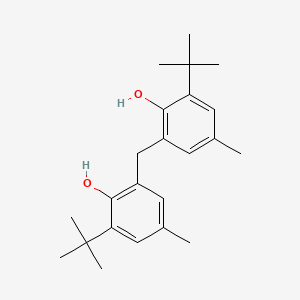
2,2'-Methylenebis(4-methyl-6-tert-butylphenol)
2,2'-Methylenebis(4-methyl-6-tert-butylphenol) is a diarylmethane. — ChEBI
- IUPAC 명칭
- 2-tert-butyl-6-[(3-tert-butyl-2-hydroxy-5-methylphenyl)methyl]-4-methylphenol
- 분자식
- C23H32O2
- 분자량
- 340.5 g/mol
- 정확한 질량
- 340.240230259 Da
- XLogP3
- 7.2
- 위상 극성 표면적
- 40.5 Ų
- 수소 결합 공여체
- 2
- 수소 결합 수용체
- 2
- 공유결합 단위
- 1
- 정의된 입체중심
- 0
다른 이름
보고된 명칭 16개 더 보기
외부 데이터베이스 식별자
- ChEBI:CHEBI:172336
- ChEMBL:CHEMBL460648
- EPA DTXSID:DTXSID4020870
- PubMed:40228673
- PubMed:38160208
- PubMed:33352258
- PubMed:22796571
- PubMed:16749692
- PubMed:16497524
- PubMed:16238337
- PubMed:16231125
- PubMed:15811949
- PubMed:15252483
- PubMed:12816477
- PubMed:11266322
추가 과학 데이터베이스의 근거
NIH PubChem PUG-View
Attributed physical-property, hazard, environmental and use annotations.
- Color/Form: Off-white powder 출처: Hazardous Substances Data Bank (HSDB)
- Density: 1.07-1.10 kg/L 출처: Hazardous Substances Data Bank (HSDB)
- LogP: Log Kow = 6.25 출처: Hazardous Substances Data Bank (HSDB)
- Melting Point: 118-128 °C 출처: Hazardous Substances Data Bank (HSDB)
- Physical Description: Liquid; Dry Powder; Other Solid; Dry Powder 출처: EPA Chemical Data Reporting (CDR)
- Physical Description: Off-white solid; [HSDB] 출처: Haz-Map, Information on Hazardous Chemicals and Occupational Diseases
- Solubility: Soluble in oxygen and aromatic solvents. 출처: Hazardous Substances Data Bank (HSDB)
- Solubility: Water solubility = 0.02 mg/l. 출처: Hazardous Substances Data Bank (HSDB)
- Signal: Danger 출처: Regulation (EC) No 1272/2008 of the European Parliament and of the Council
- GHS Hazard Statements: H360F: May damage fertility [Danger Reproductive toxicity] 출처: Regulation (EC) No 1272/2008 of the European Parliament and of the Council
- Precautionary Statement Codes: P203, P280, P318, P405, and P501 (click each P-code to see the statement) 출처: Regulation (EC) No 1272/2008 of the European Parliament and of the Council
- Note: This chemical does not meet GHS hazard criteria for 15.4% (153 of 995) of reports. 출처: European Chemicals Agency (ECHA)
- Signal: Danger 출처: European Chemicals Agency (ECHA)
- GHS Hazard Statements: H360F (25.2%): May damage fertility [Danger Reproductive toxicity]; H361 (46.2%): Suspected of damaging fertility or the unborn child [Warning Reproductive toxicity]; H413 (47.4%): May cause long lasting harmful effects to aquatic life [Hazardous to the aquatic environment, long-term hazard] 출처: European Chemicals Agency (ECHA)
- Precautionary Statement Codes: P203, P273, P280, P318, P405, and P501 (click each P-code to see the statement) 출처: European Chemicals Agency (ECHA)
- ECHA C&L Notifications Summary: Aggregated GHS information provided per 995 reports by companies from 33 notifications to the ECHA C&L Inventory. Each notification may be associated with multiple companies.; Reported as not meeting GHS hazard criteria per 153 of 995 reports by companies.; There are 32 notifications provided by 842 of 995 reports by companies with hazard statement code(s).; Information may vary between notifications depending on impurities, additives, and other factors. The percentage value in parenthesis indicates the notified classification ratio from companies that provide hazard codes. Only hazard codes with percentage values above 10% are shown. For more detailed information, please visit ECHA C&L website. 출처: European Chemicals Agency (ECHA)
- Signal: Danger 출처: NITE-CMC
- GHS Hazard Statements: H360: May damage fertility or the unborn child [Danger Reproductive toxicity]; H373: May causes damage to organs through prolonged or repeated exposure [Warning Specific target organ toxicity, repeated exposure]; H413: May cause long lasting harmful effects to aquatic life [Hazardous to the aquatic environment, long-term hazard] 출처: NITE-CMC
- Precautionary Statement Codes: P203, P260, P273, P280, P318, P319, P405, and P501 (click each P-code to see the statement) 출처: NITE-CMC
- Signal: Danger 출처: Hazardous Chemical Information System (HCIS), Safe Work Australia
- Environmental Bioconcentration: An estimated BCF value of 33100 was calculated for bis(2-hydroxy-3-tert-butyl-5-methylphenyl)methane(SRC), using an experimental log Kow of 6.25(1) and a recommended regression-derived equation(2). Bioconcentration factors of 23-37 and 60-125 were obtained during an 8 week bioconcentration study using carp and bis(2-hydroxy-3-tert-butyl-5-methylphenyl)methane concentrations of 1 and 0.1 mg/l, respectively(1). According to a recommended classification scheme(3), the experimental BCF values suggest that bioconcentration in aquatic organisms will be moderate to high(SRC). 출처: Hazardous Substances Data Bank (HSDB)
- Environmental Fate: TERRESTRIAL FATE: Based on a recommended classification scheme(1), an estimated Koc value of 59800(SRC), determined from an experimental log Kow(2) and a recommended regression-derived equation(3), indicates that bis(2-hydroxy-3-tert-butyl-5-methylphenyl)methane will have no mobility in soil(SRC). Volatilization of bis(2-hydroxy-3-tert-butyl-5-methylphenyl)methane may not be important from moist soil surfaces(SRC) given an estimated Henry's Law constant of 7.9X10⁻¹² atm-cu m/mole(4,SRC), or from dry soil surfaces(SRC) based on an estimated vapor pressure of 2.5X10⁻⁹ mm Hg(5,SRC). Based on a MITI biodegradation test, bis(2-hydroxy-3-tert-butyl-5-methylphenyl)methane will not biodegrade in soil(2). 출처: Hazardous Substances Data Bank (HSDB)
- Environmental Fate: AQUATIC FATE: Based on a recommended classification scheme(1), an estimated Koc value of 59800(SRC), determined from an experimental log Kow(2) and a recommended regression-derived equation(3), indicates that bis(2-hydroxy-3-tert-butyl-5-methylphenyl)methane will adsorb to suspended solids and sediment(SRC) in the water. Bis(2-hydroxy-3-tert-butyl-5-methylphenyl)methane should not volatilize from water surfaces based on an estimated Henry's Law constant of 7.9X10⁻¹² atm-cu m/mole(SRC), developed using a fragment constant estimation method(4). Experimental BCF values of 23-37 and 60-125 at 1 and 0.1 mg/L(2), suggest that bis(2-hydroxy-3-tert-butyl-5-methylphenyl)methane will bioconcentrate in aquatic organisms(SRC) according to a recommended classification scheme(5). Based on a MITI biodegradation test, bis(2-hydroxy-3-tert-butyl-5-methylphenyl)methane will not biodegrade in water(2). 출처: Hazardous Substances Data Bank (HSDB)
- Environmental Fate: ATMOSPHERIC FATE: According to a suggested classification scheme(1), an estimated vapor pressure of 2.5X10⁻⁹ mm Hg at 25 °C(2,SRC) indicates that bis(2-hydroxy-3-tert-butyl-5-methylphenyl)methane will exist in the particulate phase in the ambient atmosphere. Particulate-phase bis(2-hydroxy-3-tert-butyl-5-methylphenyl)methane may be physically removed from the air by wet and dry deposition(SRC). 출처: Hazardous Substances Data Bank (HSDB)
- Consumer Uses: Antioxidant 출처: EPA Chemical Data Reporting (CDR)
- Industry Uses: Not Known or Reasonably Ascertainable; UV stabilizer; Processing aids not otherwise specified; Antioxidant 출처: EPA Chemical Data Reporting (CDR)
- Sources/Uses: Used as an antioxidant and stabilizer for polymers (ABS, polypropylene, polyacetal, rubber, latex, and adhesives); [HSDB] 출처: Haz-Map, Information on Hazardous Chemicals and Occupational Diseases
- Industrial Processes with risk of exposure: Plastic Composites Manufacturing [Category: Industry] 출처: Haz-Map, Information on Hazardous Chemicals and Occupational Diseases
- Uses: Stabilizer used in styrenic and olefin polymers and polyoxymethylene homo and copolymers. 출처: Hazardous Substances Data Bank (HSDB)
- Uses: Antioxidant (ABS, polypropylene, polyacetal, rubber, latex, adhesives). 출처: Hazardous Substances Data Bank (HSDB)
- Uses: Plastics -> Typical concentration range in plastic materials -> 0.5% 출처: NORMAN Suspect List Exchange
매핑 기준: Existing checksum-valid CAS to unique PubChem CID match. 가져온 시각: 2026-08-31. 출처 기록 열기
과학적 분류와 유해성 주석은 맥락을 제공할 뿐이며, 위에 표시된 시장별 규제 판단을 대체하지 않습니다.
추가 출처 적용 범위 및 일치 상태
| 출처 | 결과 | 확인됨 |
|---|---|---|
| NIH PubChem PUG-View | 정확히 일치 | 2026-08-31 |
기록된 불일치는 출처를 확인했다는 유용한 근거이며, 해당 물질이 다른 곳에 존재하지 않는다는 주장이 아닙니다.
체크섬이 유효한 CAS 일치를 통해 2026-09-02에 NIH PubChem에서 가져왔습니다. 화학적 특성은 이 페이지의 규제 판단을 대체하지 않습니다.
공식 EU 원료 명칭 근거
이 원료 명칭은 공식 2025 EU 일반 원료 명칭 용어집과 정확히 일치합니다.
관련 목록 근거
처방 기능이 겹치는 원료
추가 공식 및 과학 출처
이 정체를 확인할 외부 데이터베이스 11개
각 링크는 해당 출처에서 이 정체를 검색합니다. 각 출처의 성격과 법적 비중
CosIng 목록에서 METHYLENE DI-T-BUTYLCRESOL이(가) 나타나는 방식
CosIng 목록은 METHYLENE DI-T-BUTYLCRESOL을(를) 화장품 원료로 나열하며, 이 페이지는 이를 부속서 기록 1건과 연결합니다. 목록 항목은 명칭과 식별자를 담고 있으며, 부속서 기록은 해당 물질이 EU 화장품 법령에서 사용금지, 사용제한 또는 허용 목록(포지티브 리스트)에 있는 위치를 보여 줍니다.
METHYLENE DI-T-BUTYLCRESOL은(는) 공식 데이터에서 화장품 기능 1개로도 태그되어 있습니다. 기능 표시는 의도된 용도를 설명하지만, 처방 또는 표시 작업 전에 연결된 부속서 기록에 대한 규제 검토를 대체하지 않습니다.