
ISOAMYL ALCOHOL
3-Methylbutan-1-ol
ISOAMYL ALCOHOL은(는) EU CosIng 목록에 등재되어 있지만, 이 페이지에는 아직 직접 연결된 부속서 기록이 없습니다.
시장별 규제 근거
여기에서 추적하는 시장 13곳 중 어느 곳에도 이 원료의 규칙이 가져와지지 않았습니다.
이는 이 목록에 관한 설명이지 법에 관한 설명이 아닙니다. 가져온 규칙이 없다는 것이 원료가 허용된다는 근거는 아닙니다. 규칙은 다른 명칭이나 식별자로, 또는 아직 이곳에 가져오지 않은 데이터세트에 존재할 수 있습니다.
ISOAMYL ALCOHOL의 목록 세부 정보
INCI 명칭
ISOAMYL ALCOHOL
설명
3-Methylbutan-1-ol
ISOAMYL ALCOHOL의 부속서 기록
주요 데이터
- FLAVOURING
Imparting taste and/or flavour to a cosmetic product.
- PERFUMING
Used for perfume and aromatic raw materials.
화학적 정체 및 특성
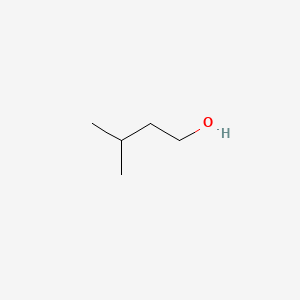
Isoamyl Alcohol
Isoamylol is an primary alcohol that is butan-1-ol in which a hydrogen at position 3 has been replaced by a methyl group. It has a role as an antifungal agent, a Saccharomyces cerevisiae metabolite and a xenobiotic metabolite. It is a volatile organic compound, a primary alcohol and an alkyl alcohol. It derives from a hydride of an isopentane. — ChEBI
- IUPAC 명칭
- 3-methylbutan-1-ol
- 분자식
- C5H12O
- 분자량
- 88.15 g/mol
- 정확한 질량
- 88.088815002 Da
- XLogP3
- 1.2
- 위상 극성 표면적
- 20.2 Ų
- 수소 결합 공여체
- 1
- 수소 결합 수용체
- 1
- 공유결합 단위
- 1
- 정의된 입체중심
- 0
다른 이름
보고된 명칭 16개 더 보기
외부 데이터베이스 식별자
- ChEBI:CHEBI:15837
- ChEMBL:CHEMBL372396
- EPA DTXSID:DTXSID3025469
- PubMed:23107675
- PubMed:23043843
- PubMed:23038161
- PubMed:22980851
- PubMed:22970999
- PubMed:22909118
- PubMed:22908416
- PubMed:22864971
- PubMed:22749163
- PubMed:22745502
- PubMed:22701113
- PubMed:22679480
추가 과학 데이터베이스의 근거
NIH PubChem PUG-View
Attributed physical-property, hazard, environmental and use annotations.
- Autoignition Temperature: 662 °F (USCG, 1999) 출처: CAMEO Chemicals
- Autoignition Temperature: 662 °F 출처: Hazardous Substances Data Bank (HSDB)
- Autoignition Temperature: 340 °C 출처: ILO-WHO International Chemical Safety Cards (ICSCs)
- Boiling Point: 270 °F at 760 mmHg (USCG, 1999) 출처: CAMEO Chemicals
- Boiling Point: 132.5 °C 출처: Hazardous Substances Data Bank (HSDB)
- Boiling Point: 131.00 to 133.00 °C. @ 760.00 mm Hg 출처: Human Metabolome Database (HMDB)
- Boiling Point: 132 °C 출처: ILO-WHO International Chemical Safety Cards (ICSCs)
- Boiling Point: 130 °C 출처: Joint FAO/WHO Expert Committee on Food Additives (JECFA)
- Boiling Point: 270 °F 출처: Occupational Safety and Health Administration (OSHA)
- Boiling Point: 131.1 °C @760 [mm Hg] 출처: PAC Chemical Database, U.S. Department of Energy
- Boiling Point: 270 °F 출처: The National Institute for Occupational Safety and Health (NIOSH)
- Color/Form: OILY, CLEAR LIQ 출처: Hazardous Substances Data Bank (HSDB)
- Color/Form: Colorless liquid. 출처: Hazardous Substances Data Bank (HSDB)
- Density: 0.81 at 68 °F (USCG, 1999) - Less dense than water; will float 출처: CAMEO Chemicals
- Density: 0.813 @ 15 °C/4 °C 출처: Hazardous Substances Data Bank (HSDB)
- Density: Relative density (water = 1): 0.8 출처: ILO-WHO International Chemical Safety Cards (ICSCs)
- Density: 0.807 - 0.813 출처: Joint FAO/WHO Expert Committee on Food Additives (JECFA)
- Density: 0.81 at 68 °F 출처: Occupational Safety and Health Administration (OSHA)
- Density: 0.8104 @ 20°C 출처: PAC Chemical Database, U.S. Department of Energy
- Density: (57 °F): 0.81 출처: The National Institute for Occupational Safety and Health (NIOSH)
- Flash Point: 114 °F (USCG, 1999) 출처: CAMEO Chemicals
- Flash Point: 43 °C 출처: Haz-Map, Information on Hazardous Chemicals and Occupational Diseases
- Flash Point: 109 °F (43 °C) (Closed cup) 출처: Hazardous Substances Data Bank (HSDB)
- Flash Point: 42 °C c.c. 출처: ILO-WHO International Chemical Safety Cards (ICSCs)
- Flash Point: 114 °F 출처: Occupational Safety and Health Administration (OSHA)
- Flash Point: 109 °F 출처: The National Institute for Occupational Safety and Health (NIOSH)
- LogP: log Kow= 1.16 출처: Hazardous Substances Data Bank (HSDB)
- LogP: 1.16 출처: Human Metabolome Database (HMDB)
- LogP: 1.28 출처: ILO-WHO International Chemical Safety Cards (ICSCs)
- Melting Point: -179 °F (NIOSH, 2024) 출처: CAMEO Chemicals
- Melting Point: -117.2 °C 출처: Hazardous Substances Data Bank (HSDB)
- Melting Point: -117.2 °C 출처: Human Metabolome Database (HMDB)
- Melting Point: -117 °C 출처: ILO-WHO International Chemical Safety Cards (ICSCs)
- Melting Point: -179 °F 출처: Occupational Safety and Health Administration (OSHA)
- Melting Point: -117.2 °C 출처: PAC Chemical Database, U.S. Department of Energy
- Melting Point: -179 °F 출처: The National Institute for Occupational Safety and Health (NIOSH)
- Odor: CHARACTERISTIC, DISAGREEABLE ODOR 출처: Hazardous Substances Data Bank (HSDB)
- Odor: Disagreeable odor. 출처: Hazardous Substances Data Bank (HSDB)
- Physical Description: Isoamyl alcohol is a colorless liquid with a mild, choking alcohol odor. Less dense than water, soluble in water. Hence floats on water. Produces an irritating vapor. (USCG, 1999) 출처: CAMEO Chemicals
- Physical Description: Dry Powder; Liquid 출처: EPA Chemical Data Reporting (CDR)
- Physical Description: Colorless liquid with a disagreeable odor; [NIOSH] 출처: Haz-Map, Information on Hazardous Chemicals and Occupational Diseases
- Physical Description: Liquid 출처: Human Metabolome Database (HMDB)
- Physical Description: COLOURLESS LIQUID WITH CHARACTERISTIC ODOUR. 출처: ILO-WHO International Chemical Safety Cards (ICSCs)
- Physical Description: Colourless to pale yellow liquid 출처: Joint FAO/WHO Expert Committee on Food Additives (JECFA)
- Physical Description: Colorless liquid with a disagreeable odor. 출처: Occupational Safety and Health Administration (OSHA)
- Physical Description: Colorless liquid with a disagreeable odor. 출처: The National Institute for Occupational Safety and Health (NIOSH)
- Refractive Index: INDEX OF REFRACTION: 1.4075 @ 20 °C/D 출처: Hazardous Substances Data Bank (HSDB)
- Refractive Index: 1.405 - 1.410 출처: Joint FAO/WHO Expert Committee on Food Additives (JECFA)
- Solubility: 2 % at 57 °F (NIOSH, 2024) 출처: CAMEO Chemicals
- Solubility: MISCIBLE WITH ALC, ETHER, BENZENE, CHLOROFORM, PETROLEUM ETHER, GLACIAL ACETIC ACID, OILS 출처: Hazardous Substances Data Bank (HSDB)
- Solubility: VERY SOL IN ACETONE 출처: Hazardous Substances Data Bank (HSDB)
- Solubility: Water solubility = 2.67X10+4 mg/l @ 25 °C 출처: Hazardous Substances Data Bank (HSDB)
- Solubility: 26.7 mg/mL at 25 °C 출처: Human Metabolome Database (HMDB)
- Solubility: Solubility in water, g/100ml: 2.5 (moderate) 출처: ILO-WHO International Chemical Safety Cards (ICSCs)
- Solubility: Soluble in ethanol, water and most organic solvents 출처: Joint FAO/WHO Expert Committee on Food Additives (JECFA)
- Solubility: (in ethanol) 출처: Joint FAO/WHO Expert Committee on Food Additives (JECFA)
- Solubility: (57 °F): 2% 출처: The National Institute for Occupational Safety and Health (NIOSH)
- Vapor Pressure: 28 mmHg (NIOSH, 2024) 출처: CAMEO Chemicals
- Vapor Pressure: 2.37 [mmHg] 출처: Haz-Map, Information on Hazardous Chemicals and Occupational Diseases
- Vapor Pressure: 2.37 mm Hg @ 25 °C 출처: Hazardous Substances Data Bank (HSDB)
- Vapor Pressure: Vapor pressure, kPa at 20 °C: 0.4 출처: ILO-WHO International Chemical Safety Cards (ICSCs)
- Vapor Pressure: 28 mmHg 출처: Occupational Safety and Health Administration (OSHA)
- Vapor Pressure: 0.75 [mm Hg] @13 °C 출처: PAC Chemical Database, U.S. Department of Energy
- Vapor Pressure: 28 mmHg 출처: The National Institute for Occupational Safety and Health (NIOSH)
- Viscosity: 3.738 cP @ 25 °C 출처: Hazardous Substances Data Bank (HSDB)
- Viscosity: 4.67 mm²/s at 25 °C 출처: ILO-WHO International Chemical Safety Cards (ICSCs)
- Exposure Routes: The substance can be absorbed into the body by inhalation and by ingestion. 출처: ILO-WHO International Chemical Safety Cards (ICSCs)
- Exposure Routes: inhalation, ingestion, skin and/or eye contact 출처: The National Institute for Occupational Safety and Health (NIOSH)
- First Aid: Excerpt from NIOSH Pocket Guide for Isoamyl alcohol (primary):; Eye: IRRIGATE IMMEDIATELY - If this chemical contacts the eyes, immediately wash (irrigate) the eyes with large amounts of water, occasionally lifting the lower and upper lids. Get medical attention immediately.; Skin: WATER FLUSH PROMPTLY - If this chemical contacts the skin, flush the contaminated skin with water promptly. If this chemical penetrates the clothing, immediately remove the clothing and flush the skin with water promptly. If irritation persists after washing, get medical attention.; Breathing: RESPIRATORY SUPPORT - If a person breathes large amounts of this chemical, move the exposed person to fresh air at once. If breathing has stopped, perform artificial respiration. Keep the affected person warm and at rest. Get medical attention as soon as possible.; Swallow: MEDICAL ATTENTION IMMEDIATELY - If this chemical has been swallowed, get medical attention immediately. (NIOSH, 2024) 출처: CAMEO Chemicals
- First Aid: (General first aid procedures); Eye: Irrigate immediately - If this chemical contacts the eyes, immediately wash (irrigate) the eyes with large amounts of water, occasionally lifting the lower and upper lids. Get medical attention immediately.; Skin: Water flush promptly - If this chemical contacts the skin, flush the contaminated skin with water promptly. If this chemical penetrates the clothing, immediately remove the clothing and flush the skin with water promptly. If irritation persists after washing, get medical attention.; Breathing: Respiratory support; Swallow: Medical attention immediately - If this chemical has been swallowed, get medical attention immediately. 출처: The National Institute for Occupational Safety and Health (NIOSH)
- Signal: Danger 출처: European Chemicals Agency (ECHA)
- GHS Hazard Statements: H226 (99.2%): Flammable liquid and vapor [Warning Flammable liquids]; H302 (17.7%): Harmful if swallowed [Warning Acute toxicity, oral]; H315 (69.5%): Causes skin irritation [Warning Skin corrosion/irritation]; H318 (10.3%): Causes serious eye damage [Danger Serious eye damage/eye irritation]; H319 (70.4%): Causes serious eye irritation [Warning Serious eye damage/eye irritation]; H332 (80.5%): Harmful if inhaled [Warning Acute toxicity, inhalation]; H335 (82.6%): May cause respiratory irritation [Warning Specific target organ toxicity, single exposure; Respiratory tract irritation] 출처: European Chemicals Agency (ECHA)
- Precautionary Statement Codes: P210, P233, P240, P241, P242, P243, P261, P264, P264+P265, P270, P271, P280, P301+P317, P302+P352, P303+P361+P353, P304+P340, P305+P351+P338, P305+P354+P338, P317, P319, P321, P330, P332+P317, P337+P317, P362+P364, P370+P378, P403+P233, P403+P235, P405, and P501 (click each P-code to see the statement) 출처: European Chemicals Agency (ECHA)
- ECHA C&L Notifications Summary: Aggregated GHS information provided per 2589 reports by companies from 47 notifications to the ECHA C&L Inventory. Each notification may be associated with multiple companies.; Information may vary between notifications depending on impurities, additives, and other factors. The percentage value in parenthesis indicates the notified classification ratio from companies that provide hazard codes. Only hazard codes with percentage values above 10% are shown. For more detailed information, please visit ECHA C&L website. 출처: European Chemicals Agency (ECHA)
- Signal: Warning 출처: European Chemicals Agency (ECHA)
- GHS Hazard Statements: H226 (52.2%): Flammable liquid and vapor [Warning Flammable liquids]; H315 (47.8%): Causes skin irritation [Warning Skin corrosion/irritation]; H319 (47.8%): Causes serious eye irritation [Warning Serious eye damage/eye irritation]; H332 (100%): Harmful if inhaled [Warning Acute toxicity, inhalation]; H335 (100%): May cause respiratory irritation [Warning Specific target organ toxicity, single exposure; Respiratory tract irritation] 출처: European Chemicals Agency (ECHA)
- Precautionary Statement Codes: P210, P233, P240, P241, P242, P243, P261, P264, P264+P265, P271, P280, P302+P352, P303+P361+P353, P304+P340, P305+P351+P338, P317, P319, P321, P332+P317, P337+P317, P362+P364, P370+P378, P403+P233, P403+P235, P405, and P501 (click each P-code to see the statement) 출처: European Chemicals Agency (ECHA)
- ECHA C&L Notifications Summary: Aggregated GHS information provided per 115 reports by companies from 4 notifications to the ECHA C&L Inventory. Each notification may be associated with multiple companies.; Information may vary between notifications depending on impurities, additives, and other factors. The percentage value in parenthesis indicates the notified classification ratio from companies that provide hazard codes. Only hazard codes with percentage values above 10% are shown. For more detailed information, please visit ECHA C&L website. 출처: European Chemicals Agency (ECHA)
- Signal: Danger 출처: NITE-CMC
- GHS Hazard Statements: H226: Flammable liquid and vapor [Warning Flammable liquids]; H302: Harmful if swallowed [Warning Acute toxicity, oral]; H318: Causes serious eye damage [Danger Serious eye damage/eye irritation]; H335: May cause respiratory irritation [Warning Specific target organ toxicity, single exposure; Respiratory tract irritation]; H336: May cause drowsiness or dizziness [Warning Specific target organ toxicity, single exposure; Narcotic effects] 출처: NITE-CMC
- Precautionary Statement Codes: P210, P233, P240, P241, P242, P243, P261, P264, P264+P265, P270, P271, P280, P301+P317, P303+P361+P353, P304+P340, P305+P354+P338, P317, P319, P330, P370+P378, P403+P233, P403+P235, P405, and P501 (click each P-code to see the statement) 출처: NITE-CMC
- GHS Hazard Statements: H226: Flammable liquid and vapor [Warning Flammable liquids]; H303: May be harmful if swallowed [Warning Acute toxicity, oral]; H313: May be harmful in contact with skin [Warning Acute toxicity, dermal]; H319: Causes serious eye irritation [Warning Serious eye damage/eye irritation]; H335: May cause respiratory irritation [Warning Specific target organ toxicity, single exposure; Respiratory tract irritation]; H336: May cause drowsiness or dizziness [Warning Specific target organ toxicity, single exposure; Narcotic effects]; H370: Causes damage to organs [Danger Specific target organ toxicity, single exposure] 출처: NITE-CMC
- NFPA Health Rating: 1 - Materials that, under emergency conditions, can cause significant irritation. 출처: Hazardous Substances Data Bank (HSDB)
- NFPA Fire Rating: 2 - Materials that must be moderately heated or exposed to relatively high ambient temperatures before ignition can occur. Materials would not under normal conditions form hazardous atmospheres with air, but under high ambient temperatures or under moderate heating could release vapor in sufficient quantities to produce hazardous atmospheres with air. 출처: Hazardous Substances Data Bank (HSDB)
- NFPA Instability Rating: 0 - Materials that in themselves are normally stable, even under fire conditions. 출처: Hazardous Substances Data Bank (HSDB)
- Target Organs: Eyes, skin, respiratory system, central nervous system 출처: The National Institute for Occupational Safety and Health (NIOSH)
- Environmental Bioconcentration: The BCF for isopentanol estimated from isopentanol's octanol/water partition coefficient, log 1.42(1), using a recommended regression equation is 7(2). Such a low BCF would indicate that isopentanol would not bioconcentrate in aquatic organisms(SRC). 출처: Hazardous Substances Data Bank (HSDB)
- Environmental Fate: TERRESTRIAL FATE: In view of isopentanol's relatively high vapor pressure, 2.37 mm Hg at 25 °C(1), moderate Henry's Law constant, 1.41X10⁻⁵ atm-cu m/mol(2), and low adsorptivity to soil, isopentanol would be expected to volatilize from dry and moist soil(SRC). It is highly mobile in soil and should leach. Isopentanol is readily biodegraded in screening tests as well as in water grab sample tests and therefore would be expected to biodegrade in soil. (SRC) 출처: Hazardous Substances Data Bank (HSDB)
- Environmental Fate: AQUATIC FATE: If released in water, isopentanol will be lost by volatilization. The volatilization half-life of isopentanol from a model river estimated from its Henry's Law constant, 1.41X10⁻⁵ atm-cu m/mol(1), is 2.55 days(2). It should also biodegrade. The half-life of isopentanol in groundwater, river water and Lake Superior harbor water in Minnesota were 15, 11, and 6.1 days, respectively(3). Isopentanol would not be expected to adsorb to sediment or bioconcentrate in aquatic organisms. 출처: Hazardous Substances Data Bank (HSDB)
- Environmental Fate: ATMOSPHERIC FATE: Isopentanol will react with photochemically-produced hydroxyl radicals in the atmosphere. The rate constant estimated for this reaction is 7.8X10⁻¹² cu cm/molec-sec(1). Assuming a hydroxyl radical concn of 5X10+5 radicals/cu cm, the half-life of isopentanol in the atmosphere will be 2.0 days(SRC). 출처: Hazardous Substances Data Bank (HSDB)
- Industry Uses: Solvent; Flotation agent 출처: EPA Chemical Data Reporting (CDR)
- Sources/Uses: Used as a solvent, paint stripper, and intermediate in the photographic and pharmaceutical industries; [ACGIH] 출처: Haz-Map, Information on Hazardous Chemicals and Occupational Diseases
- Industrial Processes with risk of exposure: Painting (Solvents) [Category: Paint]; Photographic Processing [Category: Other] 출처: Haz-Map, Information on Hazardous Chemicals and Occupational Diseases
- Uses: SYNTHETIC FLAVOR; INTERMEDIATE IN PREPN OF PHARMACEUTICALS; FOR ISOAMYL ACETATE AND OTHER ESTERS; FOR DITHIOPHOSPHATE ESTERS (LUBRICATING OIL ADDITIVE AND HYDRAULIC FLUID ADDITIVE) 출처: Hazardous Substances Data Bank (HSDB)
- Uses: SOLVENT FOR FATS, RESINS, ALKALOIDS, ETC; MFR ISOAMYL (AMYL) COMPD, ISOVALERIC ACID, MERCURY FULMINATE; MFR PYROXYLIN, ARTIFICIAL SILK, LACQUERS, SMOKELESS POWDERS; IN MICROSCOPY; FOR DEHYDRATING CELLOIDIN SOLN; FOR DETERMINING FAT IN MILK 출처: Hazardous Substances Data Bank (HSDB)
- Uses: REPORTED USES: NON-ALCOHOLIC BEVERAGES 17 PPM, ALCOHOLIC BEVERAGES 100 PPM, ICE CREAM, ICES, ETC 7.6 PPM, CANDY 52 PPM, BAKED GOODS 24 PPM, GELATINS & PUDDINGS 46 PPM, CHEWING GUM 300 PPM. 출처: Hazardous Substances Data Bank (HSDB)
매핑 기준: Existing checksum-valid CAS to unique PubChem CID match. 가져온 시각: 2026-08-31. 출처 기록 열기
과학적 분류와 유해성 주석은 맥락을 제공할 뿐이며, 위에 표시된 시장별 규제 판단을 대체하지 않습니다.
추가 출처 적용 범위 및 일치 상태
| 출처 | 결과 | 확인됨 |
|---|---|---|
| NIH PubChem PUG-View | 정확히 일치 | 2026-08-31 |
기록된 불일치는 출처를 확인했다는 유용한 근거이며, 해당 물질이 다른 곳에 존재하지 않는다는 주장이 아닙니다.
체크섬이 유효한 CAS 일치를 통해 2026-08-31에 NIH PubChem에서 가져왔습니다. 화학적 특성은 이 페이지의 규제 판단을 대체하지 않습니다.
공식 EU 원료 명칭 근거
이 원료 명칭은 공식 2025 EU 일반 원료 명칭 용어집과 정확히 일치합니다.
관련 목록 근거
처방 기능이 겹치는 원료
추가 공식 및 과학 출처
이 정체를 확인할 외부 데이터베이스 11개
각 링크는 해당 출처에서 이 정체를 검색합니다. 각 출처의 성격과 법적 비중
CosIng 목록에서 ISOAMYL ALCOHOL이(가) 나타나는 방식
CosIng 목록은 ISOAMYL ALCOHOL을(를) 화장품 원료로 나열하며, 이 페이지는 이를 부속서 기록 0건과 연결합니다. 목록 항목은 명칭과 식별자를 담고 있으며, 부속서 기록은 해당 물질이 EU 화장품 법령에서 사용금지, 사용제한 또는 허용 목록(포지티브 리스트)에 있는 위치를 보여 줍니다.
ISOAMYL ALCOHOL은(는) 공식 데이터에서 화장품 기능 2개로도 태그되어 있습니다. 기능 표시는 의도된 용도를 설명하지만, 처방 또는 표시 작업 전에 연결된 부속서 기록에 대한 규제 검토를 대체하지 않습니다.