
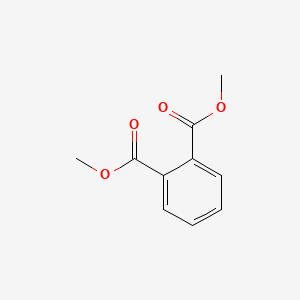
CAS 131-11-3PubChem CID 8554
Dimethyl Phthalate
Dimethyl phthalate is a methyl ester, a phthalate ester and a diester. — ChEBI
- IUPAC 명칭
- dimethyl benzene-1,2-dicarboxylate
- 분자식
- C10H10O4
- 분자량
- 194.18 g/mol
- 정확한 질량
- 194.05790880 Da
- XLogP3
- 1.6
- 위상 극성 표면적
- 52.6 Ų
- 수소 결합 공여체
- 0
- 수소 결합 수용체
- 4
- 공유결합 단위
- 1
- 정의된 입체중심
- 0
다른 이름
DIMETHYLPHTHALATEAvolinMipaxPalatinol MSolvanomSolvaroneFermineDimethyl o-phthalate
보고된 명칭 16개 더 보기
RepeftalPhthalic acid dimethyl esterUnimoll DMDimethyl 1,2-benzenedicarboxylatePhthalsaeuredimethylester1,2-Benzenedicarboxylic acid, dimethyl esterDimethyl benzene-o-dicarboxylateENT 262dimethylphtalateDMF (insect repellant)Dimethyl benzeneorthodicarboxylateRCRA waste number U102Phtalate de dimethyle08X7F5UDJMNSC-15398Dimethylester kyseliny ftalove
외부 데이터베이스 식별자
- ChEBI:CHEBI:4609
- ChEMBL:CHEMBL323348
- EPA DTXSID:DTXSID3022455
- PubMed:35739735
- PubMed:35598668
- PubMed:28571686
- PubMed:27432241
- PubMed:26924002
- PubMed:26867681
- PubMed:26472102
- PubMed:25938866
- PubMed:25349334
- PubMed:24503621
- PubMed:23843199
- PubMed:23013281
추가 과학 데이터베이스의 근거
NIH PubChem PUG-View
식별자 정확히 일치8554
Attributed physical-property, hazard, environmental and use annotations.
- Autoignition Temperature: 915 °F (USCG, 1999) 출처: CAMEO Chemicals
- Autoignition Temperature: 915 °F (490 °C) 출처: Hazardous Substances Data Bank (HSDB)
- Autoignition Temperature: 490 °C 출처: ILO-WHO International Chemical Safety Cards (ICSCs)
- Boiling Point: 542.7 °F at 760 mmHg (NTP, 1992) 출처: CAMEO Chemicals
- Boiling Point: 283.7 °C at 760 mm Hg 출처: Hazardous Substances Data Bank (HSDB)
- Boiling Point: BP: 232.7 °C at 200 mm Hg; 210.0 °C at 100 mm Hg; 194.0 °C at 60 mm Hg; 182.8 °C at 40 mm Hg; 164.0 °C at 20 mm Hg; 147.6 °C at 10 mm Hg; 131.8 °C at 5 mm Hg; 100.3 °C at 1.0 mm Hg 출처: Hazardous Substances Data Bank (HSDB)
- Boiling Point: 284 °C 출처: ILO-WHO International Chemical Safety Cards (ICSCs)
- Boiling Point: 543 °F 출처: Occupational Safety and Health Administration (OSHA)
- Boiling Point: 283.7 °C @760 [mm Hg] 출처: PAC Chemical Database, U.S. Department of Energy
- Boiling Point: 543 °F 출처: The National Institute for Occupational Safety and Health (NIOSH)
- Color/Form: Pale yellow 출처: Hazardous Substances Data Bank (HSDB)
- Color/Form: Colorless, oily liquid [Note: A solid below 42 degrees F] 출처: Hazardous Substances Data Bank (HSDB)
- Density: 1.1905 at 68 °F (USCG, 1999) - Denser than water; will sink 출처: CAMEO Chemicals
- Density: 1.196 at 15.6 °C/15.6 °C; 1.1940 at 20 °C/20 °C; 1.189 at 25 °C/25 °C 출처: Hazardous Substances Data Bank (HSDB)
- Density: Bulk density 9.93 lb/gal at 68 °F. 출처: Hazardous Substances Data Bank (HSDB)
- Density: Relative density (water = 1): 1.19 출처: ILO-WHO International Chemical Safety Cards (ICSCs)
- Density: 1.19 출처: Occupational Safety and Health Administration (OSHA)
- Density: 1.1905 @ 20°C 출처: PAC Chemical Database, U.S. Department of Energy
- Density: 1.19 출처: The National Institute for Occupational Safety and Health (NIOSH)
- Flash Point: 295 °F (NTP, 1992) 출처: CAMEO Chemicals
- Flash Point: 146 °C 출처: Haz-Map, Information on Hazardous Chemicals and Occupational Diseases
- Flash Point: 295 °F (146 °C) (Closed cup) 출처: Hazardous Substances Data Bank (HSDB)
- Flash Point: 146 °C c.c. 출처: ILO-WHO International Chemical Safety Cards (ICSCs)
- Flash Point: 295 °F 출처: Occupational Safety and Health Administration (OSHA)
- Flash Point: 295 °F 출처: The National Institute for Occupational Safety and Health (NIOSH)
- LogP: log Kow = 1.60 출처: Hazardous Substances Data Bank (HSDB)
- LogP: 1.47/2.12 출처: ILO-WHO International Chemical Safety Cards (ICSCs)
- Melting Point: 32 °F (NTP, 1992) 출처: CAMEO Chemicals
- Melting Point: 5.5 °C 출처: Hazardous Substances Data Bank (HSDB)
- Melting Point: 5.5 °C 출처: ILO-WHO International Chemical Safety Cards (ICSCs)
- Melting Point: 32 °F 출처: Occupational Safety and Health Administration (OSHA)
- Melting Point: 5.5 °C 출처: PAC Chemical Database, U.S. Department of Energy
- Melting Point: 42 °F 출처: The National Institute for Occupational Safety and Health (NIOSH)
- Odor: Slight aromatic odor 출처: Hazardous Substances Data Bank (HSDB)
- Physical Description: Dimethyl phthalate appears as a water-white liquid without significant odor. Denser than water and insoluble in water. Hence sinks in water. Flash point 300 °F. Eye contact may produce severe irritation and direct skin contact may produce mild irritation. Used in the manufacture of a variety of products including plastics, insect repellents, safety glass, and lacquer coatings. 출처: CAMEO Chemicals
- Physical Description: Liquid; CBI; Other Solid 출처: EPA Chemical Data Reporting (CDR)
- Physical Description: Colorless, oily liquid with a slight, aromatic odor; Note: A solid below 42 degrees F; [NIOSH] 출처: Haz-Map, Information on Hazardous Chemicals and Occupational Diseases
- Physical Description: COLOURLESS OILY LIQUID. 출처: ILO-WHO International Chemical Safety Cards (ICSCs)
- Physical Description: Colorless, oily liquid with a slight, aromatic odor. 출처: Occupational Safety and Health Administration (OSHA)
- Physical Description: Colorless, oily liquid with a slight, aromatic odor. [Note: A solid below 42 °F.] 출처: The National Institute for Occupational Safety and Health (NIOSH)
- Refractive Index: Index of refraction: 1.5168 at 20 °C/D 출처: Hazardous Substances Data Bank (HSDB)
- Solubility: less than 1 mg/mL at 68 °F (NTP, 1992) 출처: CAMEO Chemicals
- Solubility: In water, 4,000 mg/L at 25 °C 출처: Hazardous Substances Data Bank (HSDB)
- Solubility: Miscible with alcohol, ether, chloroform. Practically insoluble in petroleum ether, and other paraffin hydrocarbons. 출처: Hazardous Substances Data Bank (HSDB)
- Solubility: Solubility in mineral oil at 20 °C: 0.34 g/100 g 출처: Hazardous Substances Data Bank (HSDB)
- Solubility: Miscible with ethanol, ethyl ether; soluble in benzene; slightly soluble in carbon tetrachloride 출처: Hazardous Substances Data Bank (HSDB)
- Solubility: Readily soluble in organic solvents, alcohols, esters, ketones, chlorinated hydrocarbons. Slightly soluble in some types of mineral oil. 출처: Hazardous Substances Data Bank (HSDB)
- Solubility: Solubility in water, g/100ml at 20 °C: 0.43 출처: ILO-WHO International Chemical Safety Cards (ICSCs)
- Solubility: 0.4% 출처: The National Institute for Occupational Safety and Health (NIOSH)
- Vapor Pressure: 1 mmHg at 212.5 °F ; 5 mmHg at 269.2 °F; 10 mmHg at 297.7 °F (NTP, 1992) 출처: CAMEO Chemicals
- Vapor Pressure: 0.0031 [mmHg] 출처: Haz-Map, Information on Hazardous Chemicals and Occupational Diseases
- Vapor Pressure: VP: <0.01 mm Hg at 20 °C 출처: Hazardous Substances Data Bank (HSDB)
- Vapor Pressure: 3.08X10⁻³ mm Hg at 25 °C /from experimentally-derived coefficients/ 출처: Hazardous Substances Data Bank (HSDB)
- Vapor Pressure: Vapor pressure, Pa at 20 °C: 0.8 출처: ILO-WHO International Chemical Safety Cards (ICSCs)
- Vapor Pressure: 0.01 mmHg 출처: Occupational Safety and Health Administration (OSHA)
- Vapor Pressure: 0.01 mmHg 출처: The National Institute for Occupational Safety and Health (NIOSH)
- Viscosity: 17.2 cP at 25 °C 출처: Hazardous Substances Data Bank (HSDB)
- Carcinogen Classification: No indication of carcinogenicity to humans (not listed by IARC). 출처: Toxin and Toxin Target Database (T3DB)
- Exposure Routes: inhalation, ingestion, skin and/or eye contact 출처: The National Institute for Occupational Safety and Health (NIOSH)
- Exposure Routes: Oral (L1903) ; inhalation (L1903) ; dermal (L1903) 출처: Toxin and Toxin Target Database (T3DB)
- First Aid: EYES: First check the victim for contact lenses and remove if present. Flush victim's eyes with water or normal saline solution for 20 to 30 minutes while simultaneously calling a hospital or poison control center. Do not put any ointments, oils, or medication in the victim's eyes without specific instructions from a physician. IMMEDIATELY transport the victim after flushing eyes to a hospital even if no symptoms (such as redness or irritation) develop.; SKIN: IMMEDIATELY flood affected skin with water while removing and isolating all contaminated clothing. Gently wash all affected skin areas thoroughly with soap and water. If symptoms such as redness or irritation develop, IMMEDIATELY call a physician and be prepared to transport the victim to a hospital for treatment.; INHALATION: IMMEDIATELY leave the contaminated area; take deep breaths of fresh air. If symptoms (such as wheezing, coughing, shortness of breath, or burning in the mouth, throat, or chest) develop, call a physician and be prepared to transport the victim to a hospital. Provide proper respiratory protection to rescuers entering an unknown atmosphere. Whenever possible, Self-Contained Breathing Apparatus (SCBA) shou 출처: CAMEO Chemicals
- First Aid: (General first aid procedures); Eye: Irrigate promptly - If this chemical contacts the eyes, promptly wash (irrigate) the eyes with large amounts of water, occasionally lifting the lower and upper lids. Get medical attention if any discomfort continues.; Skin: Wash regularly; Breathing: Respiratory support; Swallow: Medical attention immediately - If this chemical has been swallowed, get medical attention immediately. 출처: The National Institute for Occupational Safety and Health (NIOSH)
- Signal: Danger 출처: Regulation (EC) No 1272/2008 of the European Parliament and of the Council
- GHS Hazard Statements: H242: Heating may cause a fire [Danger Self-reactive substances and mixtures; Organic peroxides]; H302: Harmful if swallowed [Warning Acute toxicity, oral]; H314: Causes severe skin burns and eye damage [Danger Skin corrosion/irritation]; H317: May cause an allergic skin reaction [Warning Sensitization, Skin]; H411: Toxic to aquatic life with long lasting effects [Hazardous to the aquatic environment, long-term hazard] 출처: Regulation (EC) No 1272/2008 of the European Parliament and of the Council
- Precautionary Statement Codes: P210, P234, P235, P240, P260, P261, P264, P270, P272, P273, P280, P301+P317, P301+P330+P331, P302+P352, P302+P361+P354, P304+P340, P305+P354+P338, P316, P321, P330, P333+P317, P362+P364, P363, P370+P378, P391, P403, P405, P410, P411, P420, and P501 (click each P-code to see the statement) 출처: Regulation (EC) No 1272/2008 of the European Parliament and of the Council
- Note: This chemical does not meet GHS hazard criteria for 95.7% (1993 of 2082) of all reports. 출처: European Chemicals Agency (ECHA)
- GHS Hazard Statements: Not Classified; Reported as not meeting GHS hazard criteria by 1993 of 2082 companies (only 4.3% companies provided GHS information). For more detailed information, please visit ECHA C&L website. 출처: European Chemicals Agency (ECHA)
- ECHA C&L Notifications Summary: Aggregated GHS information provided per 2082 reports by companies from 15 notifications to the ECHA C&L Inventory.; Reported as not meeting GHS hazard criteria per 1993 of 2082 reports by companies.; There are 14 notifications provided by 89 of 2082 reports by companies with hazard statement code(s).; Information may vary between notifications depending on impurities, additives, and other factors. The percentage value in parenthesis indicates the notified classification ratio from companies that provide hazard codes. Only hazard codes with percentage values above 10% are shown. For more detailed information, please visit ECHA C&L website. 출처: European Chemicals Agency (ECHA)
- Signal: Warning 출처: NITE-CMC
- GHS Hazard Statements: H320: Causes eye irritation [Warning Serious eye damage/eye irritation]; H335: May cause respiratory irritation [Warning Specific target organ toxicity, single exposure; Respiratory tract irritation]; H336: May cause drowsiness or dizziness [Warning Specific target organ toxicity, single exposure; Narcotic effects]; H402: Harmful to aquatic life [Hazardous to the aquatic environment, acute hazard] 출처: NITE-CMC
- Precautionary Statement Codes: P261, P264+P265, P271, P273, P304+P340, P305+P351+P338, P319, P337+P317, P403+P233, P405, and P501 (click each P-code to see the statement) 출처: NITE-CMC
- GHS Hazard Statements: H320: Causes eye irritation [Warning Serious eye damage/eye irritation]; H336: May cause drowsiness or dizziness [Warning Specific target organ toxicity, single exposure; Narcotic effects] 출처: NITE-CMC
- Precautionary Statement Codes: P261, P264+P265, P271, P304+P340, P305+P351+P338, P319, P337+P317, P403+P233, P405, and P501 (click each P-code to see the statement) 출처: NITE-CMC
- GHS Hazard Statements: H402: Harmful to aquatic life [Hazardous to the aquatic environment, acute hazard] 출처: Hazardous Substances Data Bank (HSDB)
- Health Effects: Phthalate esters are endocrine disruptors. Animal studies have shown that they disrupt reproductive development and can cause a number of malformations in affected young, such as reduced anogenital distance (AGD), cryptorchidism, hypospadias, and reduced fertility. The combination of effects associated with phthalates is called 'phthalate syndrome’. (A2883) 출처: Toxin and Toxin Target Database (T3DB)
- NFPA Health Rating: 1 - Materials that, under emergency conditions, can cause significant irritation. 출처: Hazardous Substances Data Bank (HSDB)
- NFPA Fire Rating: 1 - Materials that must be preheated before ignition can occur. Materials require considerable preheating, under all ambient temperature conditions, before ignition and combustion can occur. 출처: Hazardous Substances Data Bank (HSDB)
- NFPA Instability Rating: 0 - Materials that in themselves are normally stable, even under fire conditions. 출처: Hazardous Substances Data Bank (HSDB)
- Target Organs: Eyes, respiratory system, gastrointestinal tract 출처: The National Institute for Occupational Safety and Health (NIOSH)
- Cosmetic Ingredient Review Finding(s): Safe in the present practices of use and concentration. Ingredient, concentration, and use information are available in documents discoverable at https://cir-reports.cir-safety.org 출처: Cosmetic Ingredient Review (CIR)
- Toxicity Summary: IDENTIFICATION AND USE: Dimethyl phthalate (DMP) is a pale yellow, or colorless, oily liquid (solid below 42 °F) with slight aromatic odor. It is used as plasticizer for nitrocellulose and cellulose acetate, resins, and in solid rocket propellants; lacquers; plastics; rubber; coating agents; safety glass; and molding powders. Formerly it was used as a repellant for flies on horses and cows, and as a leech repellant. DMP is not registered for current use in the U.S., but approved pesticide uses may change periodically and so federal, state and local authorities must be consulted for currently approved uses. HUMAN EXPOSURE AND TOXICITY: In man, dimethyl phthalate has caused skin irritation reactions and skin sensitization was induced in one individual. Repeated inhalation of the vapor irritated the nose and upper respiratory tract. If swallowed, DMP may cause irritation of the stomach, dizziness, and unconsciousness. In one fatal case of suicidal ingestion of a mixture containing dimethyl phthalate and ketone peroxides, the principal toxic symptoms were marked esophagitis, gastritis, and hemorrhage. Mortality of human sperm in vitro was reduced by 25% in cultures containing 0.4 mM DM 출처: Hazardous Substances Data Bank (HSDB)
- Toxicity Summary: Phthalate esters are endocrine disruptors. They decrease foetal testis testosterone production and reduce the expression of steroidogenic genes by decreasing mRNA expression. Some phthalates have also been shown to reduce the expression of insulin-like peptide 3 (insl3), an important hormone secreted by the Leydig cell necessary for development of the gubernacular ligament. Animal studies have shown that these effects disrupt reproductive development and can cause a number of malformations in affected young. (A2883) 출처: Toxin and Toxin Target Database (T3DB)
- Environmental Bioconcentration: The mean BCF of dimethyl phthalate in sheepshead minnows was 5.4, after 24 hr(1). Bluegill sunfish showed a bioconcentration factor of 57(2) which may be elevated because only carbon-14 was measured in the experiment and metabolites may be included in the measurement of the parent compound(SRC). The depuration half-life was between 1 and 2 days(2). According to a classification scheme(3), these measured BCFs suggest that bioconcentration in aquatic organisms is low to moderate(SRC). The mean BCF of dimethyl phthalate in brown shrimp was 4.7, after 24 hr(1). Bioaccumulation factors of 3.1 and 6.3 were measured in shrimp (Peneaus aztecus) following 1 day of exposure(4). BCFs of 0.14-0.57 were reported for dimethyl phthalate in water spinach (Ipomoea aquatica) grown under different conditions on sludge from waste water treatment plants in China(5). 출처: Hazardous Substances Data Bank (HSDB)
- Environmental Fate: TERRESTRIAL FATE: Based on a classification scheme(1), Koc values of 55-360(2-4), indicate that dimethyl phthalate is expected to have high to moderate mobility in soil(SRC). Volatilization of dimethyl phthalate from moist soil surfaces is not expected to be an important fate process(SRC) given an estimated Henry's Law constant of 2.0X10⁻⁷ atm-cu m/mole(SRC), based upon its vapor pressure, 3.08X10⁻³ mm Hg(5), and water solubility, 4000 mg/L(6). Dimethyl phthalate is not expected to volatilize from dry soil surfaces(SRC) based upon its vapor pressure(5). Biodegradation half-lives in contaminated soil ranging from 15 to 123 days(7) suggest that biodegradation is dependent on prior exposure and subsequent acclimation(SRC). 출처: Hazardous Substances Data Bank (HSDB)
- Environmental Fate: AQUATIC FATE: Based on a classification scheme(1), a log Koc value of >5.2 measured in suspended solids(2), indicates that dimethyl phthalate is expected to adsorb to suspended solids and sediment(SRC). Volatilization from water surfaces is not expected(3) based upon an estimated Henry's Law constant of 2.0X10⁻⁷ atm-cu m/mole(SRC), derived from its vapor pressure, 3.08X10⁻³ mm Hg(4), and water solubility, 4000 mg/L(5). The hydrolysis half-life of dimethyl phthalate is estimated to be 3.2 yr under neutral conditions at 30 °C(6). However, at pH 9, the estimated half-lives are 11.6 and 25 days at 30 and 18 °C, respectively(7). According to a classification scheme(8), BCFs of 5.4 in sheepshead minnows(9) and 57 in bluegill sunfish(10), suggest bioconcentration in aquatic organisms is low to moderate(SRC). Biodegradation half-lives have been reported as 1-5 days in water/sediment environments and 2-12 days in water(11). Other studies saw complete removal of dimethyl phthalate in 8-11 days in river water, but only 20-32% degradation in seawater in 2 weeks(12). These studies indicate that biodegradation will occur(SRC). The half-life for direct photolysis in surface waters is estimated at 출처: Hazardous Substances Data Bank (HSDB)
- Environmental Fate: ATMOSPHERIC FATE: According to a model of gas/particle partitioning of semivolatile organic compounds in the atmosphere(1), dimethyl phthalate, which has a vapor pressure of 3.08X10⁻³ mm Hg at 25 °C(2), is expected to exist solely as a vapor in the ambient atmosphere. Vapor-phase dimethyl phthalate is degraded in the atmosphere by reaction with photochemically-produced hydroxyl radicals(SRC); the half-life for this reaction in air is estimated to be 28 days(SRC), calculated from its rate constant of 5.7X10⁻¹³ cu cm/molecule-sec at 25 °C(SRC) that was derived using a structure estimation method(3). Dimethyl phthalate contains chromophores that absorb at wavelengths >290 nm(4) and, therefore, may be susceptible to direct photolysis by sunlight(SRC). 출처: Hazardous Substances Data Bank (HSDB)
- Consumer Uses: Plasticizer 출처: EPA Chemical Data Reporting (CDR)
- Industry Uses: CBI; Intermediate; Plasticizer 출처: EPA Chemical Data Reporting (CDR)
- Cosmetic Ingredient Review Link: CIR ingredient: Dimethyl Phthalate 출처: Cosmetic Ingredient Review (CIR)
- Uses: Dimethyl phthalate is used in solid rocket propellants, lacquers, plastics, safety glasses, rubber coating agents, molding powders, insect repellants, and pesticides. 출처: EPA Hazardous Air Pollutants
- Sources/Uses: Plasticizer (added to polymers to effect flexibility and/or toughness); also used as a solvent and insect repellant; [ACGIH] 출처: Haz-Map, Information on Hazardous Chemicals and Occupational Diseases
- Restricted Notes: No longer registered for pesticide use; [HSDB] 출처: Haz-Map, Information on Hazardous Chemicals and Occupational Diseases
- Uses: For dimethyl phthalate (USEPA/OPP Pesticide Code: 028002) there are 0 labels match. /SRP: Not registered for current use in the U.S., but approved pesticide uses may change periodically and so federal, state and local authorities must be consulted for currently approved uses./ 출처: Hazardous Substances Data Bank (HSDB)
- Uses: The active ingredient is no longer contained in any registered pesticide products ... "cancelled." 출처: Hazardous Substances Data Bank (HSDB)
- Uses: Solvent and plasticizer for cellulose acetate and cellulose acetate-butyrate compositions. Insect repellent for personal protection against biting insects. 출처: Hazardous Substances Data Bank (HSDB)
- Uses: For making varnishes & clear white or slightly colored clear films which may be exposed to the sun. 출처: Hazardous Substances Data Bank (HSDB)
- Uses: For more Uses (Complete) data for DIMETHYL PHTHALATE (14 total), please visit the HSDB record page. 출처: Hazardous Substances Data Bank (HSDB)
- Uses: Dimethyl phthalate is an ectoparasiticide and has many other uses, including in solid rocket propellants, plastics, and insect repellants. (L1906) 출처: Toxin and Toxin Target Database (T3DB)
매핑 기준: Existing checksum-valid CAS to unique PubChem CID match. 가져온 시각: 2026-08-31. 출처 기록 열기
과학적 분류와 유해성 주석은 맥락을 제공할 뿐이며, 위에 표시된 시장별 규제 판단을 대체하지 않습니다.
추가 출처 적용 범위 및 일치 상태
| 출처 | 결과 | 확인됨 |
|---|---|---|
| NIH PubChem PUG-View | 정확히 일치 | 2026-08-31 |
기록된 불일치는 출처를 확인했다는 유용한 근거이며, 해당 물질이 다른 곳에 존재하지 않는다는 주장이 아닙니다.
체크섬이 유효한 CAS 일치를 통해 2026-08-31에 NIH PubChem에서 가져왔습니다. 화학적 특성은 이 페이지의 규제 판단을 대체하지 않습니다.