
CAS 1300-73-8
CAS 1300-73-8은(는) 규정 1223/2009의 부속서 II–VI에 걸쳐 EU 부속서 기록 1건과 일치합니다.
CAS 1300-73-8의 기록
1 총화학적 정체 및 특성
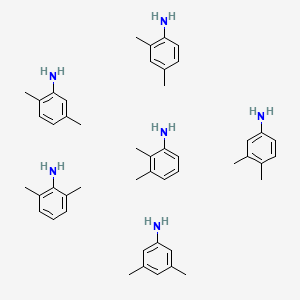
Xylidine
Xylidines is a pale-yellow to brown liquid with a weak, aromatic, amine-like odor. (NIOSH, 2024) — CAMEO Chemicals
- IUPAC 명칭
- 2,3-dimethylaniline;2,4-dimethylaniline;2,5-dimethylaniline;2,6-dimethylaniline;3,4-dimethylaniline;3,5-dimethylaniline
- 분자식
- C48H66N6
- 분자량
- 727.1 g/mol
- 정확한 질량
- 726.53489613 Da
- 위상 극성 표면적
- 156.0 Ų
- 수소 결합 공여체
- 6
- 수소 결합 수용체
- 6
- 공유결합 단위
- 6
- 정의된 입체중심
- 0
다른 이름
보고된 명칭 10개 더 보기
추가 과학 데이터베이스의 근거
NIH PubChem PUG-View
Attributed physical-property, hazard, environmental and use annotations.
- Autoignition Temperature: 520-590 °C 출처: ILO-WHO International Chemical Safety Cards (ICSCs)
- Boiling Point: 415 to 439 °F at 760 mmHg (NIOSH, 2024) 출처: CAMEO Chemicals
- Boiling Point: 213-226 °C 출처: Hazardous Substances Data Bank (HSDB)
- Boiling Point: 216-228 °C 출처: ILO-WHO International Chemical Safety Cards (ICSCs)
- Boiling Point: 415-439 °F 출처: Occupational Safety and Health Administration (OSHA)
- Boiling Point: 415-439 °F 출처: The National Institute for Occupational Safety and Health (NIOSH)
- Color/Form: Pale yellow to a brown liquid. 출처: Hazardous Substances Data Bank (HSDB)
- Color/Form: All /isomers/ except ortho-4-xylidine are liquids above 20 °C. 출처: Hazardous Substances Data Bank (HSDB)
- Color/Form: Pale-yellow to brown liquid. 출처: Hazardous Substances Data Bank (HSDB)
- Density: 0.98 (NIOSH, 2024) - Less dense than water; will float 출처: CAMEO Chemicals
- Density: 0.97-0.99 출처: Hazardous Substances Data Bank (HSDB)
- Density: Relative density (water = 1): 0.97-1.07 출처: ILO-WHO International Chemical Safety Cards (ICSCs)
- Density: 0.98 출처: Occupational Safety and Health Administration (OSHA)
- Density: .97-.99 no temp 출처: PAC Chemical Database, U.S. Department of Energy
- Density: 0.98 출처: The National Institute for Occupational Safety and Health (NIOSH)
- Flash Point: 206 °F (2,3-) (NIOSH, 2024) 출처: CAMEO Chemicals
- Flash Point: 206 °F 출처: Haz-Map, Information on Hazardous Chemicals and Occupational Diseases
- Flash Point: 90-98 °C c.c. 출처: ILO-WHO International Chemical Safety Cards (ICSCs)
- Flash Point: 206 °F (2,3-) 출처: Occupational Safety and Health Administration (OSHA)
- Flash Point: 206 °F (2,3-) 출처: The National Institute for Occupational Safety and Health (NIOSH)
- LogP: 1.8-2.2 (estimated) 출처: ILO-WHO International Chemical Safety Cards (ICSCs)
- Melting Point: -33 °F (NIOSH, 2024) 출처: CAMEO Chemicals
- Melting Point: -36 °C 출처: Hazardous Substances Data Bank (HSDB)
- Melting Point: -33 °F 출처: Occupational Safety and Health Administration (OSHA)
- Melting Point: -36 °C 출처: PAC Chemical Database, U.S. Department of Energy
- Melting Point: -33 °F 출처: The National Institute for Occupational Safety and Health (NIOSH)
- Odor: Weak aromatic amine odor 출처: Hazardous Substances Data Bank (HSDB)
- Physical Description: Xylidines is a pale-yellow to brown liquid with a weak, aromatic, amine-like odor. (NIOSH, 2024) 출처: CAMEO Chemicals
- Physical Description: Pale-yellow to brown liquid with a weak, aromatic, amine-like odor; [NIOSH] 출처: Haz-Map, Information on Hazardous Chemicals and Occupational Diseases
- Physical Description: PALE YELLOW-TO-BROWN LIQUID WITH CHARACTERISTIC ODOUR. TURNS BROWN ON EXPOSURE TO AIR. 출처: ILO-WHO International Chemical Safety Cards (ICSCs)
- Physical Description: Pale-yellow to brown liquid with a weak, aromatic, amine-like odor. 출처: Occupational Safety and Health Administration (OSHA)
- Physical Description: Pale-yellow to brown liquid with a weak, aromatic, amine-like odor. 출처: The National Institute for Occupational Safety and Health (NIOSH)
- Solubility: Slight (NIOSH, 2024) 출처: CAMEO Chemicals
- Solubility: Slightly sol in water; sol in alcohol 출처: Hazardous Substances Data Bank (HSDB)
- Solubility: Sparingly soluble in water, soluble in alcohol. 출처: Hazardous Substances Data Bank (HSDB)
- Solubility: Soluble in ether. 출처: Hazardous Substances Data Bank (HSDB)
- Solubility: Solubility in water: poor 출처: ILO-WHO International Chemical Safety Cards (ICSCs)
- Solubility: Slight 출처: The National Institute for Occupational Safety and Health (NIOSH)
- Vapor Pressure: less than 1 mmHg (NIOSH, 2024) 출처: CAMEO Chemicals
- Vapor Pressure: 0.13 [mmHg] 출처: Haz-Map, Information on Hazardous Chemicals and Occupational Diseases
- Vapor Pressure: Vapor pressure, Pa at 20 °C: 출처: ILO-WHO International Chemical Safety Cards (ICSCs)
- Vapor Pressure: <1 mmHg 출처: Occupational Safety and Health Administration (OSHA)
- Vapor Pressure: <1 mmHg 출처: The National Institute for Occupational Safety and Health (NIOSH)
- Exposure Routes: The substance can be absorbed into the body in hazardous amounts by inhalation, through the skin and by ingestion. 출처: ILO-WHO International Chemical Safety Cards (ICSCs)
- Exposure Routes: inhalation, skin absorption, ingestion, skin and/or eye contact 출처: The National Institute for Occupational Safety and Health (NIOSH)
- First Aid: Excerpt from NIOSH Pocket Guide for Xylidine:; Eye: IRRIGATE IMMEDIATELY - If this chemical contacts the eyes, immediately wash (irrigate) the eyes with large amounts of water, occasionally lifting the lower and upper lids. Get medical attention immediately.; Skin: SOAP WASH IMMEDIATELY - If this chemical contacts the skin, immediately wash the contaminated skin with soap and water. If this chemical penetrates the clothing, immediately remove the clothing, wash the skin with soap and water, and get medical attention promptly.; Breathing: RESPIRATORY SUPPORT - If a person breathes large amounts of this chemical, move the exposed person to fresh air at once. If breathing has stopped, perform artificial respiration. Keep the affected person warm and at rest. Get medical attention as soon as possible.; Swallow: MEDICAL ATTENTION IMMEDIATELY - If this chemical has been swallowed, get medical attention immediately. (NIOSH, 2024) 출처: CAMEO Chemicals
- ERG2024, Guide 153 (Xylidines, solid; Xylidines, liquid): General First Aid:; · Call 911 or emergency medical service.; · Ensure that medical personnel are aware of the material(s) involved, take precautions to protect themselves and avoid contamination.; · Move victim to fresh air if it can be done safely.; · Administer oxygen if breathing is difficult.; · If victim is not breathing:; -- DO NOT perform mouth-to-mouth resuscitation; the victim may have ingested or inhaled the substance.; -- If equipped and pulse detected, wash face and mouth, then give artificial respiration using a proper respiratory medical device (bag-valve mask, pocket mask equipped with a one-way valve or other device).; -- If no pulse detected or no respiratory medical device available, provide continuous compressions. Conduct a pulse check every two minutes or monitor for any signs of spontaneous respirations.; · Remove and isolate contaminated clothing and shoes.; · For minor skin contact, avoid spreading material on unaffected skin.; · In case of contact with substance, remove immediately by flushing skin or eyes with running water for at least 20 minutes.; · For severe burns, immediate medical attention is required.; · Effects of exposure (inhalation, ingestion, 출처: Emergency Response Guidebook (ERG)
- First Aid: (General first aid procedures); Eye: Irrigate immediately - If this chemical contacts the eyes, immediately wash (irrigate) the eyes with large amounts of water, occasionally lifting the lower and upper lids. Get medical attention immediately.; Skin: Soap wash immediately - If this chemical contacts the skin, immediately wash the contaminated skin with soap and water. If this chemical penetrates the clothing, immediately remove the clothing, wash the skin with soap and water, and get medical attention promptly.; Breathing: Respiratory support; Swallow: Medical attention immediately - If this chemical has been swallowed, get medical attention immediately. 출처: The National Institute for Occupational Safety and Health (NIOSH)
- Signal: Danger 출처: European Chemicals Agency (ECHA)
- GHS Hazard Statements: H301+H311+H331 (21.3%): Toxic if swallowed, in contact with skin or if inhaled [Danger Acute toxicity, oral; acute toxicity, dermal; acute toxicity, inhalation]; H301+H311 (56.8%): Toxic if swallowed or in contact with skin [Danger Acute toxicity, oral; acute toxicity, dermal]; H301 (98.9%): Toxic if swallowed [Danger Acute toxicity, oral]; H311 (98.4%): Toxic in contact with skin [Danger Acute toxicity, dermal]; H315 (56.8%): Causes skin irritation [Warning Skin corrosion/irritation]; H319 (57.4%): Causes serious eye irritation [Warning Serious eye damage/eye irritation]; H330 (57.9%): Fatal if inhaled [Danger Acute toxicity, inhalation]; H331 (41.5%): Toxic if inhaled [Danger Acute toxicity, inhalation]; H351 (57.9%): Suspected of causing cancer [Warning Carcinogenicity]; H373 (99.5%): May causes damage to organs through prolonged or repeated exposure [Warning Specific target organ toxicity, repeated exposure]; H411 (99.5%): Toxic to aquatic life with long lasting effects [Hazardous to the aquatic environment, long-term hazard] 출처: European Chemicals Agency (ECHA)
- Precautionary Statement Codes: P203, P260, P261, P262, P264, P264+P265, P270, P271, P273, P280, P284, P301+P316, P302+P352, P304+P340, P305+P351+P338, P316, P318, P319, P320, P321, P330, P332+P317, P337+P317, P361+P364, P362+P364, P391, P403+P233, P405, and P501 (click each P-code to see the statement) 출처: European Chemicals Agency (ECHA)
- ECHA C&L Notifications Summary: Aggregated GHS information provided per 183 reports by companies from 6 notifications to the ECHA C&L Inventory. Each notification may be associated with multiple companies.; Information may vary between notifications depending on impurities, additives, and other factors. The percentage value in parenthesis indicates the notified classification ratio from companies that provide hazard codes. Only hazard codes with percentage values above 10% are shown. For more detailed information, please visit ECHA C&L website. 출처: European Chemicals Agency (ECHA)
- Signal: Danger 출처: NITE-CMC
- GHS Hazard Statements: H302: Harmful if swallowed [Warning Acute toxicity, oral]; H312: Harmful in contact with skin [Warning Acute toxicity, dermal]; H319: Causes serious eye irritation [Warning Serious eye damage/eye irritation]; H330: Fatal if inhaled [Danger Acute toxicity, inhalation]; H336: May cause drowsiness or dizziness [Warning Specific target organ toxicity, single exposure; Narcotic effects]; H351: Suspected of causing cancer [Warning Carcinogenicity]; H371: May cause damage to organs [Warning Specific target organ toxicity, single exposure]; H373: May causes damage to organs through prolonged or repeated exposure [Warning Specific target organ toxicity, repeated exposure] 출처: NITE-CMC
- Precautionary Statement Codes: P203, P260, P261, P264, P264+P265, P270, P271, P280, P284, P301+P317, P302+P352, P304+P340, P305+P351+P338, P308+P316, P316, P317, P318, P319, P320, P321, P330, P337+P317, P362+P364, P403+P233, P405, and P501 (click each P-code to see the statement) 출처: NITE-CMC
- NFPA Health Rating: 3 - Materials that, under emergency conditions, can cause serious or permanent injury. 출처: Hazardous Substances Data Bank (HSDB)
- NFPA Fire Rating: 1 - Materials that must be preheated before ignition can occur. Materials require considerable preheating, under all ambient temperature conditions, before ignition and combustion can occur. 출처: Hazardous Substances Data Bank (HSDB)
- NFPA Instability Rating: 0 - Materials that in themselves are normally stable, even under fire conditions. 출처: Hazardous Substances Data Bank (HSDB)
- Target Organs: respiratory system, blood, liver, kidneys, cardiovascular system 출처: The National Institute for Occupational Safety and Health (NIOSH)
- Environmental Bioconcentration: Estimated(using structure estimation method and a recommended regression derived equation)(1,2) and measured BCF values for the six isomers of xylidine(SRC), ranged from <10 to 26. According to a classification scheme(3), these BCF values suggest that bioconcentration in aquatic organisms is low(SRC). 출처: Hazardous Substances Data Bank (HSDB)
- Environmental Fate: TERRESTRIAL FATE: Based on a recommended classification scheme(1), estimated Koc values ranging from 52 to 240(SRC), determined from a structure estimation method(2), indicate that xylidine is expected to have high to medium mobility in soil(SRC). However, anilines are expected to bind strongly to humus or organic matter in soils due to the high reactivity of the aromatic amino group(3,4), suggesting that mobility may be much lower in some soils(SRC). Volatilization of xylidine may be important from moist soil surfaces(SRC) given an estimated Henry's Law constant of 2.5X10⁻⁶ atm-cu m/mole(SRC), using a fragment constant estimation method(5). Xylidine is not expected to volatilize from dry soil surfaces based on measured vapor pressures ranging from 0.028 to 0.15 mm Hg for the six isomers(SRC). Limited data suggest that xylidine may biodegrade in soil under aerobic conditions(SRC). 출처: Hazardous Substances Data Bank (HSDB)
- Environmental Fate: AQUATIC FATE: Based on a recommended classification scheme(1), estimated Koc values ranging from 52 to 240(SRC) indicate that xylidine is not expected to adsorb to suspended solids and sediment in water(SRC). However, aromatic amine groups are recognized as having a strong affinity for organic carbon, suggesting that this compound may bind strongly to suspended organic material in water(2,3). Xylidine may volatilize from water surfaces(4,SRC) based on an estimated Henry's Law constant of 2.5X10⁻⁶ atm-cu m/mole(SRC), developed using a fragment constant estimation method(5). Estimated volatilization half-lives for a model river and model lake are 16 and 120 days, respectively(4,SRC). According to a classification scheme(5), estimated and measured BCF values for the six isomers(6,SRC), suggest that bioconcentration in aquatic organisms is low(SRC). Limited biodegradation data indicate that xylidine may be biodegraded under aerobic conditions in aquatic systems(SRC). Hydrolysis is not expected to occur due to lack of functional groups to hydrolyze(7,SRC). As a class, aromatic amines react relatively rapidly in sunlit natural water via reaction with photochemically produced hydroxyl rad 출처: Hazardous Substances Data Bank (HSDB)
- Environmental Fate: ATMOSPHERIC FATE: According to a model of gas/particle partitioning of semivolatile organic compounds in the atmosphere(1), xylidine, which has vapor pressures ranging from 0.028 to 0.15 mm Hg at 25 °C for the six isomers(2,SRC), is expected to exist solely as a vapor in the ambient atmosphere. Vapor-phase xylidine is degraded in the atmosphere by reaction with photochemically-produced hydroxyl radicals(SRC); the half-life for this reaction in air is expected to be about 2.0 hours based on the estimated half-lives for the six isomers(3,SRC). 출처: Hazardous Substances Data Bank (HSDB)
- Industry Uses: Dye 출처: EPA Chemical Data Reporting (CDR)
- Sources/Uses: Used to produce dyes, drugs, and organic chemicals; [ACGIH] 출처: Haz-Map, Information on Hazardous Chemicals and Occupational Diseases
- Uses: As a gasoline additive 출처: Hazardous Substances Data Bank (HSDB)
- Uses: Use in manufacture of curing agents, antioxidants, and antiozonants. 출처: Hazardous Substances Data Bank (HSDB)
- Uses: Use in polymer production 출처: Hazardous Substances Data Bank (HSDB)
- Uses: In organic synthesis in preparation of wood preservatives, wetting agents for textiles, frothing agents for ore dressing, special lacquers, and metal complexes. 출처: Hazardous Substances Data Bank (HSDB)
- Uses: For more Uses (Complete) data for XYLIDINE (6 total), please visit the HSDB record page. 출처: Hazardous Substances Data Bank (HSDB)
매핑 기준: Existing checksum-valid CAS to unique PubChem CID match. 가져온 시각: 2026-08-31. 출처 기록 열기
과학적 분류와 유해성 주석은 맥락을 제공할 뿐이며, 위에 표시된 시장별 규제 판단을 대체하지 않습니다.
추가 출처 적용 범위 및 일치 상태
| 출처 | 결과 | 확인됨 |
|---|---|---|
| NIH PubChem PUG-View | 정확히 일치 | 2026-08-31 |
기록된 불일치는 출처를 확인했다는 유용한 근거이며, 해당 물질이 다른 곳에 존재하지 않는다는 주장이 아닙니다.
체크섬이 유효한 CAS 일치를 통해 2026-09-02에 NIH PubChem에서 가져왔습니다. 화학적 특성은 이 페이지의 규제 판단을 대체하지 않습니다.
이 사이트에서 CAS 1300-73-8을(를) 사용하는 방식
CAS 1300-73-8은(는) 이 페이지를 특정 물질에 고정하는 데 사용하는 Chemical Abstracts Service 식별자입니다. 현재 데이터세트에서는 EU 부속서 기록 1건이 이 식별자를 공유하며, 같은 물질이 하나의 규제 맥락에 나타나는지 여러 맥락에 나타나는지 교차 확인하는 데 도움이 됩니다.
공급업체 규격서, SDS 또는 원료 문서에 CAS 1300-73-8이(가) 제시되어 있고 연결된 모든 부속서 II–VI 기록을 한곳에서 확인해야 할 때 이 페이지를 이용하세요. 위의 항목 카드는 농도 한도, 경고 문구, 부속서 위치 및 제품 유형 조건을 가장 빠르게 확인하는 방법입니다.