Zum Hauptinhalt springen
CAS 1 Eintrag

CAS 1300-73-8

CAS 1300-73-8 entspricht 1 EU-Anhangseintrag in den Anhängen II–VI der Verordnung (EG) Nr. 1223/2009.
Einträge zu CAS 1300-73-8

1 insgesamt

Chemische Identität und Eigenschaften

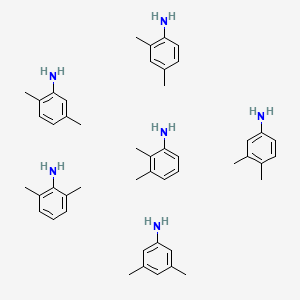
Chemische 2D-Struktur aus PubChem für CAS 1300-73-8
CAS 1300-73-8PubChem CID 56846457

Xylidine

Xylidines is a pale-yellow to brown liquid with a weak, aromatic, amine-like odor. (NIOSH, 2024) — CAMEO Chemicals

IUPAC-Name
2,3-dimethylaniline;2,4-dimethylaniline;2,5-dimethylaniline;2,6-dimethylaniline;3,4-dimethylaniline;3,5-dimethylaniline
Summenformel
C48H66N6
Molekulargewicht
727.1 g/mol
Exakte Masse
726.53489613 Da
Topologische polare Oberfläche
156,0 Ų
Wasserstoffbrücken-Donoren
6
Wasserstoffbrücken-Akzeptoren
6
Kovalente Einheiten
6
Definierte Stereozentren
0

Auch bekannt als

aminoxyleneXilidineXylidinenXylidinesXylidine isomersAminodimethylbenzeneRefChem:53412UNII-0V872Q19HT
10 weitere gemeldete Namen
HSDB 64640V872Q19HTEINECS 215-091-4AI3-24178-X (USDA)Xylidine mixed ortho-meta-para isomersEC 215-091-4DimethylaminobenzeneXylidine (mixture)CDULGHZNHURECF-UHFFFAOYSA-NC48H66N6

Belege aus weiteren wissenschaftlichen Datenbanken

NIH PubChem PUG-View
Exakter Kennungstreffer56846457

Attributed physical-property, hazard, environmental and use annotations.

  • First Aid: Excerpt from NIOSH Pocket Guide for Xylidine:; Eye: IRRIGATE IMMEDIATELY - If this chemical contacts the eyes, immediately wash (irrigate) the eyes with large amounts of water, occasionally lifting the lower and upper lids. Get medical attention immediately.; Skin: SOAP WASH IMMEDIATELY - If this chemical contacts the skin, immediately wash the contaminated skin with soap and water. If this chemical penetrates the clothing, immediately remove the clothing, wash the skin with soap and water, and get medical attention promptly.; Breathing: RESPIRATORY SUPPORT - If a person breathes large amounts of this chemical, move the exposed person to fresh air at once. If breathing has stopped, perform artificial respiration. Keep the affected person warm and at rest. Get medical attention as soon as possible.; Swallow: MEDICAL ATTENTION IMMEDIATELY - If this chemical has been swallowed, get medical attention immediately. (NIOSH, 2024) Quelle: CAMEO Chemicals
  • ERG2024, Guide 153 (Xylidines, solid; Xylidines, liquid): General First Aid:; · Call 911 or emergency medical service.; · Ensure that medical personnel are aware of the material(s) involved, take precautions to protect themselves and avoid contamination.; · Move victim to fresh air if it can be done safely.; · Administer oxygen if breathing is difficult.; · If victim is not breathing:; -- DO NOT perform mouth-to-mouth resuscitation; the victim may have ingested or inhaled the substance.; -- If equipped and pulse detected, wash face and mouth, then give artificial respiration using a proper respiratory medical device (bag-valve mask, pocket mask equipped with a one-way valve or other device).; -- If no pulse detected or no respiratory medical device available, provide continuous compressions. Conduct a pulse check every two minutes or monitor for any signs of spontaneous respirations.; · Remove and isolate contaminated clothing and shoes.; · For minor skin contact, avoid spreading material on unaffected skin.; · In case of contact with substance, remove immediately by flushing skin or eyes with running water for at least 20 minutes.; · For severe burns, immediate medical attention is required.; · Effects of exposure (inhalation, ingestion, Quelle: Emergency Response Guidebook (ERG)
  • First Aid: (General first aid procedures); Eye: Irrigate immediately - If this chemical contacts the eyes, immediately wash (irrigate) the eyes with large amounts of water, occasionally lifting the lower and upper lids. Get medical attention immediately.; Skin: Soap wash immediately - If this chemical contacts the skin, immediately wash the contaminated skin with soap and water. If this chemical penetrates the clothing, immediately remove the clothing, wash the skin with soap and water, and get medical attention promptly.; Breathing: Respiratory support; Swallow: Medical attention immediately - If this chemical has been swallowed, get medical attention immediately. Quelle: The National Institute for Occupational Safety and Health (NIOSH)
  • Signal: Danger Quelle: European Chemicals Agency (ECHA)
  • GHS Hazard Statements: H301+H311+H331 (21.3%): Toxic if swallowed, in contact with skin or if inhaled [Danger Acute toxicity, oral; acute toxicity, dermal; acute toxicity, inhalation]; H301+H311 (56.8%): Toxic if swallowed or in contact with skin [Danger Acute toxicity, oral; acute toxicity, dermal]; H301 (98.9%): Toxic if swallowed [Danger Acute toxicity, oral]; H311 (98.4%): Toxic in contact with skin [Danger Acute toxicity, dermal]; H315 (56.8%): Causes skin irritation [Warning Skin corrosion/irritation]; H319 (57.4%): Causes serious eye irritation [Warning Serious eye damage/eye irritation]; H330 (57.9%): Fatal if inhaled [Danger Acute toxicity, inhalation]; H331 (41.5%): Toxic if inhaled [Danger Acute toxicity, inhalation]; H351 (57.9%): Suspected of causing cancer [Warning Carcinogenicity]; H373 (99.5%): May causes damage to organs through prolonged or repeated exposure [Warning Specific target organ toxicity, repeated exposure]; H411 (99.5%): Toxic to aquatic life with long lasting effects [Hazardous to the aquatic environment, long-term hazard] Quelle: European Chemicals Agency (ECHA)
  • Precautionary Statement Codes: P203, P260, P261, P262, P264, P264+P265, P270, P271, P273, P280, P284, P301+P316, P302+P352, P304+P340, P305+P351+P338, P316, P318, P319, P320, P321, P330, P332+P317, P337+P317, P361+P364, P362+P364, P391, P403+P233, P405, and P501 (click each P-code to see the statement) Quelle: European Chemicals Agency (ECHA)
  • ECHA C&L Notifications Summary: Aggregated GHS information provided per 183 reports by companies from 6 notifications to the ECHA C&L Inventory. Each notification may be associated with multiple companies.; Information may vary between notifications depending on impurities, additives, and other factors. The percentage value in parenthesis indicates the notified classification ratio from companies that provide hazard codes. Only hazard codes with percentage values above 10% are shown. For more detailed information, please visit ECHA C&L website. Quelle: European Chemicals Agency (ECHA)
  • Signal: Danger Quelle: NITE-CMC
  • GHS Hazard Statements: H302: Harmful if swallowed [Warning Acute toxicity, oral]; H312: Harmful in contact with skin [Warning Acute toxicity, dermal]; H319: Causes serious eye irritation [Warning Serious eye damage/eye irritation]; H330: Fatal if inhaled [Danger Acute toxicity, inhalation]; H336: May cause drowsiness or dizziness [Warning Specific target organ toxicity, single exposure; Narcotic effects]; H351: Suspected of causing cancer [Warning Carcinogenicity]; H371: May cause damage to organs [Warning Specific target organ toxicity, single exposure]; H373: May causes damage to organs through prolonged or repeated exposure [Warning Specific target organ toxicity, repeated exposure] Quelle: NITE-CMC
  • Precautionary Statement Codes: P203, P260, P261, P264, P264+P265, P270, P271, P280, P284, P301+P317, P302+P352, P304+P340, P305+P351+P338, P308+P316, P316, P317, P318, P319, P320, P321, P330, P337+P317, P362+P364, P403+P233, P405, and P501 (click each P-code to see the statement) Quelle: NITE-CMC
  • NFPA Health Rating: 3 - Materials that, under emergency conditions, can cause serious or permanent injury. Quelle: Hazardous Substances Data Bank (HSDB)
  • NFPA Fire Rating: 1 - Materials that must be preheated before ignition can occur. Materials require considerable preheating, under all ambient temperature conditions, before ignition and combustion can occur. Quelle: Hazardous Substances Data Bank (HSDB)
  • NFPA Instability Rating: 0 - Materials that in themselves are normally stable, even under fire conditions. Quelle: Hazardous Substances Data Bank (HSDB)
  • Environmental Bioconcentration: Estimated(using structure estimation method and a recommended regression derived equation)(1,2) and measured BCF values for the six isomers of xylidine(SRC), ranged from <10 to 26. According to a classification scheme(3), these BCF values suggest that bioconcentration in aquatic organisms is low(SRC). Quelle: Hazardous Substances Data Bank (HSDB)
  • Environmental Fate: TERRESTRIAL FATE: Based on a recommended classification scheme(1), estimated Koc values ranging from 52 to 240(SRC), determined from a structure estimation method(2), indicate that xylidine is expected to have high to medium mobility in soil(SRC). However, anilines are expected to bind strongly to humus or organic matter in soils due to the high reactivity of the aromatic amino group(3,4), suggesting that mobility may be much lower in some soils(SRC). Volatilization of xylidine may be important from moist soil surfaces(SRC) given an estimated Henry's Law constant of 2.5X10⁻⁶ atm-cu m/mole(SRC), using a fragment constant estimation method(5). Xylidine is not expected to volatilize from dry soil surfaces based on measured vapor pressures ranging from 0.028 to 0.15 mm Hg for the six isomers(SRC). Limited data suggest that xylidine may biodegrade in soil under aerobic conditions(SRC). Quelle: Hazardous Substances Data Bank (HSDB)
  • Environmental Fate: AQUATIC FATE: Based on a recommended classification scheme(1), estimated Koc values ranging from 52 to 240(SRC) indicate that xylidine is not expected to adsorb to suspended solids and sediment in water(SRC). However, aromatic amine groups are recognized as having a strong affinity for organic carbon, suggesting that this compound may bind strongly to suspended organic material in water(2,3). Xylidine may volatilize from water surfaces(4,SRC) based on an estimated Henry's Law constant of 2.5X10⁻⁶ atm-cu m/mole(SRC), developed using a fragment constant estimation method(5). Estimated volatilization half-lives for a model river and model lake are 16 and 120 days, respectively(4,SRC). According to a classification scheme(5), estimated and measured BCF values for the six isomers(6,SRC), suggest that bioconcentration in aquatic organisms is low(SRC). Limited biodegradation data indicate that xylidine may be biodegraded under aerobic conditions in aquatic systems(SRC). Hydrolysis is not expected to occur due to lack of functional groups to hydrolyze(7,SRC). As a class, aromatic amines react relatively rapidly in sunlit natural water via reaction with photochemically produced hydroxyl rad Quelle: Hazardous Substances Data Bank (HSDB)
  • Environmental Fate: ATMOSPHERIC FATE: According to a model of gas/particle partitioning of semivolatile organic compounds in the atmosphere(1), xylidine, which has vapor pressures ranging from 0.028 to 0.15 mm Hg at 25 °C for the six isomers(2,SRC), is expected to exist solely as a vapor in the ambient atmosphere. Vapor-phase xylidine is degraded in the atmosphere by reaction with photochemically-produced hydroxyl radicals(SRC); the half-life for this reaction in air is expected to be about 2.0 hours based on the estimated half-lives for the six isomers(3,SRC). Quelle: Hazardous Substances Data Bank (HSDB)

Zugeordnet durch: Existing checksum-valid CAS to unique PubChem CID match. Abgerufen: 2026-08-31. Quelleneintrag öffnen

Wissenschaftliche Klassifizierungen und Gefahrenannotationen liefern Kontext und ersetzen nicht die oben gezeigte marktspezifische regulatorische Entscheidung.

Weitere Quellenabdeckung und Trefferstatus
QuelleErgebnisGeprüft
NIH PubChem PUG-ViewExakter Treffer2026-08-31

Ein erfasster Nicht-Treffer ist ein nützlicher Beleg dafür, dass die Quelle geprüft wurde; er ist keine Behauptung, dass der Stoff anderswo nicht existiert.

Am 2026-09-02 von NIH PubChem durch prüfsummengültigen CAS-Abgleich abgerufen. Chemische Eigenschaften ersetzen nicht die regulatorische Entscheidung auf dieser Seite.

Wie CAS 1300-73-8 auf dieser Website verwendet wird

CAS 1300-73-8 ist die Kennung des Chemical Abstracts Service, mit der diese Seite einem bestimmten Stoff zugeordnet wird. Im aktuellen Datenbestand hat 1 EU-Anhangseintrag diese Kennung; so können Sie gegenprüfen, ob derselbe Stoff in einem oder in mehreren regulatorischen Zusammenhängen auftaucht.

Nutzen Sie diese Seite, wenn eine Lieferantenspezifikation, ein Sicherheitsdatenblatt oder ein Rohstoffdossier CAS 1300-73-8 nennt und Sie alle verknüpften Einträge der Anhänge II–VI an einem Ort sehen möchten. Die Eintragskarten oben sind der schnellste Weg zu Konzentrationsgrenzen, Warnhinweisen, Anhangszuordnung und Produktartbedingungen.

Häufig gestellte Fragen

Ein durch CAS 1300-73-8 identifizierter Stoff kann in mehreren Anhängen der EU-Kosmetikverordnung vorkommen, wenn er in unterschiedlichen Zusammenhängen unterschiedlichen Bedingungen unterliegt. Ein Stoff kann beispielsweise nach Anhang III mit bestimmten Bedingungen beschränkt sein, und dieselbe CAS-Nummer kann auch in Anhang IV als zugelassener Farbstoff unter eigenen Eintragsbedingungen erscheinen. Jeder Eintrag muss einzeln geprüft werden.

Gleichen Sie die CAS-Nummer mit den Spezifikationsblättern und Analysenzertifikaten Ihrer Rohstoffe ab. Erscheint eine CAS-Nummer in Anhang II, prüfen Sie die Abwesenheit des Stoffs. Erscheint sie in Anhang III, prüfen Sie, ob Konzentrationsgrenzen und Produktartbedingungen in Ihrer Rezeptur eingehalten werden. Alle Anhangseinträge mit dieser CAS-Nummer sind oben aufgeführt.

Eine CAS-Nummer wird vom Chemical Abstracts Service (USA) vergeben und ist weltweit anerkannt. Eine EC-Nummer ist eine Kennung der Europäischen Kommission aus Verzeichnissen wie EINECS, ELINCS oder der NLP-Liste. Beide Kennungen können in Einträgen der EU-Kosmetikanhänge vorkommen. Manche Stoffe haben beide, manche nur eine, und einige ältere Einträge haben möglicherweise keine von beiden.

Der INCI-Checker akzeptiert Inhaltsstoffnamen, CAS-Nummern und EC-Nummern. Prüfen Sie diese CAS-Nummer direkt und gleichen Sie das Ergebnis anschließend mit den Spezifikationsblättern der Lieferanten und allen verknüpften Anhangsbedingungen ab.

Werkzeuge und nächste Schritte

Rezeptur prüfen

Eine vollständige INCI-Liste prüfen und anschließend mit CAS 1300-73-8 Lieferantendokumente zu den gefundenen Stoffen gegenprüfen.

INCI-Checker

Anhänge durchsuchen

Alle Anhänge der EU-Kosmetikverordnung nach Kategorie durchsuchen.

Alle Anhänge

Nach Name suchen

Nach INCI-Namen, Aliasen oder verwandten Kennungen suchen, die in Ihrer Dokumentation neben CAS 1300-73-8 stehen.

Suche