
CAS 128-80-3
CAS 128-80-3은(는) 규정 1223/2009의 부속서 II–VI에 걸쳐 EU 부속서 기록 2건과 일치합니다.
CAS 128-80-3의 기록
2 총화학적 정체 및 특성
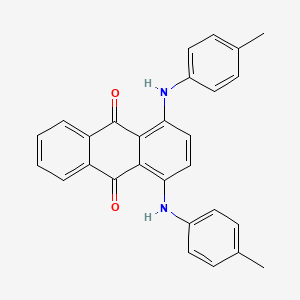
Cyanine Green G Base
- IUPAC 명칭
- 1,4-bis(4-methylanilino)anthracene-9,10-dione
- 분자식
- C28H22N2O2
- 분자량
- 418.5 g/mol
- 정확한 질량
- 418.168127949 Da
- XLogP3
- 7.8
- 위상 극성 표면적
- 58.2 Ų
- 수소 결합 공여체
- 2
- 수소 결합 수용체
- 4
- 공유결합 단위
- 1
- 정의된 입체중심
- 0
다른 이름
보고된 명칭 16개 더 보기
외부 데이터베이스 식별자
- EPA DTXSID:DTXSID9044376
- PubMed:8669891
추가 과학 데이터베이스의 근거
NIH PubChem PUG-View
Attributed physical-property, hazard, environmental and use annotations.
- Color/Form: Dark burgundy 출처: Hazardous Substances Data Bank (HSDB)
- Color/Form: Dark violet needles 출처: Hazardous Substances Data Bank (HSDB)
- Color/Form: Solid at 20 °C 출처: Hazardous Substances Data Bank (HSDB)
- Density: 0.45 g/mL 출처: Hazardous Substances Data Bank (HSDB)
- Melting Point: 218 °C 출처: Hazardous Substances Data Bank (HSDB)
- Physical Description: Dark violet solid; [Merck Index] 출처: Haz-Map, Information on Hazardous Chemicals and Occupational Diseases
- Solubility: In 2-methoxymethanol, 2 mg/mL; in ethanol 0.3 mg/mL 출처: Hazardous Substances Data Bank (HSDB)
- Solubility: Soluble in 3.4 g/100 mL alcohol at 25 °C. Soluble in hydrochloric and sulfuric acid. Sparingly soluble in methanol, ethyl ether. 출처: Hazardous Substances Data Bank (HSDB)
- Solubility: Slightly soluble in acetone, ethyl acetate, mineral oil, oleic acid, stearic acid. Soluble in benzene, toluene. 출처: Hazardous Substances Data Bank (HSDB)
- Note: This chemical does not meet GHS hazard criteria for 97.8% (2848 of 2913) of all reports. 출처: European Chemicals Agency (ECHA)
- GHS Hazard Statements: Not Classified; Reported as not meeting GHS hazard criteria by 2848 of 2913 companies (only 2.2% companies provided GHS information). For more detailed information, please visit ECHA C&L website. 출처: European Chemicals Agency (ECHA)
- ECHA C&L Notifications Summary: Aggregated GHS information provided per 2913 reports by companies from 14 notifications to the ECHA C&L Inventory.; Reported as not meeting GHS hazard criteria per 2848 of 2913 reports by companies.; There are 11 notifications provided by 65 of 2913 reports by companies with hazard statement code(s).; Information may vary between notifications depending on impurities, additives, and other factors. The percentage value in parenthesis indicates the notified classification ratio from companies that provide hazard codes. Only hazard codes with percentage values above 10% are shown. For more detailed information, please visit ECHA C&L website. 출처: European Chemicals Agency (ECHA)
- Environmental Bioconcentration: An estimated BCF of 500 was calculated in fish for D&C Green No. 6(SRC), using an estimated log Kow of 8.69(1) and a regression-derived equation(2). According to a classification scheme(3), this BCF suggests the potential for bioconcentration in aquatic organisms is high(SRC), provided the compound is not metabolized by the organism(SRC). 출처: Hazardous Substances Data Bank (HSDB)
- Environmental Fate: TERRESTRIAL FATE: Based on a classification scheme(1), an estimated Koc value of 4.8X10+6(SRC), determined from a structure estimation method(2), indicates that D&C Green No. 6 is expected to be immobile in soil(SRC). Volatilization of D&C Green No. 6 from moist soil surfaces is not expected to be an important fate process(SRC) given an estimated Henry's Law constant of 1.5X10⁻¹⁶ atm-cu m/mole(SRC), using a fragment constant estimation method(3). D&C Green No. 6 is not expected to volatilize from dry soil surfaces(SRC) based upon an estimated vapor pressure of 7.0X10⁻¹³ mm Hg at 25 °C(SRC), determined from a fragment constant method(4). D&C Green No. 6 was shown to be susceptible to photolysis on soil, with two photoproducts detected, not identified(5). Biodegradation data in soil were not available(SRC, 2011). 출처: Hazardous Substances Data Bank (HSDB)
- Environmental Fate: AQUATIC FATE: Based on a classification scheme(1), an estimated Koc value of 4.8X10+6(SRC), determined from a structure estimation method(2), indicates that D&C Green No. 6 is expected to adsorb to suspended solids and sediment(SRC). Volatilization from water surfaces is not expected(3) based upon an estimated Henry's Law constant of 1.5X10⁻¹⁶ atm-cu m/mole(SRC), developed using a fragment constant estimation method(4). According to a classification scheme(5), an estimated BCF of 500(SRC), from an estimated log Kow of 8.69(6) and a regression-derived equation(7), suggests the potential for bioconcentration in aquatic organisms is high, provided the compound is not metabolized by the organism(SRC). Biodegradation data in water were not available(SRC, 2011). 출처: Hazardous Substances Data Bank (HSDB)
- Environmental Fate: ATMOSPHERIC FATE: According to a model of gas/particle partitioning of semivolatile organic compounds in the atmosphere(1), D&C Green No. 6, which has an estimated vapor pressure of 7.0X10⁻¹³ mm Hg at 25 °C(SRC), determined from a fragment constant method(2), is expected to exist solely in the particulate phase in the ambient atmosphere. Particulate-phase D&C Green No. 6 may be removed from the air by wet or dry deposition(SRC). D&C Green No. 6 absorbs light at wavelengths 644 nm(3), and therefore may be susceptible to direct photolysis by sunlight(SRC). 출처: Hazardous Substances Data Bank (HSDB)
- Sources/Uses: Used for sutures; Approved for external drugs and cosmetics; [Merck Index] 출처: Haz-Map, Information on Hazardous Chemicals and Occupational Diseases
- Uses: Coloring fats, oils, waxes, hydrocarbon solvents, hydrocarbon-base wood stains, cellulose acetate, polystyrene and soap, and in the preparation of oleic or stearic rotogravure inks. 출처: Hazardous Substances Data Bank (HSDB)
- Uses: Coloring contact lenses; ... coloring polyethylene terephthalate surgical sutures, including sutures for ophthalmic use; ... coloring polyglycolic acid surgical sutures with diameter greater than U.S.P. size 8-0, including sutures for ophthalmic use; ... coloring poly(glycolic acid-co-trimethylene carbonate) sutures (also referred to as 1,4-dioxan-2,5-dione polymer with 1,3-dioxan-2-one) for general surgical use; and ... coloring polymethylmethacrylate support haptics of intraocular lenses. 출처: Hazardous Substances Data Bank (HSDB)
- Uses: Military smoke dye grenades used for communication 출처: Hazardous Substances Data Bank (HSDB)
매핑 기준: Existing checksum-valid CAS to unique PubChem CID match. 가져온 시각: 2026-08-31. 출처 기록 열기
과학적 분류와 유해성 주석은 맥락을 제공할 뿐이며, 위에 표시된 시장별 규제 판단을 대체하지 않습니다.
추가 출처 적용 범위 및 일치 상태
| 출처 | 결과 | 확인됨 |
|---|---|---|
| NIH PubChem PUG-View | 정확히 일치 | 2026-08-31 |
기록된 불일치는 출처를 확인했다는 유용한 근거이며, 해당 물질이 다른 곳에 존재하지 않는다는 주장이 아닙니다.
체크섬이 유효한 CAS 일치를 통해 2026-09-02에 NIH PubChem에서 가져왔습니다. 화학적 특성은 이 페이지의 규제 판단을 대체하지 않습니다.
이 사이트에서 CAS 128-80-3을(를) 사용하는 방식
CAS 128-80-3은(는) 이 페이지를 특정 물질에 고정하는 데 사용하는 Chemical Abstracts Service 식별자입니다. 현재 데이터세트에서는 EU 부속서 기록 2건이 이 식별자를 공유하며, 같은 물질이 하나의 규제 맥락에 나타나는지 여러 맥락에 나타나는지 교차 확인하는 데 도움이 됩니다.
공급업체 규격서, SDS 또는 원료 문서에 CAS 128-80-3이(가) 제시되어 있고 연결된 모든 부속서 II–VI 기록을 한곳에서 확인해야 할 때 이 페이지를 이용하세요. 위의 항목 카드는 농도 한도, 경고 문구, 부속서 위치 및 제품 유형 조건을 가장 빠르게 확인하는 방법입니다.