
CAS
기록 1건
CAS 127-06-0
CAS 127-06-0은(는) 규정 1223/2009의 부속서 II–VI에 걸쳐 EU 부속서 기록 1건과 일치합니다.
CAS 127-06-0의 기록
1 총화학적 정체 및 특성
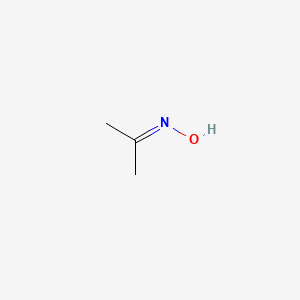
- IUPAC 명칭
- N-propan-2-ylidenehydroxylamine
- 분자식
- C3H7NO
- 분자량
- 73.09 g/mol
- 정확한 질량
- 73.052763847 Da
- XLogP3
- 0.1
- 위상 극성 표면적
- 32.6 Ų
- 수소 결합 공여체
- 1
- 수소 결합 수용체
- 2
- 공유결합 단위
- 1
- 정의된 입체중심
- 0
다른 이름
Acetone oximeAcetoxime2-Propanone, oximeAcetonoxime2-Propanone oximebeta-IsonitrosopropaneQX74TFD64TNSC-7601
보고된 명칭 16개 더 보기
CHEBI:15349actone oximeRefChem:914970DTXCID1010204-820-1propan-2-one oximepropanone oxime.beta.-Isonitrosopropanepropan-2-oneoximeN-(propan-2-ylidene)hydroxylaminePropan-2-one oxime(Chunks or pellets)propane, 2-hydroxyimino-CCRIS 5NSC 7601EINECS 204-820-1UNII-QX74TFD64T
외부 데이터베이스 식별자
- ChEBI:CHEBI:15349
- EPA DTXSID:DTXSID6020010
- PubMed:3401844
추가 과학 데이터베이스의 근거
NIH PubChem PUG-View
식별자 정확히 일치67180
Attributed physical-property, hazard, environmental and use annotations.
- Boiling Point: 133 °C 출처: Hazardous Substances Data Bank (HSDB)
- Boiling Point: Boiling point = 134.8 °C at 728 mm Hg 출처: Hazardous Substances Data Bank (HSDB)
- Color/Form: Columnar prisms 출처: Hazardous Substances Data Bank (HSDB)
- Color/Form: Colorless crystals 출처: Hazardous Substances Data Bank (HSDB)
- Density: Density: 0.9113 g/cm cu at 62 °C 출처: Hazardous Substances Data Bank (HSDB)
- Dissociation Constants: pK = 12.42 at 24.9 °C 출처: Hazardous Substances Data Bank (HSDB)
- LogP: log Kow = 0.12 출처: Hazardous Substances Data Bank (HSDB)
- Melting Point: 61 °C 출처: Hazardous Substances Data Bank (HSDB)
- Physical Description: Crystals with a chloral odor; [Hawley] White powder; [Alfa Aesar MSDS] 출처: Haz-Map, Information on Hazardous Chemicals and Occupational Diseases
- Refractive Index: Refractive index = 1.4156 at 20 °C 출처: Hazardous Substances Data Bank (HSDB)
- Solubility: In water, 30.0 to 32.7% w/w at 20.0 °C 출처: Hazardous Substances Data Bank (HSDB)
- Solubility: Soluble in water 출처: Hazardous Substances Data Bank (HSDB)
- Solubility: Soluble in ethanol, diethyl ether, chloroform, ligroin 출처: Hazardous Substances Data Bank (HSDB)
- Vapor Pressure: 3.12 [mmHg] 출처: Haz-Map, Information on Hazardous Chemicals and Occupational Diseases
- Vapor Pressure: 1.82 mm Hg at 25 °C (242 hPa) 출처: Hazardous Substances Data Bank (HSDB)
- Signal: Danger 출처: Regulation (EC) No 1272/2008 of the European Parliament and of the Council
- GHS Hazard Statements: H312: Harmful in contact with skin [Warning Acute toxicity, dermal]; H317: May cause an allergic skin reaction [Warning Sensitization, Skin]; H318: Causes serious eye damage [Danger Serious eye damage/eye irritation]; H336: May cause drowsiness or dizziness [Warning Specific target organ toxicity, single exposure; Narcotic effects]; H350: May cause cancer [Danger Carcinogenicity]; H373: May causes damage to organs through prolonged or repeated exposure [Warning Specific target organ toxicity, repeated exposure] 출처: Regulation (EC) No 1272/2008 of the European Parliament and of the Council
- Precautionary Statement Codes: P203, P260, P261, P264+P265, P271, P272, P280, P302+P352, P304+P340, P305+P354+P338, P317, P318, P319, P321, P333+P317, P362+P364, P403+P233, P405, and P501 (click each P-code to see the statement) 출처: Regulation (EC) No 1272/2008 of the European Parliament and of the Council
- Signal: Danger 출처: European Chemicals Agency (ECHA)
- GHS Hazard Statements: H228 (99.3%): Flammable solid [Danger Flammable solids]; H312 (80.9%): Harmful in contact with skin [Warning Acute toxicity, dermal]; H317 (94.7%): May cause an allergic skin reaction [Warning Sensitization, Skin]; H318 (96.7%): Causes serious eye damage [Danger Serious eye damage/eye irritation]; H351 (81.6%): Suspected of causing cancer [Warning Carcinogenicity] 출처: European Chemicals Agency (ECHA)
- Precautionary Statement Codes: P203, P210, P240, P241, P261, P264+P265, P272, P280, P302+P352, P305+P354+P338, P317, P318, P321, P333+P317, P362+P364, P370+P378, P405, and P501 (click each P-code to see the statement) 출처: European Chemicals Agency (ECHA)
- ECHA C&L Notifications Summary: Aggregated GHS information provided per 152 reports by companies from 11 notifications to the ECHA C&L Inventory. Each notification may be associated with multiple companies.; Information may vary between notifications depending on impurities, additives, and other factors. The percentage value in parenthesis indicates the notified classification ratio from companies that provide hazard codes. Only hazard codes with percentage values above 10% are shown. For more detailed information, please visit ECHA C&L website. 출처: European Chemicals Agency (ECHA)
- Signal: Danger 출처: Hazardous Substances Data Bank (HSDB)
- GHS Hazard Statements: H228: Flammable solid [Danger Flammable solids]; H312: Harmful in contact with skin [Warning Acute toxicity, dermal]; H317: May cause an allergic skin reaction [Warning Sensitization, Skin]; H318: Causes serious eye damage [Danger Serious eye damage/eye irritation]; H351: Suspected of causing cancer [Warning Carcinogenicity] 출처: Hazardous Substances Data Bank (HSDB)
- Precautionary Statement Codes: P203, P210, P240, P241, P261, P264+P265, P272, P280, P302+P352, P305+P354+P338, P317, P318, P321, P333+P317, P362+P364, P370+P378, P405, and P501 (click each P-code to see the statement) 출처: Hazardous Substances Data Bank (HSDB)
- Toxicity Summary: IDENTIFICATION AND USE: Acetoxime is a solid. It is used in organic synthesis (intermediate), as a solvent for cellulose ethers, and as a primer for diesel fuels. HUMAN STUDIES: Acetoxime has been tested in vitro as an experimental medication for herpes infection. ANIMAL STUDIES: Acetoxime was tested for carcinogenicity by chronic administration in the drinking water to male and female rats. The dose of 1.0 g/liter was administered 5 days/week for 18 months (total dose, 6.2 -7.0 g/rat). Acetoxime induced benign hepatocellular adenomas in 80% of the males but did not produce tumors in the females. The 90 day-NOAEL of the test substance in rats by the oral route was 15 mg/kg bw/day in both sexes. No effects were observed in the reproductive organs or tissues up to the highest dose tested (50 mg/kg bw/day). Acetoxime was negative in the Ames test with TA97, TA98, TA100 and TA1535 with and without metabolic activation. Acetoxime was genotoxic in Drosophila melanogaster. When tested in vivo acetoxime was found to induce a specific pattern of base damage in rat liver DNA and RNA, including the induction of increased levels of 8-hydroxyguanine. Because acetoxime was a weaker carcinogen in 출처: Hazardous Substances Data Bank (HSDB)
- Environmental Bioconcentration: An estimated BCF of 3 was calculated in fish for acetoxime(SRC), using a log Kow of 0.12(1) and a regression-derived equation(2). According to a classification scheme(3), this BCF suggests the potential for bioconcentration in aquatic organisms is low(SRC). 출처: Hazardous Substances Data Bank (HSDB)
- Environmental Fate: TERRESTRIAL FATE: Based on a classification scheme(1), an estimated Koc value of 1.3(SRC), determined from a log Kow of 0.12(2) and a regression-derived equation(3), indicates that acetoxime is expected to have very high mobility in soil(SRC). The pKa of acetoxime is 12.42(4), indicating that this compound will exist as its neutral species in the environment (pH 5-9). Volatilization of acetoxime from moist soil surfaces is expected to be an important fate process(SRC) given an estimated Henry's Law constant of 7.8X10⁻⁶ atm-cu m/mole(SRC), developed using a fragment constant estimation method(3). Acetoxime is expected to volatilize from dry soil surfaces(SRC) based upon a vapor pressure of 1.82 mm Hg at 25 °C(5). A 0% of theoretical BOD using domestic sewage in the Closed Bottle test(6) suggests that biodegradation is not an important environmental fate process in soil(SRC). 출처: Hazardous Substances Data Bank (HSDB)
- Environmental Fate: AQUATIC FATE: Based on a classification scheme(1), an estimated Koc value of 1.3(SRC), determined from a log Kow of 0.12(2) and a regression-derived equation(3), indicates that acetoxime is not expected to adsorb to suspended solids and sediment(SRC). Volatilization from water surfaces is expected(4) based upon an estimated Henry's Law constant of 7.8X10⁻⁶ atm-cu m/mole(SRC), developed using a fragment constant estimation method(3). Using this Henry's Law constant and an estimation method(5), volatilization half-lives for a model river and model lake are 4 days and 33 days, respectively(SRC). According to a classification scheme(6), an estimated BCF of 3.2(SRC), from its log Kow(2) and a regression-derived equation(3), suggests the potential for bioconcentration in aquatic organisms is low. A 0% of theoretical BOD using domestic sewage in the Closed Bottle test(7) suggests that biodegradation is not an important environmental fate process in water(SRC). 출처: Hazardous Substances Data Bank (HSDB)
- Environmental Fate: ATMOSPHERIC FATE: According to a model of gas/particle partitioning of semivolatile organic compounds in the atmosphere(1), acetoxime, which has a vapor pressure of 1.82 mm Hg at 25 °C(2), is expected to exist solely as a vapor in the ambient atmosphere. Vapor-phase acetoxime is degraded in the atmosphere by reaction with photochemically-produced hydroxyl radicals(SRC); the half-life for this reaction in air is estimated to be 48 days(SRC), calculated from its rate constant of 3.3X10⁻¹³ cu cm/molecule-sec at 25 °C(SRC) that was derived using a structure estimation method(3). Acetoxime does not contain chromophores that absorb at wavelengths >290 nm(4) and, therefore, is not expected to be susceptible to direct photolysis by sunlight(SRC). 출처: Hazardous Substances Data Bank (HSDB)
- Sources/Uses: Used as a solvent (cellulose ethers), primer (diesel fuels), and intermediate (organic synthesis); [Hawley] 출처: Haz-Map, Information on Hazardous Chemicals and Occupational Diseases
- Uses: MEDICATION 출처: Hazardous Substances Data Bank (HSDB)
- Uses: Organic synthesis (intermediate); solvent for cellulose ethers; primer for diesel fuels. 출처: Hazardous Substances Data Bank (HSDB)
매핑 기준: Existing checksum-valid CAS to unique PubChem CID match. 가져온 시각: 2026-08-31. 출처 기록 열기
과학적 분류와 유해성 주석은 맥락을 제공할 뿐이며, 위에 표시된 시장별 규제 판단을 대체하지 않습니다.
추가 출처 적용 범위 및 일치 상태
| 출처 | 결과 | 확인됨 |
|---|---|---|
| NIH PubChem PUG-View | 정확히 일치 | 2026-08-31 |
기록된 불일치는 출처를 확인했다는 유용한 근거이며, 해당 물질이 다른 곳에 존재하지 않는다는 주장이 아닙니다.
체크섬이 유효한 CAS 일치를 통해 2026-09-02에 NIH PubChem에서 가져왔습니다. 화학적 특성은 이 페이지의 규제 판단을 대체하지 않습니다.
이 사이트에서 CAS 127-06-0을(를) 사용하는 방식
CAS 127-06-0은(는) 이 페이지를 특정 물질에 고정하는 데 사용하는 Chemical Abstracts Service 식별자입니다. 현재 데이터세트에서는 EU 부속서 기록 1건이 이 식별자를 공유하며, 같은 물질이 하나의 규제 맥락에 나타나는지 여러 맥락에 나타나는지 교차 확인하는 데 도움이 됩니다.
공급업체 규격서, SDS 또는 원료 문서에 CAS 127-06-0이(가) 제시되어 있고 연결된 모든 부속서 II–VI 기록을 한곳에서 확인해야 할 때 이 페이지를 이용하세요. 위의 항목 카드는 농도 한도, 경고 문구, 부속서 위치 및 제품 유형 조건을 가장 빠르게 확인하는 방법입니다.
자주 묻는 질문
CAS 127-06-0로 식별되는 물질은 맥락에 따라 다른 조건이 적용되는 경우 EU 화장품 규정의 여러 부속서에 나타날 수 있습니다. 예를 들어 어떤 물질이 부속서 III에서 특정 조건으로 사용제한될 수 있고, 같은 CAS가 부속서 IV에서 별도의 항목 조건에 따라 허용 색소로 나타날 수도 있습니다. 각 항목은 개별적으로 검토해야 합니다.
CAS 번호를 원료 규격서 및 CoA 문서와 대조하세요. CAS가 부속서 II에 있으면 해당 물질이 없는지 확인하세요. 부속서 III에 있으면 처방에서 농도 한도와 제품 유형 조건이 충족되는지 확인하세요. 이 CAS 번호를 공유하는 모든 부속서 항목이 위에 나열되어 있습니다.
CAS 번호는 미국의 Chemical Abstracts Service가 부여하며 전 세계적으로 통용됩니다. EC 번호는 EINECS, ELINCS 또는 NLP 목록 같은 목록에 수록된 유럽연합 집행위원회 식별자입니다. 두 식별자 모두 EU 화장품 부속서 항목에 나타날 수 있습니다. 두 가지를 모두 가진 물질도 있고, 하나만 가진 물질도 있으며, 일부 오래된 항목은 둘 다 없을 수도 있습니다.
INCI 검사기는 원료명, CAS 번호 및 EC 번호를 받습니다. 이 CAS 번호를 직접 확인한 다음, 결과를 공급업체 규격서 및 연결된 모든 부속서 조건과 대조하세요.