
CAS 115-79-7
CAS 115-79-7은(는) 규정 1223/2009의 부속서 II–VI에 걸쳐 EU 부속서 기록 1건과 일치합니다.
CAS 115-79-7의 기록
1 총화학적 정체 및 특성
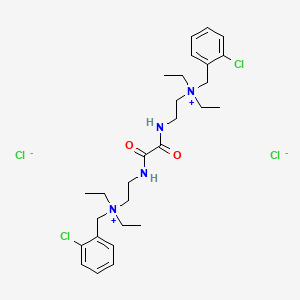
Ambenonium Chloride
Ambenonium chloride is a symmetrical oxalamide-based bis-quaternary ammonium salt having ethyl and 2-chlorobenzyl groups attached to the nitrogens. It has a role as a neurotransmitter agent and an EC 3.1.1.8 (cholinesterase) inhibitor. It is a quaternary ammonium salt and an organic chloride salt. — ChEBI
- IUPAC 명칭
- (2-chlorophenyl)methyl-[2-[[2-[2-[(2-chlorophenyl)methyl-diethylazaniumyl]ethylamino]-2-oxoacetyl]amino]ethyl]-diethylazanium dichloride
- 분자식
- C28H42Cl4N4O2
- 분자량
- 608.5 g/mol
- 정확한 질량
- 608.203237 Da
- 위상 극성 표면적
- 58.2 Ų
- 수소 결합 공여체
- 2
- 수소 결합 수용체
- 4
- 공유결합 단위
- 3
- 정의된 입체중심
- 0
다른 이름
보고된 명칭 16개 더 보기
외부 데이터베이스 식별자
- ChEBI:CHEBI:2628
- ChEMBL:CHEMBL1200541
- EPA DTXSID:DTXSID3022582
- PubMed:33844597
- PubMed:11132996
- PubMed:11099780
- PubMed:8010419
- PubMed:3912090
추가 과학 데이터베이스의 근거
NIH PubChem PUG-View
Attributed physical-property, hazard, environmental and use annotations.
- Carcinogen Classification: No indication of carcinogenicity to humans (not listed by IARC). 출처: Toxin and Toxin Target Database (T3DB)
- Exposure Routes: Oral - poorly absorbed from the gastrointestinal tract. 출처: Toxin and Toxin Target Database (T3DB)
- Signal: Danger 출처: European Chemicals Agency (ECHA)
- GHS Hazard Statements: H300 (100%): Fatal if swallowed [Danger Acute toxicity, oral] 출처: European Chemicals Agency (ECHA)
- Precautionary Statement Codes: P264, P270, P301+P316, P321, P330, P405, and P501 (click each P-code to see the statement) 출처: European Chemicals Agency (ECHA)
- ECHA C&L Notifications Summary: Aggregated GHS information provided per 38 reports by companies from 1 notifications to the ECHA C&L Inventory.; Information may vary between notifications depending on impurities, additives, and other factors. The percentage value in parenthesis indicates the notified classification ratio from companies that provide hazard codes. Only hazard codes with percentage values above 10% are shown. For more detailed information, please visit ECHA C&L website. 출처: European Chemicals Agency (ECHA)
- Health Effects: Acute exposure to cholinesterase inhibitors can cause a cholinergic crisis characterized by severe nausea/vomiting, salivation, sweating, bradycardia, hypotension, collapse, and convulsions. Increasing muscle weakness is a possibility and may result in death if respiratory muscles are involved. Accumulation of ACh at motor nerves causes overstimulation of nicotinic expression at the neuromuscular junction. When this occurs symptoms such as muscle weakness, fatigue, muscle cramps, fasciculation, and paralysis can be seen. When there is an accumulation of ACh at autonomic ganglia this causes overstimulation of nicotinic expression in the sympathetic system. Symptoms associated with this are hypertension, and hypoglycemia. Overstimulation of nicotinic acetylcholine receptors in the central nervous system, due to accumulation of ACh, results in anxiety, headache, convulsions, ataxia, depression of respiration and circulation, tremor, general weakness, and potentially coma. When there is expression of muscarinic overstimulation due to excess acetylcholine at muscarinic acetylcholine receptors symptoms of visual disturbances, tightness in chest, wheezing due to bronchoconstriction, incre 출처: Toxin and Toxin Target Database (T3DB)
- Toxicity Summary: Ambenonium is a cholinesterase or acetylcholinesterase (AChE) inhibitor. A cholinesterase inhibitor (or 'anticholinesterase') suppresses the action of acetylcholinesterase. Because of its essential function, chemicals that interfere with the action of acetylcholinesterase are potent neurotoxins, causing excessive salivation and eye-watering in low doses, followed by muscle spasms and ultimately death. Nerve gases and many substances used in insecticides have been shown to act by binding a serine in the active site of acetylcholine esterase, inhibiting the enzyme completely. Acetylcholine esterase breaks down the neurotransmitter acetylcholine, which is released at nerve and muscle junctions, in order to allow the muscle or organ to relax. The result of acetylcholine esterase inhibition is that acetylcholine builds up and continues to act so that any nerve impulses are continually transmitted and muscle contractions do not stop. Among the most common acetylcholinesterase inhibitors are phosphorus-based compounds, which are designed to bind to the active site of the enzyme. The structural requirements are a phosphorus atom bearing two lipophilic groups, a leaving group (such as a hal 출처: Toxin and Toxin Target Database (T3DB)
- Uses: Ambenonium is used to treat muscle weakness due to muscle disease (myasthenia gravis). 출처: Toxin and Toxin Target Database (T3DB)
매핑 기준: Existing checksum-valid CAS to unique PubChem CID match. 가져온 시각: 2026-08-31. 출처 기록 열기
과학적 분류와 유해성 주석은 맥락을 제공할 뿐이며, 위에 표시된 시장별 규제 판단을 대체하지 않습니다.
추가 출처 적용 범위 및 일치 상태
| 출처 | 결과 | 확인됨 |
|---|---|---|
| NIH PubChem PUG-View | 정확히 일치 | 2026-08-31 |
기록된 불일치는 출처를 확인했다는 유용한 근거이며, 해당 물질이 다른 곳에 존재하지 않는다는 주장이 아닙니다.
체크섬이 유효한 CAS 일치를 통해 2026-09-02에 NIH PubChem에서 가져왔습니다. 화학적 특성은 이 페이지의 규제 판단을 대체하지 않습니다.
이 사이트에서 CAS 115-79-7을(를) 사용하는 방식
CAS 115-79-7은(는) 이 페이지를 특정 물질에 고정하는 데 사용하는 Chemical Abstracts Service 식별자입니다. 현재 데이터세트에서는 EU 부속서 기록 1건이 이 식별자를 공유하며, 같은 물질이 하나의 규제 맥락에 나타나는지 여러 맥락에 나타나는지 교차 확인하는 데 도움이 됩니다.
공급업체 규격서, SDS 또는 원료 문서에 CAS 115-79-7이(가) 제시되어 있고 연결된 모든 부속서 II–VI 기록을 한곳에서 확인해야 할 때 이 페이지를 이용하세요. 위의 항목 카드는 농도 한도, 경고 문구, 부속서 위치 및 제품 유형 조건을 가장 빠르게 확인하는 방법입니다.