
CAS 115-79-7
CAS 115-79-7 entspricht 1 EU-Anhangseintrag in den Anhängen II–VI der Verordnung (EG) Nr. 1223/2009.
Einträge zu CAS 115-79-7
1 insgesamtChemische Identität und Eigenschaften
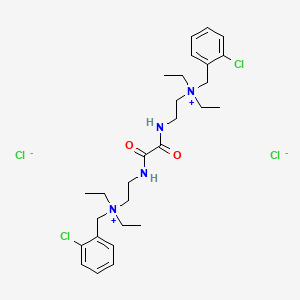
Ambenonium Chloride
Ambenonium chloride is a symmetrical oxalamide-based bis-quaternary ammonium salt having ethyl and 2-chlorobenzyl groups attached to the nitrogens. It has a role as a neurotransmitter agent and an EC 3.1.1.8 (cholinesterase) inhibitor. It is a quaternary ammonium salt and an organic chloride salt. — ChEBI
- IUPAC-Name
- (2-chlorophenyl)methyl-[2-[[2-[2-[(2-chlorophenyl)methyl-diethylazaniumyl]ethylamino]-2-oxoacetyl]amino]ethyl]-diethylazanium dichloride
- Summenformel
- C28H42Cl4N4O2
- Molekulargewicht
- 608.5 g/mol
- Exakte Masse
- 608.203237 Da
- Topologische polare Oberfläche
- 58,2 Ų
- Wasserstoffbrücken-Donoren
- 2
- Wasserstoffbrücken-Akzeptoren
- 4
- Kovalente Einheiten
- 3
- Definierte Stereozentren
- 0
Auch bekannt als
16 weitere gemeldete Namen
Kennungen in externen Datenbanken
- ChEBI:CHEBI:2628
- ChEMBL:CHEMBL1200541
- EPA DTXSID:DTXSID3022582
- PubMed:33844597
- PubMed:11132996
- PubMed:11099780
- PubMed:8010419
- PubMed:3912090
Belege aus weiteren wissenschaftlichen Datenbanken
NIH PubChem PUG-View
Attributed physical-property, hazard, environmental and use annotations.
- Carcinogen Classification: No indication of carcinogenicity to humans (not listed by IARC). Quelle: Toxin and Toxin Target Database (T3DB)
- Exposure Routes: Oral - poorly absorbed from the gastrointestinal tract. Quelle: Toxin and Toxin Target Database (T3DB)
- Signal: Danger Quelle: European Chemicals Agency (ECHA)
- GHS Hazard Statements: H300 (100%): Fatal if swallowed [Danger Acute toxicity, oral] Quelle: European Chemicals Agency (ECHA)
- Precautionary Statement Codes: P264, P270, P301+P316, P321, P330, P405, and P501 (click each P-code to see the statement) Quelle: European Chemicals Agency (ECHA)
- ECHA C&L Notifications Summary: Aggregated GHS information provided per 38 reports by companies from 1 notifications to the ECHA C&L Inventory.; Information may vary between notifications depending on impurities, additives, and other factors. The percentage value in parenthesis indicates the notified classification ratio from companies that provide hazard codes. Only hazard codes with percentage values above 10% are shown. For more detailed information, please visit ECHA C&L website. Quelle: European Chemicals Agency (ECHA)
- Health Effects: Acute exposure to cholinesterase inhibitors can cause a cholinergic crisis characterized by severe nausea/vomiting, salivation, sweating, bradycardia, hypotension, collapse, and convulsions. Increasing muscle weakness is a possibility and may result in death if respiratory muscles are involved. Accumulation of ACh at motor nerves causes overstimulation of nicotinic expression at the neuromuscular junction. When this occurs symptoms such as muscle weakness, fatigue, muscle cramps, fasciculation, and paralysis can be seen. When there is an accumulation of ACh at autonomic ganglia this causes overstimulation of nicotinic expression in the sympathetic system. Symptoms associated with this are hypertension, and hypoglycemia. Overstimulation of nicotinic acetylcholine receptors in the central nervous system, due to accumulation of ACh, results in anxiety, headache, convulsions, ataxia, depression of respiration and circulation, tremor, general weakness, and potentially coma. When there is expression of muscarinic overstimulation due to excess acetylcholine at muscarinic acetylcholine receptors symptoms of visual disturbances, tightness in chest, wheezing due to bronchoconstriction, incre Quelle: Toxin and Toxin Target Database (T3DB)
- Toxicity Summary: Ambenonium is a cholinesterase or acetylcholinesterase (AChE) inhibitor. A cholinesterase inhibitor (or 'anticholinesterase') suppresses the action of acetylcholinesterase. Because of its essential function, chemicals that interfere with the action of acetylcholinesterase are potent neurotoxins, causing excessive salivation and eye-watering in low doses, followed by muscle spasms and ultimately death. Nerve gases and many substances used in insecticides have been shown to act by binding a serine in the active site of acetylcholine esterase, inhibiting the enzyme completely. Acetylcholine esterase breaks down the neurotransmitter acetylcholine, which is released at nerve and muscle junctions, in order to allow the muscle or organ to relax. The result of acetylcholine esterase inhibition is that acetylcholine builds up and continues to act so that any nerve impulses are continually transmitted and muscle contractions do not stop. Among the most common acetylcholinesterase inhibitors are phosphorus-based compounds, which are designed to bind to the active site of the enzyme. The structural requirements are a phosphorus atom bearing two lipophilic groups, a leaving group (such as a hal Quelle: Toxin and Toxin Target Database (T3DB)
- Uses: Ambenonium is used to treat muscle weakness due to muscle disease (myasthenia gravis). Quelle: Toxin and Toxin Target Database (T3DB)
Zugeordnet durch: Existing checksum-valid CAS to unique PubChem CID match. Abgerufen: 2026-08-31. Quelleneintrag öffnen
Wissenschaftliche Klassifizierungen und Gefahrenannotationen liefern Kontext und ersetzen nicht die oben gezeigte marktspezifische regulatorische Entscheidung.
Weitere Quellenabdeckung und Trefferstatus
| Quelle | Ergebnis | Geprüft |
|---|---|---|
| NIH PubChem PUG-View | Exakter Treffer | 2026-08-31 |
Ein erfasster Nicht-Treffer ist ein nützlicher Beleg dafür, dass die Quelle geprüft wurde; er ist keine Behauptung, dass der Stoff anderswo nicht existiert.
Am 2026-09-02 von NIH PubChem durch prüfsummengültigen CAS-Abgleich abgerufen. Chemische Eigenschaften ersetzen nicht die regulatorische Entscheidung auf dieser Seite.
Wie CAS 115-79-7 auf dieser Website verwendet wird
CAS 115-79-7 ist die Kennung des Chemical Abstracts Service, mit der diese Seite einem bestimmten Stoff zugeordnet wird. Im aktuellen Datenbestand hat 1 EU-Anhangseintrag diese Kennung; so können Sie gegenprüfen, ob derselbe Stoff in einem oder in mehreren regulatorischen Zusammenhängen auftaucht.
Nutzen Sie diese Seite, wenn eine Lieferantenspezifikation, ein Sicherheitsdatenblatt oder ein Rohstoffdossier CAS 115-79-7 nennt und Sie alle verknüpften Einträge der Anhänge II–VI an einem Ort sehen möchten. Die Eintragskarten oben sind der schnellste Weg zu Konzentrationsgrenzen, Warnhinweisen, Anhangszuordnung und Produktartbedingungen.
Häufig gestellte Fragen
Werkzeuge und nächste Schritte
Rezeptur prüfen
Eine vollständige INCI-Liste prüfen und anschließend mit CAS 115-79-7 Lieferantendokumente zu den gefundenen Stoffen gegenprüfen.
INCI-CheckerNach Name suchen
Nach INCI-Namen, Aliasen oder verwandten Kennungen suchen, die in Ihrer Dokumentation neben CAS 115-79-7 stehen.
Suche