
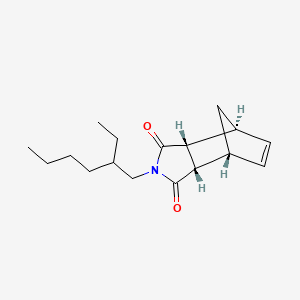
CAS 113-48-4PubChem CID 101008927
Mgk 264
N-Octyl bicycloheptene dicarboximide (MGK 264) is an ingredient in some common pesticides. It has no intrinsic pesticidal activity itself, but rather is a synergist enhancing the potency of pyrethroid ingredients. It is used in a variety of household and veterinary products — Toxin and Toxin Target Database (T3DB)
- IUPAC 명칭
- (1R,2S,6R,7S)-4-(2-ethylhexyl)-4-azatricyclo[5.2.1.02,6]dec-8-ene-3,5-dione
- 분자식
- C17H25NO2
- 분자량
- 275.4 g/mol
- 정확한 질량
- 275.188529040 Da
- XLogP3
- 3.4
- 위상 극성 표면적
- 37.4 Ų
- 수소 결합 공여체
- 0
- 수소 결합 수용체
- 2
- 공유결합 단위
- 1
- 정의된 입체중심
- 4
다른 이름
Caswell No. 613UNII-1B9RV7L76COctyl bicycloheptenedicarboximideHSDB 1745N-(2-ethylhexyl)-5-norbornene-2,3-dicarboxamideN-Octyl bicycloheptene dicarboximideEINECS 204-029-1EPA Pesticide Chemical Code 057001
보고된 명칭 16개 더 보기
BRN 0025024N-2-Ethylhexyl bicycloheptenedicarboximideAI3-08184Carboximide5-21-10-00184 (Beilstein Handbook Reference)N-Octylbicyclo-(2.2.1)-5-heptene-2,3-dicarboximideEndomethylenetetrahydrophthalic acid, N-2-ethylhexylimideEndomethylenetetrahydrophthalic acid, N-2-ethylhexyl imideN-(2-Ethylhexyl)-8,9,10-trinorborn-5-ene-2,3-dicarboximideETHYLHEXYLBICYCLOHEPTENE DICARBOXIMIDEMGK 264 [HSDB]ENT-8184NSC-36678NSC-406879N-(2-ETHYLEXYL)-NORBORNENE DICARBOXIMIDERefChem:158472
외부 데이터베이스 식별자
- PubMed:33049310
추가 과학 데이터베이스의 근거
NIH PubChem PUG-View
식별자 정확히 일치101008927
Attributed physical-property, hazard, environmental and use annotations.
- Boiling Point: 157 °C 출처: Hazardous Substances Data Bank (HSDB)
- Color/Form: Dark, oily liquid 출처: Hazardous Substances Data Bank (HSDB)
- Color/Form: Very light, yellow colored liquid 출처: Hazardous Substances Data Bank (HSDB)
- Density: 1.04 g/cu cm 출처: Hazardous Substances Data Bank (HSDB)
- Flash Point: 177 °C (351 °F) - closed cup 출처: Hazardous Substances Data Bank (HSDB)
- LogP: log Kow = 3.61 (cis-isomer); 3.80 (trans-siomer) /3.70 average/ 출처: Hazardous Substances Data Bank (HSDB)
- Melting Point: <-20 °C 출처: Hazardous Substances Data Bank (HSDB)
- Physical Description: Light yellow liquid; [HSDB] 출처: Haz-Map, Information on Hazardous Chemicals and Occupational Diseases
- Solubility: Practically insoluble in water 출처: Hazardous Substances Data Bank (HSDB)
- Solubility: Miscible with most organic solvents including petroleum oils and fluorinated hydrocarbons, also DDT and HCH 출처: Hazardous Substances Data Bank (HSDB)
- Solubility: Miscible in: acetone, methanol, isopropanol, petroleum ether, Concoco LPA (petroleum distillate), ethyl acetate, toluene, chloroform, acetonitrile, Cyclo Solv 53 (aromatic petroleum distillate) and Isopar M (petroleum distillate) 출처: Hazardous Substances Data Bank (HSDB)
- Vapor Pressure: 0.000018 [mmHg] 출처: Haz-Map, Information on Hazardous Chemicals and Occupational Diseases
- Vapor Pressure: 1.80X10⁻⁵ mm Hg at 25 °C 출처: Hazardous Substances Data Bank (HSDB)
- pH: pH = 6.9; typical range of 6.8 to 7.2 출처: Hazardous Substances Data Bank (HSDB)
- Carcinogen Classification: No indication of carcinogenicity to humans (not listed by IARC). 출처: Toxin and Toxin Target Database (T3DB)
- Note: This chemical does not meet GHS hazard criteria for 2.5% (2 of 80) of reports. 출처: European Chemicals Agency (ECHA)
- Signal: Danger 출처: European Chemicals Agency (ECHA)
- GHS Hazard Statements: H311 (50%): Toxic in contact with skin [Danger Acute toxicity, dermal]; H317 (43.8%): May cause an allergic skin reaction [Warning Sensitization, Skin]; H332 (46.2%): Harmful if inhaled [Warning Acute toxicity, inhalation]; H411 (46.2%): Toxic to aquatic life with long lasting effects [Hazardous to the aquatic environment, long-term hazard] 출처: European Chemicals Agency (ECHA)
- Precautionary Statement Codes: P261, P262, P264, P270, P271, P272, P273, P280, P302+P352, P304+P340, P316, P317, P321, P333+P317, P361+P364, P362+P364, P391, P405, and P501 (click each P-code to see the statement) 출처: European Chemicals Agency (ECHA)
- ECHA C&L Notifications Summary: Aggregated GHS information provided per 80 reports by companies from 6 notifications to the ECHA C&L Inventory. Each notification may be associated with multiple companies.; Reported as not meeting GHS hazard criteria per 2 of 80 reports by companies.; There are 5 notifications provided by 78 of 80 reports by companies with hazard statement code(s).; Information may vary between notifications depending on impurities, additives, and other factors. The percentage value in parenthesis indicates the notified classification ratio from companies that provide hazard codes. Only hazard codes with percentage values above 10% are shown. For more detailed information, please visit ECHA C&L website. 출처: European Chemicals Agency (ECHA)
- Signal: Danger 출처: Hazardous Substances Data Bank (HSDB)
- GHS Hazard Statements: H311: Toxic in contact with skin [Danger Acute toxicity, dermal]; H401: Toxic to aquatic life [Hazardous to the aquatic environment, acute hazard]; H411: Toxic to aquatic life with long lasting effects [Hazardous to the aquatic environment, long-term hazard] 출처: Hazardous Substances Data Bank (HSDB)
- Precautionary Statement Codes: P262, P264, P270, P273, P280, P302+P352, P316, P321, P361+P364, P391, P405, and P501 (click each P-code to see the statement) 출처: Hazardous Substances Data Bank (HSDB)
- Toxicity Summary: IDENTIFICATION AND USE: MGK 264 is a very light, yellow colored liquid. It is used as a synergist for pyrethroids in aerosol sprays for household and veterinary use. HUMAN STUDIES: In vitro, MGK 264 treatment did not result in statistically significant and reproducible alterations in testosterone or estradiol production. MGK 264 was negative for estrogen receptor transcriptional activation in the test system. MGK 264 inhibited aromatase activity. ANIMAL STUDIES: MGK 264 caused acute eye irritation in rabbits. A 90-day rat inhalation toxicity study demonstrated that at the lowest dose tested, there were indications of metaplasia/hyperplasia and changes in the larynx. At higher doses, histopathology of the larynx revealed additional changes and more intense changes in the epithelium and throat. The liver is the target organ of MGK 264. Liver effects were noted in the adults in a rat chronic/oncogenicity study, a mouse chronic/oncogenicity study, a rat multi-generation reproduction study, and subchronic and chronic dog studies. The dog appeared to be the most sensitive species for liver alterations but these alterations were limited to slight to moderate brown pigment and circulating 출처: Hazardous Substances Data Bank (HSDB)
- Environmental Bioconcentration: An estimated BCF of 130 was calculated in fish for MGK 264(SRC), using a log Kow of 3.7(1) and a regression-derived equation(2). According to a classification scheme(3), this BCF suggests the potential for bioconcentration in aquatic organisms is high, provided the compound is not metabolized by the organism. 출처: Hazardous Substances Data Bank (HSDB)
- Environmental Fate: TERRESTRIAL FATE: Based on a classification scheme(1), Koc values of 636 and 3106(2) indicate that MGK 264 is expected to have low to slight mobility in soil(SRC). Volatilization of MGK 264 from moist soil surfaces is not expected to be an important fate process(SRC) given an estimated Henry's Law constant of 2.8X10⁻⁷ atm-cu m/mole(SRC), using a fragment constant estimation method(3). MGK 264 is not expected to volatilize from dry soil surfaces(SRC) based upon a vapor pressure of 1.8X10⁻⁵ mm Hg at 25 °C(4). Biodegradation of MGK 264 is expected to be slow based on an aerobic biodegradation half-life of 341 days in soil(2). 출처: Hazardous Substances Data Bank (HSDB)
- Environmental Fate: AQUATIC FATE: Based on a classification scheme(1), Koc values of 636 and 3106(2) indicate that MGK 264 is expected to adsorb to suspended solids and sediment(SRC). Volatilization from water surfaces is not expected(3) based upon an estimated Henry's Law constant of 2.8X10⁻⁷ atm-cu m/mole(SRC), developed using a fragment constant estimation method(4). According to a classification scheme(5), an estimated BCF of 130(SRC), from its log Kow of 3.7(6) and a regression-derived equation(4), suggests the potential for bioconcentration in aquatic organisms is high. MGK 264 did not undergo hydrolysis after 30 days under environmental conditions (pH 5 to 9)(6). Based on an aerobic biodegradation half-life of 341 days in soil, MGK 264 is not expected to biodegrade in water(2). 출처: Hazardous Substances Data Bank (HSDB)
- Environmental Fate: ATMOSPHERIC FATE: According to a model of gas/particle partitioning of semivolatile organic compounds in the atmosphere(1), MGK 264, which has a vapor pressure of 1.8X10⁻⁵ mm Hg at 25 °C(2), will exist in both the vapor and particulate phases in the ambient atmosphere. Vapor-phase MGK 264 is degraded in the atmosphere by reaction with photochemically-produced hydroxyl radicals(SRC); the half-life for this reaction in air is estimated to be 3.9 hours(SRC), calculated from its rate constant of 9.9X10⁻¹¹ cu cm/molecule-sec at 25 °C(SRC) that was derived using a structure estimation method(3). The rate constant for the vapor-phase reaction of MGK 264 with ozone has been estimated as 2.0X10⁻¹⁶ cu cm/molecule-sec at 25 °C(SRC) that was derived using a structure estimation method(3). This corresponds to an atmospheric half-life of about 1.4 hours at an atmospheric concentration of 7X10+11 ozone molecules per cu cm(4). Particulate-phase MGK 264 may be removed from the air by wet and dry deposition(SRC). MGK 264 does not absorb at wavelengths >275 nm(5) and, therefore, is not expected to be susceptible to direct photolysis by sunlight(SRC). 출처: Hazardous Substances Data Bank (HSDB)
- Sources/Uses: Used as synergist for pyrethrins, allethrin, pyethroids, and rotenone; Commonly used with piperonyl butoxide in household and industrial aerosols; [HSDB] 출처: Haz-Map, Information on Hazardous Chemicals and Occupational Diseases
- Industrial Processes with risk of exposure: Farming (Pesticides) [Category: Industry] 출처: Haz-Map, Information on Hazardous Chemicals and Occupational Diseases
- Uses: For MGK 264 (USEPA/OPP Pesticide Code: 057001) ACTIVE products with label matches. /SRP: Registered for use in the U.S. but approved pesticide uses may change periodically and so federal, state and local authorities must be consulted for currently approved uses./ 출처: Hazardous Substances Data Bank (HSDB)
- Uses: MGK-264 is a pesticide active ingredient that is classified as a synergist. 출처: Hazardous Substances Data Bank (HSDB)
- Uses: MKG-264 is used with insecticides to target many types of pests, including various types of ants, worms, beetles, mites, flies, gnats, spiders, weevils, caterpillars, grubs, moths, ticks, lice, wasps, aphids, midges, and others. 출처: Hazardous Substances Data Bank (HSDB)
- Uses: Synergist for pyrethroids in aerosol sprays for household and veterinary use. 출처: Hazardous Substances Data Bank (HSDB)
- Uses: It is used in a variety of household and veterinary products. 출처: Toxin and Toxin Target Database (T3DB)
매핑 기준: Existing checksum-valid CAS to unique PubChem CID match. 가져온 시각: 2026-08-31. 출처 기록 열기
과학적 분류와 유해성 주석은 맥락을 제공할 뿐이며, 위에 표시된 시장별 규제 판단을 대체하지 않습니다.
추가 출처 적용 범위 및 일치 상태
| 출처 | 결과 | 확인됨 |
|---|---|---|
| NIH PubChem PUG-View | 정확히 일치 | 2026-08-31 |
기록된 불일치는 출처를 확인했다는 유용한 근거이며, 해당 물질이 다른 곳에 존재하지 않는다는 주장이 아닙니다.
체크섬이 유효한 CAS 일치를 통해 2026-08-31에 NIH PubChem에서 가져왔습니다. 화학적 특성은 이 페이지의 규제 판단을 대체하지 않습니다.