
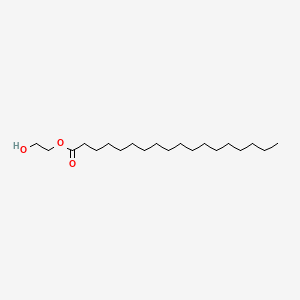
CAS 111-60-4PubChem CID 24762
Glycol monostearate
Polyoxyl 40 stearate is an octadecanoate ester composed of repeating 8-40 ethyleneoxy units. It is an ingredient used in cosmetics and beauty products primarily as a surfactant and emulsifier. It has a role as a nonionic surfactant, an emulsifier and a food emulsifier. It is a hydroxypolyether and an octadecanoate ester. — ChEBI
- IUPAC 명칭
- 2-hydroxyethyl octadecanoate
- 분자식
- C20H40O3
- 분자량
- 328.5 g/mol
- 정확한 질량
- 328.29774513 Da
- XLogP3
- 7.8
- 위상 극성 표면적
- 46.5 Ų
- 수소 결합 공여체
- 1
- 수소 결합 수용체
- 3
- 공유결합 단위
- 1
- 정의된 입체중심
- 0
다른 이름
Ethylene glycol monostearateGlycol stearateMonthybaseMonthyleParastarinIvoritSedetolProdhybase ethyl
보고된 명칭 16개 더 보기
Prodhybas NClindrol SEGEmerest 2350Ethylene glycol stearateLipo EGMSEmpilan 2848OCTADECANOIC ACID, 2-HYDROXYETHYL ESTERUSAF KE-11STEARIC ACID, 2-HYDROXYETHYL ESTERStearic acid, monoester with ethylene glycolS 1510324G66D0ECHEBI:167626RefChem:1086082203-886-9926-608-4
외부 데이터베이스 식별자
- ChEBI:CHEBI:167626
- ChEBI:CHEBI:32027
- ChEMBL:CHEMBL2355383
- EPA DTXSID:DTXSID5026881
- PubMed:18717575
- PubMed:1680169
추가 과학 데이터베이스의 근거
NIH PubChem PUG-View
식별자 정확히 일치24762
Attributed physical-property, hazard, environmental and use annotations.
- Color/Form: CREAM-COLORED SOFT, WAXY OR PASTY SOLID @ 25 °C 출처: Hazardous Substances Data Bank (HSDB)
- Flash Point: MYRJ 45: 500 °F OC 출처: Hazardous Substances Data Bank (HSDB)
- Melting Point: MP: 30-34 °C /POLYETHYLENE GLYCOL 400 MONOSTEARATE USP XVI/ 출처: Hazardous Substances Data Bank (HSDB)
- Melting Point: 60.00 to 61.00 °C. @ 760.00 mm Hg 출처: Human Metabolome Database (HMDB)
- Odor: FAINT FATTY ODOR 출처: Hazardous Substances Data Bank (HSDB)
- Physical Description: Dry Powder; Other Solid; Large Crystals; Liquid; Liquid 출처: EPA Chemical Data Reporting (CDR)
- Physical Description: Light tan solid; [Hawley] 출처: Haz-Map, Information on Hazardous Chemicals and Occupational Diseases
- Solubility: POLYETHYLENE GLYCOL ESTERS AND ETHERS INCR THE WATER SOLUBILITY OF TYROTHRICIN. 출처: Hazardous Substances Data Bank (HSDB)
- Solubility: SOL IN CARBON TETRACHLORIDE, PETROLEUM BENZIN, CHLOROFORM, ETHER; SLIGHTLY SOL IN ALCOHOL; INSOL IN WATER /POLYETHYLENE GLYCOL 400 MONOSTEARATE USP XVI/ 출처: Hazardous Substances Data Bank (HSDB)
- Solubility: GENERALLY SOL OR DISPERSIBLE IN WATER 출처: Hazardous Substances Data Bank (HSDB)
- Solubility: SOL IN TOLUENE, ACETONE, ETHER AND ETHANOL 출처: Hazardous Substances Data Bank (HSDB)
- Note: This chemical does not meet GHS hazard criteria for 75.2% (357 of 475) of all reports. 출처: European Chemicals Agency (ECHA)
- Signal: Warning 출처: European Chemicals Agency (ECHA)
- GHS Hazard Statements: H315 (18.9%): Causes skin irritation [Warning Skin corrosion/irritation]; H319 (19.2%): Causes serious eye irritation [Warning Serious eye damage/eye irritation]; H335 (17.3%): May cause respiratory irritation [Warning Specific target organ toxicity, single exposure; Respiratory tract irritation] 출처: European Chemicals Agency (ECHA)
- Precautionary Statement Codes: P261, P264, P264+P265, P271, P280, P302+P352, P304+P340, P305+P351+P338, P319, P321, P332+P317, P337+P317, P362+P364, P403+P233, P405, and P501 (click each P-code to see the statement) 출처: European Chemicals Agency (ECHA)
- ECHA C&L Notifications Summary: Aggregated GHS information provided per 475 reports by companies from 12 notifications to the ECHA C&L Inventory. Each notification may be associated with multiple companies.; Reported as not meeting GHS hazard criteria per 357 of 475 reports by companies.; There are 10 notifications provided by 118 of 475 reports by companies with hazard statement code(s).; Information may vary between notifications depending on impurities, additives, and other factors. The percentage value in parenthesis indicates the notified classification ratio from companies that provide hazard codes. Only hazard codes with percentage values above 10% are shown. For more detailed information, please visit ECHA C&L website. 출처: European Chemicals Agency (ECHA)
- Note: This chemical does not meet GHS hazard criteria for 87% (267 of 307) of all reports. 출처: European Chemicals Agency (ECHA)
- GHS Hazard Statements: H319 (13%): Causes serious eye irritation [Warning Serious eye damage/eye irritation] 출처: European Chemicals Agency (ECHA)
- Precautionary Statement Codes: P264+P265, P280, P305+P351+P338, and P337+P317 (click each P-code to see the statement) 출처: European Chemicals Agency (ECHA)
- ECHA C&L Notifications Summary: Aggregated GHS information provided per 307 reports by companies from 3 notifications to the ECHA C&L Inventory.; Reported as not meeting GHS hazard criteria per 267 of 307 reports by companies.; There are 2 notifications provided by 40 of 307 reports by companies with hazard statement code(s).; Information may vary between notifications depending on impurities, additives, and other factors. The percentage value in parenthesis indicates the notified classification ratio from companies that provide hazard codes. Only hazard codes with percentage values above 10% are shown. For more detailed information, please visit ECHA C&L website. 출처: European Chemicals Agency (ECHA)
- Cosmetic Ingredient Review Finding(s): Safe in the present practices of use and concentration. Ingredient, concentration, and use information are available in documents discoverable at https://cir-reports.cir-safety.org 출처: Cosmetic Ingredient Review (CIR)
- Consumer Uses: Surfactant (surface active agent); Plasticizer; Emulsifier 출처: EPA Chemical Data Reporting (CDR)
- Industry Uses: Surfactant (surface active agent); Lubricating agent; Emulsifier; Plasticizer 출처: EPA Chemical Data Reporting (CDR)
- Cosmetic Ingredient Review Link: CIR ingredient: Glycol Stearate 출처: Cosmetic Ingredient Review (CIR)
- Cosmetic Ingredient Review Link: CIR ingredient: Glycol Stearate SE 출처: Cosmetic Ingredient Review (CIR)
- Sources/Uses: Used as a surfactant, emulsifier (cosmetics, pharmaceuticals, textile finishes, defoamers, and baked goods), dye assistant, lubricant, and antistatic agent; Also used in dentifrice compositions and to make creams, lotions, ointments, and pharmaceutical preparations; [HSDB] 출처: Haz-Map, Information on Hazardous Chemicals and Occupational Diseases
- Industrial Processes with risk of exposure: Textiles (Printing, Dyeing, or Finishing) [Category: Industry] 출처: Haz-Map, Information on Hazardous Chemicals and Occupational Diseases
- Uses: SURFACTANT 출처: Hazardous Substances Data Bank (HSDB)
- Uses: PEG 400 MONOSTEARATE USP XVI: IN PREPN OF CREAMS, LOTIONS, OINTMENTS & PHARMACEUTICAL PREPN WHICH ARE SOL IN WATER 출처: Hazardous Substances Data Bank (HSDB)
- Uses: EMULSIFIER IN COSMETICS, PHARMACEUTICALS, TEXTILE FINISHES, DEFOAMERS; DYE ASSISTANT; LUBRICANT; ANTISTATIC AGENT 출처: Hazardous Substances Data Bank (HSDB)
- Uses: IN SUNSCREEN COMPOSITIONS AS MOISTURIZING BASE 출처: Hazardous Substances Data Bank (HSDB)
- Uses: For more Uses (Complete) data for POLYETHYLENE GLYCOL STEARATE (6 total), please visit the HSDB record page. 출처: Hazardous Substances Data Bank (HSDB)
매핑 기준: Existing checksum-valid CAS to unique PubChem CID match. 가져온 시각: 2026-08-31. 출처 기록 열기
과학적 분류와 유해성 주석은 맥락을 제공할 뿐이며, 위에 표시된 시장별 규제 판단을 대체하지 않습니다.
추가 출처 적용 범위 및 일치 상태
| 출처 | 결과 | 확인됨 |
|---|---|---|
| NIH PubChem PUG-View | 정확히 일치 | 2026-08-31 |
기록된 불일치는 출처를 확인했다는 유용한 근거이며, 해당 물질이 다른 곳에 존재하지 않는다는 주장이 아닙니다.
체크섬이 유효한 CAS 일치를 통해 2026-08-31에 NIH PubChem에서 가져왔습니다. 화학적 특성은 이 페이지의 규제 판단을 대체하지 않습니다.