
OCTOCRYLENE
2-Cyano-3,3-diphenyl acrylic acid 2-ethylhexyl ester / Octocrilene
OCTOCRYLENE은(는) EU 화장품의 허용 목록(포지티브 리스트) 자외선 차단 성분 항목으로 부속서 VI에 나타납니다. 이 기록의 최대 농도: a) 9% b) 10% Footnote (*3): Benzophenone as an impurity and/or degradation product of Octocrylene shall be kept at trace level..
이 항목 읽는 방법
Octocrylene is permitted at 9% in sprays and 10% elsewhere, with a condition that is not about octocrylene at all: benzophenone arising as an impurity or degradation product must be kept to trace level.
- Propellant sprays: 9%. Other products: 10%.
- Benzophenone present as an impurity or a degradation product must be kept at trace level.
- That condition concerns a substance the formula never deliberately contains, so it is a raw-material and stability question.
- Benzophenone itself is prohibited in cosmetics, which is why the trace condition exists.
The concentration limits are unremarkable. The condition attached to them is not, because it governs something a formulator does not add. Octocrylene can carry benzophenone as a manufacturing impurity, and it can generate benzophenone as it degrades — and benzophenone is prohibited in cosmetics. The entry therefore requires that benzophenone, whether it arrives as an impurity or forms later, is kept at trace level.
That turns a compliance question into two practical ones. The first is about the raw material: supplier specification and certificate of analysis, because impurity content is set before the ingredient reaches the formula. The second is about stability, since degradation happens over a product's shelf life and in the conditions it is stored in — which means the answer at manufacture is not necessarily the answer at the end of a period after opening.
Article 17 of the regulation is the general provision behind this: the unintended presence of a prohibited substance is tolerated only where it is technically unavoidable under good manufacturing practice and the product remains safe. This entry makes that expectation explicit for one filter.
대조 대상
기록 세부 정보
최대 농도
a) 9% b) 10% Footnote (*3): Benzophenone as an impurity and/or degradation product of Octocrylene shall be kept at trace level.
INCI 용어집 명칭
OCTOCRYLENE
화학명
2-Cyano-3,3-diphenyl acrylic acid 2-ethylhexyl ester / Octocrilene
화학명 / IUPAC 명칭
2-Cyano-3,3-diphenyl acrylic acid 2-ethylhexyl ester / Octocrylene
규제 정보
주요 데이터
화학적 정체 및 특성
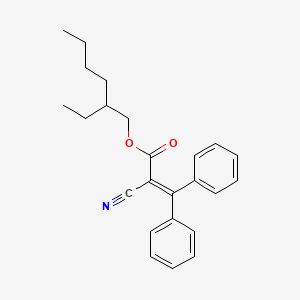
- IUPAC 명칭
- 2-ethylhexyl 2-cyano-3,3-diphenylprop-2-enoate
- 분자식
- C24H27NO2
- 분자량
- 361.5 g/mol
- 정확한 질량
- 361.204179104 Da
- XLogP3
- 7.1
- 위상 극성 표면적
- 50.1 Ų
- 수소 결합 공여체
- 0
- 수소 결합 수용체
- 3
- 공유결합 단위
- 1
- 정의된 입체중심
- 0
다른 이름
보고된 명칭 16개 더 보기
외부 데이터베이스 식별자
- ChEBI:CHEBI:135526
- ChEMBL:CHEMBL1201147
- EPA DTXSID:DTXSID9025299
- PubMed:34864131
- PubMed:32889307
- PubMed:23035447
- PubMed:22980125
- PubMed:22960810
- PubMed:22957488
- PubMed:22828885
- PubMed:22669305
- PubMed:22629203
- PubMed:22530300
- PubMed:22482479
- PubMed:22428874
체크섬이 유효한 CAS 일치를 통해 2026-09-02에 NIH PubChem에서 가져왔습니다. 화학적 특성은 이 페이지의 규제 판단을 대체하지 않습니다.
OCTOCRYLENE의 목록 링크
OCTOCRYLENE의 관련 기록
POTASSIUM CHLORATE / SODIUM CHLORATE
ISOEUGENOL
Alpha-Damascone/cis-Rose ketone 1/trans-Rose ketone 1; Rose ketone 4 (Damascone); Rose ketone 3 (de…
OCTOCRYLENE에 대한 부속서 VI의 의미
OCTOCRYLENE은(는) EU 화장품 규정 1223/2009 부속서 VI에 등재된 허용 자외선 차단 성분입니다. 이 허용 목록(포지티브 리스트)에 포함된 자외선 차단 성분만 EU 화장품에서 자외선 차단 목적으로 사용할 수 있습니다.
이 항목에 명시된 최대 허용 농도는 바로 사용 가능한 제품에 적용됩니다. 일부 자외선 차단 성분은 특정 적용 유형으로 제한되거나 표시 사항에 경고 문구가 필요합니다.
이 기록은 명칭 및 식별자 교차 참조를 위해 CosIng 목록 원료 2건과 연결되어 있습니다. 또한 이 페이지에는 식별자, 부속서 논리 또는 명칭 패턴이 겹치는 관련 부속서 기록 12건이 표시됩니다.
규제 준수 체크리스트
- 바로 사용 가능한 제품의 농도는 다음을 초과해서는 안 됩니다: a) 9% b) 10% Footnote (*3): Benzophenone as an impurity and/or degradation product of Octocrylene shall be kept at trace level.
- 해당 자외선 차단 성분이 씻어내지 않는 제품과 씻어내는 제품 모두에 허용되는지 확인하세요.