
Chromium (III) oxide
CI 77288
Chromium (III) oxide은(는) EU 화장품의 허용 목록(포지티브 리스트) 색소 항목으로 부속서 IV에 나타납니다.
기록 세부 정보
경고 문구
free from chromate ion
색상 인덱스 또는 용어집
CI 77288
화학명
Chromium (III) oxide
화학명 / IUPAC 명칭
Chromium (III) oxide
색상
Green
규제 정보
식별된 원료
주요 데이터
화학적 정체 및 특성
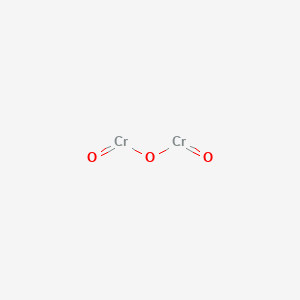
- IUPAC 명칭
- oxo(oxochromiooxy)chromium
- 분자식
- Cr2O3
- 분자량
- 151.990 g/mol
- 정확한 질량
- 151.865753 Da
- 위상 극성 표면적
- 43.4 Ų
- 수소 결합 공여체
- 0
- 수소 결합 수용체
- 3
- 공유결합 단위
- 1
- 정의된 입체중심
- 0
다른 이름
보고된 명칭 16개 더 보기
외부 데이터베이스 식별자
- ChEBI:CHEBI:48242
- EPA DTXSID:DTXSID4043721
- PubMed:26086747
- PubMed:24885771
- PubMed:21384495
- PubMed:15003702
- PubMed:12634122
- PubMed:1423875
추가 과학 데이터베이스의 근거
NIH PubChem PUG-View
Attributed physical-property, hazard, environmental and use annotations.
- Boiling Point: 4000 °C 출처: Hazardous Substances Data Bank (HSDB)
- Boiling Point: 4000 °C 출처: ILO-WHO International Chemical Safety Cards (ICSCs)
- Color/Form: Light to dark green, fine, hexagonal crystals 출처: Hazardous Substances Data Bank (HSDB)
- Color/Form: Green powder 출처: Hazardous Substances Data Bank (HSDB)
- Color/Form: Bright-green, extremely hard crystals 출처: Hazardous Substances Data Bank (HSDB)
- Density: 5.22 at 25 °C 출처: Hazardous Substances Data Bank (HSDB)
- Density: 5.22 g/cm³ 출처: ILO-WHO International Chemical Safety Cards (ICSCs)
- Density: 5.22 @25 °C 출처: PAC Chemical Database, U.S. Department of Energy
- Melting Point: 2435 °C 출처: Hazardous Substances Data Bank (HSDB)
- Melting Point: 2435 °C 출처: ILO-WHO International Chemical Safety Cards (ICSCs)
- Melting Point: 2320 °C 출처: PAC Chemical Database, U.S. Department of Energy
- Physical Description: Dry Powder; Large Crystals; Dry Powder; Large Crystals; Liquid; Other Solid; Dry Powder; CBI; Large Crystals 출처: EPA Chemical Data Reporting (CDR)
- Physical Description: Green, hygroscopic solid; [CHEMINFO] Insoluble in water; [ACGIH] 출처: Haz-Map, Information on Hazardous Chemicals and Occupational Diseases
- Physical Description: LIGHT-TO-DARK-GREEN POWDER. 출처: ILO-WHO International Chemical Safety Cards (ICSCs)
- Refractive Index: Index of refraction: 2.551 출처: Hazardous Substances Data Bank (HSDB)
- Solubility: In water, 3.13 ug/L at 20 °C, pH 6; 2.96 ug/L at 20 °C, pH 8 출처: Hazardous Substances Data Bank (HSDB)
- Solubility: Practically insoluble in water 출처: Hazardous Substances Data Bank (HSDB)
- Solubility: Practically insoluble in alcohol, acetone; slightly soluble in acids, alkalies 출처: Hazardous Substances Data Bank (HSDB)
- Solubility: Insoluble in acids, and alkalies 출처: Hazardous Substances Data Bank (HSDB)
- Solubility: Solubility in water: none 출처: ILO-WHO International Chemical Safety Cards (ICSCs)
- pH: Trivalent chromium compounds are amphoteric 출처: Hazardous Substances Data Bank (HSDB)
- Carcinogen Classification: 3, not classifiable as to its carcinogenicity to humans. (L135) 출처: Toxin and Toxin Target Database (T3DB)
- Exposure Routes: Oral (L16) ; inhalation (L16) ; dermal (L16) 출처: Toxin and Toxin Target Database (T3DB)
- Note: This chemical does not meet GHS hazard criteria for 57.8% (1112 of 1924) of all reports. 출처: European Chemicals Agency (ECHA)
- Signal: Danger 출처: European Chemicals Agency (ECHA)
- GHS Hazard Statements: H302 (24%): Harmful if swallowed [Warning Acute toxicity, oral]; H317 (25.7%): May cause an allergic skin reaction [Warning Sensitization, Skin]; H319 (24.3%): Causes serious eye irritation [Warning Serious eye damage/eye irritation]; H360 (14.6%): May damage fertility or the unborn child [Danger Reproductive toxicity] 출처: European Chemicals Agency (ECHA)
- Precautionary Statement Codes: P203, P261, P264, P264+P265, P270, P272, P280, P301+P317, P302+P352, P305+P351+P338, P318, P321, P330, P333+P317, P337+P317, P362+P364, P405, and P501 (click each P-code to see the statement) 출처: European Chemicals Agency (ECHA)
- ECHA C&L Notifications Summary: Aggregated GHS information provided per 1924 reports by companies from 27 notifications to the ECHA C&L Inventory. Each notification may be associated with multiple companies.; Reported as not meeting GHS hazard criteria per 1112 of 1924 reports by companies.; There are 23 notifications provided by 812 of 1924 reports by companies with hazard statement code(s).; Information may vary between notifications depending on impurities, additives, and other factors. The percentage value in parenthesis indicates the notified classification ratio from companies that provide hazard codes. Only hazard codes with percentage values above 10% are shown. For more detailed information, please visit ECHA C&L website. 출처: European Chemicals Agency (ECHA)
- Signal: Danger 출처: NITE-CMC
- GHS Hazard Statements: H317: May cause an allergic skin reaction [Warning Sensitization, Skin]; H334: May cause allergy or asthma symptoms or breathing difficulties if inhaled [Danger Sensitization, respiratory]; H372: Causes damage to organs through prolonged or repeated exposure [Danger Specific target organ toxicity, repeated exposure] 출처: NITE-CMC
- Precautionary Statement Codes: P233, P260, P261, P264, P270, P271, P272, P280, P284, P302+P352, P304+P340, P319, P321, P333+P317, P342+P316, P362+P364, P403, and P501 (click each P-code to see the statement) 출처: NITE-CMC
- GHS Hazard Statements: H317: May cause an allergic skin reaction [Warning Sensitization, Skin]; H334: May cause allergy or asthma symptoms or breathing difficulties if inhaled [Danger Sensitization, respiratory] 출처: NITE-CMC
- Precautionary Statement Codes: P233, P260, P261, P271, P272, P280, P284, P302+P352, P304+P340, P321, P333+P317, P342+P316, P362+P364, P403, and P501 (click each P-code to see the statement) 출처: NITE-CMC
- Health Effects: Chromium in its trivalent state is not very toxic. It may be oxidized to hexavalent chromium, a known carcinogen. Hexavalent chromium has also been shown to affect reproduction and development. (A12) 출처: Toxin and Toxin Target Database (T3DB)
- Toxicity Summary: IDENTIFICATION AND USE: Chromic oxide (Cr(2)O(3)) is a green powder. It is not registered for current use in the U.S., but approved pesticide uses may change periodically and so federal, state and local authorities must be consulted for currently approved uses. It is used in abrasives and electric semiconductors; in alloys; in printing fabrics and banknotes. It is also used in dyeing polymers; colorant for latex paints, in manufacturing of chromium metal and aluminum-chromium master alloys. It's other uses include catalyst in organic synthesis, green granules in asphalt roofing, component of refractory brick. Chromic oxide is a color additive in drug use. HUMAN EXPOSURE AND TOXICITY: Fine chromic oxide particles were insoluble in the culture medium; on the contrary, Cr(2)O(3) nanoparticles released soluble hexavalent chromium into the culture medium. Human lung carcinoma A549 cells and human keratinocyte HaCaT cells showed an increase in intracellular reactive oxygen species (ROS) level and activation of antioxidant defense systems on exposure to Cr(2)O(3) nanoparticles. The cellular influences of Cr(2)O(3) nanoparticles matched those of hexavalent chromium. Human lung epithelial c 출처: Hazardous Substances Data Bank (HSDB)
- Toxicity Summary: Trivalent chromium may also form complexes with peptides, proteins, and DNA, resulting in DNA-protein crosslinks, DNA strand breaks, DNA-DNA interstrand crosslinks, chromium-DNA adducts, chromosomal aberrations and alterations in cellular signaling pathways. It has been shown to induce carcinogenesis by overstimulating cellular regulatory pathways and increasing peroxide levels by activating certain mitogen-activated protein kinases. It can also cause transcriptional repression by cross-linking histone deacetylase 1-DNA methyltransferase 1 complexes to CYP1A1 promoter chromatin, inhibiting histone modification. Chromium may increase its own toxicity by modifying metal regulatory transcription factor 1, causing the inhibition of zinc-induced metallothionein transcription. (A12, L16, A34, A35, A36) 출처: Toxin and Toxin Target Database (T3DB)
- Consumer Uses: Other; Processing aids not otherwise specified; Catalyst; Not Known or Reasonably Ascertainable; Corrosion inhibitor; Pigment 출처: EPA Chemical Data Reporting (CDR)
- Industry Uses: Abrasives; Other; Pigment; Dye; Catalyst; Not Known or Reasonably Ascertainable; Corrosion inhibitor 출처: EPA Chemical Data Reporting (CDR)
- Sources/Uses: Used in abrasives, refractory materials, semiconductors, pigments, alloys, textile printing inks, and catalysts; [Merck Index] Used as a pigment in polymers and latex paints; [HSDB] 출처: Haz-Map, Information on Hazardous Chemicals and Occupational Diseases
- Industrial Processes with risk of exposure: Semiconductor Manufacturing [Category: Industry]; Painting (Pigments, Binders, and Biocides) [Category: Paint]; Textiles (Printing, Dyeing, or Finishing) [Category: Industry] 출처: Haz-Map, Information on Hazardous Chemicals and Occupational Diseases
- Uses: For chromic oxide (USEPA/OPP Pesticide Code: 021103) there are 0 labels match. /SRP: Not registered for current use in the U.S., but approved pesticide uses may change periodically and so federal, state and local authorities must be consulted for currently approved uses./ 출처: Hazardous Substances Data Bank (HSDB)
- Uses: In abrasives, refractory materials, electric semiconductors; as pigment, particularly in coloring glass; in alloys; in printing fabrics and banknotes; catalyst for organic and inorganic reactions. 출처: Hazardous Substances Data Bank (HSDB)
- Uses: Used in dyeing polymers, ... colorant for latex paints. 출처: Hazardous Substances Data Bank (HSDB)
- Uses: In metallurgy in the manufacture of chromium metal and aluminum-chromium master alloys. 출처: Hazardous Substances Data Bank (HSDB)
- Uses: For more Uses (Complete) data for Chromium (III) oxide (11 total), please visit the HSDB record page. 출처: Hazardous Substances Data Bank (HSDB)
- Uses: Plastics -> Typical concentration range in plastic materials -> 1% 출처: NORMAN Suspect List Exchange
- Uses: Chromium(III) oxide is commonly used as pigment, under the name viridian, in paints, inks, and glasses. (L523) 출처: Toxin and Toxin Target Database (T3DB)
매핑 기준: Existing checksum-valid CAS to unique PubChem CID match. 가져온 시각: 2026-08-31. 출처 기록 열기
과학적 분류와 유해성 주석은 맥락을 제공할 뿐이며, 위에 표시된 시장별 규제 판단을 대체하지 않습니다.
추가 출처 적용 범위 및 일치 상태
| 출처 | 결과 | 확인됨 |
|---|---|---|
| NIH PubChem PUG-View | 정확히 일치 | 2026-08-31 |
기록된 불일치는 출처를 확인했다는 유용한 근거이며, 해당 물질이 다른 곳에 존재하지 않는다는 주장이 아닙니다.
체크섬이 유효한 CAS 일치를 통해 2026-09-02에 NIH PubChem에서 가져왔습니다. 화학적 특성은 이 페이지의 규제 판단을 대체하지 않습니다.
Chromium (III) oxide의 목록 링크
Chromium (III) oxide의 관련 기록
이 기록에 직접 일치하는 항목이 제한적이어서, 부속서 IV의 인접 항목도 함께 표시합니다.
CI 77491
Chromium (III) oxide에 대한 부속서 IV의 의미
Chromium (III) oxide은(는) EU 화장품 규정 1223/2009 부속서 IV에 등재된 허용 색소입니다. 이 허용 목록(포지티브 리스트)에 있는 색소만 EU 시장의 화장품에 착색 목적으로 사용할 수 있습니다.
부속서 IV의 일부 색소는 제품 유형에 따라 제한됩니다. 예를 들어 눈 주위나 점막에 바르는 제품에는 사용이 금지됩니다. 사용 전에 위의 제품 유형 및 조건 필드를 확인하세요.
이 기록은 명칭 및 식별자 교차 참조를 위해 CosIng 목록 원료 1건과 연결되어 있습니다. 또한 이 페이지에는 식별자, 부속서 논리 또는 명칭 패턴이 겹치는 관련 부속서 기록 12건이 표시됩니다.
규제 준수 체크리스트
- 색소가 위에 나열된 허용 제품 유형에서만 사용되는지 확인하세요.
- 색상 인덱스 번호와 CAS 식별자를 성분 표기에 기록하세요.