
Benzaldehyde
Benzaldehyde은(는) 부속서 III에 등재되어 있으며 이 기록에 표시된 조건에서만 사용할 수 있습니다.
기록 세부 정보
기타 제한 사항
The presence of the substance shall be indicated in the list of ingredients referred to in Article 19(1), point (g), when its concentration exceeds: — 0,001 % in leave-on products — 0,01 % in rinse-off products.
INCI 용어집 명칭
Benzaldehyde
화학명
Benzaldehyde
규제 정보
주요 데이터
화학적 정체 및 특성
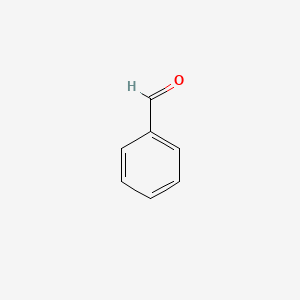
Benzaldehyde
Benzaldehyde is an arenecarbaldehyde that consists of benzene bearing a single formyl substituent; the simplest aromatic aldehyde and parent of the class of benzaldehydes. It has a role as a flavouring agent, a fragrance, an odorant receptor agonist, an EC 3.1.1.3 (triacylglycerol lipase) inhibitor, a plant metabolite and an EC 3.5.5.1 (nitrilase) inhibitor. — ChEBI
- IUPAC 명칭
- benzaldehyde
- 분자식
- C7H6O
- 분자량
- 106.12 g/mol
- 정확한 질량
- 106.041864811 Da
- XLogP3
- 1.5
- 위상 극성 표면적
- 17.1 Ų
- 수소 결합 공여체
- 0
- 수소 결합 수용체
- 1
- 공유결합 단위
- 1
- 정의된 입체중심
- 0
다른 이름
보고된 명칭 16개 더 보기
외부 데이터베이스 식별자
- ChEBI:CHEBI:17169
- ChEMBL:CHEMBL15972
- EPA DTXSID:DTXSID8039241
- PubMed:32496054
- PubMed:25512087
- PubMed:23220590
- PubMed:23125754
- PubMed:23125697
- PubMed:23124467
- PubMed:23090634
- PubMed:23064551
- PubMed:23051061
- PubMed:23043335
- PubMed:23043316
- PubMed:23009997
추가 과학 데이터베이스의 근거
EMBL-EBI ChEBI
benzaldehyde
An arenecarbaldehyde that consists of benzene bearing a single formyl substituent; the simplest aromatic aldehyde and parent of the class of benzaldehydes.
- 처방
- C7H6O
- 평균 질량
- 106.124 g/mol
- 단일 동위원소 질량
- 106.04186 Da
- 형식 전하
- 0
- benzaldehydes — is a (CHEBI:22698)
- plant metabolite — has role (CHEBI:76924)
- flavouring agent — has role (CHEBI:35617)
- fragrance — has role (CHEBI:48318)
- odorant receptor agonist — has role (CHEBI:62873)
- EC 3.5.5.1 (nitrilase) inhibitor — has role (CHEBI:77118)
- EC 3.1.1.3 (triacylglycerol lipase) inhibitor — has role (CHEBI:65001)
- benzaldehydes — is a (CHEBI:22698)
- 11943806 출처: PubMed
- 12692643 출처: PubMed
- 12738275 출처: PubMed
- 12746108 출처: PubMed
- 1388821 출처: PubMed
- 15087594 출처: PubMed
- 15658857 출처: PubMed
- 16248550 출처: PubMed
- 16508147 출처: PubMed
- 16557466 출처: PubMed
- 18348134 출처: PubMed
- 20733068 출처: PubMed
- 20878540 출처: PubMed
- 21035797 출처: PubMed
- 21538605 출처: PubMed
- 21773601 출처: PubMed
- 21828928 출처: PubMed
- 23263855 출처: PubMed
추가 선별 명칭
이 출처의 상호 참조
- CAS: 100-52-7 — KEGG COMPOUND
- CAS: 100-52-7 — ChemIDplus
- CAS: 100-52-7 — NIST Chemistry WebBook
- REGISTRY_NUMBER: 471223 — Reaxys
- MANUAL_X_REF: Benzaldehyde — Wikipedia
- MANUAL_X_REF: BENZALDEHYDE — MetaCyc
- MANUAL_X_REF: C00193 — KEGG COMPOUND
- MANUAL_X_REF: C00261 — KEGG COMPOUND
- MANUAL_X_REF: C00261 — KEGG COMPOUND
- MANUAL_X_REF: c0279 — UM-BBD
- MANUAL_X_REF: D02314 — KEGG DRUG
- MANUAL_X_REF: HBX — PDBeChem
- MANUAL_X_REF: HMDB0006115 — HMDB
매핑 기준: Exact CAS cross-reference in the ChEBI compound record. 출처 업데이트: 2016-08-05. 가져온 시각: 2026-08-31. 출처 기록 열기
NIH PubChem PUG-View
Attributed physical-property, hazard, environmental and use annotations.
- Autoignition Temperature: 378 °F (USCG, 1999) 출처: CAMEO Chemicals
- Autoignition Temperature: 377 °F, 192 °C 출처: Hazardous Substances Data Bank (HSDB)
- Autoignition Temperature: 192 °C 출처: ILO-WHO International Chemical Safety Cards (ICSCs)
- Boiling Point: 354 °F at 760 mmHg (NTP, 1992) 출처: CAMEO Chemicals
- Boiling Point: 178.7 °C 출처: Hazardous Substances Data Bank (HSDB)
- Boiling Point: 62.00 to 63.00 °C. @ 10.00 mm Hg 출처: Human Metabolome Database (HMDB)
- Boiling Point: 179 °C 출처: ILO-WHO International Chemical Safety Cards (ICSCs)
- Boiling Point: 178 °C 출처: Joint FAO/WHO Expert Committee on Food Additives (JECFA)
- Boiling Point: 179 °C @760 [mm Hg] 출처: PAC Chemical Database, U.S. Department of Energy
- Color/Form: Strongly refractive liquid, becoming yellowish on keeping 출처: Hazardous Substances Data Bank (HSDB)
- Color/Form: Colorless or yellowish, strongly refractive volatile oil 출처: Hazardous Substances Data Bank (HSDB)
- Density: 1.046 at 68 °F (USCG, 1999) - Denser than water; will sink 출처: CAMEO Chemicals
- Density: 1.050 at 15 °C/4 °C 출처: Hazardous Substances Data Bank (HSDB)
- Density: Relative density (water = 1): 1.05 출처: ILO-WHO International Chemical Safety Cards (ICSCs)
- Density: 1.040-1.047 출처: Joint FAO/WHO Expert Committee on Food Additives (JECFA)
- Density: 1.041 @25 °C 출처: PAC Chemical Database, U.S. Department of Energy
- Dissociation Constants: pKa = 14.90 출처: Hazardous Substances Data Bank (HSDB)
- Flash Point: 148 °F (NTP, 1992) 출처: CAMEO Chemicals
- Flash Point: 145 °F, 63 °C (Closed cup) 출처: Hazardous Substances Data Bank (HSDB)
- Flash Point: 73.9 °C (Open cup) 출처: Hazardous Substances Data Bank (HSDB)
- Flash Point: 63 °C c.c. 출처: ILO-WHO International Chemical Safety Cards (ICSCs)
- LogP: log Kow = 1.48 출처: Hazardous Substances Data Bank (HSDB)
- LogP: 1.48 출처: Human Metabolome Database (HMDB)
- LogP: 1.48 출처: ILO-WHO International Chemical Safety Cards (ICSCs)
- Melting Point: -15 °F (NTP, 1992) 출처: CAMEO Chemicals
- Melting Point: -57.12 °C 출처: Hazardous Substances Data Bank (HSDB)
- Melting Point: -26 °C 출처: Human Metabolome Database (HMDB)
- Melting Point: -26 °C 출처: ILO-WHO International Chemical Safety Cards (ICSCs)
- Melting Point: -57.1 °C 출처: PAC Chemical Database, U.S. Department of Energy
- Odor: Characteristic odor or volatile oil of almond 출처: Hazardous Substances Data Bank (HSDB)
- Odor: Odor resembling oil of bitter almond 출처: Hazardous Substances Data Bank (HSDB)
- Physical Description: Benzaldehyde appears as a clear colorless to yellow liquid with a bitter almond odor. Flash point near 145 °F. More denser than water and insoluble in water. Hence sinks in water. Vapors are heavier than air. The primary hazard is to the environment. Immediate steps should be taken to limit spread to the environment. Easily penetrates the soil to contaminate groundwater and nearby waterways. Used in flavoring and perfume making. 출처: CAMEO Chemicals
- Physical Description: CBI; Liquid 출처: EPA Chemical Data Reporting (CDR)
- Physical Description: Colorless to yellowish liquid with an odor of almond oil; [AIHA] In air, readily oxidizes to benzoic acid; [CAMEO] 출처: Haz-Map, Information on Hazardous Chemicals and Occupational Diseases
- Physical Description: Liquid 출처: Human Metabolome Database (HMDB)
- Physical Description: COLOURLESS-TO-YELLOW LIQUID WITH CHARACTERISTIC ODOUR. 출처: ILO-WHO International Chemical Safety Cards (ICSCs)
- Physical Description: colourless to yellow liquid with a sweet, strong almond odour 출처: Joint FAO/WHO Expert Committee on Food Additives (JECFA)
- Refractive Index: Index of refraction: 1.5456 at 20 °C/D 출처: Hazardous Substances Data Bank (HSDB)
- Refractive Index: 1.544-1.547 출처: Joint FAO/WHO Expert Committee on Food Additives (JECFA)
- Solubility: less than 0.1 mg/mL at 67.1 °F (NTP, 1992) 출처: CAMEO Chemicals
- Solubility: In water, 6950 mg/L at 25 °C 출처: Hazardous Substances Data Bank (HSDB)
- Solubility: Approximately 0.6% wt. at 20 °C 출처: Hazardous Substances Data Bank (HSDB)
- Solubility: Miscible with alcohol, ether, fixed and volatile oils 출처: Hazardous Substances Data Bank (HSDB)
- Solubility: Soluble in liquid ammonia 출처: Hazardous Substances Data Bank (HSDB)
- Solubility: Solubility of water in benzaldehyde at 20 °C, wt%: 1.5 출처: Hazardous Substances Data Bank (HSDB)
- Solubility: 6.95 mg/mL at 25 °C 출처: Human Metabolome Database (HMDB)
- Solubility: Solubility in water at 25 °C: poor 출처: ILO-WHO International Chemical Safety Cards (ICSCs)
- Solubility: very slightly soluble in water; soluble in organic solvents, oils 출처: Joint FAO/WHO Expert Committee on Food Additives (JECFA)
- Solubility: miscible at room temperature (in ethanol) 출처: Joint FAO/WHO Expert Committee on Food Additives (JECFA)
- Vapor Pressure: 1 mmHg at 79.2 °F ; 5 mmHg at 122.2 °F; 10 mmHg at 144 °F (NTP, 1992) 출처: CAMEO Chemicals
- Vapor Pressure: 0.12 [mmHg] 출처: Haz-Map, Information on Hazardous Chemicals and Occupational Diseases
- Vapor Pressure: 1.27 mm Hg at 25 °C 출처: Hazardous Substances Data Bank (HSDB)
- Vapor Pressure: Vapor pressure, Pa at 26 °C: 133 출처: ILO-WHO International Chemical Safety Cards (ICSCs)
- Vapor Pressure: 0.127 [mm Hg] @25 °C 출처: PAC Chemical Database, U.S. Department of Energy
- Viscosity: 1.321 cp at 25 °C 출처: Hazardous Substances Data Bank (HSDB)
- Substance: Benzaldehyde 출처: NTP Technical Reports
- NTP Technical Report: TR-378: Toxicology and Carcinogenesis Studies of Benzaldehyde (CASRN 100-52-7) in F344/N Rats and B6C3F1 Mice (Gavage Studies) (1990 ) 출처: NTP Technical Reports
- Peer Review Date: 06/27/89 출처: NTP Technical Reports
- Conclusion for Male Rat: No Evidence 출처: NTP Technical Reports
- Conclusion for Female Rat: No Evidence 출처: NTP Technical Reports
- Conclusion for Male Mice: Some Evidence 출처: NTP Technical Reports
- Conclusion for Female Mice: Some Evidence 출처: NTP Technical Reports
- Summary: Under the conditions of these 2-year gavage studies, there was no evidence of carcinogenic activity of benzaldehyde for male or female F344/N rats receiving 200 or 400 mg/kg per day. There was some evidence of carcinogenic activity of benzaldehyde for male or female B6C3F1 mice, as indicated by increased incidences of squamous cell papillomas and hyperplasia of the forestomach. Female rats and male and female mice might have been able to tolerate higher doses. 출처: NTP Technical Reports
- Exposure Routes: The substance can be absorbed into the body by inhalation of its vapour, through the skin and by ingestion. 출처: ILO-WHO International Chemical Safety Cards (ICSCs)
- First Aid: EYES: First check the victim for contact lenses and remove if present. Flush victim's eyes with water or normal saline solution for 20 to 30 minutes while simultaneously calling a hospital or poison control center. Do not put any ointments, oils, or medication in the victim's eyes without specific instructions from a physician. IMMEDIATELY transport the victim after flushing eyes to a hospital even if no symptoms (such as redness or irritation) develop.; SKIN: IMMEDIATELY flood affected skin with water while removing and isolating all contaminated clothing. Gently wash all affected skin areas thoroughly with soap and water. IMMEDIATELY call a hospital or poison control center even if no symptoms (such as redness or irritation) develop. IMMEDIATELY transport the victim to a hospital for treatment after washing the affected areas.; INHALATION: IMMEDIATELY leave the contaminated area; take deep breaths of fresh air. IMMEDIATELY call a physician and be prepared to transport the victim to a hospital even if no symptoms (such as wheezing, coughing, shortness of breath, or burning in the mouth, throat, or chest) develop. Provide proper respiratory protection to rescuers entering an unknow 출처: CAMEO Chemicals
- ERG2024, Guide 171 (Benzaldehyde): General First Aid:; · Call 911 or emergency medical service.; · Ensure that medical personnel are aware of the material(s) involved, take precautions to protect themselves and avoid contamination.; · Move victim to fresh air if it can be done safely.; · Administer oxygen if breathing is difficult.; · If victim is not breathing:; -- DO NOT perform mouth-to-mouth resuscitation; the victim may have ingested or inhaled the substance.; -- If equipped and pulse detected, wash face and mouth, then give artificial respiration using a proper respiratory medical device (bag-valve mask, pocket mask equipped with a one-way valve or other device).; -- If no pulse detected or no respiratory medical device available, provide continuous compressions. Conduct a pulse check every two minutes or monitor for any signs of spontaneous respirations.; · Remove and isolate contaminated clothing and shoes.; · For minor skin contact, avoid spreading material on unaffected skin.; · In case of contact with substance, remove immediately by flushing skin or eyes with running water for at least 20 minutes.; · For severe burns, immediate medical attention is required.; · Effects of exposure (inhalation, ingestion, 출처: Emergency Response Guidebook (ERG)
- Signal: Warning 출처: Regulation (EC) No 1272/2008 of the European Parliament and of the Council
- GHS Hazard Statements: H302: Harmful if swallowed [Warning Acute toxicity, oral] 출처: Regulation (EC) No 1272/2008 of the European Parliament and of the Council
- Precautionary Statement Codes: P264, P270, P301+P317, P330, and P501 (click each P-code to see the statement) 출처: Regulation (EC) No 1272/2008 of the European Parliament and of the Council
- Signal: Warning 출처: European Chemicals Agency (ECHA)
- GHS Hazard Statements: H302 (100%): Harmful if swallowed [Warning Acute toxicity, oral]; H319 (22.1%): Causes serious eye irritation [Warning Serious eye damage/eye irritation]; H332 (23.4%): Harmful if inhaled [Warning Acute toxicity, inhalation]; H336 (14.9%): May cause drowsiness or dizziness [Warning Specific target organ toxicity, single exposure; Narcotic effects] 출처: European Chemicals Agency (ECHA)
- Precautionary Statement Codes: P261, P264, P264+P265, P270, P271, P280, P301+P317, P304+P340, P305+P351+P338, P317, P319, P330, P337+P317, P403+P233, P405, and P501 (click each P-code to see the statement) 출처: European Chemicals Agency (ECHA)
- ECHA C&L Notifications Summary: Aggregated GHS information provided per 3000 reports by companies from 52 notifications to the ECHA C&L Inventory. Each notification may be associated with multiple companies.; Information may vary between notifications depending on impurities, additives, and other factors. The percentage value in parenthesis indicates the notified classification ratio from companies that provide hazard codes. Only hazard codes with percentage values above 10% are shown. For more detailed information, please visit ECHA C&L website. 출처: European Chemicals Agency (ECHA)
- Signal: Warning 출처: NITE-CMC
- GHS Hazard Statements: H227: Combustible liquid [Warning Flammable liquids]; H302: Harmful if swallowed [Warning Acute toxicity, oral]; H319: Causes serious eye irritation [Warning Serious eye damage/eye irritation]; H335: May cause respiratory irritation [Warning Specific target organ toxicity, single exposure; Respiratory tract irritation]; H336: May cause drowsiness or dizziness [Warning Specific target organ toxicity, single exposure; Narcotic effects]; H371: May cause damage to organs [Warning Specific target organ toxicity, single exposure]; H373: May causes damage to organs through prolonged or repeated exposure [Warning Specific target organ toxicity, repeated exposure]; H401: Toxic to aquatic life [Hazardous to the aquatic environment, acute hazard]; H412: Harmful to aquatic life with long lasting effects [Hazardous to the aquatic environment, long-term hazard] 출처: NITE-CMC
- Precautionary Statement Codes: P210, P260, P261, P264, P264+P265, P270, P271, P273, P280, P301+P317, P304+P340, P305+P351+P338, P308+P316, P319, P330, P337+P317, P370+P378, P403, P403+P233, P405, and P501 (click each P-code to see the statement) 출처: NITE-CMC
- Signal: Danger 출처: NITE-CMC
- GHS Hazard Statements: H227: Combustible liquid [Warning Flammable liquids]; H302: Harmful if swallowed [Warning Acute toxicity, oral]; H315: Causes skin irritation [Warning Skin corrosion/irritation]; H317: May cause an allergic skin reaction [Warning Sensitization, Skin]; H320: Causes eye irritation [Warning Serious eye damage/eye irritation]; H335: May cause respiratory irritation [Warning Specific target organ toxicity, single exposure; Respiratory tract irritation]; H336: May cause drowsiness or dizziness [Warning Specific target organ toxicity, single exposure; Narcotic effects]; H371: May cause damage to organs [Warning Specific target organ toxicity, single exposure]; H372: Causes damage to organs through prolonged or repeated exposure [Danger Specific target organ toxicity, repeated exposure] 출처: NITE-CMC
- NFPA Health Rating: 1 - Materials that, under emergency conditions, can cause significant irritation. 출처: Hazardous Substances Data Bank (HSDB)
- NFPA Fire Rating: 2 - Materials that must be moderately heated or exposed to relatively high ambient temperatures before ignition can occur. Materials would not under normal conditions form hazardous atmospheres with air, but under high ambient temperatures or under moderate heating could release vapor in sufficient quantities to produce hazardous atmospheres with air. 출처: Hazardous Substances Data Bank (HSDB)
- NFPA Instability Rating: 0 - Materials that in themselves are normally stable, even under fire conditions. 출처: Hazardous Substances Data Bank (HSDB)
- Target Organs: Gastrointestinal; Urinary 출처: EPA Integrated Risk Information System (IRIS)
- Cosmetic Ingredient Review Finding(s): Safe in the present practices of use and concentration. Ingredient, concentration, and use information are available in documents discoverable at https://cir-reports.cir-safety.org 출처: Cosmetic Ingredient Review (CIR)
- Toxicity Summary: IDENTIFICATION AND USE: Benzaldehyde is a strongly refractive liquid, becoming yellowish on keeping. It is used in cosmetics as a denaturant, a flavoring agent, and as a fragrance. Currently used in only seven cosmetic products, its highest reported concentration of use was 0.5% in perfumes. Substantial amounts are used in the production of derivatives that are also employed in the perfume and flavor industries. In the pharmaceutical industry benzaldehyde is used as an intermediate in the manufacture of chloramphenicol, ephedrine, ampicillin, diphenylhydantoin, and other products. HUMAN EXPOSURE AND TOXICITY: It may cause contact dermatitis. It was positive in sister chromatid exchange assay with human lymphocytes from healthy non-smoking donors. Benzaldehyde was found to induce formation of stable DNA-protein cross-links in cultured human lymphoma cells. Benzaldehyde was found to lack significant activity against most human tumor cells tested. ANIMAL STUDIES: It was was slightly irritating to the rabbit eye. Histological examination of the trachea and lungs showed a slight irritation of respiratory epithelium for nonsensitized guinea pigs. In the acute studies, benzaldehyde induce 출처: Hazardous Substances Data Bank (HSDB)
- Environmental Bioconcentration: An estimated BCF of 4.4 was calculated in fish for benzaldehyde(SRC), using a log Kow of 1.48(1) and a regression-derived equation(2). According to a classification scheme(3), this BCF suggests the potential for bioconcentration in aquatic organisms is low. 출처: Hazardous Substances Data Bank (HSDB)
- Environmental Fate: TERRESTRIAL FATE: Based on a classification scheme(1), an estimated Koc value of 11(SRC), determined from a structure estimation method(2), indicates that benzaldehyde is expected to have very high mobility in soil(SRC). Volatilization of benzaldehyde from moist soil surfaces is expected to be an important fate process(SRC) given a Henry's Law constant of 2.67X10⁻⁵ atm-cu m/mole(3). Benzaldehyde is expected to volatilize from dry soil surfaces(SRC) based upon a vapor pressure of 1.27 mm Hg at 25 °C(4). A 66% of theoretical BOD using activated sludge in a 2-week Japanese MITI test(5) suggests that biodegradation is an important environmental fate process in soil(SRC). Other biological screening studies have also demonstrated that benzaldehyde is readily biodegradable(6-8). 출처: Hazardous Substances Data Bank (HSDB)
- Environmental Fate: AQUATIC FATE: Based on a classification scheme(1), an estimated Koc value of 11(SRC), determined from a structure estimation method(2), indicates that benzaldehyde is not expected to adsorb to suspended solids and sediment(SRC). Volatilization from water surfaces is expected(3) based upon a Henry's Law constant of 2.67X10⁻⁵ atm-cu m/mole(4). Using this Henry's Law constant and an estimation method(3), volatilization half-lives for a model river and model lake are 1.5 and 14 days, respectively(SRC). According to a classification scheme(5), an estimated BCF of 4.4(SRC), from its log Kow of 1.48(6) and a regression-derived equation(2), suggests the potential for bioconcentration in aquatic organisms is low. A 66% of theoretical BOD using activated sludge in a 2-week Japanese MITI test(7) suggests that biodegradation is an important environmental fate process in water(SRC). Other biological screening studies have also demonstrated that benzaldehyde is readily biodegradable(8-10). Hydrolysis is not expected to be an important environmental fate process since this compound lacks functional groups that hydrolyze under environmental conditions(3). 출처: Hazardous Substances Data Bank (HSDB)
- Environmental Fate: ATMOSPHERIC FATE: According to a model of gas/particle partitioning of semivolatile organic compounds in the atmosphere(1), benzaldehyde, which has a vapor pressure of 1.27 mm Hg at 25 °C(2), is expected to exist solely as a vapor in the ambient atmosphere. Vapor-phase benzaldehyde is degraded in the atmosphere by reaction with photochemically-produced hydroxyl radicals(SRC); the half-life for this reaction in air is estimated to be 30 hours(SRC), calculated from its rate constant of 1.29X10⁻¹¹ cu cm/molecule-sec at 25 °C(3). Vapor-phase benzaldehyde is also degraded in the atmosphere by reaction with nitrate radicals(SRC); the half-life for this reaction in air is estimated to be 7.5 days(SRC), calculated from its rate constant of 4.30X10⁻¹⁵ cu cm/molecule-sec at 25 °C(4). The atmospheric reaction between benzaldehyde and ozone is too slow to be important environmentally(5). Benzaldehyde absorbs UV radiation between 300 and 380 nm in the gas-phase(6,7) and, therefore, may be susceptible to direct photolysis by sunlight(SRC). Small quantities of benzaldehyde have been detected in atmospheric aerosol particulates(8,9) which can be physically removed from air via dry and wet depositi 출처: Hazardous Substances Data Bank (HSDB)
- Consumer Uses: Intermediate; Fragrance; Flavoring and nutrient 출처: EPA Chemical Data Reporting (CDR)
- Industry Uses: Flavoring and nutrient; Solvent; Intermediate; Fragrance 출처: EPA Chemical Data Reporting (CDR)
- Cosmetic Ingredient Review Link: CIR ingredient: Benzaldehyde 출처: Cosmetic Ingredient Review (CIR)
- Sources/Uses: Used as a chemical intermediate and a solvent for resins and oils; [HSDB] Used as a flavoring agent in food and perfume additive (FDA-approved); [AIHA] 출처: Haz-Map, Information on Hazardous Chemicals and Occupational Diseases
- Restricted Notes: No longer registered by EPA for use in any pesticide products; [HSDB] 출처: Haz-Map, Information on Hazardous Chemicals and Occupational Diseases
- Uses: For benzaldehyde (USEPA/OPP Pesticide Code: 008601) there are 0 labels match. /SRP: Not registered for current use in the U.S., but approved pesticide uses may change periodically and so federal, state and local authorities must be consulted for currently approved uses./ 출처: Hazardous Substances Data Bank (HSDB)
- Uses: The active ingredient is no longer contained in any registered pesticide products ... "cancelled." 출처: Hazardous Substances Data Bank (HSDB)
- Uses: The single largest use for benzaldehyde ... is the production of benzyl alcohol via hydrogenation. 출처: Hazardous Substances Data Bank (HSDB)
- Uses: Benzaldehyde is an aromatic aldehyde used in cosmetics as a denaturant, a flavoring agent, and as a fragrance. Currently used in only seven cosmetic products, its highest reported concentration of use was 0.5% in perfumes. 출처: Hazardous Substances Data Bank (HSDB)
- Uses: For more Uses (Complete) data for BENZALDEHYDE (11 total), please visit the HSDB record page. 출처: Hazardous Substances Data Bank (HSDB)
매핑 기준: Existing checksum-valid CAS to unique PubChem CID match. 가져온 시각: 2026-08-31. 출처 기록 열기
과학적 분류와 유해성 주석은 맥락을 제공할 뿐이며, 위에 표시된 시장별 규제 판단을 대체하지 않습니다.
추가 출처 적용 범위 및 일치 상태
| 출처 | 결과 | 확인됨 |
|---|---|---|
| EMBL-EBI ChEBI | 정확히 일치 | 2026-08-31 |
| NIH PubChem PUG-View | 정확히 일치 | 2026-08-31 |
기록된 불일치는 출처를 확인했다는 유용한 근거이며, 해당 물질이 다른 곳에 존재하지 않는다는 주장이 아닙니다.
체크섬이 유효한 CAS 일치를 통해 2026-08-31에 NIH PubChem에서 가져왔습니다. 화학적 특성은 이 페이지의 규제 판단을 대체하지 않습니다.
Benzaldehyde의 목록 링크
Benzaldehyde의 관련 기록
이 기록에 직접 일치하는 항목이 제한적이어서, 부속서 III의 인접 항목도 함께 표시합니다.
Benzaldehyde에 대한 부속서 III의 의미
Benzaldehyde은(는) EU 화장품 규정 1223/2009 부속서 III에 따른 사용제한 물질입니다. 화장품에서의 사용은 위 항목에 명시된 농도 한도, 제품 유형 제한 및 필수 경고 문구를 포함한 특정 조건에서만 허용됩니다.
이 물질을 처방에 포함할 때는 최대 농도, 제품 범위 및 경고 표시 등 모든 조건을 동시에 충족해야 합니다. 한 조건을 준수한다고 해서 다른 조건이 면제되지 않습니다.
이 기록은 명칭 및 식별자 교차 참조를 위해 CosIng 목록 원료 1건과 연결되어 있습니다. 또한 이 페이지에는 식별자, 부속서 논리 또는 명칭 패턴이 겹치는 관련 부속서 기록 12건이 표시됩니다.
규제 준수 체크리스트
- 사용 조건을 제품정보파일(PIF)에 기록하세요.