
CETRIMONIUM CHLORIDE (1) / STRARTRIMONIUM CHLORIDE (1)
C16-alkyltrimethylammonium chloride C18-alkyltrimethyammonium chloride
CETRIMONIUM CHLORIDE (1) / STRARTRIMONIUM CHLORIDE (1)은(는) 부속서 III에 등재되어 있으며 이 기록에 표시된 조건에서만 사용할 수 있습니다. 이 기록의 최대 농도: (a) 2,5% for the individual concentrarions or the sum of the individual concentrations of cetrimonium chloride and streartrimonium chloride (b) 1,0% for the individual concentrarions or the sum of the individual concentrations of cetrimonium chloride and streartrimonium chloride (c) 0,5% for the individual concentrarions or the sum of the individual concentrations of cetrimonium chloride and streartrimonium chloride.
기록 세부 정보
최대 농도
(a) 2,5% for the individual concentrarions or the sum of the individual concentrations of cetrimonium chloride and streartrimonium chloride (b) 1,0% for the individual concentrarions or the sum of the individual concentrations of cetrimonium chloride and streartrimonium chloride (c) 0,5% for the individual concentrarions or the sum of the individual concentrations of cetrimonium chloride and streartrimonium chloride
기타 제한 사항
For purposes other than inhibiting the development of microorganisms in the product. The purpose has to be apparent from the presentation of the product.
INCI 용어집 명칭
CETRIMONIUM CHLORIDE (1) / STRARTRIMONIUM CHLORIDE (1)
화학명
C16-alkyltrimethylammonium chloride C18-alkyltrimethyammonium chloride
화학명 / IUPAC 명칭
C16-alkyltrimethylammonium chloride C18-alkyltrimethyammonium chloride
규제 정보
주요 데이터
화학적 정체 및 특성
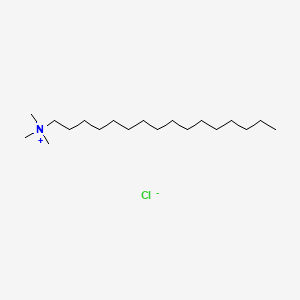
Hexadecyltrimethylammonium chloride
Cetyltrimethylammonium chloride is the organic chloride salt of cetyltrimethylammonium. It has a role as a surfactant. It is a quaternary ammonium salt and an organic chloride salt. It contains a cetyltrimethylammonium ion. — ChEBI
- IUPAC 명칭
- hexadecyl(trimethyl)azanium chloride
- 분자식
- C19H42ClN
- 분자량
- 320.0 g/mol
- 정확한 질량
- 319.3005780 Da
- 위상 극성 표면적
- 0.0 Ų
- 수소 결합 공여체
- 0
- 수소 결합 수용체
- 1
- 공유결합 단위
- 2
- 정의된 입체중심
- 0
다른 이름
보고된 명칭 16개 더 보기
외부 데이터베이스 식별자
- ChEBI:CHEBI:53581
- ChEMBL:CHEMBL1895807
- EPA DTXSID:DTXSID6026901
- PubMed:10124
추가 과학 데이터베이스의 근거
NIH PubChem PUG-View
Attributed physical-property, hazard, environmental and use annotations.
- Autoignition Temperature: 750 °F (USCG, 1999) 출처: CAMEO Chemicals
- Autoignition Temperature: 750 °F /ISOPROPYL ALCOHOL SOLN OF CETYLTRIMETHYLAMMONIUM CHLORIDE/ 출처: Hazardous Substances Data Bank (HSDB)
- Boiling Point: 180 °F at 760 mmHg (isopropyl alcohol) (USCG, 1999) 출처: CAMEO Chemicals
- Density: 0.9 at 77 °F (approx.) (USCG, 1999) - Less dense than water; will float 출처: CAMEO Chemicals
- Flash Point: 69 °F (USCG, 1999) 출처: CAMEO Chemicals
- LogP: log Kow= 3.23 출처: Hazardous Substances Data Bank (HSDB)
- Physical Description: Hexadecyltrimethylammonium chloride appears as colorless to pale yellow liquid with an odor of rubbing alcohol. Floats or sinks in water. (USCG, 1999) 출처: CAMEO Chemicals
- Physical Description: Liquid; CBI 출처: EPA Chemical Data Reporting (CDR)
- Physical Description: Solution: Clear to pale yellow liquid; [HSDB] White powder; [MSDSonline] 출처: Haz-Map, Information on Hazardous Chemicals and Occupational Diseases
- Solubility: Water solubility: 440 mg/l at 30 °C 출처: Hazardous Substances Data Bank (HSDB)
- First Aid: INGESTION: do NOT induce vomiting; drink large quanities of fluid and call a physician immediately.; EYES: flush with water for at least 15 min. and call a physician.; SKIN: flush with water. (USCG, 1999) 출처: CAMEO Chemicals
- Note: This chemical does not meet GHS hazard criteria for 0.5% (5 of 1105) of reports. 출처: European Chemicals Agency (ECHA)
- Signal: Danger 출처: European Chemicals Agency (ECHA)
- GHS Hazard Statements: H302 (49%): Harmful if swallowed [Warning Acute toxicity, oral]; H311 (28.6%): Toxic in contact with skin [Danger Acute toxicity, dermal]; H314 (41.5%): Causes severe skin burns and eye damage [Danger Skin corrosion/irritation]; H315 (52.3%): Causes skin irritation [Warning Skin corrosion/irritation]; H318 (85.7%): Causes serious eye damage [Danger Serious eye damage/eye irritation]; H335 (44.3%): May cause respiratory irritation [Warning Specific target organ toxicity, single exposure; Respiratory tract irritation]; H400 (99.4%): Very toxic to aquatic life [Warning Hazardous to the aquatic environment, acute hazard]; H410 (40.9%): Very toxic to aquatic life with long lasting effects [Warning Hazardous to the aquatic environment, long-term hazard] 출처: European Chemicals Agency (ECHA)
- Precautionary Statement Codes: P260, P261, P262, P264, P264+P265, P270, P271, P273, P280, P301+P317, P301+P330+P331, P302+P352, P302+P361+P354, P304+P340, P305+P354+P338, P316, P317, P319, P321, P330, P332+P317, P361+P364, P362+P364, P363, P391, P403+P233, P405, and P501 (click each P-code to see the statement) 출처: European Chemicals Agency (ECHA)
- ECHA C&L Notifications Summary: Aggregated GHS information provided per 1105 reports by companies from 42 notifications to the ECHA C&L Inventory. Each notification may be associated with multiple companies.; Reported as not meeting GHS hazard criteria per 5 of 1105 reports by companies.; There are 41 notifications provided by 1100 of 1105 reports by companies with hazard statement code(s).; Information may vary between notifications depending on impurities, additives, and other factors. The percentage value in parenthesis indicates the notified classification ratio from companies that provide hazard codes. Only hazard codes with percentage values above 10% are shown. For more detailed information, please visit ECHA C&L website. 출처: European Chemicals Agency (ECHA)
- Signal: Danger 출처: NITE-CMC
- GHS Hazard Statements: H302: Harmful if swallowed [Warning Acute toxicity, oral]; H315: Causes skin irritation [Warning Skin corrosion/irritation]; H318: Causes serious eye damage [Danger Serious eye damage/eye irritation]; H335: May cause respiratory irritation [Warning Specific target organ toxicity, single exposure; Respiratory tract irritation]; H400: Very toxic to aquatic life [Warning Hazardous to the aquatic environment, acute hazard]; H410: Very toxic to aquatic life with long lasting effects [Warning Hazardous to the aquatic environment, long-term hazard] 출처: NITE-CMC
- Precautionary Statement Codes: P261, P264, P264+P265, P270, P271, P273, P280, P301+P317, P302+P352, P304+P340, P305+P354+P338, P317, P319, P321, P330, P332+P317, P362+P364, P391, P403+P233, P405, and P501 (click each P-code to see the statement) 출처: NITE-CMC
- Signal: Warning 출처: NITE-CMC
- GHS Hazard Statements: H302: Harmful if swallowed [Warning Acute toxicity, oral]; H315: Causes skin irritation [Warning Skin corrosion/irritation]; H319: Causes serious eye irritation [Warning Serious eye damage/eye irritation]; H335: May cause respiratory irritation [Warning Specific target organ toxicity, single exposure; Respiratory tract irritation] 출처: NITE-CMC
- Precautionary Statement Codes: P261, P264, P264+P265, P270, P271, P280, P301+P317, P302+P352, P304+P340, P305+P351+P338, P319, P321, P330, P332+P317, P337+P317, P362+P364, P403+P233, P405, and P501 (click each P-code to see the statement) 출처: NITE-CMC
- Signal: Danger 출처: Hazardous Chemical Information System (HCIS), Safe Work Australia
- Cosmetic Ingredient Review Conclusion: The CIR Expert Panel concluded the following ingredients are safe in the present practices of use and concentration described in the safety assessment when formulated to be non-irritating...Cetrimonium Chloride... 출처: Cosmetic Ingredient Review (CIR)
- Cosmetic Ingredient Review Finding(s): Safe for use in cosmetics, with qualifications 출처: Cosmetic Ingredient Review (CIR)
- Environmental Bioconcentration: An estimated BCF of 71 was calculated for trimethylhexadecylammonium chloride(SRC), using an estimated log Kow of 3.23(1) and a regression-derived equation(2). According to a classification scheme(3), this BCF suggests the potential for bioconcentration in aquatic organisms is moderate. 출처: Hazardous Substances Data Bank (HSDB)
- Environmental Fate: TERRESTRIAL FATE: Based on a classification scheme(1), an estimated Koc value of 2.2X10+5(SRC), determined from a structure estimation method(2), indicates that trimethylhexadecylammonium chloride is expected to be immobile in soil(SRC). Volatilization of trimethylhexadecylammonium chloride from moist soil surfaces is not expected to be an important fate process(SRC) given an estimated Henry's Law constant of 2.9X10⁻¹⁰ atm-cu m/mole(SRC), using a fragment constant estimation method(3). Trimethylhexadecylammonium chloride is not expected to volatilize from dry soil surfaces(SRC) based upon an estimated vapor pressure of 2.8X10⁻¹⁰ mm Hg(SRC), determined from a fragment constant method(4). 출처: Hazardous Substances Data Bank (HSDB)
- Environmental Fate: AQUATIC FATE: Based on a classification scheme(1), an estimated Koc value of 2.2X10+5(SRC), determined from an estimation method(2), indicates that trimethylhexadecylammonium chloride is expected to adsorb to suspended solids and sediment in water(SRC). Volatilization from water surfaces is not expected(3) based upon an estimated Henry's Law constant of 2.9X10⁻¹⁰ atm-cu m/mole(SRC), developed using a fragment constant estimation method(4). According to a classification scheme(5), an estimated BCF of 71(SRC), from its log Kow of 3.23(6) and a regression-derived equation(7), suggests the potential for bioconcentration in aquatic organisms is moderate. The MITI, closed bottle, and Sturm tests revealed no degradation after 10 days, microbial growth after 17 days, and 84% degradation after 13 days, respectively(8). 10-20 ppm trimethylhexadecylammonium chloride was degraded with a half-life of 3.1 days in freshwater collected from the Ohio river 1 mile below discharge from a municipal treatment plant at 20 °C and pH 6.9(9). 출처: Hazardous Substances Data Bank (HSDB)
- Environmental Fate: ATMOSPHERIC FATE: According to a model of gas/particle partitioning of semivolatile organic compounds in the atmosphere(1), trimethylhexadecylammonium chloride, which has an estimated vapor pressure of 2.8X10⁻¹⁰ mm Hg at 25 °C(SRC), using a fragment constant estimation method(2), is expected to exist solely in the particulate phase in the ambient atmosphere. Particulate-phase trimethylhexadecylammonium chloride may be removed from the air by wet and dry deposition(SRC). 출처: Hazardous Substances Data Bank (HSDB)
- Consumer Uses: Cleaning agent; Corrosion inhibitor; Softener and conditioner; Surface modifier; Surfactant (surface active agent) 출처: EPA Chemical Data Reporting (CDR)
- Industry Uses: Corrosion inhibitor; Processing aids, specific to petroleum production; Softener and conditioner; Surface modifier; CBI; Processing aids not otherwise specified; Surfactant (surface active agent) 출처: EPA Chemical Data Reporting (CDR)
- Cosmetic Ingredient Review Link: CIR ingredient: Cetrimonium Chloride 출처: Cosmetic Ingredient Review (CIR)
- Sources/Uses: Available as a 25% aqueous solution and 50% solution in isopropyl alcohol and water for use in antifungal formulations and hair conditioners; Also used as a disinfectant/germicide, cationic detergent, fermentation aid, dispersant, coagulant for antibiotic production, and antistatic and softening agent for textile finishes; [HSDB] 출처: Haz-Map, Information on Hazardous Chemicals and Occupational Diseases
- Industrial Processes with risk of exposure: Using Disinfectants or Biocides [Category: Clean]; Textiles (Printing, Dyeing, or Finishing) [Category: Industry] 출처: Haz-Map, Information on Hazardous Chemicals and Occupational Diseases
- Uses: USED IN ANTIFUNGAL FORMULATION; IN HAIR CONDITIONER FORMULATION; DISINFECTANT; CATIONIC DETERGENT 출처: Hazardous Substances Data Bank (HSDB)
- Uses: SOFTENER IN HAIR TREATMENTS, EG, CREME RINSES 출처: Hazardous Substances Data Bank (HSDB)
- Uses: FERMENTATION AID 출처: Hazardous Substances Data Bank (HSDB)
- Uses: GERMICIDE 출처: Hazardous Substances Data Bank (HSDB)
- Uses: For more Uses (Complete) data for TRIMETHYLHEXADECYLAMMONIUM CHLORIDE (6 total), please visit the HSDB record page. 출처: Hazardous Substances Data Bank (HSDB)
매핑 기준: Existing checksum-valid CAS to unique PubChem CID match. 가져온 시각: 2026-08-31. 출처 기록 열기
과학적 분류와 유해성 주석은 맥락을 제공할 뿐이며, 위에 표시된 시장별 규제 판단을 대체하지 않습니다.
추가 출처 적용 범위 및 일치 상태
| 출처 | 결과 | 확인됨 |
|---|---|---|
| NIH PubChem PUG-View | 정확히 일치 | 2026-08-31 |
기록된 불일치는 출처를 확인했다는 유용한 근거이며, 해당 물질이 다른 곳에 존재하지 않는다는 주장이 아닙니다.
체크섬이 유효한 CAS 일치를 통해 2026-08-31에 NIH PubChem에서 가져왔습니다. 화학적 특성은 이 페이지의 규제 판단을 대체하지 않습니다.
CETRIMONIUM CHLORIDE (1) / STRARTRIMONIUM CHLORIDE (1)의 목록 링크
CETRIMONIUM CHLORIDE (1) / STRARTRIMONIUM CHLORIDE (1)의 관련 기록
이 기록에 직접 일치하는 항목이 제한적이어서, 부속서 III의 인접 항목도 함께 표시합니다.
BEHENTRIMONIUM CHLORIDE (1) / CETRIMONIUM BROMIDE / CETRIMONIUM CHLORIDE (2)/ LAURTRIMONIUM BROMIDE…
2,2'-METHYLENEBIS 4-AMINOPHENOL HCL
5-Amino-6-Chloro-o- Cresol / 5-Amino-6-Chloro-o- Cresol HCl
CETRIMONIUM CHLORIDE (1) / STRARTRIMONIUM CHLORIDE (1)에 대한 부속서 III의 의미
CETRIMONIUM CHLORIDE (1) / STRARTRIMONIUM CHLORIDE (1)은(는) EU 화장품 규정 1223/2009 부속서 III에 따른 사용제한 물질입니다. 화장품에서의 사용은 위 항목에 명시된 농도 한도, 제품 유형 제한 및 필수 경고 문구를 포함한 특정 조건에서만 허용됩니다.
이 물질을 처방에 포함할 때는 최대 농도, 제품 범위 및 경고 표시 등 모든 조건을 동시에 충족해야 합니다. 한 조건을 준수한다고 해서 다른 조건이 면제되지 않습니다.
이 기록은 명칭 및 식별자 교차 참조를 위해 CosIng 목록 원료 2건과 연결되어 있습니다. 또한 이 페이지에는 식별자, 부속서 논리 또는 명칭 패턴이 겹치는 관련 부속서 기록 11건이 표시됩니다.
규제 준수 체크리스트
- 처방 농도가 다음을 초과하지 않는지 확인하세요: (a) 2,5% for the individual concentrarions or the sum of the individual concentrations of cetrimonium chloride and streartrimonium chloride (b) 1,0% for the individual concentrarions or the sum of the individual concentrations of cetrimonium chloride and streartrimonium chloride (c) 0,5% for the individual concentrarions or the sum of the individual concentrations of cetrimonium chloride and streartrimonium chloride
- 제품 유형 적합성을 확인하세요: (a) Rinse-off hair products (b) Leave-on hair products (c) Leave-on face products
- 사용 조건을 제품정보파일(PIF)에 기록하세요.
자주 묻는 질문
부속서 III 기록 CETRIMONIUM CHLORIDE (1) / STRARTRIMONIUM CHLORIDE (1)의 출처 주석
이 페이지는 공개된 유럽연합 집행위원회 화장품 자료에서 가져온 CETRIMONIUM CHLORIDE (1) / STRARTRIMONIUM CHLORIDE (1)의 부속서 III 기록 하나를 요약하고, 가능한 경우 연결된 목록 또는 식별자 일치 항목을 추가합니다.
이 기록 페이지를 이용해 CETRIMONIUM CHLORIDE (1) / STRARTRIMONIUM CHLORIDE (1)의 부속서 III 조건을 검토하되, 최종 규제 판단은 현행 공식 부속서 문구 및 원본 파일로 확인하세요.