
CETRIMONIUM CHLORIDE (1) / STRARTRIMONIUM CHLORIDE (1)
C16-alkyltrimethylammonium chloride C18-alkyltrimethyammonium chloride
CETRIMONIUM CHLORIDE (1) / STRARTRIMONIUM CHLORIDE (1) ist in Anhang III aufgeführt und darf nur unter den in diesem Eintrag genannten Bedingungen verwendet werden. Höchstkonzentration in diesem Eintrag: (a) 2,5% for the individual concentrarions or the sum of the individual concentrations of cetrimonium chloride and streartrimonium chloride (b) 1,0% for the individual concentrarions or the sum of the individual concentrations of cetrimonium chloride and streartrimonium chloride (c) 0,5% for the individual concentrarions or the sum of the individual concentrations of cetrimonium chloride and streartrimonium chloride.
Eintragsdetails
Höchstkonzentration
(a) 2,5% for the individual concentrarions or the sum of the individual concentrations of cetrimonium chloride and streartrimonium chloride (b) 1,0% for the individual concentrarions or the sum of the individual concentrations of cetrimonium chloride and streartrimonium chloride (c) 0,5% for the individual concentrarions or the sum of the individual concentrations of cetrimonium chloride and streartrimonium chloride
Sonstige Beschränkungen
For purposes other than inhibiting the development of microorganisms in the product. The purpose has to be apparent from the presentation of the product.
INCI-Glossarname
CETRIMONIUM CHLORIDE (1) / STRARTRIMONIUM CHLORIDE (1)
Chemische Bezeichnung
C16-alkyltrimethylammonium chloride C18-alkyltrimethyammonium chloride
Chemische / IUPAC-Bezeichnung
C16-alkyltrimethylammonium chloride C18-alkyltrimethyammonium chloride
Regulatorische Informationen
Kerndaten
Chemische Identität und Eigenschaften
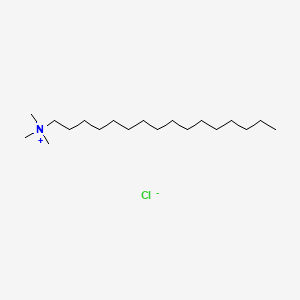
Hexadecyltrimethylammonium chloride
Cetyltrimethylammonium chloride is the organic chloride salt of cetyltrimethylammonium. It has a role as a surfactant. It is a quaternary ammonium salt and an organic chloride salt. It contains a cetyltrimethylammonium ion. — ChEBI
- IUPAC-Name
- hexadecyl(trimethyl)azanium chloride
- Summenformel
- C19H42ClN
- Molekulargewicht
- 320.0 g/mol
- Exakte Masse
- 319.3005780 Da
- Topologische polare Oberfläche
- 0,0 Ų
- Wasserstoffbrücken-Donoren
- 0
- Wasserstoffbrücken-Akzeptoren
- 1
- Kovalente Einheiten
- 2
- Definierte Stereozentren
- 0
Auch bekannt als
16 weitere gemeldete Namen
Kennungen in externen Datenbanken
- ChEBI:CHEBI:53581
- ChEMBL:CHEMBL1895807
- EPA DTXSID:DTXSID6026901
- PubMed:10124
Belege aus weiteren wissenschaftlichen Datenbanken
NIH PubChem PUG-View
Attributed physical-property, hazard, environmental and use annotations.
- Autoignition Temperature: 750 °F (USCG, 1999) Quelle: CAMEO Chemicals
- Autoignition Temperature: 750 °F /ISOPROPYL ALCOHOL SOLN OF CETYLTRIMETHYLAMMONIUM CHLORIDE/ Quelle: Hazardous Substances Data Bank (HSDB)
- Boiling Point: 180 °F at 760 mmHg (isopropyl alcohol) (USCG, 1999) Quelle: CAMEO Chemicals
- Density: 0.9 at 77 °F (approx.) (USCG, 1999) - Less dense than water; will float Quelle: CAMEO Chemicals
- Flash Point: 69 °F (USCG, 1999) Quelle: CAMEO Chemicals
- LogP: log Kow= 3.23 Quelle: Hazardous Substances Data Bank (HSDB)
- Physical Description: Hexadecyltrimethylammonium chloride appears as colorless to pale yellow liquid with an odor of rubbing alcohol. Floats or sinks in water. (USCG, 1999) Quelle: CAMEO Chemicals
- Physical Description: Liquid; CBI Quelle: EPA Chemical Data Reporting (CDR)
- Physical Description: Solution: Clear to pale yellow liquid; [HSDB] White powder; [MSDSonline] Quelle: Haz-Map, Information on Hazardous Chemicals and Occupational Diseases
- Solubility: Water solubility: 440 mg/l at 30 °C Quelle: Hazardous Substances Data Bank (HSDB)
- First Aid: INGESTION: do NOT induce vomiting; drink large quanities of fluid and call a physician immediately.; EYES: flush with water for at least 15 min. and call a physician.; SKIN: flush with water. (USCG, 1999) Quelle: CAMEO Chemicals
- Note: This chemical does not meet GHS hazard criteria for 0.5% (5 of 1105) of reports. Quelle: European Chemicals Agency (ECHA)
- Signal: Danger Quelle: European Chemicals Agency (ECHA)
- GHS Hazard Statements: H302 (49%): Harmful if swallowed [Warning Acute toxicity, oral]; H311 (28.6%): Toxic in contact with skin [Danger Acute toxicity, dermal]; H314 (41.5%): Causes severe skin burns and eye damage [Danger Skin corrosion/irritation]; H315 (52.3%): Causes skin irritation [Warning Skin corrosion/irritation]; H318 (85.7%): Causes serious eye damage [Danger Serious eye damage/eye irritation]; H335 (44.3%): May cause respiratory irritation [Warning Specific target organ toxicity, single exposure; Respiratory tract irritation]; H400 (99.4%): Very toxic to aquatic life [Warning Hazardous to the aquatic environment, acute hazard]; H410 (40.9%): Very toxic to aquatic life with long lasting effects [Warning Hazardous to the aquatic environment, long-term hazard] Quelle: European Chemicals Agency (ECHA)
- Precautionary Statement Codes: P260, P261, P262, P264, P264+P265, P270, P271, P273, P280, P301+P317, P301+P330+P331, P302+P352, P302+P361+P354, P304+P340, P305+P354+P338, P316, P317, P319, P321, P330, P332+P317, P361+P364, P362+P364, P363, P391, P403+P233, P405, and P501 (click each P-code to see the statement) Quelle: European Chemicals Agency (ECHA)
- ECHA C&L Notifications Summary: Aggregated GHS information provided per 1105 reports by companies from 42 notifications to the ECHA C&L Inventory. Each notification may be associated with multiple companies.; Reported as not meeting GHS hazard criteria per 5 of 1105 reports by companies.; There are 41 notifications provided by 1100 of 1105 reports by companies with hazard statement code(s).; Information may vary between notifications depending on impurities, additives, and other factors. The percentage value in parenthesis indicates the notified classification ratio from companies that provide hazard codes. Only hazard codes with percentage values above 10% are shown. For more detailed information, please visit ECHA C&L website. Quelle: European Chemicals Agency (ECHA)
- Signal: Danger Quelle: NITE-CMC
- GHS Hazard Statements: H302: Harmful if swallowed [Warning Acute toxicity, oral]; H315: Causes skin irritation [Warning Skin corrosion/irritation]; H318: Causes serious eye damage [Danger Serious eye damage/eye irritation]; H335: May cause respiratory irritation [Warning Specific target organ toxicity, single exposure; Respiratory tract irritation]; H400: Very toxic to aquatic life [Warning Hazardous to the aquatic environment, acute hazard]; H410: Very toxic to aquatic life with long lasting effects [Warning Hazardous to the aquatic environment, long-term hazard] Quelle: NITE-CMC
- Precautionary Statement Codes: P261, P264, P264+P265, P270, P271, P273, P280, P301+P317, P302+P352, P304+P340, P305+P354+P338, P317, P319, P321, P330, P332+P317, P362+P364, P391, P403+P233, P405, and P501 (click each P-code to see the statement) Quelle: NITE-CMC
- Signal: Warning Quelle: NITE-CMC
- GHS Hazard Statements: H302: Harmful if swallowed [Warning Acute toxicity, oral]; H315: Causes skin irritation [Warning Skin corrosion/irritation]; H319: Causes serious eye irritation [Warning Serious eye damage/eye irritation]; H335: May cause respiratory irritation [Warning Specific target organ toxicity, single exposure; Respiratory tract irritation] Quelle: NITE-CMC
- Precautionary Statement Codes: P261, P264, P264+P265, P270, P271, P280, P301+P317, P302+P352, P304+P340, P305+P351+P338, P319, P321, P330, P332+P317, P337+P317, P362+P364, P403+P233, P405, and P501 (click each P-code to see the statement) Quelle: NITE-CMC
- Signal: Danger Quelle: Hazardous Chemical Information System (HCIS), Safe Work Australia
- Cosmetic Ingredient Review Conclusion: The CIR Expert Panel concluded the following ingredients are safe in the present practices of use and concentration described in the safety assessment when formulated to be non-irritating...Cetrimonium Chloride... Quelle: Cosmetic Ingredient Review (CIR)
- Cosmetic Ingredient Review Finding(s): Safe for use in cosmetics, with qualifications Quelle: Cosmetic Ingredient Review (CIR)
- Environmental Bioconcentration: An estimated BCF of 71 was calculated for trimethylhexadecylammonium chloride(SRC), using an estimated log Kow of 3.23(1) and a regression-derived equation(2). According to a classification scheme(3), this BCF suggests the potential for bioconcentration in aquatic organisms is moderate. Quelle: Hazardous Substances Data Bank (HSDB)
- Environmental Fate: TERRESTRIAL FATE: Based on a classification scheme(1), an estimated Koc value of 2.2X10+5(SRC), determined from a structure estimation method(2), indicates that trimethylhexadecylammonium chloride is expected to be immobile in soil(SRC). Volatilization of trimethylhexadecylammonium chloride from moist soil surfaces is not expected to be an important fate process(SRC) given an estimated Henry's Law constant of 2.9X10⁻¹⁰ atm-cu m/mole(SRC), using a fragment constant estimation method(3). Trimethylhexadecylammonium chloride is not expected to volatilize from dry soil surfaces(SRC) based upon an estimated vapor pressure of 2.8X10⁻¹⁰ mm Hg(SRC), determined from a fragment constant method(4). Quelle: Hazardous Substances Data Bank (HSDB)
- Environmental Fate: AQUATIC FATE: Based on a classification scheme(1), an estimated Koc value of 2.2X10+5(SRC), determined from an estimation method(2), indicates that trimethylhexadecylammonium chloride is expected to adsorb to suspended solids and sediment in water(SRC). Volatilization from water surfaces is not expected(3) based upon an estimated Henry's Law constant of 2.9X10⁻¹⁰ atm-cu m/mole(SRC), developed using a fragment constant estimation method(4). According to a classification scheme(5), an estimated BCF of 71(SRC), from its log Kow of 3.23(6) and a regression-derived equation(7), suggests the potential for bioconcentration in aquatic organisms is moderate. The MITI, closed bottle, and Sturm tests revealed no degradation after 10 days, microbial growth after 17 days, and 84% degradation after 13 days, respectively(8). 10-20 ppm trimethylhexadecylammonium chloride was degraded with a half-life of 3.1 days in freshwater collected from the Ohio river 1 mile below discharge from a municipal treatment plant at 20 °C and pH 6.9(9). Quelle: Hazardous Substances Data Bank (HSDB)
- Environmental Fate: ATMOSPHERIC FATE: According to a model of gas/particle partitioning of semivolatile organic compounds in the atmosphere(1), trimethylhexadecylammonium chloride, which has an estimated vapor pressure of 2.8X10⁻¹⁰ mm Hg at 25 °C(SRC), using a fragment constant estimation method(2), is expected to exist solely in the particulate phase in the ambient atmosphere. Particulate-phase trimethylhexadecylammonium chloride may be removed from the air by wet and dry deposition(SRC). Quelle: Hazardous Substances Data Bank (HSDB)
- Consumer Uses: Cleaning agent; Corrosion inhibitor; Softener and conditioner; Surface modifier; Surfactant (surface active agent) Quelle: EPA Chemical Data Reporting (CDR)
- Industry Uses: Corrosion inhibitor; Processing aids, specific to petroleum production; Softener and conditioner; Surface modifier; CBI; Processing aids not otherwise specified; Surfactant (surface active agent) Quelle: EPA Chemical Data Reporting (CDR)
- Cosmetic Ingredient Review Link: CIR ingredient: Cetrimonium Chloride Quelle: Cosmetic Ingredient Review (CIR)
- Sources/Uses: Available as a 25% aqueous solution and 50% solution in isopropyl alcohol and water for use in antifungal formulations and hair conditioners; Also used as a disinfectant/germicide, cationic detergent, fermentation aid, dispersant, coagulant for antibiotic production, and antistatic and softening agent for textile finishes; [HSDB] Quelle: Haz-Map, Information on Hazardous Chemicals and Occupational Diseases
- Industrial Processes with risk of exposure: Using Disinfectants or Biocides [Category: Clean]; Textiles (Printing, Dyeing, or Finishing) [Category: Industry] Quelle: Haz-Map, Information on Hazardous Chemicals and Occupational Diseases
- Uses: USED IN ANTIFUNGAL FORMULATION; IN HAIR CONDITIONER FORMULATION; DISINFECTANT; CATIONIC DETERGENT Quelle: Hazardous Substances Data Bank (HSDB)
- Uses: SOFTENER IN HAIR TREATMENTS, EG, CREME RINSES Quelle: Hazardous Substances Data Bank (HSDB)
- Uses: FERMENTATION AID Quelle: Hazardous Substances Data Bank (HSDB)
- Uses: GERMICIDE Quelle: Hazardous Substances Data Bank (HSDB)
- Uses: For more Uses (Complete) data for TRIMETHYLHEXADECYLAMMONIUM CHLORIDE (6 total), please visit the HSDB record page. Quelle: Hazardous Substances Data Bank (HSDB)
Zugeordnet durch: Existing checksum-valid CAS to unique PubChem CID match. Abgerufen: 2026-08-31. Quelleneintrag öffnen
Wissenschaftliche Klassifizierungen und Gefahrenannotationen liefern Kontext und ersetzen nicht die oben gezeigte marktspezifische regulatorische Entscheidung.
Weitere Quellenabdeckung und Trefferstatus
| Quelle | Ergebnis | Geprüft |
|---|---|---|
| NIH PubChem PUG-View | Exakter Treffer | 2026-08-31 |
Ein erfasster Nicht-Treffer ist ein nützlicher Beleg dafür, dass die Quelle geprüft wurde; er ist keine Behauptung, dass der Stoff anderswo nicht existiert.
Am 2026-08-31 von NIH PubChem durch prüfsummengültigen CAS-Abgleich abgerufen. Chemische Eigenschaften ersetzen nicht die regulatorische Entscheidung auf dieser Seite.
Verzeichnisverknüpfungen für CETRIMONIUM CHLORIDE (1) / STRARTRIMONIUM CHLORIDE (1)
Verwandte Einträge zu CETRIMONIUM CHLORIDE (1) / STRARTRIMONIUM CHLORIDE (1)
Für diesen Eintrag gibt es nur wenige direkte Treffer; daher werden auch nahe liegende Einträge aus Anhang III angezeigt.
BEHENTRIMONIUM CHLORIDE (1) / CETRIMONIUM BROMIDE / CETRIMONIUM CHLORIDE (2)/ LAURTRIMONIUM BROMIDE…
2,6-Diaminopyridine
2,2'-METHYLENEBIS 4-AMINOPHENOL HCL
5-Amino-6-Chloro-o- Cresol / 5-Amino-6-Chloro-o- Cresol HCl
Was Anhang III für CETRIMONIUM CHLORIDE (1) / STRARTRIMONIUM CHLORIDE (1) bedeutet
CETRIMONIUM CHLORIDE (1) / STRARTRIMONIUM CHLORIDE (1) ist ein beschränkter Stoff nach Anhang III der EU-Kosmetikverordnung (EG) Nr. 1223/2009. Seine Verwendung in kosmetischen Mitteln ist nur unter den im obigen Eintrag genannten besonderen Bedingungen zulässig, einschließlich geltender Konzentrationsgrenzen, Beschränkungen der Produktart und erforderlicher Warnhinweise.
Wird dieser Stoff in einer Rezeptur verwendet, müssen alle Bedingungen – Höchstkonzentration, Produktbereich und Warnhinweise – gleichzeitig erfüllt sein. Die Einhaltung einer Bedingung hebt die anderen nicht auf.
Dieser Eintrag ist zum Abgleich von Namen und Kennungen mit 2 Inhaltsstoffen des CosIng-Verzeichnisses verknüpft. Die Seite zeigt außerdem 11 verwandte Anhangseinträge mit überschneidenden Kennungen, Anhangslogik oder Namensmustern.
Compliance-Checkliste
- Stellen Sie sicher, dass die Konzentration in der Rezeptur nicht überschreitet: (a) 2,5% for the individual concentrarions or the sum of the individual concentrations of cetrimonium chloride and streartrimonium chloride (b) 1,0% for the individual concentrarions or the sum of the individual concentrations of cetrimonium chloride and streartrimonium chloride (c) 0,5% for the individual concentrarions or the sum of the individual concentrations of cetrimonium chloride and streartrimonium chloride
- Prüfen Sie die Vereinbarkeit mit der Produktart: (a) Rinse-off hair products (b) Leave-on hair products (c) Leave-on face products
- Dokumentieren Sie die Verwendungsbedingungen in der Produktinformationsdatei (PIF).
Häufig gestellte Fragen
Quellenhinweis zu Anhang III, Eintrag CETRIMONIUM CHLORIDE (1) / STRARTRIMONIUM CHLORIDE (1)
Diese Seite fasst einen Eintrag aus Anhang III für CETRIMONIUM CHLORIDE (1) / STRARTRIMONIUM CHLORIDE (1) aus öffentlichen Materialien der Europäischen Kommission zu kosmetischen Mitteln zusammen und ergänzt, soweit verfügbar, verknüpfte Treffer aus dem Verzeichnis oder bei Kennungen.
Nutzen Sie diese Eintragsseite, um die Bedingungen aus Anhang III für CETRIMONIUM CHLORIDE (1) / STRARTRIMONIUM CHLORIDE (1) zu prüfen; bestätigen Sie jede endgültige regulatorische Entscheidung jedoch anhand des aktuellen amtlichen Anhangswortlauts und der Quelldateien.
Werkzeuge und nächste Schritte
Rezeptur prüfen
Fügen Sie eine vollständige INCI-Liste ein, um CETRIMONIUM CHLORIDE (1) / STRARTRIMONIUM CHLORIDE (1) und andere markierte EU-Anhangseinträge in einem Durchgang zu finden.
INCI-CheckerEinträge vergleichen
CETRIMONIUM CHLORIDE (1) / STRARTRIMONIUM CHLORIDE (1) nebeneinander mit einem anderen Anhangseintrag vergleichen, um Unterschiede bei Beschränkungen, Konzentrationen und Anhangszuordnung zu prüfen.
VergleichenDen Anhang durchsuchen
Alle Einträge in Anhang III ansehen und die regulatorischen Bedingungen der Stoffe in diesem Anhang vergleichen.
Anhang III öffnen