
1,3-Dimethylpentylamine and its salts
1,3-Dimethylpentylamine and its salts은(는) EU 시장에 출시되는 화장품에 사용이 금지된 물질로 부속서 II에 등재되어 있습니다.
기록 세부 정보
화학명
1,3-Dimethylpentylamine and its salts
규제 정보
주요 데이터
화학적 정체 및 특성
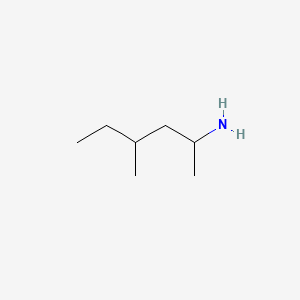
- IUPAC 명칭
- 4-methylhexan-2-amine
- 분자식
- C7H17N
- 분자량
- 115.22 g/mol
- 정확한 질량
- 115.136099547 Da
- XLogP3
- 1.9
- 위상 극성 표면적
- 26.0 Ų
- 수소 결합 공여체
- 1
- 수소 결합 수용체
- 1
- 공유결합 단위
- 1
- 정의된 입체중심
- 0
다른 이름
보고된 명칭 16개 더 보기
외부 데이터베이스 식별자
추가 과학 데이터베이스의 근거
EMBL-EBI ChEBI
methylhexaneamine
- 처방
- C7H17N
- 평균 질량
- 115.220 g/mol
- 단일 동위원소 질량
- 115.13610 Da
- 형식 전하
- 0
- alkylamine — is a (CHEBI:13759)
- alkylamine — is a (CHEBI:13759)
추가 선별 명칭
이 출처의 상호 참조
- CAS: 105-41-9 — DrugCentral
- MANUAL_X_REF: 3353 — DrugCentral
매핑 기준: Exact CAS cross-reference in the ChEBI compound record. 출처 업데이트: 2017-02-23. 가져온 시각: 2026-08-31. 출처 기록 열기
NIH PubChem PUG-View
Attributed physical-property, hazard, environmental and use annotations.
- Boiling Point: 132.5 °C 출처: Hazardous Substances Data Bank (HSDB)
- Color/Form: Liquid 출처: Hazardous Substances Data Bank (HSDB)
- Density: 0.7655 g/cu cm at 20 °C 출처: Hazardous Substances Data Bank (HSDB)
- Odor: Amine odor 출처: Hazardous Substances Data Bank (HSDB)
- Refractive Index: Index of Refraction: 1.4150 at 25 °C 출처: Hazardous Substances Data Bank (HSDB)
- Solubility: Slightly soluble in water; very soluble in ethanol, ether, chloroform and dilute acid 출처: Hazardous Substances Data Bank (HSDB)
- Signal: Danger 출처: European Chemicals Agency (ECHA)
- GHS Hazard Statements: H226 (100%): Flammable liquid and vapor [Warning Flammable liquids]; H302 (100%): Harmful if swallowed [Warning Acute toxicity, oral]; H314 (100%): Causes severe skin burns and eye damage [Danger Skin corrosion/irritation]; H335 (100%): May cause respiratory irritation [Warning Specific target organ toxicity, single exposure; Respiratory tract irritation] 출처: European Chemicals Agency (ECHA)
- Precautionary Statement Codes: P210, P233, P240, P241, P242, P243, P260, P261, P264, P270, P271, P280, P301+P317, P301+P330+P331, P302+P361+P354, P303+P361+P353, P304+P340, P305+P354+P338, P316, P319, P321, P330, P363, P370+P378, P403+P233, P403+P235, P405, and P501 (click each P-code to see the statement) 출처: European Chemicals Agency (ECHA)
- ECHA C&L Notifications Summary: Aggregated GHS information provided per 39 reports by companies from 2 notifications to the ECHA C&L Inventory. Each notification may be associated with multiple companies.; Information may vary between notifications depending on impurities, additives, and other factors. The percentage value in parenthesis indicates the notified classification ratio from companies that provide hazard codes. Only hazard codes with percentage values above 10% are shown. For more detailed information, please visit ECHA C&L website. 출처: European Chemicals Agency (ECHA)
- Environmental Bioconcentration: An estimated BCF of 12 was calculated in fish for 1,3-dimethylamylamine(SRC), using an estimated log Kow of 2.16(1) and a regression-derived equation(1). According to a classification scheme(2), this BCF suggests the potential for bioconcentration in aquatic organisms is low(SRC). 출처: Hazardous Substances Data Bank (HSDB)
- Environmental Fate: TERRESTRIAL FATE: Based on a classification scheme(1), an estimated Koc value of 200(SRC), determined from a structure estimation method(2), indicates that 1,3-dimethylamylamine is expected to have moderate mobility in soil(SRC). The pKa of 1,3-dimethylamylamine is estimated to be 10.6(SRC) based on analogy to similar amines(3), indicating that this compound will exist primarily in cation form in the environment and cations generally adsorb more strongly to soils containing organic carbon and clay than their neutral counterparts(4). Volatilization of 1,3-dimethylamylamine from moist soil surfaces may occur(SRC) given an estimated Henry's Law constant of 4.2X10⁻⁵ atm-cu m/mole(SRC), using a fragment constant estimation method(2). 1,3-Dimethylamylamine is expected to volatilize from dry soil surfaces(SRC) based upon an estimated vapor pressure of 8.9 mm Hg at 25 °C(SRC), determined from a fragment constant method(2). Environmental biodegradation data specific to 1,3-dimethylamylamine were not available(SRC, 2014). However, similar aliphatic amines (such as amylamine and sec-butylamine) have been classified as readily biodegradable using the Japanese MITI test where these aliphatic am 출처: Hazardous Substances Data Bank (HSDB)
- Environmental Fate: AQUATIC FATE: Based on a classification scheme(1), an estimated Koc value of 200(SRC), determined from a structure estimation method(2), indicates that 1,3-dimethylamylamine may have moderate adsorption to suspended solids and sediment(SRC). Volatilization from water surfaces is expected(3) based upon an estimated Henry's Law constant of 4.2X10⁻⁵ atm-cu m/mole(SRC), developed using a fragment constant estimation method(2). Using this Henry's Law constant and an estimation method(3), volatilization half-lives for a model river and model lake are 1.1 and 11.1 days, respectively(SRC). According to a classification scheme(4), an estimated BCF of 12(SRC), from an estimated log Kow of 2.16(2) and a regression-derived equation(2), suggests the potential for bioconcentration in aquatic organisms is low. 1,3-Dimethylamylamine is not expected to undergo hydrolysis in the environment due to the lack of functional groups that hydrolyze under environmental conditions(3). Environmental biodegradation data specific to 1,3-dimethylamylamine were not available(SRC, 2014). However, similar aliphatic amines (such as amylamine and sec-butylamine) have been classified as readily biodegradable using the 출처: Hazardous Substances Data Bank (HSDB)
- Environmental Fate: ATMOSPHERIC FATE: According to a model of gas/particle partitioning of semivolatile organic compounds in the atmosphere(1), 1,3-dimethylamylamine, which has an estimated vapor pressure of 8.9 mm Hg at 25 °C(SRC), determined from a fragment constant method(2), is expected to exist solely as a vapor in the ambient atmosphere. Vapor-phase 1,3-dimethylamylamine is degraded in the atmosphere by reaction with photochemically-produced hydroxyl radicals(SRC); the half-life for this reaction in air is estimated to be about 8 hours(SRC), calculated from its rate constant of 4.9X10⁻¹¹ cu cm/molecule-sec at 25 °C(SRC) that was derived using a structure estimation method(2). 1,3-Dimethylamylamine does not contain chromophores that absorb at wavelengths >290 nm(3) and, therefore, is not expected to be susceptible to direct photolysis by sunlight(SRC). 출처: Hazardous Substances Data Bank (HSDB)
- Uses: DMAA (1,3-dimethylamylamine) is an amphetamine derivative that has been widely used in sports supplements sold in the United States. Also known as methylhexanamine or geranium extract, DMAA is often touted as a "natural" stimulant, with many claimed functional uses including a body-building aid, an athletic performance enhancer, and a weight-loss aid. Although DMAA at one time was approved as a drug for nasal decongestion, no medical use of DMAA is recognized today. FDA is not aware of any reliable science indicating that DMAA exists naturally in plants. 출처: Hazardous Substances Data Bank (HSDB)
- Uses: THERAPEUTIC CATEGORY: Adrenergic 출처: Hazardous Substances Data Bank (HSDB)
- Uses: /Former Use/ MEDICATION 출처: Hazardous Substances Data Bank (HSDB)
매핑 기준: Existing checksum-valid CAS to unique PubChem CID match. 가져온 시각: 2026-08-31. 출처 기록 열기
과학적 분류와 유해성 주석은 맥락을 제공할 뿐이며, 위에 표시된 시장별 규제 판단을 대체하지 않습니다.
추가 출처 적용 범위 및 일치 상태
| 출처 | 결과 | 확인됨 |
|---|---|---|
| EMBL-EBI ChEBI | 정확히 일치 | 2026-08-31 |
| NIH PubChem PUG-View | 정확히 일치 | 2026-08-31 |
기록된 불일치는 출처를 확인했다는 유용한 근거이며, 해당 물질이 다른 곳에 존재하지 않는다는 주장이 아닙니다.
체크섬이 유효한 CAS 일치를 통해 2026-08-31에 NIH PubChem에서 가져왔습니다. 화학적 특성은 이 페이지의 규제 판단을 대체하지 않습니다.
1,3-Dimethylpentylamine and its salts의 관련 기록
이 기록에 직접 일치하는 항목이 제한적이어서, 부속서 II의 인접 항목도 함께 표시합니다.
Toluidines, their isomers, salts and halogenated and sulphonated derivatives
Xylidines, their isomers, salts and halogenated and sulphonated derivatives
Imperatorin (9-(3-methylbut-2-enyloxy)furo[3,2-g]chromen-7-one)
1,3-Dimethylpentylamine and its salts에 대한 부속서 II의 의미
1,3-Dimethylpentylamine and its salts은(는) EU 화장품 규정 1223/2009 부속서 II에 따라 사용금지 물질로 등재되어 있으며 의도적으로 첨가해서는 안 됩니다. 제17조는 별도로, 우수화장품제조관리기준(GMP)에 따라 기술적으로 피할 수 없고 제3조의 안전 요건에 부합하는 비의도적 미량에 대해 다룹니다.
처방 개발자는 원료와 원재료를 선별하여 이 물질이 들어 있지 않은지 확인해야 합니다. 공급업체는 요청 시 부재를 확인하는 문서를 제공해야 합니다.
또한 이 페이지에는 식별자, 부속서 논리 또는 명칭 패턴이 겹치는 관련 부속서 기록 12건이 표시됩니다.
규제 준수 체크리스트
- 이 물질이 모든 원료와 완제품 처방에 없는지 확인하세요.
- 원료 공급업체에 부재 확인서 또는 CoA를 요청하세요.
- 선별 결과를 제품정보파일(PIF)에 기록하세요.
자주 묻는 질문
부속서 II 기록 1,3-Dimethylpentylamine and its salts의 출처 주석
이 페이지는 공개된 유럽연합 집행위원회 화장품 자료에서 가져온 1,3-Dimethylpentylamine and its salts의 부속서 II 기록 하나를 요약하고, 가능한 경우 연결된 목록 또는 식별자 일치 항목을 추가합니다.
이 기록 페이지를 이용해 1,3-Dimethylpentylamine and its salts의 부속서 II 조건을 검토하되, 최종 규제 판단은 현행 공식 부속서 문구 및 원본 파일로 확인하세요.