
1,3-Dimethylpentylamine and its salts
1,3-Dimethylpentylamine and its salts ist in Anhang II als verbotener Stoff für kosmetische Mittel aufgeführt, die in der EU in Verkehr gebracht werden.
Eintragsdetails
Chemische Bezeichnung
1,3-Dimethylpentylamine and its salts
Regulatorische Informationen
Kerndaten
Chemische Identität und Eigenschaften
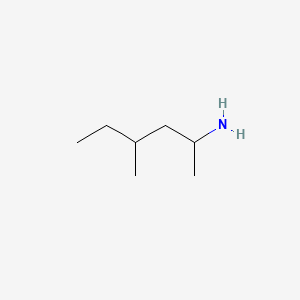
- IUPAC-Name
- 4-methylhexan-2-amine
- Summenformel
- C7H17N
- Molekulargewicht
- 115.22 g/mol
- Exakte Masse
- 115.136099547 Da
- XLogP3
- 1,9
- Topologische polare Oberfläche
- 26,0 Ų
- Wasserstoffbrücken-Donoren
- 1
- Wasserstoffbrücken-Akzeptoren
- 1
- Kovalente Einheiten
- 1
- Definierte Stereozentren
- 0
Auch bekannt als
16 weitere gemeldete Namen
Kennungen in externen Datenbanken
Belege aus weiteren wissenschaftlichen Datenbanken
EMBL-EBI ChEBI
methylhexaneamine
- Rezeptur
- C7H17N
- Durchschnittsmasse
- 115.220 g/mol
- Monoisotopische Masse
- 115.13610 Da
- Formale Ladung
- 0
- alkylamine — is a (CHEBI:13759)
- alkylamine — is a (CHEBI:13759)
Weitere kuratierte Namen
Querverweise aus dieser Quelle
- CAS: 105-41-9 — DrugCentral
- MANUAL_X_REF: 3353 — DrugCentral
Zugeordnet durch: Exact CAS cross-reference in the ChEBI compound record. Quelle aktualisiert: 2017-02-23. Abgerufen: 2026-08-31. Quelleneintrag öffnen
NIH PubChem PUG-View
Attributed physical-property, hazard, environmental and use annotations.
- Boiling Point: 132.5 °C Quelle: Hazardous Substances Data Bank (HSDB)
- Color/Form: Liquid Quelle: Hazardous Substances Data Bank (HSDB)
- Density: 0.7655 g/cu cm at 20 °C Quelle: Hazardous Substances Data Bank (HSDB)
- Odor: Amine odor Quelle: Hazardous Substances Data Bank (HSDB)
- Refractive Index: Index of Refraction: 1.4150 at 25 °C Quelle: Hazardous Substances Data Bank (HSDB)
- Solubility: Slightly soluble in water; very soluble in ethanol, ether, chloroform and dilute acid Quelle: Hazardous Substances Data Bank (HSDB)
- Signal: Danger Quelle: European Chemicals Agency (ECHA)
- GHS Hazard Statements: H226 (100%): Flammable liquid and vapor [Warning Flammable liquids]; H302 (100%): Harmful if swallowed [Warning Acute toxicity, oral]; H314 (100%): Causes severe skin burns and eye damage [Danger Skin corrosion/irritation]; H335 (100%): May cause respiratory irritation [Warning Specific target organ toxicity, single exposure; Respiratory tract irritation] Quelle: European Chemicals Agency (ECHA)
- Precautionary Statement Codes: P210, P233, P240, P241, P242, P243, P260, P261, P264, P270, P271, P280, P301+P317, P301+P330+P331, P302+P361+P354, P303+P361+P353, P304+P340, P305+P354+P338, P316, P319, P321, P330, P363, P370+P378, P403+P233, P403+P235, P405, and P501 (click each P-code to see the statement) Quelle: European Chemicals Agency (ECHA)
- ECHA C&L Notifications Summary: Aggregated GHS information provided per 39 reports by companies from 2 notifications to the ECHA C&L Inventory. Each notification may be associated with multiple companies.; Information may vary between notifications depending on impurities, additives, and other factors. The percentage value in parenthesis indicates the notified classification ratio from companies that provide hazard codes. Only hazard codes with percentage values above 10% are shown. For more detailed information, please visit ECHA C&L website. Quelle: European Chemicals Agency (ECHA)
- Environmental Bioconcentration: An estimated BCF of 12 was calculated in fish for 1,3-dimethylamylamine(SRC), using an estimated log Kow of 2.16(1) and a regression-derived equation(1). According to a classification scheme(2), this BCF suggests the potential for bioconcentration in aquatic organisms is low(SRC). Quelle: Hazardous Substances Data Bank (HSDB)
- Environmental Fate: TERRESTRIAL FATE: Based on a classification scheme(1), an estimated Koc value of 200(SRC), determined from a structure estimation method(2), indicates that 1,3-dimethylamylamine is expected to have moderate mobility in soil(SRC). The pKa of 1,3-dimethylamylamine is estimated to be 10.6(SRC) based on analogy to similar amines(3), indicating that this compound will exist primarily in cation form in the environment and cations generally adsorb more strongly to soils containing organic carbon and clay than their neutral counterparts(4). Volatilization of 1,3-dimethylamylamine from moist soil surfaces may occur(SRC) given an estimated Henry's Law constant of 4.2X10⁻⁵ atm-cu m/mole(SRC), using a fragment constant estimation method(2). 1,3-Dimethylamylamine is expected to volatilize from dry soil surfaces(SRC) based upon an estimated vapor pressure of 8.9 mm Hg at 25 °C(SRC), determined from a fragment constant method(2). Environmental biodegradation data specific to 1,3-dimethylamylamine were not available(SRC, 2014). However, similar aliphatic amines (such as amylamine and sec-butylamine) have been classified as readily biodegradable using the Japanese MITI test where these aliphatic am Quelle: Hazardous Substances Data Bank (HSDB)
- Environmental Fate: AQUATIC FATE: Based on a classification scheme(1), an estimated Koc value of 200(SRC), determined from a structure estimation method(2), indicates that 1,3-dimethylamylamine may have moderate adsorption to suspended solids and sediment(SRC). Volatilization from water surfaces is expected(3) based upon an estimated Henry's Law constant of 4.2X10⁻⁵ atm-cu m/mole(SRC), developed using a fragment constant estimation method(2). Using this Henry's Law constant and an estimation method(3), volatilization half-lives for a model river and model lake are 1.1 and 11.1 days, respectively(SRC). According to a classification scheme(4), an estimated BCF of 12(SRC), from an estimated log Kow of 2.16(2) and a regression-derived equation(2), suggests the potential for bioconcentration in aquatic organisms is low. 1,3-Dimethylamylamine is not expected to undergo hydrolysis in the environment due to the lack of functional groups that hydrolyze under environmental conditions(3). Environmental biodegradation data specific to 1,3-dimethylamylamine were not available(SRC, 2014). However, similar aliphatic amines (such as amylamine and sec-butylamine) have been classified as readily biodegradable using the Quelle: Hazardous Substances Data Bank (HSDB)
- Environmental Fate: ATMOSPHERIC FATE: According to a model of gas/particle partitioning of semivolatile organic compounds in the atmosphere(1), 1,3-dimethylamylamine, which has an estimated vapor pressure of 8.9 mm Hg at 25 °C(SRC), determined from a fragment constant method(2), is expected to exist solely as a vapor in the ambient atmosphere. Vapor-phase 1,3-dimethylamylamine is degraded in the atmosphere by reaction with photochemically-produced hydroxyl radicals(SRC); the half-life for this reaction in air is estimated to be about 8 hours(SRC), calculated from its rate constant of 4.9X10⁻¹¹ cu cm/molecule-sec at 25 °C(SRC) that was derived using a structure estimation method(2). 1,3-Dimethylamylamine does not contain chromophores that absorb at wavelengths >290 nm(3) and, therefore, is not expected to be susceptible to direct photolysis by sunlight(SRC). Quelle: Hazardous Substances Data Bank (HSDB)
- Uses: DMAA (1,3-dimethylamylamine) is an amphetamine derivative that has been widely used in sports supplements sold in the United States. Also known as methylhexanamine or geranium extract, DMAA is often touted as a "natural" stimulant, with many claimed functional uses including a body-building aid, an athletic performance enhancer, and a weight-loss aid. Although DMAA at one time was approved as a drug for nasal decongestion, no medical use of DMAA is recognized today. FDA is not aware of any reliable science indicating that DMAA exists naturally in plants. Quelle: Hazardous Substances Data Bank (HSDB)
- Uses: THERAPEUTIC CATEGORY: Adrenergic Quelle: Hazardous Substances Data Bank (HSDB)
- Uses: /Former Use/ MEDICATION Quelle: Hazardous Substances Data Bank (HSDB)
Zugeordnet durch: Existing checksum-valid CAS to unique PubChem CID match. Abgerufen: 2026-08-31. Quelleneintrag öffnen
Wissenschaftliche Klassifizierungen und Gefahrenannotationen liefern Kontext und ersetzen nicht die oben gezeigte marktspezifische regulatorische Entscheidung.
Weitere Quellenabdeckung und Trefferstatus
| Quelle | Ergebnis | Geprüft |
|---|---|---|
| EMBL-EBI ChEBI | Exakter Treffer | 2026-08-31 |
| NIH PubChem PUG-View | Exakter Treffer | 2026-08-31 |
Ein erfasster Nicht-Treffer ist ein nützlicher Beleg dafür, dass die Quelle geprüft wurde; er ist keine Behauptung, dass der Stoff anderswo nicht existiert.
Am 2026-08-31 von NIH PubChem durch prüfsummengültigen CAS-Abgleich abgerufen. Chemische Eigenschaften ersetzen nicht die regulatorische Entscheidung auf dieser Seite.
Verwandte Einträge zu 1,3-Dimethylpentylamine and its salts
Für diesen Eintrag gibt es nur wenige direkte Treffer; daher werden auch nahe liegende Einträge aus Anhang II angezeigt.
2-Amino-1,2-bis(4-methoxyphenyl)ethanol and its salts
4-Aminosalicylic acid and its salts
Octodrine (INN) and its salts
Toluidines, their isomers, salts and halogenated and sulphonated derivatives
Tuaminoheptane (INN), its isomers and salts
Xylidines, their isomers, salts and halogenated and sulphonated derivatives
Imperatorin (9-(3-methylbut-2-enyloxy)furo[3,2-g]chromen-7-one)
Procainamide (INN), its salts and derivatives
Ammi majus L. and its galenical preparations
Was Anhang II für 1,3-Dimethylpentylamine and its salts bedeutet
1,3-Dimethylpentylamine and its salts ist in Anhang II der EU-Kosmetikverordnung (EG) Nr. 1223/2009 als verbotener Stoff aufgeführt und darf nicht absichtlich zugesetzt werden. Artikel 17 regelt gesondert unbeabsichtigte geringe Mengen, die bei guter Herstellungspraxis technisch unvermeidbar und mit der Sicherheitsanforderung nach Artikel 3 vereinbar sind.
Rezepturentwickler müssen ihre Inhaltsstoffe und Rohstoffe prüfen, um sicherzustellen, dass keiner davon diesen Stoff enthält. Lieferanten sollten auf Anfrage eine Dokumentation vorlegen, die die Abwesenheit bestätigt.
Die Seite zeigt außerdem 12 verwandte Anhangseinträge mit überschneidenden Kennungen, Anhangslogik oder Namensmustern.
Compliance-Checkliste
- Prüfen Sie, dass dieser Stoff in allen Rohstoffen und fertigen Rezepturen nicht enthalten ist.
- Fordern Sie von Rohstofflieferanten eine Abwesenheitsbestätigung oder ein Analysenzertifikat an.
- Dokumentieren Sie das Prüfergebnis in der Produktinformationsdatei (PIF).
Häufig gestellte Fragen
Quellenhinweis zu Anhang II, Eintrag 1,3-Dimethylpentylamine and its salts
Diese Seite fasst einen Eintrag aus Anhang II für 1,3-Dimethylpentylamine and its salts aus öffentlichen Materialien der Europäischen Kommission zu kosmetischen Mitteln zusammen und ergänzt, soweit verfügbar, verknüpfte Treffer aus dem Verzeichnis oder bei Kennungen.
Nutzen Sie diese Eintragsseite, um die Bedingungen aus Anhang II für 1,3-Dimethylpentylamine and its salts zu prüfen; bestätigen Sie jede endgültige regulatorische Entscheidung jedoch anhand des aktuellen amtlichen Anhangswortlauts und der Quelldateien.
Werkzeuge und nächste Schritte
Rezeptur prüfen
Fügen Sie eine vollständige INCI-Liste ein, um 1,3-Dimethylpentylamine and its salts und andere markierte EU-Anhangseinträge in einem Durchgang zu finden.
INCI-CheckerEinträge vergleichen
1,3-Dimethylpentylamine and its salts nebeneinander mit einem anderen Anhangseintrag vergleichen, um Unterschiede bei Beschränkungen, Konzentrationen und Anhangszuordnung zu prüfen.
VergleichenDen Anhang durchsuchen
Alle Einträge in Anhang II ansehen und die regulatorischen Bedingungen der Stoffe in diesem Anhang vergleichen.
Anhang II öffnen