
N,N’-methylenediacrylamide
N,N’-methylenediacrylamide은(는) EU 시장에 출시되는 화장품에 사용이 금지된 물질로 부속서 II에 등재되어 있습니다.
기록 세부 정보
화학명
N,N’-methylenediacrylamide
규제 정보
주요 데이터
화학적 정체 및 특성
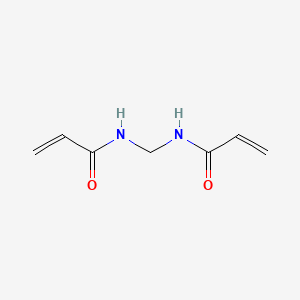
Methylenebisacrylamide
N,n'-methylenebisacrylamide is a white crystalline powder with a neutral odor. (NTP, 1992) — CAMEO Chemicals
- IUPAC 명칭
- N-[(prop-2-enoylamino)methyl]prop-2-enamide
- 분자식
- C7H10N2O2
- 분자량
- 154.17 g/mol
- 정확한 질량
- 154.074227566 Da
- XLogP3
- 0.1
- 위상 극성 표면적
- 58.2 Ų
- 수소 결합 공여체
- 2
- 수소 결합 수용체
- 2
- 공유결합 단위
- 1
- 정의된 입체중심
- 0
다른 이름
보고된 명칭 16개 더 보기
외부 데이터베이스 식별자
추가 과학 데이터베이스의 근거
NIH PubChem PUG-View
Attributed physical-property, hazard, environmental and use annotations.
- Density: 1.235 at 86 °F (NTP, 1992) - Denser than water; will sink 출처: CAMEO Chemicals
- Density: 1.235 @ 30°C 출처: PAC Chemical Database, U.S. Department of Energy
- Melting Point: 365 °F (with decomposition) (NTP, 1992) 출처: CAMEO Chemicals
- Physical Description: N,n'-methylenebisacrylamide is a white crystalline powder with a neutral odor. (NTP, 1992) 출처: CAMEO Chemicals
- Physical Description: Dry Powder 출처: EPA Chemical Data Reporting (CDR)
- Physical Description: White solid; [CAMEO] 출처: Haz-Map, Information on Hazardous Chemicals and Occupational Diseases
- Solubility: 0.1 to 1 mg/mL at 64 °F (NTP, 1992) 출처: CAMEO Chemicals
- First Aid: EYES: First check the victim for contact lenses and remove if present. Flush victim's eyes with water or normal saline solution for 20 to 30 minutes while simultaneously calling a hospital or poison control center. Do not put any ointments, oils, or medication in the victim's eyes without specific instructions from a physician. IMMEDIATELY transport the victim after flushing eyes to a hospital even if no symptoms (such as redness or irritation) develop.; SKIN: IMMEDIATELY flood affected skin with water while removing and isolating all contaminated clothing. Gently wash all affected skin areas thoroughly with soap and water. If symptoms such as redness or irritation develop, IMMEDIATELY call a physician and be prepared to transport the victim to a hospital for treatment.; INHALATION: IMMEDIATELY leave the contaminated area; take deep breaths of fresh air. If symptoms (such as wheezing, coughing, shortness of breath, or burning in the mouth, throat, or chest) develop, call a physician and be prepared to transport the victim to a hospital. Provide proper respiratory protection to rescuers entering an unknown atmosphere. Whenever possible, Self-Contained Breathing Apparatus (SCBA) shou 출처: CAMEO Chemicals
- Signal: Danger 출처: Regulation (EC) No 1272/2008 of the European Parliament and of the Council
- GHS Hazard Statements: H340: May cause genetic defects [Danger Germ cell mutagenicity] 출처: Regulation (EC) No 1272/2008 of the European Parliament and of the Council
- Precautionary Statement Codes: P203, P280, P318, P405, and P501 (click each P-code to see the statement) 출처: Regulation (EC) No 1272/2008 of the European Parliament and of the Council
- Signal: Danger 출처: European Chemicals Agency (ECHA)
- GHS Hazard Statements: H301 (54.4%): Toxic if swallowed [Danger Acute toxicity, oral]; H302 (45.6%): Harmful if swallowed [Warning Acute toxicity, oral]; H312 (35.3%): Harmful in contact with skin [Warning Acute toxicity, dermal]; H317 (19.1%): May cause an allergic skin reaction [Warning Sensitization, Skin]; H318 (19.1%): Causes serious eye damage [Danger Serious eye damage/eye irritation]; H332 (51.1%): Harmful if inhaled [Warning Acute toxicity, inhalation]; H340 (54.6%): May cause genetic defects [Danger Germ cell mutagenicity]; H350 (35.1%): May cause cancer [Danger Carcinogenicity]; H351 (19.3%): Suspected of causing cancer [Warning Carcinogenicity]; H360 (19.1%): May damage fertility or the unborn child [Danger Reproductive toxicity]; H361 (31.4%): Suspected of damaging fertility or the unborn child [Warning Reproductive toxicity]; H372 (54.4%): Causes damage to organs through prolonged or repeated exposure [Danger Specific target organ toxicity, repeated exposure] 출처: European Chemicals Agency (ECHA)
- Precautionary Statement Codes: P203, P260, P261, P264, P264+P265, P270, P271, P272, P280, P301+P316, P301+P317, P302+P352, P304+P340, P305+P354+P338, P317, P318, P319, P321, P330, P333+P317, P362+P364, P405, and P501 (click each P-code to see the statement) 출처: European Chemicals Agency (ECHA)
- ECHA C&L Notifications Summary: Aggregated GHS information provided per 544 reports by companies from 21 notifications to the ECHA C&L Inventory. Each notification may be associated with multiple companies.; Information may vary between notifications depending on impurities, additives, and other factors. The percentage value in parenthesis indicates the notified classification ratio from companies that provide hazard codes. Only hazard codes with percentage values above 10% are shown. For more detailed information, please visit ECHA C&L website. 출처: European Chemicals Agency (ECHA)
- Signal: Danger 출처: NITE-CMC
- GHS Hazard Statements: H301: Toxic if swallowed [Danger Acute toxicity, oral]; H340: May cause genetic defects [Danger Germ cell mutagenicity]; H360: May damage fertility or the unborn child [Danger Reproductive toxicity]; H370: Causes damage to organs [Danger Specific target organ toxicity, single exposure] 출처: NITE-CMC
- Precautionary Statement Codes: P203, P260, P264, P270, P280, P301+P316, P308+P316, P318, P321, P330, P405, and P501 (click each P-code to see the statement) 출처: NITE-CMC
- Industry Uses: Monomers 출처: EPA Chemical Data Reporting (CDR)
- Sources/Uses: Used as an organic intermediate, cross-linking agent, for making polyacrylamides, and for preparing polyacrylamide gel for electrophoresis, chemical grouting, and other uses; [NTP] 출처: Haz-Map, Information on Hazardous Chemicals and Occupational Diseases
매핑 기준: Existing checksum-valid CAS to unique PubChem CID match. 가져온 시각: 2026-08-31. 출처 기록 열기
과학적 분류와 유해성 주석은 맥락을 제공할 뿐이며, 위에 표시된 시장별 규제 판단을 대체하지 않습니다.
추가 출처 적용 범위 및 일치 상태
| 출처 | 결과 | 확인됨 |
|---|---|---|
| NIH PubChem PUG-View | 정확히 일치 | 2026-08-31 |
기록된 불일치는 출처를 확인했다는 유용한 근거이며, 해당 물질이 다른 곳에 존재하지 않는다는 주장이 아닙니다.
체크섬이 유효한 CAS 일치를 통해 2026-09-02에 NIH PubChem에서 가져왔습니다. 화학적 특성은 이 페이지의 규제 판단을 대체하지 않습니다.
N,N’-methylenediacrylamide의 목록 링크
N,N’-methylenediacrylamide의 관련 기록
이 기록에 직접 일치하는 항목이 제한적이어서, 부속서 II의 인접 항목도 함께 표시합니다.
Fenpropidin (ISO); (R,S)-1-[3-(4-tert-butylphenyl)-2-methylpropyl]piperidine
Sodium 3-(allyloxy)-2-hydroxypropanesulphonate
S-metolachlor (ISO); 2-chloro-N-(2-ethyl-6-methylphenyl)-N-[(2S)-1-methoxypropan-2-yl]acetamide; (R…
7-oxabicyclo[4.1.0]hept-3-ylmethyl 7-oxabicyclo[4.1.0]heptane-3-carboxylate
Pyraclostrobin (ISO); methyl N-(2-{[1-(4-chlorophenyl)-1H-pyrazol-3-yl]oxymethyl}phenyl) N-methoxy …
Benthiavalicarb-isopropyl (ISO); isopropyl [(S)-1-{[(R)-1-(6-fluoro-1,3-benzothiazol-2-yl)ethyl]car…
2-(dimethylamino)-2-[(4-methylphenyl)methyl]-1-[4-(morpholin-4-yl)phenyl]butan-1-one
N,N’-methylenediacrylamide에 대한 부속서 II의 의미
N,N’-methylenediacrylamide은(는) EU 화장품 규정 1223/2009 부속서 II에 따라 사용금지 물질로 등재되어 있으며 의도적으로 첨가해서는 안 됩니다. 제17조는 별도로, 우수화장품제조관리기준(GMP)에 따라 기술적으로 피할 수 없고 제3조의 안전 요건에 부합하는 비의도적 미량에 대해 다룹니다.
처방 개발자는 원료와 원재료를 선별하여 이 물질이 들어 있지 않은지 확인해야 합니다. 공급업체는 요청 시 부재를 확인하는 문서를 제공해야 합니다.
이 기록은 명칭 및 식별자 교차 참조를 위해 CosIng 목록 원료 1건과 연결되어 있습니다. 또한 이 페이지에는 식별자, 부속서 논리 또는 명칭 패턴이 겹치는 관련 부속서 기록 12건이 표시됩니다.
규제 준수 체크리스트
- 이 물질이 모든 원료와 완제품 처방에 없는지 확인하세요.
- 원료 공급업체에 부재 확인서 또는 CoA를 요청하세요.
- 선별 결과를 제품정보파일(PIF)에 기록하세요.