
Dimethylamine
Dimethylamine은(는) EU 시장에 출시되는 화장품에 사용이 금지된 물질로 부속서 II에 등재되어 있습니다.
기록 세부 정보
화학명
Dimethylamine
규제 정보
주요 데이터
화학적 정체 및 특성
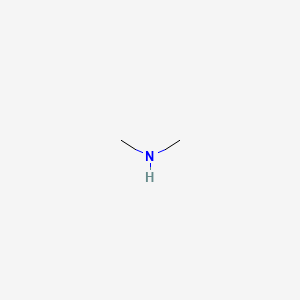
Dimethylamine
Dimethylamine is a secondary aliphatic amine where both N-substituents are methyl. It has a role as a metabolite. It is a member of methylamines and a secondary aliphatic amine. It is a conjugate base of a dimethylaminium. — ChEBI
- IUPAC 명칭
- N-methylmethanamine
- 분자식
- C2H7N
- 분자량
- 45.08 g/mol
- 정확한 질량
- 45.057849228 Da
- XLogP3
- -0.2
- 위상 극성 표면적
- 12.0 Ų
- 수소 결합 공여체
- 1
- 수소 결합 수용체
- 1
- 공유결합 단위
- 1
- 정의된 입체중심
- 0
다른 이름
보고된 명칭 16개 더 보기
외부 데이터베이스 식별자
- ChEBI:CHEBI:17170
- ChEMBL:CHEMBL120433
- EPA DTXSID:DTXSID5024057
- PubMed:23125571
- PubMed:23080400
- PubMed:23057717
- PubMed:22986132
- PubMed:22984827
- PubMed:22963339
- PubMed:22925760
- PubMed:22905022
- PubMed:22902581
- PubMed:22876948
- PubMed:22834792
- PubMed:22821843
추가 과학 데이터베이스의 근거
NIH PubChem PUG-View
Attributed physical-property, hazard, environmental and use annotations.
- Autoignition Temperature: 756 °F (USCG, 1999) 출처: CAMEO Chemicals
- Autoignition Temperature: 752 °F (400 °C) 출처: Hazardous Substances Data Bank (HSDB)
- Autoignition Temperature: 400 °C 출처: ILO-WHO International Chemical Safety Cards (ICSCs)
- Boiling Point: 45.3 °F at 760 mmHg (NTP, 1992) 출처: CAMEO Chemicals
- Boiling Point: 7.3 °C 출처: Hazardous Substances Data Bank (HSDB)
- Boiling Point: 7.0 °C 출처: ILO-WHO International Chemical Safety Cards (ICSCs)
- Boiling Point: 51 °C 출처: ILO-WHO International Chemical Safety Cards (ICSCs)
- Boiling Point: 44 °F 출처: Occupational Safety and Health Administration (OSHA)
- Boiling Point: 6.88 °C @760 [mm Hg] 출처: PAC Chemical Database, U.S. Department of Energy
- Boiling Point: 44 °F 출처: The National Institute for Occupational Safety and Health (NIOSH)
- Color/Form: Colorless gas 출처: Hazardous Substances Data Bank (HSDB)
- Density: 0.671 at 44.4 °F (USCG, 1999) - Less dense than water; will float 출처: CAMEO Chemicals
- Density: 0.6804 g/cu cm at 0 °C 출처: Hazardous Substances Data Bank (HSDB)
- Density: Bulk density approximately 7.8 lb/gal 출처: Hazardous Substances Data Bank (HSDB)
- Density: Saturated liquid density: 42.110 lb/cu ft; liquid heat capacity: 0.731 Btu/lb-F (all at 40 °F) 출처: Hazardous Substances Data Bank (HSDB)
- Density: Saturated vapor pressure: 29.990 lb/sq in; saturated vapor density: 0.23550 lb/cu ft; ideal gas heat capacity: 0.364 Btu/lb-F (all at 75 °F) 출처: Hazardous Substances Data Bank (HSDB)
- Density: Relative density (water = 1): 0.7 출처: ILO-WHO International Chemical Safety Cards (ICSCs)
- Density: Relative density (water = 1): 0.9 출처: ILO-WHO International Chemical Safety Cards (ICSCs)
- Density: 0.67 (liquid at 44 °F) 출처: Occupational Safety and Health Administration (OSHA)
- Density: 0.6804 @ 0°C 출처: PAC Chemical Database, U.S. Department of Energy
- Density: 0.67 (Liquid at 44 °F) 출처: The National Institute for Occupational Safety and Health (NIOSH)
- Density: 1.56(relative gas density) 출처: The National Institute for Occupational Safety and Health (NIOSH)
- Dissociation Constants: pKa = 10.732 at 25 °C (conjugate acid) 출처: Hazardous Substances Data Bank (HSDB)
- Flash Point: 20 °F (USCG, 1999) 출처: CAMEO Chemicals
- Flash Point: The Guide from the Emergency Response Guidebook is for anhydrous dimethylamine. 20 °F 출처: Haz-Map, Information on Hazardous Chemicals and Occupational Diseases
- Flash Point: -6.69 °C (19.96 °F) - closed cup 출처: Hazardous Substances Data Bank (HSDB)
- Flash Point: 20 °F (Closed cup) 출처: Hazardous Substances Data Bank (HSDB)
- Flash Point: -18 °C c.c. 출처: ILO-WHO International Chemical Safety Cards (ICSCs)
- Flash Point: 20 °F (liquid) 출처: Occupational Safety and Health Administration (OSHA)
- Flash Point: NA (Gas) 20 °F (Liquid) 출처: The National Institute for Occupational Safety and Health (NIOSH)
- LogP: log Kow = -0.38 출처: Hazardous Substances Data Bank (HSDB)
- LogP: -0.38 출처: Human Metabolome Database (HMDB)
- LogP: -0.2 출처: ILO-WHO International Chemical Safety Cards (ICSCs)
- LogP: -0.38 출처: ILO-WHO International Chemical Safety Cards (ICSCs)
- Melting Point: -135 °F (NTP, 1992) 출처: CAMEO Chemicals
- Melting Point: -93 °C 출처: Hazardous Substances Data Bank (HSDB)
- Melting Point: Deliquescent leaflets; mp: 171 °C; very soluble in water; soluble in alcohol, chloroform; practically insoluble in ether /Dimethylamine hydrochloride/ 출처: Hazardous Substances Data Bank (HSDB)
- Melting Point: -92.2 °C 출처: Human Metabolome Database (HMDB)
- Melting Point: -92.2 °C 출처: ILO-WHO International Chemical Safety Cards (ICSCs)
- Melting Point: -37 °C 출처: ILO-WHO International Chemical Safety Cards (ICSCs)
- Melting Point: -134 °F 출처: Occupational Safety and Health Administration (OSHA)
- Melting Point: -92.18 °C 출처: PAC Chemical Database, U.S. Department of Energy
- Melting Point: -134 °F 출처: The National Institute for Occupational Safety and Health (NIOSH)
- Odor: ... Ammonia or fish-like odor ... 출처: Hazardous Substances Data Bank (HSDB)
- Physical Description: Dimethylamine, anhydrous appears as a colorless gas smelling of fish at low concentrations and of ammonia at higher concentrations. Shipped as a liquid under its vapor pressure. Contact with the unconfined liquid can cause frostbite by evaporative cooling and chemical type burns. The gas, which is corrosive, dissolves readily in water to form flammable corrosive solutions. The gas is heavier than air and can asphyxiate by the displacement of air. Gas is easily ignited and produces toxic oxides of nitrogen when burned. Long-term inhalation of low concentrations or short-term inhalation of low concentrations has adverse health effects. Under prolonged exposure to fire or intense heat the containers may rupture violently and rocket. Used to make other chemicals and as a solvent. 출처: CAMEO Chemicals
- Physical Description: Dimethylamine, aqueous solution appears as a solution of a gas in water. Odor ranging from a fishlike to ammonia-like depending on vapor concentration. Corrosive to skin and eyes. Vapors heavier than air. Toxic oxides of nitrogen produced during combustion. 출처: CAMEO Chemicals
- Physical Description: Gas Vapor; Liquid; Liquid 출처: EPA Chemical Data Reporting (CDR)
- Physical Description: Colorless gas with an ammonia- or fish-like odor; Note: A liquid below 44 degrees F. Shipped as a liquefied compressed gas; [NIOSH] 출처: Haz-Map, Information on Hazardous Chemicals and Occupational Diseases
- Physical Description: Liquid 출처: Human Metabolome Database (HMDB)
- Physical Description: COLOURLESS COMPRESSED LIQUEFIED GAS WITH PUNGENT ODOUR. 출처: ILO-WHO International Chemical Safety Cards (ICSCs)
- Physical Description: SOLUTION IN WATER WITH PUNGENT ODOUR. 출처: ILO-WHO International Chemical Safety Cards (ICSCs)
- Physical Description: Colorless gas with an ammonia- or fish-like odor. 출처: Occupational Safety and Health Administration (OSHA)
- Physical Description: Colorless gas with an ammonia- or fish-like odor. [Note: A liquid below 44 °F. Shipped as a liquefied compressed gas.] 출처: The National Institute for Occupational Safety and Health (NIOSH)
- Refractive Index: Index of refraction: 1.350 at 17 °C/D 출처: Hazardous Substances Data Bank (HSDB)
- Solubility: 24 % at 140 °F (NIOSH, 2024) 출처: CAMEO Chemicals
- Solubility: In water, 163 g/100g water at 40 °C 출처: Hazardous Substances Data Bank (HSDB)
- Solubility: Very soluble in water forming a very strong alkaline solution 출처: Hazardous Substances Data Bank (HSDB)
- Solubility: Soluble in ethanol, ethyl ether 출처: Hazardous Substances Data Bank (HSDB)
- Solubility: Solubilities in various solvents at 1 atm and 20 °C.[Table#2482] 출처: Hazardous Substances Data Bank (HSDB)
- Solubility: 1630 mg/mL at 40 °C 출처: Human Metabolome Database (HMDB)
- Solubility: Solubility in water, g/100ml: 354 (very soluble) 출처: ILO-WHO International Chemical Safety Cards (ICSCs)
- Solubility: Solubility in water: very soluble 출처: ILO-WHO International Chemical Safety Cards (ICSCs)
- Solubility: (140 °F): 24% 출처: The National Institute for Occupational Safety and Health (NIOSH)
- Vapor Pressure: 1388.03 mmHg at 70 °F (USCG, 1999) 출처: CAMEO Chemicals
- Vapor Pressure: 1520 mm Hg at 25 °C 출처: Hazardous Substances Data Bank (HSDB)
- Vapor Pressure: Vapor pressure, kPa at 25 °C: 203 출처: ILO-WHO International Chemical Safety Cards (ICSCs)
- Vapor Pressure: Vapor pressure, kPa at 20 °C: 26.3 출처: ILO-WHO International Chemical Safety Cards (ICSCs)
- Vapor Pressure: 1.7 atm 출처: Occupational Safety and Health Administration (OSHA)
- Vapor Pressure: 750 [mm Hg] @6.6 °C 출처: PAC Chemical Database, U.S. Department of Energy
- Vapor Pressure: 1.7 atm 출처: The National Institute for Occupational Safety and Health (NIOSH)
- Viscosity: 1.7 mPa.s at 15.5 °C /40% Dimethylamine aqueous solution/ 출처: Hazardous Substances Data Bank (HSDB)
- Viscosity: 1.7 mPa*s at 20 °C 출처: ILO-WHO International Chemical Safety Cards (ICSCs)
- pH: Aqueous solutions of dimethylamine are highly alkaline, like ammonia 출처: Hazardous Substances Data Bank (HSDB)
- Carcinogen Classification: No indication of carcinogenicity to humans (not listed by IARC). 출처: Toxin and Toxin Target Database (T3DB)
- Exposure Routes: The substance can be absorbed into the body by inhalation. 출처: ILO-WHO International Chemical Safety Cards (ICSCs)
- Exposure Routes: The substance can be absorbed into the body by inhalation of its aerosol and by ingestion. 출처: ILO-WHO International Chemical Safety Cards (ICSCs)
- Exposure Routes: inhalation, skin and/or eye contact (liquid) 출처: The National Institute for Occupational Safety and Health (NIOSH)
- Exposure Routes: Endogenous, Ingestion, Dermal (contact) 출처: Toxin and Toxin Target Database (T3DB)
- First Aid: EYES: First check the victim for contact lenses and remove if present. Flush victim's eyes with water or normal saline solution for 20 to 30 minutes while simultaneously calling a hospital or poison control center. Do not put any ointments, oils, or medication in the victim's eyes without specific instructions from a physician. IMMEDIATELY transport the victim after flushing eyes to a hospital even if no symptoms (such as redness or irritation) develop.; SKIN: CAUTION: Exposure of skin to compressed gases may result in freezing of the skin. Treatment for frostbite may be necessary. Remove the victim from the source of contamination. IMMEDIATELY wash affected areas gently with COLD water (and soap, if necessary) while removing and isolating all contaminated clothing. Dry carefully with clean, soft towels. If symptoms such as inflammation or irritation develop, IMMEDIATELY call a physician or go to a hospital for treatment.; INHALATION: IMMEDIATELY leave the contaminated area; take deep breaths of fresh air. If symptoms (such as wheezing, coughing, shortness of breath, or burning in the mouth, throat, or chest) develop, call a physician and be prepared to transport the victim to a ho 출처: CAMEO Chemicals
- First Aid: Excerpt from ERG Guide 132 [Flammable Liquids - Corrosive]:; Refer to the "General First Aid" section. Specific First Aid: For corrosives, in case of contact, immediately flush skin or eyes with running water for at least 30 minutes. Additional flushing may be required. In case of burns, immediately cool affected skin for as long as possible with cold water. Do not remove clothing if adhering to skin. (ERG, 2024) 출처: CAMEO Chemicals
- ERG2024, Guide 132 (Dimethylamine, aqueous solution; Dimethylamine, solution): General First Aid:; · Call 911 or emergency medical service.; · Ensure that medical personnel are aware of the material(s) involved, take precautions to protect themselves and avoid contamination.; · Move victim to fresh air if it can be done safely.; · Administer oxygen if breathing is difficult.; · If victim is not breathing:; -- DO NOT perform mouth-to-mouth resuscitation; the victim may have ingested or inhaled the substance.; -- If equipped and pulse detected, wash face and mouth, then give artificial respiration using a proper respiratory medical device (bag-valve mask, pocket mask equipped with a one-way valve or other device).; -- If no pulse detected or no respiratory medical device available, provide continuous compressions. Conduct a pulse check every two minutes or monitor for any signs of spontaneous respirations.; · Remove and isolate contaminated clothing and shoes.; · For minor skin contact, avoid spreading material on unaffected skin.; · In case of contact with substance, remove immediately by flushing skin or eyes with running water for at least 20 minutes.; · For severe burns, immediate medical attention is required.; · Effects of exposure (inhalation, ingestion, 출처: Emergency Response Guidebook (ERG)
- ERG2024, Guide 118 (Dimethylamine, anhydrous): General First Aid:; · Call 911 or emergency medical service.; · Ensure that medical personnel are aware of the material(s) involved, take precautions to protect themselves and avoid contamination.; · Move victim to fresh air if it can be done safely.; · Administer oxygen if breathing is difficult.; · If victim is not breathing:; -- DO NOT perform mouth-to-mouth resuscitation; the victim may have ingested or inhaled the substance.; -- If equipped and pulse detected, wash face and mouth, then give artificial respiration using a proper respiratory medical device (bag-valve mask, pocket mask equipped with a one-way valve or other device).; -- If no pulse detected or no respiratory medical device available, provide continuous compressions. Conduct a pulse check every two minutes or monitor for any signs of spontaneous respirations.; · Remove and isolate contaminated clothing and shoes.; · For minor skin contact, avoid spreading material on unaffected skin.; · In case of contact with substance, remove immediately by flushing skin or eyes with running water for at least 20 minutes.; · For severe burns, immediate medical attention is required.; · Effects of exposure (inhalation, ingestion, 출처: Emergency Response Guidebook (ERG)
- First Aid: (General first aid procedures); Eye: Irrigate immediately (liquid)/Frostbite; Skin: Water flush immediately (liquid)/Frostbite; Breathing: Respiratory support 출처: The National Institute for Occupational Safety and Health (NIOSH)
- Signal: Danger 출처: Regulation (EC) No 1272/2008 of the European Parliament and of the Council
- GHS Hazard Statements: H220: Extremely flammable gas [Danger Flammable gases]; H315: Causes skin irritation [Warning Skin corrosion/irritation]; H318: Causes serious eye damage [Danger Serious eye damage/eye irritation]; H332: Harmful if inhaled [Warning Acute toxicity, inhalation]; H335: May cause respiratory irritation [Warning Specific target organ toxicity, single exposure; Respiratory tract irritation] 출처: Regulation (EC) No 1272/2008 of the European Parliament and of the Council
- Precautionary Statement Codes: P203, P210, P222, P261, P264, P264+P265, P271, P280, P302+P352, P304+P340, P305+P354+P338, P317, P319, P321, P332+P317, P362+P364, P377, P381, P403, P403+P233, P405, and P501 (click each P-code to see the statement) 출처: Regulation (EC) No 1272/2008 of the European Parliament and of the Council
- GHS Hazard Statements: H224: Extremely flammable liquid and vapor [Danger Flammable liquids]; H302: Harmful if swallowed [Warning Acute toxicity, oral]; H314: Causes severe skin burns and eye damage [Danger Skin corrosion/irritation]; H332: Harmful if inhaled [Warning Acute toxicity, inhalation] 출처: Regulation (EC) No 1272/2008 of the European Parliament and of the Council
- Precautionary Statement Codes: P210, P233, P240, P241, P242, P243, P260, P261, P264, P270, P271, P280, P301+P317, P301+P330+P331, P302+P361+P354, P303+P361+P353, P304+P340, P305+P354+P338, P316, P317, P321, P330, P363, P370+P378, P403+P235, P405, and P501 (click each P-code to see the statement) 출처: Regulation (EC) No 1272/2008 of the European Parliament and of the Council
- Signal: Danger 출처: European Chemicals Agency (ECHA)
- GHS Hazard Statements: H220 (65.5%): Extremely flammable gas [Danger Flammable gases]; H224 (47.3%): Extremely flammable liquid and vapor [Danger Flammable liquids]; H280 (30.1%): Contains gas under pressure; may explode if heated [Warning Gases under pressure]; H302 (47.1%): Harmful if swallowed [Warning Acute toxicity, oral]; H314 (47.1%): Causes severe skin burns and eye damage [Danger Skin corrosion/irritation]; H315 (66.1%): Causes skin irritation [Warning Skin corrosion/irritation]; H318 (88.7%): Causes serious eye damage [Danger Serious eye damage/eye irritation]; H332 (99.4%): Harmful if inhaled [Warning Acute toxicity, inhalation]; H335 (92.5%): May cause respiratory irritation [Warning Specific target organ toxicity, single exposure; Respiratory tract irritation]; H411 (12.8%): Toxic to aquatic life with long lasting effects [Hazardous to the aquatic environment, long-term hazard]; H412 (33.3%): Harmful to aquatic life with long lasting effects [Hazardous to the aquatic environment, long-term hazard] 출처: European Chemicals Agency (ECHA)
- Precautionary Statement Codes: P203, P210, P222, P233, P240, P241, P242, P243, P260, P261, P264, P264+P265, P270, P271, P273, P280, P301+P317, P301+P330+P331, P302+P352, P302+P361+P354, P303+P361+P353, P304+P340, P305+P354+P338, P316, P317, P319, P321, P330, P332+P317, P362+P364, P363, P370+P378, P377, P381, P391, P403, P403+P233, P403+P235, P405, P410+P403, and P501 (click each P-code to see the statement) 출처: European Chemicals Agency (ECHA)
- ECHA C&L Notifications Summary: Aggregated GHS information provided per 3043 reports by companies from 43 notifications to the ECHA C&L Inventory. Each notification may be associated with multiple companies.; Information may vary between notifications depending on impurities, additives, and other factors. The percentage value in parenthesis indicates the notified classification ratio from companies that provide hazard codes. Only hazard codes with percentage values above 10% are shown. For more detailed information, please visit ECHA C&L website. 출처: European Chemicals Agency (ECHA)
- Signal: Danger 출처: NITE-CMC
- GHS Hazard Statements: H220: Extremely flammable gas [Danger Flammable gases]; H280: Contains gas under pressure; may explode if heated [Warning Gases under pressure]; H314: Causes severe skin burns and eye damage [Danger Skin corrosion/irritation]; H317: May cause an allergic skin reaction [Warning Sensitization, Skin]; H318: Causes serious eye damage [Danger Serious eye damage/eye irritation]; H332: Harmful if inhaled [Warning Acute toxicity, inhalation]; H336: May cause drowsiness or dizziness [Warning Specific target organ toxicity, single exposure; Narcotic effects]; H370: Causes damage to organs [Danger Specific target organ toxicity, single exposure]; H372: Causes damage to organs through prolonged or repeated exposure [Danger Specific target organ toxicity, repeated exposure]; H401: Toxic to aquatic life [Hazardous to the aquatic environment, acute hazard]; H412: Harmful to aquatic life with long lasting effects [Hazardous to the aquatic environment, long-term hazard] 출처: NITE-CMC
- Precautionary Statement Codes: P203, P210, P222, P260, P261, P264, P264+P265, P270, P271, P272, P273, P280, P301+P330+P331, P302+P352, P302+P361+P354, P304+P340, P305+P354+P338, P308+P316, P316, P317, P319, P321, P333+P317, P362+P364, P363, P377, P381, P403, P403+P233, P405, P410+P403, and P501 (click each P-code to see the statement) 출처: NITE-CMC
- Health Effects: Chronic exposure to uremic toxins can lead to a number of conditions including renal damage, chronic kidney disease and cardiovascular disease. 출처: Toxin and Toxin Target Database (T3DB)
- NFPA Health Rating: 3 - Materials that, under emergency conditions, can cause serious or permanent injury. 출처: Hazardous Substances Data Bank (HSDB)
- NFPA Fire Rating: 4 - Materials that rapidly or completely vaporize at atmospheric pressure and normal ambient temperature or that are readily dispersed in air and burn readily. 출처: Hazardous Substances Data Bank (HSDB)
- NFPA Instability Rating: 0 - Materials that in themselves are normally stable, even under fire conditions. 출처: Hazardous Substances Data Bank (HSDB)
- Target Organs: Eyes, skin, respiratory system 출처: The National Institute for Occupational Safety and Health (NIOSH)
- Toxicity Summary: IDENTIFICATION AND USE: Dimethylamine (DMA) is a colorless gas. It is used as acid-gas absorbent, solvent antioxidants, manufacture of dimethylformamide and dimethylacetamide, dyes, flotation agent, gasoline stabilizers, pharmaceuticals, textile chemicals, rubber accelerators, electroplating, dehairing agent, missile fuels, pesticide propellant, rocket propellants, surfactants, reagent for magnesium. HUMAN STUDIES: Workers in a foundry complaining of breathlessness and choking were found to be exposed to 1-46 mg/cu m DMA in the air. Vision has become misty and halos have appeared several hours after workmen have been exposed to the vapors of DMA at concentration too low to cause discomfort or disability during several hours of exposure. The edema of the corneal epithelium, which is principally responsible for the disturbance of vision, clears spontaneously by the next day, but after exceptionally intense exposures the edema and blurring have taken several days to clear and have been accompanied by photophobia and discomfort from roughness of the corneal surface. ANIMAL STUDIES: A 6% solution of DMA, when applied to the skin of rabbits, caused reddening, then thickening and ulcerati 출처: Hazardous Substances Data Bank (HSDB)
- Toxicity Summary: Uremic toxins such as dimethylamine are actively transported into the kidneys via organic ion transporters (especially OAT3). Increased levels of uremic toxins can stimulate the production of reactive oxygen species. This seems to be mediated by the direct binding or inhibition by uremic toxins of the enzyme NADPH oxidase (especially NOX4 which is abundant in the kidneys and heart) (A7868). Reactive oxygen species can induce several different DNA methyltransferases (DNMTs) which are involved in the silencing of a protein known as KLOTHO. KLOTHO has been identified as having important roles in anti-aging, mineral metabolism, and vitamin D metabolism. A number of studies have indicated that KLOTHO mRNA and protein levels are reduced during acute or chronic kidney diseases in response to high local levels of reactive oxygen species (A7869) 출처: Toxin and Toxin Target Database (T3DB)
- Environmental Bioconcentration: An estimated BCF of 3 was calculated in fish for dimethylamine(SRC), using a log Kow of -0.38(1) and a regression-derived equation(2). According to a classification scheme(3), this BCF suggests the potential for bioconcentration in aquatic organisms is low(SRC). 출처: Hazardous Substances Data Bank (HSDB)
- Environmental Fate: TERRESTRIAL FATE: Based on a classification scheme(1), a mean Koc value of 434.9 measured in 5 soils(2), indicates that dimethylamine is expected to have moderate mobility in soil(SRC). The pKa of dimethylamine is 10.73(3), indicating that this compound will exist almost entirely in cation form in the environment and cations generally adsorb more strongly to soils containing organic carbon and clay than their neutral counterparts(4). Volatilization of the cation from moist soil is not expected because cations do not volatilize(SRC). Dimethylamine is expected to volatilize from dry soil surfaces(SRC) based upon a vapor pressure of 1520 mm Hg at 25 °C(5). Dimethylamine was biodegraded 69-89% in three Saskatchewan soils during a 7 day incubation period(6), suggesting that biodegradation may be an important environmental fate process in soil(SRC). 출처: Hazardous Substances Data Bank (HSDB)
- Environmental Fate: AQUATIC FATE: Based on a classification scheme(1), a measured Koc value of 508 in lake sediment(2), indicates that dimethylamine is expected to adsorb to suspended solids and sediment(SRC). A pKa of 10.73(3) indicates dimethylamine will exist almost entirely in the cation form at pH values of 5 to 9 and, therefore, volatilization from water surfaces is not expected to be an important fate process(SRC). Dimethylamine is not expected to undergo hydrolysis in the environment due to the lack of functional groups that hydrolyze under environmental conditions(4). According to a classification scheme(5), an estimated BCF of 3(SRC), from its log Kow of -0.38(6) and a regression-derived equation(7), suggests the potential for bioconcentration in aquatic organisms is low. Dimethylamine is expected to biodegrade in water based on a half-life of 1.6 days in Vistula River water (Warsaw, Poland) following a 0.3 day lag period(8). 출처: Hazardous Substances Data Bank (HSDB)
- Environmental Fate: ATMOSPHERIC FATE: According to a model of gas/particle partitioning of semivolatile organic compounds in the atmosphere(1), dimethylamine, which has a vapor pressure of 1520 mm Hg at 25 °C(2), is expected to exist solely as a gas in the ambient atmosphere. Gas-phase dimethylamine is degraded in the atmosphere by reaction with photochemically-produced hydroxyl radicals(SRC); the half-life for this reaction in air is estimated to be 6 hours(SRC), calculated from its rate constant of 6.54X10⁻¹¹ cu cm/molecule-sec at 25 °C(3). Dimethylamine does not contain chromophores that absorb at wavelengths >290 nm(4) and, therefore, is not expected to be susceptible to direct photolysis by sunlight(SRC). 출처: Hazardous Substances Data Bank (HSDB)
- Consumer Uses: Not Known or Reasonably Ascertainable 출처: EPA Chemical Data Reporting (CDR)
- Industry Uses: Binder; Not Known or Reasonably Ascertainable; Soil amendments (fertilizers); pH regulating agent; Intermediate 출처: EPA Chemical Data Reporting (CDR)
- Sources/Uses: Used as an accelerator in the manufacturing of rubber, detergents, and pesticides; Used in leather tanning; Urinary excretion in humans increased after eating certain fish, meat, dairy, and grains containing DMA; [ACGIH] Used in electroplating, epoxy resin curing, textile manufacturing, photographic processing, hide dehairing, and pharmaceutical production; [HSDB] 출처: Haz-Map, Information on Hazardous Chemicals and Occupational Diseases
- Industrial Processes with risk of exposure: Electroplating [Category: Plate]; Textiles (Fiber & Fabric Manufacturing) [Category: Industry]; Plastic Composites Manufacturing [Category: Industry]; Leather Tanning and Processing [Category: Industry]; Photographic Processing [Category: Other] 출처: Haz-Map, Information on Hazardous Chemicals and Occupational Diseases
- Uses: It is used ... for the production of the solvents dimethylformamide (DMF) and dimethylacetamide (DMAC), for water-treating agents, surfactants, rubber-processing compounds, and a range of agrochemicals. 출처: Hazardous Substances Data Bank (HSDB)
- Uses: As accelerator in vulcanizing rubber, tanning, manufacturing detergent soaps, or attracting boll weevils to exterminate them /former use/. As reagent for magnesium. 출처: Hazardous Substances Data Bank (HSDB)
- Uses: Acid-gas absorbent, solvent antioxidants, manufacture of dimethylformamide and dimethylacetamide, dyes, flotation agent, gasoline stabilizers, pharmaceuticals, textile chemicals, rubber accelerators, electroplating, dehairing agent, missile fuels, pesticide propellant, rocket propellants, surfactants, reagent for magnesium. 출처: Hazardous Substances Data Bank (HSDB)
- Uses: Use as an antiknock agent in fuels. 출처: Hazardous Substances Data Bank (HSDB)
- Uses: Chemical intermediate in pesticide production, solvents, surfactants, rubber processing, and epoxy resin accelerators. 출처: Hazardous Substances Data Bank (HSDB)
- Uses: Naturally produced by the body (endogenous). 출처: Toxin and Toxin Target Database (T3DB)
매핑 기준: Existing checksum-valid CAS to unique PubChem CID match. 가져온 시각: 2026-08-31. 출처 기록 열기
과학적 분류와 유해성 주석은 맥락을 제공할 뿐이며, 위에 표시된 시장별 규제 판단을 대체하지 않습니다.
추가 출처 적용 범위 및 일치 상태
| 출처 | 결과 | 확인됨 |
|---|---|---|
| NIH PubChem PUG-View | 정확히 일치 | 2026-08-31 |
기록된 불일치는 출처를 확인했다는 유용한 근거이며, 해당 물질이 다른 곳에 존재하지 않는다는 주장이 아닙니다.
체크섬이 유효한 CAS 일치를 통해 2026-08-31에 NIH PubChem에서 가져왔습니다. 화학적 특성은 이 페이지의 규제 판단을 대체하지 않습니다.
Dimethylamine의 관련 기록
이 기록에 직접 일치하는 항목이 제한적이어서, 부속서 II의 인접 항목도 함께 표시합니다.
1,1-Bis(dimethylaminomethyl)propyl benzoate (amydricaine, alypine) and its salts
Dimethylamine에 대한 부속서 II의 의미
Dimethylamine은(는) EU 화장품 규정 1223/2009 부속서 II에 따라 사용금지 물질로 등재되어 있으며 의도적으로 첨가해서는 안 됩니다. 제17조는 별도로, 우수화장품제조관리기준(GMP)에 따라 기술적으로 피할 수 없고 제3조의 안전 요건에 부합하는 비의도적 미량에 대해 다룹니다.
처방 개발자는 원료와 원재료를 선별하여 이 물질이 들어 있지 않은지 확인해야 합니다. 공급업체는 요청 시 부재를 확인하는 문서를 제공해야 합니다.
또한 이 페이지에는 식별자, 부속서 논리 또는 명칭 패턴이 겹치는 관련 부속서 기록 12건이 표시됩니다.
규제 준수 체크리스트
- 이 물질이 모든 원료와 완제품 처방에 없는지 확인하세요.
- 원료 공급업체에 부재 확인서 또는 CoA를 요청하세요.
- 선별 결과를 제품정보파일(PIF)에 기록하세요.