
Nickel carbonate; basic nickel carbonate; carbonic acid, nickel (2+) salt [1]; carbonic acid, nickel salt [2]; [micro-[carbonato(2-)-O:O']]dihydroxy trinickel [3]; [carbonato(2-)]tetrahydroxytrinickel [4]
Nickel carbonate; basic nickel carbonate; carbonic acid, nickel (2+) salt [1]; carbonic acid, nickel salt [2]; [micro-[carbonato(2-)-O:O']]dihydroxy trinickel [3]; [carbonato(2-)]tetrahydroxytrinickel [4]은(는) EU 시장에 출시되는 화장품에 사용이 금지된 물질로 부속서 II에 등재되어 있습니다.
기록 세부 정보
화학명
Nickel carbonate; basic nickel carbonate; carbonic acid, nickel (2+) salt [1]; carbonic acid, nickel salt [2]; [micro-[carbonato(2-)-O:O']]dihydroxy trinickel [3]; [carbonato(2-)]tetrahydroxytrinickel [4]
규제 정보
기타 지침
(EC) 2009/790
SCCS 의견
- Opinion concerning Chemical Ingredients in Cosmetic Products classified as Carcinogenic, Mutagenic or Toxic to Reproduction according to the Chemicals Directive 67/548/EECC
- Opinion concerning Chemical Ingredients in Cosmetic Products classified as Carcinogenic, Mutagenic or Toxic to Reproduction according to the Chemicals Directive 67/548/EEC
CMR
| 카테고리 | Carcinogenic | Mutagenic | Reprotoxic |
|---|---|---|---|
| Cat. 1A | ✓ | — | — |
| Cat. 1B | — | — | ✓ |
| Cat. 2 | — | ✓ | — |
주요 데이터
화학적 정체 및 특성
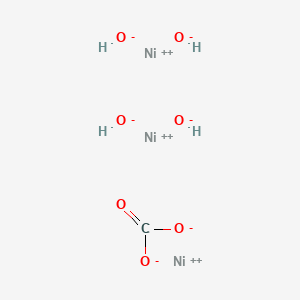
Nickel carbonate hydroxide
- IUPAC 명칭
- tris(nickel(2+));carbonate;tetrahydroxide
- 분자식
- CH4Ni3O7
- 분자량
- 304.12 g/mol
- 정확한 질량
- 303.797171 Da
- 위상 극성 표면적
- 67.2 Ų
- 수소 결합 공여체
- 4
- 수소 결합 수용체
- 7
- 공유결합 단위
- 8
- 정의된 입체중심
- 0
다른 이름
보고된 명칭 14개 더 보기
외부 데이터베이스 식별자
- EPA DTXSID:DTXSID7051638
추가 과학 데이터베이스의 근거
NIH PubChem PUG-View
Attributed physical-property, hazard, environmental and use annotations.
- Density: 2.6 @25 °C 출처: PAC Chemical Database, U.S. Department of Energy
- Physical Description: Large Crystals; Dry Powder; Dry Powder; Other Solid 출처: EPA Chemical Data Reporting (CDR)
- Physical Description: Tetrahydrate: Green odorless solid; [Merck Index] Light green powder; Insoluble in water; [MSDSonline] 출처: Haz-Map, Information on Hazardous Chemicals and Occupational Diseases
- Solubility: Light green crystals or brown powder; mol wt 587.57; decomp before melting; insol in cold water; decomp in hot water; sol in acid, ammonium salts /Tetrahydrate/ 출처: Hazardous Substances Data Bank (HSDB)
- Solubility: Odorless; insol in water; sol in ammonia, dil acids with effervescence /Tetrahydrate/ 출처: Hazardous Substances Data Bank (HSDB)
- Signal: Danger 출처: Regulation (EC) No 1272/2008 of the European Parliament and of the Council
- GHS Hazard Statements: H302: Harmful if swallowed [Warning Acute toxicity, oral]; H315: Causes skin irritation [Warning Skin corrosion/irritation]; H317: May cause an allergic skin reaction [Warning Sensitization, Skin]; H332: Harmful if inhaled [Warning Acute toxicity, inhalation]; H334: May cause allergy or asthma symptoms or breathing difficulties if inhaled [Danger Sensitization, respiratory]; H341: Suspected of causing genetic defects [Warning Germ cell mutagenicity]; H350i: May cause cancer by inhalation [Danger Carcinogenicity]; H360D ***: May damage the unborn child [Danger Reproductive toxicity]; H372 **: Causes damage to organs through prolonged or repeated exposure [Danger Specific target organ toxicity, repeated exposure]; H400: Very toxic to aquatic life [Warning Hazardous to the aquatic environment, acute hazard]; H410: Very toxic to aquatic life with long lasting effects [Warning Hazardous to the aquatic environment, long-term hazard] 출처: Regulation (EC) No 1272/2008 of the European Parliament and of the Council
- Precautionary Statement Codes: P203, P233, P260, P261, P264, P270, P271, P272, P273, P280, P284, P301+P317, P302+P352, P304+P340, P317, P318, P319, P321, P330, P332+P317, P333+P317, P342+P316, P362+P364, P391, P403, P405, and P501 (click each P-code to see the statement) 출처: Regulation (EC) No 1272/2008 of the European Parliament and of the Council
- Signal: Danger 출처: European Chemicals Agency (ECHA)
- GHS Hazard Statements: H302 (100%): Harmful if swallowed [Warning Acute toxicity, oral]; H315 (100%): Causes skin irritation [Warning Skin corrosion/irritation]; H317 (100%): May cause an allergic skin reaction [Warning Sensitization, Skin]; H319 (61.1%): Causes serious eye irritation [Warning Serious eye damage/eye irritation]; H330 (61.1%): Fatal if inhaled [Danger Acute toxicity, inhalation]; H332 (38.9%): Harmful if inhaled [Warning Acute toxicity, inhalation]; H334 (100%): May cause allergy or asthma symptoms or breathing difficulties if inhaled [Danger Sensitization, respiratory]; H341 (100%): Suspected of causing genetic defects [Warning Germ cell mutagenicity]; H350 (84.5%): May cause cancer [Danger Carcinogenicity]; H350i (15.5%): May cause cancer by inhalation [Danger Carcinogenicity]; H360 (84.5%): May damage fertility or the unborn child [Danger Reproductive toxicity]; H360D (15.5%): May damage the unborn child [Danger Reproductive toxicity]; H372 (100%): Causes damage to organs through prolonged or repeated exposure [Danger Specific target organ toxicity, repeated exposure]; H400 (100%): Very toxic to aquatic life [Warning Hazardous to the aquatic environment, acute hazard]; H410 (100%): Ver 출처: European Chemicals Agency (ECHA)
- Precautionary Statement Codes: P203, P233, P260, P261, P264, P264+P265, P270, P271, P272, P273, P280, P284, P301+P317, P302+P352, P304+P340, P305+P351+P338, P316, P317, P318, P319, P320, P321, P330, P332+P317, P333+P317, P337+P317, P342+P316, P362+P364, P391, P403, P403+P233, P405, and P501 (click each P-code to see the statement) 출처: European Chemicals Agency (ECHA)
- ECHA C&L Notifications Summary: Aggregated GHS information provided per 226 reports by companies from 11 notifications to the ECHA C&L Inventory. Each notification may be associated with multiple companies.; Information may vary between notifications depending on impurities, additives, and other factors. The percentage value in parenthesis indicates the notified classification ratio from companies that provide hazard codes. Only hazard codes with percentage values above 10% are shown. For more detailed information, please visit ECHA C&L website. 출처: European Chemicals Agency (ECHA)
- Toxicity Summary: ... Nickel carbonate is insoluble in water. ... Respiratory absorption with secondary gastrointestinal absorption of nickel (insoluble compounds) is the major route of entry during occupational exposure. Percutaneous absorption is negligible, quanitatively, but is important in the pathogenesis of contact hypersensitivity. Absorption is related to the solubility of the compound /and nickel carbonate is classified as an insoluble salt/. Nickel carbonate ... induced local mesenchymal tumors in a variety of experimental animals after im, sc, ip, intrapleural, intraocular, intraosseous, intrarenal, intra-articular, intratesticular or intra-adipose administration. 출처: Hazardous Substances Data Bank (HSDB)
- Consumer Uses: Processing aids not otherwise specified 출처: EPA Chemical Data Reporting (CDR)
- Industry Uses: Processing aids not otherwise specified; Plating agent; Not Known or Reasonably Ascertainable; Intermediate 출처: EPA Chemical Data Reporting (CDR)
- Sources/Uses: Used in nickel plating, ceramic colors and glazes, and as a catalyst for hardening of fats; [HSDB] 출처: Haz-Map, Information on Hazardous Chemicals and Occupational Diseases
- Industrial Processes with risk of exposure: Electroplating [Category: Plate] 출처: Haz-Map, Information on Hazardous Chemicals and Occupational Diseases
- Activities with risk of exposure: Ceramics making [Category: Hobbies] 출처: Haz-Map, Information on Hazardous Chemicals and Occupational Diseases
- Uses: Nickel plating; catalyst for hardening of fats; in ceramic colors and glazes 출처: Hazardous Substances Data Bank (HSDB)
- Uses: Preparation of nickel catalysts /Tetrahydrate/ 출처: Hazardous Substances Data Bank (HSDB)
매핑 기준: Existing checksum-valid CAS to unique PubChem CID match. 가져온 시각: 2026-08-31. 출처 기록 열기
과학적 분류와 유해성 주석은 맥락을 제공할 뿐이며, 위에 표시된 시장별 규제 판단을 대체하지 않습니다.
추가 출처 적용 범위 및 일치 상태
| 출처 | 결과 | 확인됨 |
|---|---|---|
| NIH PubChem PUG-View | 정확히 일치 | 2026-08-31 |
기록된 불일치는 출처를 확인했다는 유용한 근거이며, 해당 물질이 다른 곳에 존재하지 않는다는 주장이 아닙니다.
체크섬이 유효한 CAS 일치를 통해 2026-09-02에 NIH PubChem에서 가져왔습니다. 화학적 특성은 이 페이지의 규제 판단을 대체하지 않습니다.
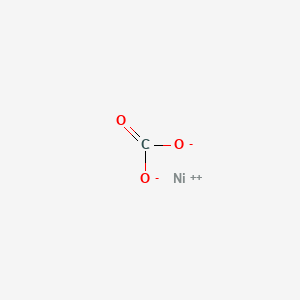
Nickel carbonate
Nickel Carbonate is a light green, crystalline inorganic compound that produces toxic gases upon heating. Nickel carbonate is used in electroplating, to prepare nickel monoxide, to make colored glass and as a catalyst in the treatment of wastewater. Exposure to this substance can cause severe dermatitis, skin and asthma-like allergies and affects the lungs, kidneys, gastrointestinal tract and neurological system. Nickel carbonate is a known carcinogen and is associated with an increased risk of developing lung and nasal cancers. (NCI05) — NCI Thesaurus (NCIt)
- IUPAC 명칭
- nickel(2+) carbonate
- 분자식
- CNiO3
- 분자량
- 118.702 g/mol
- 정확한 질량
- 117.920086 Da
- 위상 극성 표면적
- 63.2 Ų
- 수소 결합 공여체
- 0
- 수소 결합 수용체
- 3
- 공유결합 단위
- 2
- 정의된 입체중심
- 0
다른 이름
보고된 명칭 16개 더 보기
외부 데이터베이스 식별자
- EPA DTXSID:DTXSID201333983
- PubMed:16099703
체크섬이 유효한 CAS 일치를 통해 2026-09-02에 NIH PubChem에서 가져왔습니다. 화학적 특성은 이 페이지의 규제 판단을 대체하지 않습니다.
Nickel carbonate; basic nickel carbonate; carbonic acid, nickel (2+) salt [1]; carbonic acid, nickel salt [2]; [micro-[carbonato(2-)-O:O']]dihydroxy trinickel [3]; [carbonato(2-)]tetrahydroxytrinickel [4]의 관련 기록
이 기록에 직접 일치하는 항목이 제한적이어서, 부속서 II의 인접 항목도 함께 표시합니다.
3-(4-Isopropylphenyl)-1,1-dimethylurea (Isoproturon - ISO)
5-(2,4-Dioxo-1,2,3,4-tetrahydropyrimidine)-3-fluoro-2-hydroxymethylterahydrofuran
Crotonaldehyde [1]; (E)-crotonaldehyde [2]
Hexahydrocyclopenta[c]pyrrole-1-(1H)-ammonium N-ethoxycarbonyl-N-(p-tolylsulfonyl)azanide
5-Ethoxy-3-trichloromethyl-1,2,4-thiadiazole (Etridiazole - ISO)
4,4'-Carbonimidoylbis[N,N-dimethylaniline] and its salts
Nickel carbonate; basic nickel carbonate; carbonic acid, nickel (2+) salt [1]; carbonic acid, nickel salt [2]; [micro-[carbonato(2-)-O:O']]dihydroxy trinickel [3]; [carbonato(2-)]tetrahydroxytrinickel [4]에 대한 부속서 II의 의미
Nickel carbonate; basic nickel carbonate; carbonic acid, nickel (2+) salt [1]; carbonic acid, nickel salt [2]; [micro-[carbonato(2-)-O:O']]dihydroxy trinickel [3]; [carbonato(2-)]tetrahydroxytrinickel [4]은(는) EU 화장품 규정 1223/2009 부속서 II에 따라 사용금지 물질로 등재되어 있으며 의도적으로 첨가해서는 안 됩니다. 제17조는 별도로, 우수화장품제조관리기준(GMP)에 따라 기술적으로 피할 수 없고 제3조의 안전 요건에 부합하는 비의도적 미량에 대해 다룹니다.
처방 개발자는 원료와 원재료를 선별하여 이 물질이 들어 있지 않은지 확인해야 합니다. 공급업체는 요청 시 부재를 확인하는 문서를 제공해야 합니다.
또한 이 페이지에는 식별자, 부속서 논리 또는 명칭 패턴이 겹치는 관련 부속서 기록 12건이 표시됩니다.
규제 준수 체크리스트
- 이 물질이 모든 원료와 완제품 처방에 없는지 확인하세요.
- 원료 공급업체에 부재 확인서 또는 CoA를 요청하세요.
- 선별 결과를 제품정보파일(PIF)에 기록하세요.
- 이 물질은 CMR로 분류되어 있습니다. 사용 전에 위의 CMR 표를 검토하고 현재 부속서 II/III 상태를 확인하세요.
자주 묻는 질문
부속서 II 기록 Nickel carbonate; basic nickel carbonate; carbonic acid, nickel (2+) salt [1]; carbonic acid, nickel salt [2]; [micro-[carbonato(2-)-O:O']]dihydroxy trinickel [3]; [carbonato(2-)]tetrahydroxytrinickel [4]의 출처 주석
이 페이지는 공개된 유럽연합 집행위원회 화장품 자료에서 가져온 Nickel carbonate; basic nickel carbonate; carbonic acid, nickel (2+) salt [1]; carbonic acid, nickel salt [2]; [micro-[carbonato(2-)-O:O']]dihydroxy trinickel [3]; [carbonato(2-)]tetrahydroxytrinickel [4]의 부속서 II 기록 하나를 요약하고, 가능한 경우 연결된 목록 또는 식별자 일치 항목을 추가합니다.
이 기록 페이지를 이용해 Nickel carbonate; basic nickel carbonate; carbonic acid, nickel (2+) salt [1]; carbonic acid, nickel salt [2]; [micro-[carbonato(2-)-O:O']]dihydroxy trinickel [3]; [carbonato(2-)]tetrahydroxytrinickel [4]의 부속서 II 조건을 검토하되, 최종 규제 판단은 현행 공식 부속서 문구 및 원본 파일로 확인하세요.
도구 및 다음 단계
처방 확인
전체 INCI 목록을 붙여넣어 Nickel carbonate; basic nickel carbonate; carbonic acid, nickel (2+) salt [1]; carbonic acid, nickel salt [2]; [micro-[carbonato(2-)-O:O']]dihydroxy trinickel [3]; [carbonato(2-)]tetrahydroxytrinickel [4] 및 기타 표시된 EU 부속서 기록을 한 번에 찾아보세요.
INCI 검사기항목 비교
Nickel carbonate; basic nickel carbonate; carbonic acid, nickel (2+) salt [1]; carbonic acid, nickel salt [2]; [micro-[carbonato(2-)-O:O']]dihydroxy trinickel [3]; [carbonato(2-)]tetrahydroxytrinickel [4]을(를) 다른 부속서 기록과 나란히 비교하여 제한 사항, 농도 및 부속서 위치의 차이를 검토하세요.
비교