
Nickel carbonate; basic nickel carbonate; carbonic acid, nickel (2+) salt [1]; carbonic acid, nickel salt [2]; [micro-[carbonato(2-)-O:O']]dihydroxy trinickel [3]; [carbonato(2-)]tetrahydroxytrinickel [4]
Nickel carbonate; basic nickel carbonate; carbonic acid, nickel (2+) salt [1]; carbonic acid, nickel salt [2]; [micro-[carbonato(2-)-O:O']]dihydroxy trinickel [3]; [carbonato(2-)]tetrahydroxytrinickel [4] figure à l’annexe II en tant que substance interdite dans les produits cosmétiques mis sur le marché de l’UE.
Détails de la fiche
Nom chimique
Nickel carbonate; basic nickel carbonate; carbonic acid, nickel (2+) salt [1]; carbonic acid, nickel salt [2]; [micro-[carbonato(2-)-O:O']]dihydroxy trinickel [3]; [carbonato(2-)]tetrahydroxytrinickel [4]
Informations réglementaires
Autres directives
(EC) 2009/790
Avis du SCCS
- Opinion concerning Chemical Ingredients in Cosmetic Products classified as Carcinogenic, Mutagenic or Toxic to Reproduction according to the Chemicals Directive 67/548/EECC
- Opinion concerning Chemical Ingredients in Cosmetic Products classified as Carcinogenic, Mutagenic or Toxic to Reproduction according to the Chemicals Directive 67/548/EEC
CMR
| Catégorie | Carcinogenic | Mutagenic | Reprotoxic |
|---|---|---|---|
| Cat. 1A | ✓ | — | — |
| Cat. 1B | — | — | ✓ |
| Cat. 2 | — | ✓ | — |
Données clés
Identité et propriétés chimiques
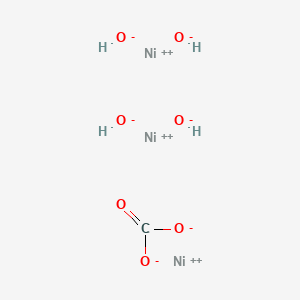
Nickel carbonate hydroxide
- Nom IUPAC
- tris(nickel(2+));carbonate;tetrahydroxide
- Formule moléculaire
- CH4Ni3O7
- Masse moléculaire
- 304.12 g/mol
- Masse exacte
- 303.797171 Da
- Surface polaire topologique
- 67,2 Ų
- Donneurs de liaisons hydrogène
- 4
- Accepteurs de liaisons hydrogène
- 7
- Unités covalentes
- 8
- Stéréocentres définis
- 0
Également connu sous le nom de
14 autres noms signalés
Identifiants de bases de données externes
- EPA DTXSID:DTXSID7051638
Preuves issues de bases de données scientifiques complémentaires
NIH PubChem PUG-View
Attributed physical-property, hazard, environmental and use annotations.
- Density: 2.6 @25 °C Source: PAC Chemical Database, U.S. Department of Energy
- Physical Description: Large Crystals; Dry Powder; Dry Powder; Other Solid Source: EPA Chemical Data Reporting (CDR)
- Physical Description: Tetrahydrate: Green odorless solid; [Merck Index] Light green powder; Insoluble in water; [MSDSonline] Source: Haz-Map, Information on Hazardous Chemicals and Occupational Diseases
- Solubility: Light green crystals or brown powder; mol wt 587.57; decomp before melting; insol in cold water; decomp in hot water; sol in acid, ammonium salts /Tetrahydrate/ Source: Hazardous Substances Data Bank (HSDB)
- Solubility: Odorless; insol in water; sol in ammonia, dil acids with effervescence /Tetrahydrate/ Source: Hazardous Substances Data Bank (HSDB)
- Signal: Danger Source: Regulation (EC) No 1272/2008 of the European Parliament and of the Council
- GHS Hazard Statements: H302: Harmful if swallowed [Warning Acute toxicity, oral]; H315: Causes skin irritation [Warning Skin corrosion/irritation]; H317: May cause an allergic skin reaction [Warning Sensitization, Skin]; H332: Harmful if inhaled [Warning Acute toxicity, inhalation]; H334: May cause allergy or asthma symptoms or breathing difficulties if inhaled [Danger Sensitization, respiratory]; H341: Suspected of causing genetic defects [Warning Germ cell mutagenicity]; H350i: May cause cancer by inhalation [Danger Carcinogenicity]; H360D ***: May damage the unborn child [Danger Reproductive toxicity]; H372 **: Causes damage to organs through prolonged or repeated exposure [Danger Specific target organ toxicity, repeated exposure]; H400: Very toxic to aquatic life [Warning Hazardous to the aquatic environment, acute hazard]; H410: Very toxic to aquatic life with long lasting effects [Warning Hazardous to the aquatic environment, long-term hazard] Source: Regulation (EC) No 1272/2008 of the European Parliament and of the Council
- Precautionary Statement Codes: P203, P233, P260, P261, P264, P270, P271, P272, P273, P280, P284, P301+P317, P302+P352, P304+P340, P317, P318, P319, P321, P330, P332+P317, P333+P317, P342+P316, P362+P364, P391, P403, P405, and P501 (click each P-code to see the statement) Source: Regulation (EC) No 1272/2008 of the European Parliament and of the Council
- Signal: Danger Source: European Chemicals Agency (ECHA)
- GHS Hazard Statements: H302 (100%): Harmful if swallowed [Warning Acute toxicity, oral]; H315 (100%): Causes skin irritation [Warning Skin corrosion/irritation]; H317 (100%): May cause an allergic skin reaction [Warning Sensitization, Skin]; H319 (61.1%): Causes serious eye irritation [Warning Serious eye damage/eye irritation]; H330 (61.1%): Fatal if inhaled [Danger Acute toxicity, inhalation]; H332 (38.9%): Harmful if inhaled [Warning Acute toxicity, inhalation]; H334 (100%): May cause allergy or asthma symptoms or breathing difficulties if inhaled [Danger Sensitization, respiratory]; H341 (100%): Suspected of causing genetic defects [Warning Germ cell mutagenicity]; H350 (84.5%): May cause cancer [Danger Carcinogenicity]; H350i (15.5%): May cause cancer by inhalation [Danger Carcinogenicity]; H360 (84.5%): May damage fertility or the unborn child [Danger Reproductive toxicity]; H360D (15.5%): May damage the unborn child [Danger Reproductive toxicity]; H372 (100%): Causes damage to organs through prolonged or repeated exposure [Danger Specific target organ toxicity, repeated exposure]; H400 (100%): Very toxic to aquatic life [Warning Hazardous to the aquatic environment, acute hazard]; H410 (100%): Ver Source: European Chemicals Agency (ECHA)
- Precautionary Statement Codes: P203, P233, P260, P261, P264, P264+P265, P270, P271, P272, P273, P280, P284, P301+P317, P302+P352, P304+P340, P305+P351+P338, P316, P317, P318, P319, P320, P321, P330, P332+P317, P333+P317, P337+P317, P342+P316, P362+P364, P391, P403, P403+P233, P405, and P501 (click each P-code to see the statement) Source: European Chemicals Agency (ECHA)
- ECHA C&L Notifications Summary: Aggregated GHS information provided per 226 reports by companies from 11 notifications to the ECHA C&L Inventory. Each notification may be associated with multiple companies.; Information may vary between notifications depending on impurities, additives, and other factors. The percentage value in parenthesis indicates the notified classification ratio from companies that provide hazard codes. Only hazard codes with percentage values above 10% are shown. For more detailed information, please visit ECHA C&L website. Source: European Chemicals Agency (ECHA)
- Toxicity Summary: ... Nickel carbonate is insoluble in water. ... Respiratory absorption with secondary gastrointestinal absorption of nickel (insoluble compounds) is the major route of entry during occupational exposure. Percutaneous absorption is negligible, quanitatively, but is important in the pathogenesis of contact hypersensitivity. Absorption is related to the solubility of the compound /and nickel carbonate is classified as an insoluble salt/. Nickel carbonate ... induced local mesenchymal tumors in a variety of experimental animals after im, sc, ip, intrapleural, intraocular, intraosseous, intrarenal, intra-articular, intratesticular or intra-adipose administration. Source: Hazardous Substances Data Bank (HSDB)
- Consumer Uses: Processing aids not otherwise specified Source: EPA Chemical Data Reporting (CDR)
- Industry Uses: Processing aids not otherwise specified; Plating agent; Not Known or Reasonably Ascertainable; Intermediate Source: EPA Chemical Data Reporting (CDR)
- Sources/Uses: Used in nickel plating, ceramic colors and glazes, and as a catalyst for hardening of fats; [HSDB] Source: Haz-Map, Information on Hazardous Chemicals and Occupational Diseases
- Industrial Processes with risk of exposure: Electroplating [Category: Plate] Source: Haz-Map, Information on Hazardous Chemicals and Occupational Diseases
- Activities with risk of exposure: Ceramics making [Category: Hobbies] Source: Haz-Map, Information on Hazardous Chemicals and Occupational Diseases
- Uses: Nickel plating; catalyst for hardening of fats; in ceramic colors and glazes Source: Hazardous Substances Data Bank (HSDB)
- Uses: Preparation of nickel catalysts /Tetrahydrate/ Source: Hazardous Substances Data Bank (HSDB)
Mis en correspondance par: Existing checksum-valid CAS to unique PubChem CID match. Récupéré le: 2026-08-31. Ouvrir la fiche source
Les classifications scientifiques et les annotations de danger apportent du contexte et ne remplacent pas la décision réglementaire propre au marché indiquée ci-dessus.
Couverture des sources complémentaires et état des correspondances
| Source | Résultat | Vérifié |
|---|---|---|
| NIH PubChem PUG-View | Correspondance exacte | 2026-08-31 |
Une absence de correspondance enregistrée est une preuve utile que la source a été vérifiée ; ce n’est pas l’affirmation que la substance n’existe pas ailleurs.
Récupéré depuis NIH PubChem le 2026-09-02 par correspondance CAS à somme de contrôle valide. Les propriétés chimiques ne remplacent pas la décision réglementaire de cette page.
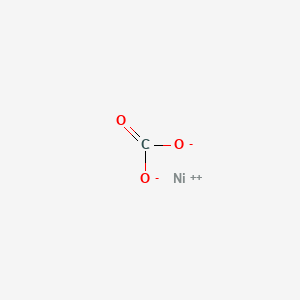
Nickel carbonate
Nickel Carbonate is a light green, crystalline inorganic compound that produces toxic gases upon heating. Nickel carbonate is used in electroplating, to prepare nickel monoxide, to make colored glass and as a catalyst in the treatment of wastewater. Exposure to this substance can cause severe dermatitis, skin and asthma-like allergies and affects the lungs, kidneys, gastrointestinal tract and neurological system. Nickel carbonate is a known carcinogen and is associated with an increased risk of developing lung and nasal cancers. (NCI05) — NCI Thesaurus (NCIt)
- Nom IUPAC
- nickel(2+) carbonate
- Formule moléculaire
- CNiO3
- Masse moléculaire
- 118.702 g/mol
- Masse exacte
- 117.920086 Da
- Surface polaire topologique
- 63,2 Ų
- Donneurs de liaisons hydrogène
- 0
- Accepteurs de liaisons hydrogène
- 3
- Unités covalentes
- 2
- Stéréocentres définis
- 0
Également connu sous le nom de
16 autres noms signalés
Identifiants de bases de données externes
- EPA DTXSID:DTXSID201333983
- PubMed:16099703
Récupéré depuis NIH PubChem le 2026-09-02 par correspondance CAS à somme de contrôle valide. Les propriétés chimiques ne remplacent pas la décision réglementaire de cette page.
Fiches associées pour Nickel carbonate; basic nickel carbonate; carbonic acid, nickel (2+) salt [1]; carbonic acid, nickel salt [2]; [micro-[carbonato(2-)-O:O']]dihydroxy trinickel [3]; [carbonato(2-)]tetrahydroxytrinickel [4]
Les correspondances directes sont limitées pour cette fiche ; des entrées voisines de l’annexe II sont donc également affichées.
3-(4-Isopropylphenyl)-1,1-dimethylurea (Isoproturon - ISO)
5-(2,4-Dioxo-1,2,3,4-tetrahydropyrimidine)-3-fluoro-2-hydroxymethylterahydrofuran
Crotonaldehyde [1]; (E)-crotonaldehyde [2]
Hexahydrocyclopenta[c]pyrrole-1-(1H)-ammonium N-ethoxycarbonyl-N-(p-tolylsulfonyl)azanide
5-Ethoxy-3-trichloromethyl-1,2,4-thiadiazole (Etridiazole - ISO)
4,4'-Carbonimidoylbis[N,N-dimethylaniline] and its salts
Ce que signifie l’annexe II pour Nickel carbonate; basic nickel carbonate; carbonic acid, nickel (2+) salt [1]; carbonic acid, nickel salt [2]; [micro-[carbonato(2-)-O:O']]dihydroxy trinickel [3]; [carbonato(2-)]tetrahydroxytrinickel [4]
Nickel carbonate; basic nickel carbonate; carbonic acid, nickel (2+) salt [1]; carbonic acid, nickel salt [2]; [micro-[carbonato(2-)-O:O']]dihydroxy trinickel [3]; [carbonato(2-)]tetrahydroxytrinickel [4] figure comme substance interdite à l’annexe II du règlement (CE) n° 1223/2009 relatif aux produits cosmétiques et ne doit pas être ajouté intentionnellement. L’article 17 traite séparément des traces involontaires, techniquement inévitables dans le respect des bonnes pratiques de fabrication et compatibles avec l’exigence de sécurité de l’article 3.
Les formulateurs doivent contrôler leurs ingrédients et matières premières afin de s’assurer qu’aucun ne contient cette substance. Les fournisseurs doivent fournir, sur demande, une documentation confirmant son absence.
La page fait également apparaître 12 fiches d’annexe associées présentant des identifiants, une logique d’annexe ou des schémas de dénomination qui se recoupent.
Liste de contrôle de conformité
- Vérifiez que cette substance est absente de toutes les matières premières et formulations finies.
- Demandez aux fournisseurs de matières premières une attestation d’absence ou un certificat d’analyse.
- Consignez le résultat du contrôle dans le dossier d’information produit (DIP).
- Cette substance a une classification CMR. Examinez le tableau CMR ci-dessus et vérifiez le statut actuel dans les annexes II/III avant toute utilisation.
Questions fréquentes
Note de source pour la fiche Nickel carbonate; basic nickel carbonate; carbonic acid, nickel (2+) salt [1]; carbonic acid, nickel salt [2]; [micro-[carbonato(2-)-O:O']]dihydroxy trinickel [3]; [carbonato(2-)]tetrahydroxytrinickel [4] de l’annexe II
Cette page résume une fiche de l’annexe II pour Nickel carbonate; basic nickel carbonate; carbonic acid, nickel (2+) salt [1]; carbonic acid, nickel salt [2]; [micro-[carbonato(2-)-O:O']]dihydroxy trinickel [3]; [carbonato(2-)]tetrahydroxytrinickel [4] à partir de documents publics de la Commission européenne sur les cosmétiques et ajoute les correspondances d’inventaire ou d’identifiants associées lorsqu’elles sont disponibles.
Utilisez cette page de fiche pour examiner les conditions de l’annexe II pour Nickel carbonate; basic nickel carbonate; carbonic acid, nickel (2+) salt [1]; carbonic acid, nickel salt [2]; [micro-[carbonato(2-)-O:O']]dihydroxy trinickel [3]; [carbonato(2-)]tetrahydroxytrinickel [4], mais confirmez toute décision réglementaire finale auprès du libellé officiel en vigueur de l’annexe et des fichiers sources.
Outils et étapes suivantes
Vérifiez votre formule
Collez une liste INCI complète pour détecter Nickel carbonate; basic nickel carbonate; carbonic acid, nickel (2+) salt [1]; carbonic acid, nickel salt [2]; [micro-[carbonato(2-)-O:O']]dihydroxy trinickel [3]; [carbonato(2-)]tetrahydroxytrinickel [4] et d’autres fiches d’annexe de l’UE signalées en une seule passe.
Vérificateur INCIComparer des entrées
Comparez Nickel carbonate; basic nickel carbonate; carbonic acid, nickel (2+) salt [1]; carbonic acid, nickel salt [2]; [micro-[carbonato(2-)-O:O']]dihydroxy trinickel [3]; [carbonato(2-)]tetrahydroxytrinickel [4] côte à côte avec une autre fiche d’annexe pour examiner les différences de restrictions, de concentrations et d’annexe.
ComparerParcourir l’annexe
Consultez toutes les fiches de l’annexe II et comparez les conditions réglementaires entre les substances de cette annexe.
Ouvrir l’annexe II