
아다팔렌
Listed by the Korean MFDS as a substance that may not be used in cosmetics.
Décision réglementaire et conditions complètes
- Statut
- Prohibited
- Rôle juridique
- Binding rule
- Résumé réglementaire
- Listed by the Korean MFDS as a substance that may not be used in cosmetics.
- Conditions et restrictions
- A prohibition entry may contain no separate condition text because the regulatory outcome is the prohibition itself. Ouvrez la source citée et appliquez les exigences applicables à l’ensemble du marché ci-dessous.
Identité de la substance
- Nom dans la source officielle
- 아다팔렌
- CAS
- 106685-40-9
- EC
- Not supplied in this source row
- Correspondance d’identité
- standalone:official_korean_name
Aperçu multi-marchés pour cette identité
Fiches exactes associées actuellement présentes sur ce site. L’absence d’un marché signifie qu’aucune correspondance exacte n’a été importée, et non une autorisation d’utiliser la substance.
South Korea
Fiche actuelle1 fiche associée
Ouvrir la fiche justificative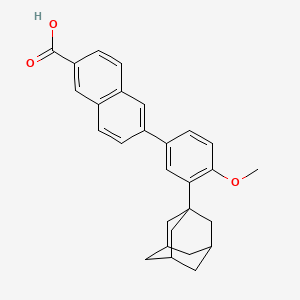
Chimie vérifiée pour le CAS 106685-40-9
Adapalene
Adapalene is a naphthoic acid that is CD437 in which the phenolic hydroxy group has been converted to its methyl ether. It has a role as a non-steroidal anti-inflammatory drug, a dermatologic drug and an EC 2.7.11.22 (cyclin-dependent kinase) inhibitor. It is a monocarboxylic acid, a naphthoic acid and a member of adamantanes. It is functionally related to a CD437. — ChEBI
- Nom IUPAC
- 6-[3-(1-adamantyl)-4-methoxyphenyl]naphthalene-2-carboxylic acid
- Formule moléculaire
- C28H28O3
- Masse moléculaire
- 412.5 g/mol
- Masse exacte
- 412.20384475 Da
- Masse monoisotopique
- 412.20384475 Da
- XLogP3
- 7,7
- Surface polaire topologique
- 46,5 Ų
- Complexité moléculaire
- 644,0
- Charge formelle
- 0
- Donneurs de liaisons hydrogène
- 1
- Accepteurs de liaisons hydrogène
- 3
- Liaisons rotatives
- 4
- Atomes lourds
- 31
- Unités covalentes
- 1
Noms et synonymes signalés à PubChem
16 autres noms signalés
Identifiants de bases de données externes
- ChEBI:CHEBI:31174
- ChEMBL:CHEMBL1265
- ChEMBL:CHEMBL4303650
- EPA DTXSID:DTXSID5046481
- PubMed:24177211
- PubMed:22988653
- PubMed:22908733
- PubMed:22859236
- PubMed:22847319
- PubMed:22808305
- PubMed:22779096
- PubMed:22772617
- PubMed:22728381
- PubMed:22677304
- PubMed:22648218
- PubMed:22615511
Statistiques de structure avancées
- Stéréocentres atomiques définis
- 0
- Stéréocentres atomiques non définis
- 0
- Stéréocentres de liaison définis
- 0
- Stéréocentres de liaison non définis
- 0
- Caractéristiques pharmacophoriques 3D
- 11
- Cycles 3D
- 7
- Groupes hydrophobes 3D
- 0
- Caractéristiques d’accepteur 3D
- 3
- Caractéristiques de donneur 3D
- 0
- Centres anioniques 3D
- 1
- Centres cationiques 3D
- 0
- Conformères 3D
- 6
- Rotors 3D effectifs
- 5,2
Identifiants de structure lisibles par machine
- SMILES
COC1=C(C=C(C=C1)C2=CC3=C(C=C2)C=C(C=C3)C(=O)O)C45CC6CC(C4)CC(C6)C5- InChI
InChI=1S/C28H28O3/c1-31-26-7-6-23(21-2-3-22-12-24(27(29)30)5-4-20(22)11-21)13-25(26)28-14-17-8-18(15-28)10-19(9-17)16-28/h2-7,11-13,17-19H,8-10,14-16H2,1H3,(H,29,30)- InChIKey
LZCDAPDGXCYOEH-UHFFFAOYSA-N
Preuves issues de bases de données scientifiques complémentaires
EMBL-EBI ChEBI
adapalene
A naphthoic acid that is CD437 in which the phenolic hydroxy group has been converted to its methyl ether.
- Formule
- C28H28O3
- Masse moyenne
- 412.529 g/mol
- Masse monoisotopique
- 412.20384 Da
- Charge formelle
- 0
- naphthoic acid — is a (CHEBI:25483)
- monocarboxylic acid — is a (CHEBI:25384)
- adamantanes — is a (CHEBI:51339)
- dermatologic drug — has role (CHEBI:50177)
- non-steroidal anti-inflammatory drug — has role (CHEBI:35475)
- EC 2.7.11.22 (cyclin-dependent kinase) inhibitor — has role (CHEBI:82665)
- CD437 — has functional parent (CHEBI:88334)
- dermatologic drug — has role (CHEBI:50177)
- non-steroidal anti-inflammatory drug — has role (CHEBI:35475)
- EC 2.7.11.22 (cyclin-dependent kinase) inhibitor — has role (CHEBI:82665)
- naphthoic acid — is a (CHEBI:25483)
- monocarboxylic acid — is a (CHEBI:25384)
- adamantanes — is a (CHEBI:51339)
- 11594670 Source: PubMed
- 12833014 Source: PubMed
- 16472241 Source: PubMed
- 18759424 Source: PubMed
- 22194678 Source: PubMed
- 23956101 Source: PubMed
- 25016424 Source: PubMed
- 25790278 Source: PubMed
- 26398439 Source: PubMed
- 26483036 Source: PubMed
- 29706423 Source: PubMed
- 30852084 Source: PubMed
- 34812616 Source: PubMed
- 35820623 Source: PubMed
- 37468498 Source: PubMed
- 8544175 Source: PubMed
Noms supplémentaires validés
Références croisées de cette source
Mis en correspondance par: Exact CAS cross-reference in the ChEBI compound record. Source mise à jour le: 2017-02-22. Récupéré le: 2026-08-31. Ouvrir la fiche source
NIH PubChem PUG-View
Attributed physical-property, hazard, environmental and use annotations.
- Boiling Point: 606.3 Source: DrugBank
- LogP: 6.917 Source: DrugBank
- LogP: 8.6 Source: Human Metabolome Database (HMDB)
- Melting Point: 300 Source: DrugBank
- Physical Description: Solid Source: Human Metabolome Database (HMDB)
- Solubility: 4.01e-06 g/L Source: Human Metabolome Database (HMDB)
- Carcinogen Classification: No indication of carcinogenicity to humans (not listed by IARC). Source: Toxin and Toxin Target Database (T3DB)
- Exposure Routes: Absorption of adapalene through human skin is low. Only trace amounts (<0.25 ng/mL) of parent substance have been found in the plasma of acne patients following chronic topical application of adapalene in controlled clinical trials Source: Toxin and Toxin Target Database (T3DB)
- Note: This chemical does not meet GHS hazard criteria for 9.1% (1 of 11) of reports. Source: European Chemicals Agency (ECHA)
- Signal: Warning Source: European Chemicals Agency (ECHA)
- GHS Hazard Statements: H302 (18.2%): Harmful if swallowed [Warning Acute toxicity, oral]; H315 (72.7%): Causes skin irritation [Warning Skin corrosion/irritation]; H317 (54.5%): May cause an allergic skin reaction [Warning Sensitization, Skin]; H319 (72.7%): Causes serious eye irritation [Warning Serious eye damage/eye irritation]; H335 (18.2%): May cause respiratory irritation [Warning Specific target organ toxicity, single exposure; Respiratory tract irritation]; H361 (81.8%): Suspected of damaging fertility or the unborn child [Warning Reproductive toxicity] Source: European Chemicals Agency (ECHA)
- Precautionary Statement Codes: P203, P261, P264, P264+P265, P270, P271, P272, P280, P301+P317, P302+P352, P304+P340, P305+P351+P338, P318, P319, P321, P330, P332+P317, P333+P317, P337+P317, P362+P364, P403+P233, P405, and P501 (click each P-code to see the statement) Source: European Chemicals Agency (ECHA)
- ECHA C&L Notifications Summary: Aggregated GHS information provided per 11 reports by companies from 7 notifications to the ECHA C&L Inventory. Each notification may be associated with multiple companies.; Reported as not meeting GHS hazard criteria per 1 of 11 reports by companies.; There are 6 notifications provided by 10 of 11 reports by companies with hazard statement code(s).; Information may vary between notifications depending on impurities, additives, and other factors. The percentage value in parenthesis indicates the notified classification ratio from companies that provide hazard codes. Only hazard codes with percentage values above 10% are shown. For more detailed information, please visit ECHA C&L website. Source: European Chemicals Agency (ECHA)
- Health Effects: Chronic ingestion of the drug may lead to the same side effects as those associated with excessive oral intake of Vitamin A. Source: Toxin and Toxin Target Database (T3DB)
- Toxicity Summary: If the adapalene is applied excessively, marked redness, scaling, or skin discomfort may occur. In addition, according to product labeling, chronic ingestion of the drug may lead to the same adverse drug reactions associated with excessive oral intake of vitamin A. Source: StatPearls
- Toxicity Summary: Mechanistically, adapalene binds to specific retinoic acid nuclear receptors (gamma and beta) and retinoid X receptors but does not bind to the cytosolic receptor protein. Although the exact mode of action of adapalene is unknown, it is suggested that topical adapalene may normalize the differentiation of follicular epithelial cells resulting in decreased microcomedone formation. Source: Toxin and Toxin Target Database (T3DB)
- Uses: Use (kg) in USA (2002): 78; Consumption (g per capita) in the USA (2002): 0.000278; Calculated removal (%): 97.7 Source: NORMAN Suspect List Exchange
- Uses: For the topical treatment of comedo, papular and pustular acne (acne vulgaris) of the face, chest or back. Source: Toxin and Toxin Target Database (T3DB)
Mis en correspondance par: Existing checksum-valid CAS to unique PubChem CID match. Récupéré le: 2026-08-31. Ouvrir la fiche source
Les classifications scientifiques et les annotations de danger apportent du contexte et ne remplacent pas la décision réglementaire propre au marché indiquée ci-dessus.
Couverture des sources complémentaires et état des correspondances
| Source | Résultat | Vérifié |
|---|---|---|
| EMBL-EBI ChEBI | Correspondance exacte | 2026-08-31 |
| NIH PubChem PUG-View | Correspondance exacte | 2026-08-31 |
Une absence de correspondance enregistrée est une preuve utile que la source a été vérifiée ; ce n’est pas l’affirmation que la substance n’existe pas ailleurs.
Récupéré depuis NIH PubChem le 2026-08-31 par correspondance CAS à somme de contrôle valide. Les propriétés chimiques ne remplacent pas la décision réglementaire de cette page.
Source officielle et provenance
- Source enregistrée
- South Korea MFDS cosmetic ingredient data
- Référence de la source
- 화장품 안전기준 등에 관한 규정, 별표 1, record 1-571
- Identifiant de la fiche source
1-571- Version de la source
- 2026-19
- Langue de la source
- Korean
- État de la traduction
- No English translation
- Date d’effet
- 2026-03-18
- Source mise à jour le
- 2026-03-18
- Instantané vérifié le
- 2026-08-30 04:33 UTC
- Méthode de validation
- MFDS JSON appendices 1–2 parse; 1077 prohibited, 243 restricted
- SHA-256
056de35b843a5e31f709073f9e79d5e6e18f7c9164eb537bb099b185a37ef7d8
Notes du jeu de données enregistré
- Couverture du jeu de données
- Ingredient identity and separate restriction/regulation data endpoints
- Note sur l’autorité
- Korean source is canonical; English materials alone are not complete enough for certification
Place de cette fiche dans le jeu de données du marché
Répartition des statuts
Un texte de conditions est présent pour 638 des 1320 fiches actuelles. Un champ de conditions vide est interprété selon le type de fiche ci-dessus ; il n’est jamais converti en une affirmation d’utilisation sans restriction.
South Korea contexte du marché
Complete current appendix dataset
Version de la couverture : MFDS Notice 2026-19, effective 18 March 2026
All rows in official Appendix 1 (prohibited) and Appendix 2 (restricted) of the Safety Standards for Cosmetics.
Liste de contrôle de vérification
- Match the Korean canonical substance name and identifiers.
- Review all Appendix 1 and 2 matches and conditions.
- Check functional-cosmetic and positive-list requirements where applicable.
- Confirm current MFDS notice, responsible seller and label obligations.
Sources officielles du marché
- South Korea MFDS cosmetic ingredient dataKorean source is canonical; English materials alone are not complete enough for certification
Procédure de vérification et exhaustivité de la fiche
Avant d’utiliser ce résultat dans une décision de conformité
- Confirmez que « 아다팔렌 » et chaque identifiant CAS/CE correspondent à la matière de votre spécification fournisseur.
- Match the Korean canonical substance name and identifiers.
- Review all Appendix 1 and 2 matches and conditions.
- Check functional-cosmetic and positive-list requirements where applicable.
- Confirm current MFDS notice, responsible seller and label obligations.
- Consignez la version de la source et revérifiez auprès de l’autorité de réglementation avant la fabrication, la notification ou la mise sur le marché.
Champs disponibles dans cette fiche
- Nom officiel de la substanceDisponible
- CASDisponible
- ECNon fourni
- Texte de condition distinctAbsent de la ligne source
- Date d’effetDisponible
- Empreinte de l’instantané et méthodeDisponible
Questions auxquelles cette page répond
Citation stable
아다팔렌. 화장품 안전기준 등에 관한 규정, 별표 1, record 1-571. South Korea. Source version 2026-19. CosIng Checker regulatory record: https://cosingchecker.com/fr/regulations/kr/records/1297/
Citez l’autorité de réglementation comme autorité juridique. Cette page est un index structuré de preuves et une aide à la vérification, et non un substitut au texte officiel ni à une évaluation juridique professionnelle.
Interprétation et limites pour South Korea
This official record identifies the substance as prohibited for cosmetic use in the stated market scope.
Do not rely on a formulation containing this identity until the cited source, effective date and exact substance match have been verified.
Comment interpréter le rôle juridique
The cited row forms part of a binding rule or legally incorporated list for this market.
Preuves sur cette page
- Résultat enregistré : Prohibited
- Rôle juridique : Binding rule
- Version de la source : 2026-19
- Date d’effet : 2026-03-18
Ce que cela ne prouve pas
Korean source wording is canonical and other positive lists/notices may still apply to the formulation.
Recherche complémentaire sur la substance auprès de sources faisant autorité
Aucune de ces sources ne prévaut sur la décision de marché ci-dessus.
Cosmetic Ingredient Review safety assessments
Expert Panel conclusions, assessed ingredient groups, use conditions, dates and report documents
Independent expert review considered by FDA; not a government approval or binding market rule
Rechercher cette identité à la sourceFDA Global Substance Registration System
UNII identifiers, preferred names, substance types, codes and public substance relationships
Identity registry only; UNII availability does not imply FDA review or approval
Rechercher cette identité à la sourceILO/WHO International Chemical Safety Cards
Hazards, symptoms, first aid, storage, incompatibilities and physical properties for covered chemicals
International occupational chemical-safety reference; not cosmetic-use approval
Rechercher cette identité à la sourceJapan NITE-CHRIP
Chemical identity, Japanese and foreign legal lists, GHS hazards and exposure-related information
Chemical-management evidence; cosmetic status remains governed by the applicable MHLW standard and market rules
Rechercher cette identité à la sourceNIOSH Pocket Guide to Chemical Hazards
REL, PEL, IDLH, properties, exposure routes, symptoms, target organs, first aid and measurement methods for covered workplace chemicals
US occupational-health guidance and limits; not a cosmetic ingredient decision
Rechercher cette identité à la sourceOECD eChemPortal
Gateway to authority-owned physical-property, fate, ecotoxicity, toxicity, exposure and GHS records
Discovery gateway; each linked authority remains responsible for its data
Rechercher cette identité à la sourceUS EPA CompTox CTX APIs
Clé d’API requise pour l’importDTXSID identity, experimental and predicted properties, toxicity, bioactivity, exposure and environmental data
Scientific and computational evidence; predictions must remain labelled and do not determine cosmetic legality
Rechercher cette identité à la source