
1,2-苯基二羧酸支链和直链二戊基酯, 正戊基异戊基邻苯二甲酸酯, 双正戊 基邻苯二甲酸酯, 双异戊基邻苯二甲 酸酯 — 1,2-Benzenedicarboxylic acid, dipentylester, branched and linear (CAS No. 84777-06-0),n-Pentyl-isopentylphthalate,di-n-Pentyl phthalate (CAS No. 131-18-0), Diisopentylphthalate (CAS No. 605-50-5)
1,2-Benzenedicarboxylic acid, dipentylester, branched and linear (CAS No. 84777-06-0),n-Pentyl-isopentylphthalate,di-n-Pentyl phthalate (CAS No. 131-18-0), Diisopentylphthalate (CAS No. 605-50-5)
The NMPA binding 2021 catalogue prohibits this raw material in cosmetic formulas in China.
Décision réglementaire et conditions complètes
- Statut
- Prohibited
- Rôle juridique
- Binding rule
- Résumé réglementaire
- The NMPA binding 2021 catalogue prohibits this raw material in cosmetic formulas in China.
- Conditions et restrictions
Prohibited in cosmetic product formulas. Verify the cited Chinese source identity and any later NMPA amendment before use.
Identité de la substance
- Nom dans la source officielle
- 1,2-苯基二羧酸支链和直链二戊基酯, 正戊基异戊基邻苯二甲酸酯, 双正戊 基邻苯二甲酸酯, 双异戊基邻苯二甲 酸酯 — 1,2-Benzenedicarboxylic acid, dipentylester, branched and linear (CAS No. 84777-06-0),n-Pentyl-isopentylphthalate,di-n-Pentyl phthalate (CAS No. 131-18-0), Diisopentylphthalate (CAS No. 605-50-5)
- CAS
- 84777-06-0; 131-18-0; 605-50-5
- EC
- Not supplied in this source row
- Correspondance d’identité
- standalone:official_nmpa_record
Aperçu multi-marchés pour cette identité
Fiches exactes associées actuellement présentes sur ce site. L’absence d’un marché signifie qu’aucune correspondance exacte n’a été importée, et non une autorisation d’utiliser la substance.
European Union
1 fiche associée
Ouvrir la fiche justificativeNew Zealand
3 fiches associées
Ouvrir la fiche justificativeChina
Fiche actuelle1 fiche associée · 1 avec conditions spécifiques
Ouvrir la fiche justificativeSouth Korea
1 fiche associée · 1 avec conditions spécifiques
Ouvrir la fiche justificativeBrazil
1 fiche associée · 1 avec conditions spécifiques
Ouvrir la fiche justificativeIndia
1 fiche associée · 1 avec conditions spécifiques
Ouvrir la fiche justificativeSaudi Arabia
1 fiche associée
Ouvrir la fiche justificative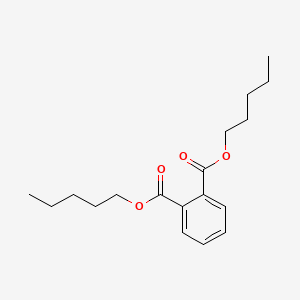
Chimie vérifiée pour le CAS 131-18-0
Dipentyl phthalate
Dipentyl phthalate is a phthalate ester that is the dipentyl ester of benzene-1,2-dicarboxylic acid. It has a role as a plasticiser. It is a phthalate ester and a diester. It is functionally related to a pentan-1-ol. — ChEBI
- Nom IUPAC
- dipentyl benzene-1,2-dicarboxylate
- Formule moléculaire
- C18H26O4
- Masse moléculaire
- 306.4 g/mol
- Masse exacte
- 306.18310931 Da
- Masse monoisotopique
- 306.18310931 Da
- XLogP3
- 5,8
- Surface polaire topologique
- 52,6 Ų
- Complexité moléculaire
- 295,0
- Charge formelle
- 0
- Donneurs de liaisons hydrogène
- 0
- Accepteurs de liaisons hydrogène
- 4
- Liaisons rotatives
- 12
- Atomes lourds
- 22
- Unités covalentes
- 1
Noms et synonymes signalés à PubChem
16 autres noms signalés
Identifiants de bases de données externes
- ChEBI:CHEBI:34680
- ChEMBL:CHEMBL1503330
- EPA DTXSID:DTXSID5031131
- PubMed:40570975
- PubMed:36715143
- PubMed:33983380
- PubMed:33798595
- PubMed:33049310
- PubMed:28927721
- PubMed:28571686
- PubMed:27532513
- PubMed:26472102
- PubMed:26454885
- PubMed:25938866
- PubMed:25055962
Statistiques de structure avancées
- Stéréocentres atomiques définis
- 0
- Stéréocentres atomiques non définis
- 0
- Stéréocentres de liaison définis
- 0
- Stéréocentres de liaison non définis
- 0
- Caractéristiques pharmacophoriques 3D
- 5
- Cycles 3D
- 1
- Groupes hydrophobes 3D
- 2
- Caractéristiques d’accepteur 3D
- 2
- Caractéristiques de donneur 3D
- 0
- Centres anioniques 3D
- 0
- Centres cationiques 3D
- 0
- Conformères 3D
- 10
- Rotors 3D effectifs
- 12,0
Identifiants de structure lisibles par machine
- SMILES
CCCCCOC(=O)C1=CC=CC=C1C(=O)OCCCCC- InChI
InChI=1S/C18H26O4/c1-3-5-9-13-21-17(19)15-11-7-8-12-16(15)18(20)22-14-10-6-4-2/h7-8,11-12H,3-6,9-10,13-14H2,1-2H3- InChIKey
IPKKHRVROFYTEK-UHFFFAOYSA-N
Preuves issues de bases de données scientifiques complémentaires
NIH PubChem PUG-View
Attributed physical-property, hazard, environmental and use annotations.
- Boiling Point: 648 °F at 760 mmHg (NTP, 1992) Source: CAMEO Chemicals
- Boiling Point: 342 °C Source: Hazardous Substances Data Bank (HSDB)
- Color/Form: Colorless, oily liquid Source: Hazardous Substances Data Bank (HSDB)
- Density: 1.022 at 68 °F (NTP, 1992) - Denser than water; will sink Source: CAMEO Chemicals
- Density: 1.022 at 20 °C Source: Hazardous Substances Data Bank (HSDB)
- Flash Point: 357 °F (NTP, 1992) Source: CAMEO Chemicals
- Flash Point: 357 °F; 180 °C (Closed cup) Source: Hazardous Substances Data Bank (HSDB)
- Flash Point: 245 dec F (118 °C) (Closed cup) Source: Hazardous Substances Data Bank (HSDB)
- LogP: log Kow = 5.62 Source: Hazardous Substances Data Bank (HSDB)
- Melting Point: less than -67 °F (NTP, 1992) Source: CAMEO Chemicals
- Melting Point: FP: less than -55 °C Source: Hazardous Substances Data Bank (HSDB)
- Odor: Nearly odorless Source: Hazardous Substances Data Bank (HSDB)
- Physical Description: Di-n-pentyl phthalate is a clear colorless to light yellow liquid. Practically odorless. Floats on water. (NTP, 1992) Source: CAMEO Chemicals
- Physical Description: Colorless oily liquid; [Hawley] Clear colorless to light yellow liquid; [CAMEO] Clear very faintly yellow liquid; [MSDSonline] Source: Haz-Map, Information on Hazardous Chemicals and Occupational Diseases
- Refractive Index: Index of refraction: 1.488 at 25 °C Source: Hazardous Substances Data Bank (HSDB)
- Solubility: less than 1 mg/mL at 68 °F (NTP, 1992) Source: CAMEO Chemicals
- Solubility: Phthalate esters are soluble to various extents in many common organic solvents and oils, but have a relatively low solubility in water. /Phthalate esters/ Source: Hazardous Substances Data Bank (HSDB)
- Solubility: Soluble in carbon tetrachloride, carbon disulfide Source: Hazardous Substances Data Bank (HSDB)
- Solubility: In water, 0.8 mg/L at 25 °C Source: Hazardous Substances Data Bank (HSDB)
- Vapor Pressure: 0.000196 [mmHg] Source: Haz-Map, Information on Hazardous Chemicals and Occupational Diseases
- Vapor Pressure: Vapor pressures for phthalate esters are extremely low, contributing much to their thermal stability in plastics. /Phthalate esters/ Source: Hazardous Substances Data Bank (HSDB)
- Carcinogen Classification: No indication of carcinogenicity to humans (not listed by IARC). Source: Toxin and Toxin Target Database (T3DB)
- Exposure Routes: Oral (L1903) ; inhalation (L1903) ; dermal (L1903) Source: Toxin and Toxin Target Database (T3DB)
- First Aid: EYES: First check the victim for contact lenses and remove if present. Flush victim's eyes with water or normal saline solution for 20 to 30 minutes while simultaneously calling a hospital or poison control center. Do not put any ointments, oils, or medication in the victim's eyes without specific instructions from a physician. IMMEDIATELY transport the victim after flushing eyes to a hospital even if no symptoms (such as redness or irritation) develop.; SKIN: IMMEDIATELY flood affected skin with water while removing and isolating all contaminated clothing. Gently wash all affected skin areas thoroughly with soap and water. If symptoms such as redness or irritation develop, IMMEDIATELY call a physician and be prepared to transport the victim to a hospital for treatment.; INHALATION: IMMEDIATELY leave the contaminated area; take deep breaths of fresh air. If symptoms (such as wheezing, coughing, shortness of breath, or burning in the mouth, throat, or chest) develop, call a physician and be prepared to transport the victim to a hospital. Provide proper respiratory protection to rescuers entering an unknown atmosphere. Whenever possible, Self-Contained Breathing Apparatus (SCBA) shou Source: CAMEO Chemicals
- Signal: Danger Source: Regulation (EC) No 1272/2008 of the European Parliament and of the Council
- GHS Hazard Statements: H360FD: May damage fertility; May damage the unborn child [Danger Reproductive toxicity]; H400: Very toxic to aquatic life [Warning Hazardous to the aquatic environment, acute hazard] Source: Regulation (EC) No 1272/2008 of the European Parliament and of the Council
- Precautionary Statement Codes: P203, P273, P280, P318, P391, P405, and P501 (click each P-code to see the statement) Source: Regulation (EC) No 1272/2008 of the European Parliament and of the Council
- Signal: Danger Source: European Chemicals Agency (ECHA)
- GHS Hazard Statements: H360 (99.3%): May damage fertility or the unborn child [Danger Reproductive toxicity]; H400 (100%): Very toxic to aquatic life [Warning Hazardous to the aquatic environment, acute hazard] Source: European Chemicals Agency (ECHA)
- Precautionary Statement Codes: P203, P273, P280, P318, P391, P405, and P501 (click each P-code to see the statement) Source: European Chemicals Agency (ECHA)
- ECHA C&L Notifications Summary: Aggregated GHS information provided per 271 reports by companies from 10 notifications to the ECHA C&L Inventory. Each notification may be associated with multiple companies.; Information may vary between notifications depending on impurities, additives, and other factors. The percentage value in parenthesis indicates the notified classification ratio from companies that provide hazard codes. Only hazard codes with percentage values above 10% are shown. For more detailed information, please visit ECHA C&L website. Source: European Chemicals Agency (ECHA)
- Signal: Danger Source: NITE-CMC
- GHS Hazard Statements: H360: May damage fertility or the unborn child [Danger Reproductive toxicity] Source: NITE-CMC
- Precautionary Statement Codes: P203, P280, P318, P405, and P501 (click each P-code to see the statement) Source: NITE-CMC
- Signal: Danger Source: Hazardous Chemical Information System (HCIS), Safe Work Australia
- GHS Hazard Statements: H360FD: May damage fertility; May damage the unborn child [Danger Reproductive toxicity]; H400: Very toxic to aquatic life [Warning Hazardous to the aquatic environment, acute hazard] Source: Hazardous Chemical Information System (HCIS), Safe Work Australia
- Health Effects: Phthalate esters are endocrine disruptors. Animal studies have shown that they disrupt reproductive development and can cause a number of malformations in affected young, such as reduced anogenital distance (AGD), cryptorchidism, hypospadias, and reduced fertility. The combination of effects associated with phthalates is called 'phthalate syndrome’. (A2883) Source: Toxin and Toxin Target Database (T3DB)
- NFPA Health Rating: 1 - Materials that, under emergency conditions, can cause significant irritation. Source: Hazardous Substances Data Bank (HSDB)
- NFPA Fire Rating: 1 - Materials that must be preheated before ignition can occur. Materials require considerable preheating, under all ambient temperature conditions, before ignition and combustion can occur. Source: Hazardous Substances Data Bank (HSDB)
- NFPA Instability Rating: 0 - Materials that in themselves are normally stable, even under fire conditions. Source: Hazardous Substances Data Bank (HSDB)
- Toxicity Summary: Phthalate esters are endocrine disruptors. They decrease foetal testis testosterone production and reduce the expression of steroidogenic genes by decreasing mRNA expression. Some phthalates have also been shown to reduce the expression of insulin-like peptide 3 (insl3), an important hormone secreted by the Leydig cell necessary for development of the gubernacular ligament. Animal studies have shown that these effects disrupt reproductive development and can cause a number of malformations in affected young. (A2883) Source: Toxin and Toxin Target Database (T3DB)
- Environmental Bioconcentration: An estimated BCF of 420 was calculated in fish for diamyl phthalate(SRC), using a log Kow of 5.62(1) and a regression-derived equation(2). According to a classification scheme(3), this BCF suggests the potential for bioconcentration in aquatic organisms is high, provided the compound is not metabolized by the organism(SRC). However, bioconcentration studies on compounds which are structurally similar suggest that bioconcentration may be lower than that indicated by the regression-derived equations due to the ability of aquatic organisms to readily metabolize this class of compounds(4). Source: Hazardous Substances Data Bank (HSDB)
- Environmental Fate: TERRESTRIAL FATE: Based on a classification scheme(1), an estimated Koc value of 27,000(SRC), determined from a log Kow values of 5.62(2), and a regression-derived equation(3), indicate that diamyl phthalate is expected to be immobile in soil(SRC). Volatilization of diamyl phthalate from moist soil surfaces is not expected to be an important fate process(SRC) given an estimated Henry's Law constant of 8.9X10⁻⁷ atm-cu m/mole(SRC), using a fragment constant estimation method(4). Diamyl phthalate is not expected to volatilize from dry soil surfaces(SRC) based upon an estimated vapor pressure of 2.0X10⁻⁴ mm Hg(SRC), determined from a fragment constant method(5). Biodegradation studies using pure cultures indicate that diamyl phthalate may biodegrade under aerobic conditions yielding phthalic acid and amyl alcohol(6). Although biodegradation data on diamyl phthalate are limited, biodegradation studies on a series of phthalate esters have demonstrated that, in general, phthalate esters are readily biodegraded(7). Source: Hazardous Substances Data Bank (HSDB)
- Environmental Fate: AQUATIC FATE: Based on a classification scheme(1), an estimated Koc value of 27,000(SRC), determined from a log Kow values of 5.62(2), and a regression-derived equation(3), indicate that diamyl phthalate is expected to adsorb to suspended solids and sediment(SRC). Volatilization from water surfaces is not expected(3) based upon an estimated Henry's Law constant of 8.9X10⁻⁷ atm-cu m/mole(SRC), developed using a fragment constant estimation method(4). According to a classification scheme(5), an estimated BCF of 420(SRC), from its log Kow(2) and a regression-derived equation(6), suggests the potential for bioconcentration in aquatic organisms is high, provided the compound is not metabolized by the organism(SRC). However, bioconcentration studies on compounds which are structurally similar suggest that bioconcentration may be lower than that indicated by the regression-derived equations due to the ability of aquatic organisms to readily metabolize this class of compounds(7). Estimated hydrolysis half-lives of 3.4 years and 130 days at pHs 7 and 8, respectively, suggest that hydrolysis is not expected to be an important process(8). Biodegradation studies using pure cultures indicate th Source: Hazardous Substances Data Bank (HSDB)
- Environmental Fate: ATMOSPHERIC FATE: According to a model of gas/particle partitioning of semivolatile organic compounds in the atmosphere(1), diamyl phthalate, which has an estimated vapor pressure of 2.0X10⁻⁴ mm Hg at 25 °C(SRC), determined from a fragment constant method(2), is expected to exist solely as a vapor in the ambient atmosphere. Vapor-phase diamyl phthalate is degraded in the atmosphere by reaction with photochemically-produced hydroxyl radicals(SRC); the half-life for this reaction in air is estimated to be 32 hours(SRC), calculated from its rate constant of 1.2X10⁻¹¹ cu cm/molecule-sec at 25 °C(SRC) that was derived using a structure estimation method(3). Diamyl phthalate does contain chromophores that absorb at wavelengths >290 nm(4) and therefore may be susceptible to direct photolysis by sunlight(SRC). Source: Hazardous Substances Data Bank (HSDB)
- Sources/Uses: Used as plasticizer; [Hawley] Source: Haz-Map, Information on Hazardous Chemicals and Occupational Diseases
- Uses: Plasticizer Source: Hazardous Substances Data Bank (HSDB)
- Uses: Phthalate esters are mainly used as plasticizers, primarily used to soften polyvinyl chloride. They are found in a number of products, including glues, building materials, personal care products, detergents and surfactants, packaging, children's toys, paints, pharmaceuticals, food products, and textiles. Phthalates are used in a variety of household applications such as shower curtains, vinyl upholstery, adhesives, floor tiles, food containers and wrappers, and cleaning materials. Personal care items containing phthalates include perfume, eye shadow, moisturizer, nail polish, liquid soap, and hair spray. (L1903) Source: Toxin and Toxin Target Database (T3DB)
Mis en correspondance par: Existing checksum-valid CAS to unique PubChem CID match. Récupéré le: 2026-08-31. Ouvrir la fiche source
Les classifications scientifiques et les annotations de danger apportent du contexte et ne remplacent pas la décision réglementaire propre au marché indiquée ci-dessus.
Couverture des sources complémentaires et état des correspondances
| Source | Résultat | Vérifié |
|---|---|---|
| NIH PubChem PUG-View | Correspondance exacte | 2026-08-31 |
Une absence de correspondance enregistrée est une preuve utile que la source a été vérifiée ; ce n’est pas l’affirmation que la substance n’existe pas ailleurs.
Récupéré depuis NIH PubChem le 2026-09-02 par correspondance CAS à somme de contrôle valide. Les propriétés chimiques ne remplacent pas la décision réglementaire de cette page.
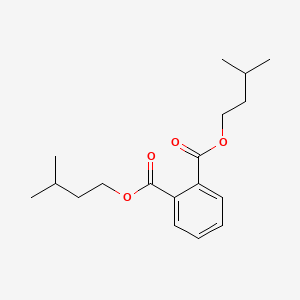
Chimie vérifiée pour le CAS 605-50-5
Diisopentyl phthalate
isoamyl phthalate has been reported in Cryptotaenia canadensis with data available. — LOTUS - the natural products occurrence database
- Nom IUPAC
- bis(3-methylbutyl) benzene-1,2-dicarboxylate
- Formule moléculaire
- C18H26O4
- Masse moléculaire
- 306.4 g/mol
- Masse exacte
- 306.18310931 Da
- Masse monoisotopique
- 306.18310931 Da
- XLogP3
- 5,6
- Surface polaire topologique
- 52,6 Ų
- Complexité moléculaire
- 315,0
- Charge formelle
- 0
- Donneurs de liaisons hydrogène
- 0
- Accepteurs de liaisons hydrogène
- 4
- Liaisons rotatives
- 10
- Atomes lourds
- 22
- Unités covalentes
- 1
Noms et synonymes signalés à PubChem
16 autres noms signalés
Identifiants de bases de données externes
- EPA DTXSID:DTXSID80209236
- PubMed:22715693
Statistiques de structure avancées
- Stéréocentres atomiques définis
- 0
- Stéréocentres atomiques non définis
- 0
- Stéréocentres de liaison définis
- 0
- Stéréocentres de liaison non définis
- 0
- Caractéristiques pharmacophoriques 3D
- 5
- Cycles 3D
- 1
- Groupes hydrophobes 3D
- 2
- Caractéristiques d’accepteur 3D
- 2
- Caractéristiques de donneur 3D
- 0
- Centres anioniques 3D
- 0
- Centres cationiques 3D
- 0
- Conformères 3D
- 10
- Rotors 3D effectifs
- 10,0
Identifiants de structure lisibles par machine
- SMILES
CC(C)CCOC(=O)C1=CC=CC=C1C(=O)OCCC(C)C- InChI
InChI=1S/C18H26O4/c1-13(2)9-11-21-17(19)15-7-5-6-8-16(15)18(20)22-12-10-14(3)4/h5-8,13-14H,9-12H2,1-4H3- InChIKey
JANBFCARANRIKJ-UHFFFAOYSA-N
Récupéré depuis NIH PubChem le 2026-09-02 par correspondance CAS à somme de contrôle valide. Les propriétés chimiques ne remplacent pas la décision réglementaire de cette page.
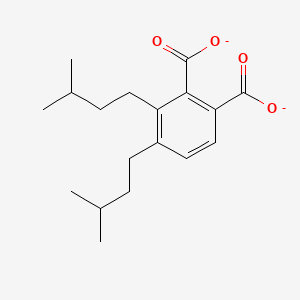
Chimie vérifiée pour le CAS 84777-06-0
1,2-Benzenedicarboxylic acid, dipentyl ester, branched and linear
- Nom IUPAC
- 3,4-bis(3-methylbutyl)phthalate
- Formule moléculaire
- C18H24O4-2
- Formule sans charge
- C18H24O4
- Masse moléculaire
- 304.4 g/mol
- Masse exacte
- 304.16745924 Da
- Masse monoisotopique
- 304.16745924 Da
- XLogP3
- 6,5
- Surface polaire topologique
- 80,3 Ų
- Complexité moléculaire
- 364,0
- Charge formelle
- -2
- Donneurs de liaisons hydrogène
- 0
- Accepteurs de liaisons hydrogène
- 4
- Liaisons rotatives
- 6
- Atomes lourds
- 22
- Unités covalentes
- 1
Noms et synonymes signalés à PubChem
Statistiques de structure avancées
- Stéréocentres atomiques définis
- 0
- Stéréocentres atomiques non définis
- 0
- Stéréocentres de liaison définis
- 0
- Stéréocentres de liaison non définis
- 0
- Caractéristiques pharmacophoriques 3D
- 9
- Cycles 3D
- 1
- Groupes hydrophobes 3D
- 2
- Caractéristiques d’accepteur 3D
- 4
- Caractéristiques de donneur 3D
- 0
- Centres anioniques 3D
- 2
- Centres cationiques 3D
- 0
- Conformères 3D
- 10
- Rotors 3D effectifs
- 8,0
Identifiants de structure lisibles par machine
- SMILES
CC(C)CCC1=C(C(=C(C=C1)C(=O)[O-])C(=O)[O-])CCC(C)C- InChI
InChI=1S/C18H26O4/c1-11(2)5-7-13-8-10-15(17(19)20)16(18(21)22)14(13)9-6-12(3)4/h8,10-12H,5-7,9H2,1-4H3,(H,19,20)(H,21,22)/p-2- InChIKey
YRWFRHKQYQHUTP-UHFFFAOYSA-L
Récupéré depuis NIH PubChem le 2026-09-02 par correspondance CAS à somme de contrôle valide. Les propriétés chimiques ne remplacent pas la décision réglementaire de cette page.
Source officielle et provenance
- Source enregistrée
- China NMPA banned raw-material catalogues (2021)
- Référence de la source
- NMPA 2021 Catalogue of Raw Materials Banned for Cosmetics, entry 14
- Identifiant de la fiche source
chemical-14- Version de la source
- NMPA Announcement No. 74 of 2021, effective 2021-05-26
- Langue de la source
- Chinese with source English/Latin identity
- État de la traduction
- Official English translation · Traduction anglaise
- Date d’effet
- 2021-05-26
- Source mise à jour le
- 2021-05-26
- Instantané vérifié le
- 2026-08-31 14:13 UTC
- Méthode de validation
- pdfplumber tables; exact 1,284 + 109 row counts and contiguous source numbering
- SHA-256
8848aa3e0c7ac5e74f56fc27927336c4fc2e5bc80137da087c2ca9ba2d2c075e
Notes du jeu de données enregistré
- Couverture du jeu de données
- All 1,284 banned raw materials and 109 banned plant/animal raw materials effective from 26 May 2021
- Note sur l’autorité
- Binding NMPA catalogues replacing Tables 1 and 2 of the 2015 Technical Specification
Place de cette fiche dans le jeu de données du marché
Répartition des statuts
Un texte de conditions est présent pour 1393 des 1393 fiches actuelles. Un champ de conditions vide est interprété selon le type de fiche ci-dessus ; il n’est jamais converti en une affirmation d’utilisation sans restriction.
China contexte du marché
Complete prohibited catalogues plus official-source workflow
Version de la couverture : NMPA 2021 banned catalogues plus dynamic IECIC List I/List II system current since 2025
All 1,284 banned raw materials and 109 banned plant/animal raw materials, plus the official workflow for the dynamic existing-ingredient inventory, other technical restrictions and new ingredients.
Liste de contrôle de vérification
- Search the current NMPA IECIC List I and List II by Chinese name and identity.
- Check prohibited/restricted and positive lists in the current Safety and Technical Standards.
- Review technical purpose, use history and any monitoring period.
- Confirm Chinese labelling, safety assessment and filing/registration duties.
Sources officielles du marché
- China NMPA IECIC dynamic inventoryOfficial NMPA inventory, not a blanket permission or safety decision
- China draft mandatory cosmetic safety standardConsultation draft — not current law and not a substitute for the effective NMPA catalogues
- China NMPA banned raw-material catalogues (2021)Binding NMPA catalogues replacing Tables 1 and 2 of the 2015 Technical Specification
Procédure de vérification et exhaustivité de la fiche
Avant d’utiliser ce résultat dans une décision de conformité
- Confirmez que « 1,2-苯基二羧酸支链和直链二戊基酯, 正戊基异戊基邻苯二甲酸酯, 双正戊 基邻苯二甲酸酯, 双异戊基邻苯二甲 酸酯 — 1,2-Benzenedicarboxylic acid, dipentylester, branched and linear (CAS No. 84777-06-0),n-Pentyl-isopentylphthalate,di-n-Pentyl phthalate (CAS No. 131-18-0), Diisopentylphthalate (CAS No. 605-50-5) » et chaque identifiant CAS/CE correspondent à la matière de votre spécification fournisseur.
- Search the current NMPA IECIC List I and List II by Chinese name and identity.
- Check prohibited/restricted and positive lists in the current Safety and Technical Standards.
- Review technical purpose, use history and any monitoring period.
- Confirm Chinese labelling, safety assessment and filing/registration duties.
- Consignez la version de la source et revérifiez auprès de l’autorité de réglementation avant la fabrication, la notification ou la mise sur le marché.
Champs disponibles dans cette fiche
- Nom officiel de la substanceDisponible
- CASDisponible
- ECNon fourni
- Texte de condition distinctDisponible
- Date d’effetDisponible
- Empreinte de l’instantané et méthodeDisponible
Questions auxquelles cette page répond
Citation stable
1,2-苯基二羧酸支链和直链二戊基酯, 正戊基异戊基邻苯二甲酸酯, 双正戊 基邻苯二甲酸酯, 双异戊基邻苯二甲 酸酯 — 1,2-Benzenedicarboxylic acid, dipentylester, branched and linear (CAS No. 84777-06-0),n-Pentyl-isopentylphthalate,di-n-Pentyl phthalate (CAS No. 131-18-0), Diisopentylphthalate (CAS No. 605-50-5). NMPA 2021 Catalogue of Raw Materials Banned for Cosmetics, entry 14. China. Source version NMPA Announcement No. 74 of 2021, effective 2021-05-26. CosIng Checker regulatory record: https://cosingchecker.com/fr/regulations/cn/records/11703/
Citez l’autorité de réglementation comme autorité juridique. Cette page est un index structuré de preuves et une aide à la vérification, et non un substitut au texte officiel ni à une évaluation juridique professionnelle.
Interprétation et limites pour China
This official record identifies the substance as prohibited for cosmetic use in the stated market scope.
Do not rely on a formulation containing this identity until the cited source, effective date and exact substance match have been verified.
Comment interpréter le rôle juridique
The cited row forms part of a binding rule or legally incorporated list for this market.
Preuves sur cette page
- Résultat enregistré : Prohibited
- Rôle juridique : Binding rule
- Version de la source : NMPA Announcement No. 74 of 2021, effective 2021-05-26
- Date d’effet : 2021-05-26
Ce que cela ne prouve pas
IECIC listing is not blanket approval; absence may require the new cosmetic ingredient route, and restrictions are checked separately.
Recherche complémentaire sur la substance auprès de sources faisant autorité
Aucune de ces sources ne prévaut sur la décision de marché ci-dessus.
Cosmetic Ingredient Review safety assessments
Expert Panel conclusions, assessed ingredient groups, use conditions, dates and report documents
Independent expert review considered by FDA; not a government approval or binding market rule
Rechercher cette identité à la sourceFDA Global Substance Registration System
UNII identifiers, preferred names, substance types, codes and public substance relationships
Identity registry only; UNII availability does not imply FDA review or approval
Rechercher cette identité à la sourceILO/WHO International Chemical Safety Cards
Hazards, symptoms, first aid, storage, incompatibilities and physical properties for covered chemicals
International occupational chemical-safety reference; not cosmetic-use approval
Rechercher cette identité à la sourceJapan NITE-CHRIP
Chemical identity, Japanese and foreign legal lists, GHS hazards and exposure-related information
Chemical-management evidence; cosmetic status remains governed by the applicable MHLW standard and market rules
Rechercher cette identité à la sourceNIOSH Pocket Guide to Chemical Hazards
REL, PEL, IDLH, properties, exposure routes, symptoms, target organs, first aid and measurement methods for covered workplace chemicals
US occupational-health guidance and limits; not a cosmetic ingredient decision
Rechercher cette identité à la sourceOECD eChemPortal
Gateway to authority-owned physical-property, fate, ecotoxicity, toxicity, exposure and GHS records
Discovery gateway; each linked authority remains responsible for its data
Rechercher cette identité à la sourceUS EPA CompTox CTX APIs
Clé d’API requise pour l’importDTXSID identity, experimental and predicted properties, toxicity, bioactivity, exposure and environmental data
Scientific and computational evidence; predictions must remain labelled and do not determine cosmetic legality
Rechercher cette identité à la source