
Ammonium fluoride Ammonium fluoride CAS No 12125-01-8
ASEAN Annex III lists this record among substances allowed only under restrictions and conditions. Member-state transition rules and deviations still require local verification.
Décision réglementaire et conditions complètes
- Statut
- Restricted
- Rôle juridique
- Binding rule
- Résumé réglementaire
- ASEAN Annex III lists this record among substances allowed only under restrictions and conditions. Member-state transition rules and deviations still require local verification.
- Conditions et restrictions
(a) Oral hygiene products (except mouthwash) (b) Mouthwash · 0.15 % calculated as F. When mixed with other fluorine compounds permitted under this Annex, total F concentration must not exceed 0.15 % · (a) & (b) Contains ammonium fluoride. (a) “Children of 6 years and younger: use a pea-sized amount for supervised brushing to minimize swallowing. In case of intake of fluoride from other sources consult a dentist or doctor.” (12) (b) Do not use for children below 6 years of age
Identité de la substance
- Nom dans la source officielle
- Ammonium fluoride Ammonium fluoride CAS No 12125-01-8
- CAS
- 12125-01-8
- EC
- 235-185-9
- Correspondance d’identité
- cas_number
- Ingrédient associé
- AMMONIUM FLUORIDE
Données d’identité CosIng associées
Noms et alias
Description CosIng : Ammonium fluoride
Note de restriction de l’inventaire de l’UE : III/33
Fonction cosmétique enregistrée : ANTIPLAQUE, ORAL CARE
Pages de fonctions :ANTIPLAQUE, ORAL CARE
Voir le profil complet de l’ingrédientAperçu multi-marchés pour cette identité
Fiches exactes associées actuellement présentes sur ce site. L’absence d’un marché signifie qu’aucune correspondance exacte n’a été importée, et non une autorisation d’utiliser la substance.
European Union
1 fiche associée · 1 avec conditions spécifiques
Ouvrir la fiche justificativeGreat Britain
1 fiche associée · 1 avec conditions spécifiques
Ouvrir la fiche justificativeNew Zealand
1 fiche associée · 1 avec conditions spécifiques
Ouvrir la fiche justificativeASEAN
Fiche actuelle1 fiche associée · 1 avec conditions spécifiques
Ouvrir la fiche justificativeIndia
1 fiche associée · 1 avec conditions spécifiques
Ouvrir la fiche justificativeSaudi Arabia
1 fiche associée
Ouvrir la fiche justificative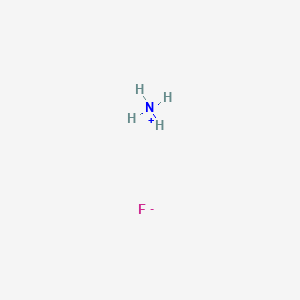
Chimie vérifiée pour le CAS 12125-01-8
Ammonium fluoride
Ammonium fluoride is a fluoride salt having ammonium (NH4+) as the counterion. It is a fluoride salt and an ammonium salt. — ChEBI
- Nom IUPAC
- azanium fluoride
- Formule moléculaire
- FH4N
- Masse moléculaire
- 37.037 g/mol
- Masse exacte
- 37.032777294 Da
- Masse monoisotopique
- 37.032777294 Da
- Surface polaire topologique
- 1,0 Ų
- Complexité moléculaire
- 0,0
- Charge formelle
- 0
- Donneurs de liaisons hydrogène
- 1
- Accepteurs de liaisons hydrogène
- 1
- Liaisons rotatives
- 0
- Atomes lourds
- 2
- Unités covalentes
- 2
Noms et synonymes signalés à PubChem
16 autres noms signalés
Identifiants de bases de données externes
- ChEBI:CHEBI:66871
- EPA DTXSID:DTXSID6050463
Statistiques de structure avancées
- Stéréocentres atomiques définis
- 0
- Stéréocentres atomiques non définis
- 0
- Stéréocentres de liaison définis
- 0
- Stéréocentres de liaison non définis
- 0
- Conformères 3D
- 0
Identifiants de structure lisibles par machine
- SMILES
[NH4+].[F-]- InChI
InChI=1S/FH.H3N/h1H;1H3- InChIKey
LDDQLRUQCUTJBB-UHFFFAOYSA-N
Preuves issues de bases de données scientifiques complémentaires
NIH PubChem PUG-View
Attributed physical-property, hazard, environmental and use annotations.
- Boiling Point: 212 °F at 760 mmHg (USCG, 1999) Source: CAMEO Chemicals
- Color/Form: Deliquescent leaflets or needles; hexagonal prisms by sublimation; occurs commercially as a granular powder Source: Hazardous Substances Data Bank (HSDB)
- Color/Form: White hexagonal crystals Source: Hazardous Substances Data Bank (HSDB)
- Density: 1.32 at 77 °F (USCG, 1999) - Denser than water; will sink Source: CAMEO Chemicals
- Density: 1.015 Source: Hazardous Substances Data Bank (HSDB)
- Density: 1.01 g/cm³ Source: ILO-WHO International Chemical Safety Cards (ICSCs)
- Density: 1.00925 @25 °C Source: PAC Chemical Database, U.S. Department of Energy
- Melting Point: 238 °C Source: Hazardous Substances Data Bank (HSDB)
- Melting Point: sublimes Source: ILO-WHO International Chemical Safety Cards (ICSCs)
- Melting Point: 126 °C Source: PAC Chemical Database, U.S. Department of Energy
- Odor: Odorless Source: Hazardous Substances Data Bank (HSDB)
- Physical Description: Ammonium fluoride is a white crystalline solid. It is soluble in water. It is noncombustible. It is corrosive to aluminum. It is used in chemical analysis, in brewing, and as a preservative for wood. Source: CAMEO Chemicals
- Physical Description: Liquid; Dry Powder; Large Crystals; CBI Source: EPA Chemical Data Reporting (CDR)
- Physical Description: Colorless or white solid; [ICSC] Deliquescent; [Merck Index] White crystalline solid with an ammonia-like odor; [MSDSonline] Source: Haz-Map, Information on Hazardous Chemicals and Occupational Diseases
- Physical Description: COLOURLESS CRYSTALS OR WHITE POWDER. Source: ILO-WHO International Chemical Safety Cards (ICSCs)
- Solubility: 83.5 g/100 g water at 25 °C Source: Hazardous Substances Data Bank (HSDB)
- Solubility: 100 g/100 mL of water at 0 °C Source: Hazardous Substances Data Bank (HSDB)
- Solubility: 82.780 lb/100 lb of water at 70 °F Source: Hazardous Substances Data Bank (HSDB)
- Solubility: 45.3 g/100 g water at 25 °C Source: Hazardous Substances Data Bank (HSDB)
- Solubility: Slightly soluble in alcohol Source: Hazardous Substances Data Bank (HSDB)
- Solubility: Solubility in water, g/100ml at 25 °C: 45.3 Source: ILO-WHO International Chemical Safety Cards (ICSCs)
- pH: The aqueous solution is acidic. Source: Hazardous Substances Data Bank (HSDB)
- Exposure Routes: The substance can be absorbed into the body by inhalation of its aerosol and by ingestion. Source: ILO-WHO International Chemical Safety Cards (ICSCs)
- First Aid: Begin first aid as quickly as possible.; INHALATION: remove to fresh air.; INGESTION: perform gastric lavage with limewater or 1% calcium chloride solution; support respiration; call a physician.; EYES: flush with water for 15 min.; consult physician.; SKIN: shower immediately with large quantities of water; remove all contaminated clothing in the shower at once; consult physician. (USCG, 1999) Source: CAMEO Chemicals
- ERG2024, Guide 154 (Ammonium fluoride): General First Aid:; · Call 911 or emergency medical service.; · Ensure that medical personnel are aware of the material(s) involved, take precautions to protect themselves and avoid contamination.; · Move victim to fresh air if it can be done safely.; · Administer oxygen if breathing is difficult.; · If victim is not breathing:; -- DO NOT perform mouth-to-mouth resuscitation; the victim may have ingested or inhaled the substance.; -- If equipped and pulse detected, wash face and mouth, then give artificial respiration using a proper respiratory medical device (bag-valve mask, pocket mask equipped with a one-way valve or other device).; -- If no pulse detected or no respiratory medical device available, provide continuous compressions. Conduct a pulse check every two minutes or monitor for any signs of spontaneous respirations.; · Remove and isolate contaminated clothing and shoes.; · For minor skin contact, avoid spreading material on unaffected skin.; · In case of contact with substance, remove immediately by flushing skin or eyes with running water for at least 20 minutes.; · For severe burns, immediate medical attention is required.; · Effects of exposure (inhalation, ingestion, Source: Emergency Response Guidebook (ERG)
- Signal: Danger Source: Regulation (EC) No 1272/2008 of the European Parliament and of the Council
- GHS Hazard Statements: H301: Toxic if swallowed [Danger Acute toxicity, oral]; H311: Toxic in contact with skin [Danger Acute toxicity, dermal]; H331: Toxic if inhaled [Danger Acute toxicity, inhalation] Source: Regulation (EC) No 1272/2008 of the European Parliament and of the Council
- Precautionary Statement Codes: P261, P262, P264, P270, P271, P280, P301+P316, P302+P352, P304+P340, P316, P321, P330, P361+P364, P403+P233, P405, and P501 (click each P-code to see the statement) Source: Regulation (EC) No 1272/2008 of the European Parliament and of the Council
- Signal: Danger Source: European Chemicals Agency (ECHA)
- GHS Hazard Statements: H301 (100%): Toxic if swallowed [Danger Acute toxicity, oral]; H311 (98.7%): Toxic in contact with skin [Danger Acute toxicity, dermal]; H314 (14.7%): Causes severe skin burns and eye damage [Danger Skin corrosion/irritation]; H318 (16.7%): Causes serious eye damage [Danger Serious eye damage/eye irritation]; H331 (99.9%): Toxic if inhaled [Danger Acute toxicity, inhalation] Source: European Chemicals Agency (ECHA)
- Precautionary Statement Codes: P260, P261, P262, P264, P264+P265, P270, P271, P280, P301+P316, P301+P330+P331, P302+P352, P302+P361+P354, P304+P340, P305+P354+P338, P316, P317, P321, P330, P361+P364, P363, P403+P233, P405, and P501 (click each P-code to see the statement) Source: European Chemicals Agency (ECHA)
- ECHA C&L Notifications Summary: Aggregated GHS information provided per 3035 reports by companies from 19 notifications to the ECHA C&L Inventory. Each notification may be associated with multiple companies.; Information may vary between notifications depending on impurities, additives, and other factors. The percentage value in parenthesis indicates the notified classification ratio from companies that provide hazard codes. Only hazard codes with percentage values above 10% are shown. For more detailed information, please visit ECHA C&L website. Source: European Chemicals Agency (ECHA)
- Signal: Danger Source: NITE-CMC
- GHS Hazard Statements: H319: Causes serious eye irritation [Warning Serious eye damage/eye irritation]; H372: Causes damage to organs through prolonged or repeated exposure [Danger Specific target organ toxicity, repeated exposure] Source: NITE-CMC
- Precautionary Statement Codes: P260, P264, P264+P265, P270, P280, P305+P351+P338, P319, P337+P317, and P501 (click each P-code to see the statement) Source: NITE-CMC
- Signal: Warning Source: NITE-CMC
- GHS Hazard Statements: H335: May cause respiratory irritation [Warning Specific target organ toxicity, single exposure; Respiratory tract irritation]; H373: May causes damage to organs through prolonged or repeated exposure [Warning Specific target organ toxicity, repeated exposure] Source: NITE-CMC
- NFPA Health Rating: 3 - Materials that, under emergency conditions, can cause serious or permanent injury. Source: Hazardous Substances Data Bank (HSDB)
- NFPA Fire Rating: 0 - Materials that will not burn under typical fire conditions, including intrinsically noncombustible materials such as concrete, stone, and sand. Source: Hazardous Substances Data Bank (HSDB)
- NFPA Instability Rating: 0 - Materials that in themselves are normally stable, even under fire conditions. Source: Hazardous Substances Data Bank (HSDB)
- Consumer Uses: Plating agent; Etching agent Source: EPA Chemical Data Reporting (CDR)
- Industry Uses: Semiconductor and photovoltaic agent; Processing aids not otherwise specified; Plating agent; Other; Intermediate; Etching agent; Surface modifier; Cleaning agent Source: EPA Chemical Data Reporting (CDR)
- Sources/Uses: Used in etching and frosting glass; as antiseptic in brewing beer; for preserving wood; in printing and dyeing textiles; and as mothproofing agent; [HSDB] Used as a wet etchant in semiconductor manufacturing at a standard concentration of 40%; [CSH, p. 46] Source: Haz-Map, Information on Hazardous Chemicals and Occupational Diseases
- Industrial Processes with risk of exposure: Semiconductor Manufacturing [Category: Industry]; Applying Wood Preservatives [Category: Other]; Using Disinfectants or Biocides [Category: Clean]; Textiles (Printing, Dyeing, or Finishing) [Category: Industry]; Glass Manufacturing [Category: Industry] Source: Haz-Map, Information on Hazardous Chemicals and Occupational Diseases
- Uses: Etching and frosting glass, as antiseptic in brewing beer; preserving wood; in printing and dyeing textiles; as mothproofing agent Source: Hazardous Substances Data Bank (HSDB)
- Uses: Fluorides; analytical chemistry Source: Hazardous Substances Data Bank (HSDB)
- Uses: Ammonium fluoride is available principally as a laboratory reagent. If it is needed in large quantities, one mole of aqueous ammonia can be mixed with one mole of the more readily available ammonium bifluoride. Source: Hazardous Substances Data Bank (HSDB)
Mis en correspondance par: Existing checksum-valid CAS to unique PubChem CID match. Récupéré le: 2026-08-31. Ouvrir la fiche source
Les classifications scientifiques et les annotations de danger apportent du contexte et ne remplacent pas la décision réglementaire propre au marché indiquée ci-dessus.
Couverture des sources complémentaires et état des correspondances
| Source | Résultat | Vérifié |
|---|---|---|
| NIH PubChem PUG-View | Correspondance exacte | 2026-08-31 |
Une absence de correspondance enregistrée est une preuve utile que la source a été vérifiée ; ce n’est pas l’affirmation que la substance n’existe pas ailleurs.
Récupéré depuis NIH PubChem le 2026-09-02 par correspondance CAS à somme de contrôle valide. Les propriétés chimiques ne remplacent pas la décision réglementaire de cette page.
Source officielle et provenance
- Source enregistrée
- ASEAN Cosmetic Directive annexes
- Référence de la source
- ASEAN Annex III, reference 33
- Identifiant de la fiche source
III-33- Version de la source
- 2026-1
- Langue de la source
- English
- État de la traduction
- Original is English
- Source mise à jour le
- 2026-06-22
- Instantané vérifié le
- 2026-08-30 04:44 UTC
- Méthode de validation
- pdfplumber ruled-table extraction with per-annex reviewed counts
- SHA-256
ffad59f6c01a92c82042c54203ee14969425c2a82bd04c2f4012ff82513e69f1
Notes du jeu de données enregistré
- Couverture du jeu de données
- Banned, restricted and positive-list substances under the harmonised ASEAN framework
- Note sur l’autorité
- Regional directive; member-state transitions and deviations still require local verification
Place de cette fiche dans le jeu de données du marché
Répartition des statuts
Un texte de conditions est présent pour 462 des 2224 fiches actuelles. Un champ de conditions vide est interprété selon le type de fiche ci-dessus ; il n’est jamais converti en une affirmation d’utilisation sans restriction.
ASEAN contexte du marché
Complete regional annex dataset
Version de la couverture : ASEAN Cosmetic Directive annexes 2026-1, 22 June 2026
Annexes II, III, IV, VI and VII covering prohibited, restricted and positive-list substances.
Liste de contrôle de vérification
- Search all ACD annexes by name and identifiers.
- Apply product type, maximum level and warning conditions.
- Confirm the target member state's adoption and transition date.
- Complete the local notification and responsible-company requirements.
Sources officielles du marché
- ASEAN Cosmetic Directive annexesRegional directive; member-state transitions and deviations still require local verification
Procédure de vérification et exhaustivité de la fiche
Avant d’utiliser ce résultat dans une décision de conformité
- Confirmez que « Ammonium fluoride Ammonium fluoride CAS No 12125-01-8 » et chaque identifiant CAS/CE correspondent à la matière de votre spécification fournisseur.
- Search all ACD annexes by name and identifiers.
- Apply product type, maximum level and warning conditions.
- Confirm the target member state's adoption and transition date.
- Complete the local notification and responsible-company requirements.
- Consignez la version de la source et revérifiez auprès de l’autorité de réglementation avant la fabrication, la notification ou la mise sur le marché.
Champs disponibles dans cette fiche
- Nom officiel de la substanceDisponible
- CASDisponible
- ECDisponible
- Texte de condition distinctDisponible
- Date d’effetNon fourni
- Empreinte de l’instantané et méthodeDisponible
Questions auxquelles cette page répond
Citation stable
Ammonium fluoride Ammonium fluoride CAS No 12125-01-8. ASEAN Annex III, reference 33. ASEAN. Source version 2026-1. CosIng Checker regulatory record: https://cosingchecker.com/fr/regulations/asean/records/3903/
Citez l’autorité de réglementation comme autorité juridique. Cette page est un index structuré de preuves et une aide à la vérification, et non un substitut au texte officiel ni à une évaluation juridique professionnelle.
Interprétation et limites pour ASEAN
This substance is not unrestricted: cosmetic use is subject to the conditions in the cited official record.
Check product type, body area, concentration, purity and warning requirements before deciding whether a formulation is compliant.
Comment interpréter le rôle juridique
The cited row forms part of a binding rule or legally incorporated list for this market.
Preuves sur cette page
- Résultat enregistré : Restricted
- Rôle juridique : Binding rule
- Version de la source : 2026-1
Ce que cela ne prouve pas
Regional annex coverage does not replace member-state implementation dates, notifications or national deviations.
Recherche complémentaire sur la substance auprès de sources faisant autorité
Aucune de ces sources ne prévaut sur la décision de marché ci-dessus.
Cosmetic Ingredient Review safety assessments
Expert Panel conclusions, assessed ingredient groups, use conditions, dates and report documents
Independent expert review considered by FDA; not a government approval or binding market rule
Rechercher cette identité à la sourceFDA Global Substance Registration System
UNII identifiers, preferred names, substance types, codes and public substance relationships
Identity registry only; UNII availability does not imply FDA review or approval
Rechercher cette identité à la sourceILO/WHO International Chemical Safety Cards
Hazards, symptoms, first aid, storage, incompatibilities and physical properties for covered chemicals
International occupational chemical-safety reference; not cosmetic-use approval
Rechercher cette identité à la sourceJapan NITE-CHRIP
Chemical identity, Japanese and foreign legal lists, GHS hazards and exposure-related information
Chemical-management evidence; cosmetic status remains governed by the applicable MHLW standard and market rules
Rechercher cette identité à la sourceNIOSH Pocket Guide to Chemical Hazards
REL, PEL, IDLH, properties, exposure routes, symptoms, target organs, first aid and measurement methods for covered workplace chemicals
US occupational-health guidance and limits; not a cosmetic ingredient decision
Rechercher cette identité à la sourceOECD eChemPortal
Gateway to authority-owned physical-property, fate, ecotoxicity, toxicity, exposure and GHS records
Discovery gateway; each linked authority remains responsible for its data
Rechercher cette identité à la sourceUS EPA CompTox CTX APIs
Clé d’API requise pour l’importDTXSID identity, experimental and predicted properties, toxicity, bioactivity, exposure and environmental data
Scientific and computational evidence; predictions must remain labelled and do not determine cosmetic legality
Rechercher cette identité à la source