Aller au contenu principal
CAS 1 fiche

CAS 12125-01-8

Le CAS 12125-01-8 correspond à 1 fiche d’annexe de l’UE dans les annexes II à VI du règlement (CE) n° 1223/2009.

Fiches pour le CAS 12125-01-8

1 au total
Annexe
III
Entrée
33

AMMONIUM FLUORIDE

Ammonium fluoride

Contains ammonium fluoride. For any toothpaste with compounds containing fluorine in a concentration of 0,1 to 0,15 % calculated as F unless it is already labelled as contra-indicated for children (e.g. “for adult use …

EC
Concentration max.

Identité et propriétés chimiques

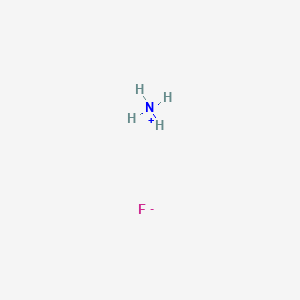
Structure chimique 2D PubChem pour le CAS 12125-01-8
CAS 12125-01-8PubChem CID 25516

Ammonium fluoride

Ammonium fluoride is a fluoride salt having ammonium (NH4+) as the counterion. It is a fluoride salt and an ammonium salt. — ChEBI

Nom IUPAC
azanium fluoride
Formule moléculaire
FH4N
Masse moléculaire
37.037 g/mol
Masse exacte
37.032777294 Da
Surface polaire topologique
1,0 Ų
Donneurs de liaisons hydrogène
1
Accepteurs de liaisons hydrogène
1
Unités covalentes
2
Stéréocentres définis
0

Également connu sous le nom de

Ammonium fluoride ((NH4)F)Fluoruro amonicoAmmonium fluorureNeutral ammonium fluorideFluorure d'ammoniumFluorek amonowy4QT928IM0ACHEBI:66871
16 autres noms signalés
RefChem:5548235-185-9NH4Fazanium;fluorideammonium monofluorideFluorek amonowy [Polish]Ammonium fluorure [French]Fluoruro amonico [Spanish]Fluorure d'ammonium [French]CCRIS 2285HSDB 6287EINECS 235-185-9UN2505UNII-4QT928IM0Aammonia hydrofluorideEC 235-185-9
Identifiants de bases de données externes

Preuves issues de bases de données scientifiques complémentaires

NIH PubChem PUG-View
Correspondance exacte d’identifiant25516

Attributed physical-property, hazard, environmental and use annotations.

  • First Aid: Begin first aid as quickly as possible.; INHALATION: remove to fresh air.; INGESTION: perform gastric lavage with limewater or 1% calcium chloride solution; support respiration; call a physician.; EYES: flush with water for 15 min.; consult physician.; SKIN: shower immediately with large quantities of water; remove all contaminated clothing in the shower at once; consult physician. (USCG, 1999) Source: CAMEO Chemicals
  • ERG2024, Guide 154 (Ammonium fluoride): General First Aid:; · Call 911 or emergency medical service.; · Ensure that medical personnel are aware of the material(s) involved, take precautions to protect themselves and avoid contamination.; · Move victim to fresh air if it can be done safely.; · Administer oxygen if breathing is difficult.; · If victim is not breathing:; -- DO NOT perform mouth-to-mouth resuscitation; the victim may have ingested or inhaled the substance.; -- If equipped and pulse detected, wash face and mouth, then give artificial respiration using a proper respiratory medical device (bag-valve mask, pocket mask equipped with a one-way valve or other device).; -- If no pulse detected or no respiratory medical device available, provide continuous compressions. Conduct a pulse check every two minutes or monitor for any signs of spontaneous respirations.; · Remove and isolate contaminated clothing and shoes.; · For minor skin contact, avoid spreading material on unaffected skin.; · In case of contact with substance, remove immediately by flushing skin or eyes with running water for at least 20 minutes.; · For severe burns, immediate medical attention is required.; · Effects of exposure (inhalation, ingestion, Source: Emergency Response Guidebook (ERG)
  • Signal: Danger Source: Regulation (EC) No 1272/2008 of the European Parliament and of the Council
  • GHS Hazard Statements: H301: Toxic if swallowed [Danger Acute toxicity, oral]; H311: Toxic in contact with skin [Danger Acute toxicity, dermal]; H331: Toxic if inhaled [Danger Acute toxicity, inhalation] Source: Regulation (EC) No 1272/2008 of the European Parliament and of the Council
  • Precautionary Statement Codes: P261, P262, P264, P270, P271, P280, P301+P316, P302+P352, P304+P340, P316, P321, P330, P361+P364, P403+P233, P405, and P501 (click each P-code to see the statement) Source: Regulation (EC) No 1272/2008 of the European Parliament and of the Council
  • Signal: Danger Source: European Chemicals Agency (ECHA)
  • GHS Hazard Statements: H301 (100%): Toxic if swallowed [Danger Acute toxicity, oral]; H311 (98.7%): Toxic in contact with skin [Danger Acute toxicity, dermal]; H314 (14.7%): Causes severe skin burns and eye damage [Danger Skin corrosion/irritation]; H318 (16.7%): Causes serious eye damage [Danger Serious eye damage/eye irritation]; H331 (99.9%): Toxic if inhaled [Danger Acute toxicity, inhalation] Source: European Chemicals Agency (ECHA)
  • Precautionary Statement Codes: P260, P261, P262, P264, P264+P265, P270, P271, P280, P301+P316, P301+P330+P331, P302+P352, P302+P361+P354, P304+P340, P305+P354+P338, P316, P317, P321, P330, P361+P364, P363, P403+P233, P405, and P501 (click each P-code to see the statement) Source: European Chemicals Agency (ECHA)
  • ECHA C&L Notifications Summary: Aggregated GHS information provided per 3035 reports by companies from 19 notifications to the ECHA C&L Inventory. Each notification may be associated with multiple companies.; Information may vary between notifications depending on impurities, additives, and other factors. The percentage value in parenthesis indicates the notified classification ratio from companies that provide hazard codes. Only hazard codes with percentage values above 10% are shown. For more detailed information, please visit ECHA C&L website. Source: European Chemicals Agency (ECHA)
  • Signal: Danger Source: NITE-CMC
  • GHS Hazard Statements: H319: Causes serious eye irritation [Warning Serious eye damage/eye irritation]; H372: Causes damage to organs through prolonged or repeated exposure [Danger Specific target organ toxicity, repeated exposure] Source: NITE-CMC
  • Precautionary Statement Codes: P260, P264, P264+P265, P270, P280, P305+P351+P338, P319, P337+P317, and P501 (click each P-code to see the statement) Source: NITE-CMC
  • Signal: Warning Source: NITE-CMC
  • GHS Hazard Statements: H335: May cause respiratory irritation [Warning Specific target organ toxicity, single exposure; Respiratory tract irritation]; H373: May causes damage to organs through prolonged or repeated exposure [Warning Specific target organ toxicity, repeated exposure] Source: NITE-CMC
  • Industry Uses: Semiconductor and photovoltaic agent; Processing aids not otherwise specified; Plating agent; Other; Intermediate; Etching agent; Surface modifier; Cleaning agent Source: EPA Chemical Data Reporting (CDR)
  • Sources/Uses: Used in etching and frosting glass; as antiseptic in brewing beer; for preserving wood; in printing and dyeing textiles; and as mothproofing agent; [HSDB] Used as a wet etchant in semiconductor manufacturing at a standard concentration of 40%; [CSH, p. 46] Source: Haz-Map, Information on Hazardous Chemicals and Occupational Diseases
  • Industrial Processes with risk of exposure: Semiconductor Manufacturing [Category: Industry]; Applying Wood Preservatives [Category: Other]; Using Disinfectants or Biocides [Category: Clean]; Textiles (Printing, Dyeing, or Finishing) [Category: Industry]; Glass Manufacturing [Category: Industry] Source: Haz-Map, Information on Hazardous Chemicals and Occupational Diseases
  • Uses: Etching and frosting glass, as antiseptic in brewing beer; preserving wood; in printing and dyeing textiles; as mothproofing agent Source: Hazardous Substances Data Bank (HSDB)
  • Uses: Fluorides; analytical chemistry Source: Hazardous Substances Data Bank (HSDB)
  • Uses: Ammonium fluoride is available principally as a laboratory reagent. If it is needed in large quantities, one mole of aqueous ammonia can be mixed with one mole of the more readily available ammonium bifluoride. Source: Hazardous Substances Data Bank (HSDB)

Mis en correspondance par: Existing checksum-valid CAS to unique PubChem CID match. Récupéré le: 2026-08-31. Ouvrir la fiche source

Les classifications scientifiques et les annotations de danger apportent du contexte et ne remplacent pas la décision réglementaire propre au marché indiquée ci-dessus.

Couverture des sources complémentaires et état des correspondances
SourceRésultatVérifié
NIH PubChem PUG-ViewCorrespondance exacte2026-08-31

Une absence de correspondance enregistrée est une preuve utile que la source a été vérifiée ; ce n’est pas l’affirmation que la substance n’existe pas ailleurs.

Récupéré depuis NIH PubChem le 2026-09-02 par correspondance CAS à somme de contrôle valide. Les propriétés chimiques ne remplacent pas la décision réglementaire de cette page.

Comment le CAS 12125-01-8 est utilisé sur ce site

Le CAS 12125-01-8 est l’identifiant du Chemical Abstracts Service utilisé pour rattacher cette page à une substance précise. Dans le jeu de données actuel, 1 fiche d’annexe de l’UE partage cet identifiant, ce qui vous aide à vérifier si la même substance apparaît dans un seul contexte réglementaire ou dans plusieurs.

Utilisez cette page lorsqu’une spécification fournisseur, une FDS ou un dossier de matière première vous donne le CAS 12125-01-8 et que vous devez voir au même endroit toutes les fiches liées des annexes II à VI. Les cartes d’entrées ci-dessus sont le moyen le plus rapide d’accéder aux limites de concentration, aux avertissements, à l’annexe concernée et aux conditions par type de produit.

Questions fréquentes

Une substance identifiée par le CAS 12125-01-8 peut figurer dans plusieurs annexes du règlement de l’UE sur les cosmétiques lorsqu’elle est soumise à des conditions différentes selon les contextes. Par exemple, une substance peut être soumise à restrictions à l’annexe III avec des conditions précises, et le même CAS peut aussi figurer à l’annexe IV comme colorant autorisé, dans une entrée distincte avec ses propres conditions. Chaque entrée doit être examinée individuellement.

Recoupez le numéro CAS avec les fiches de spécification de vos matières premières et vos certificats d’analyse. Lorsqu’un CAS figure à l’annexe II, vérifiez son absence. Lorsqu’il figure à l’annexe III, vérifiez que les limites de concentration et les conditions de type de produit sont respectées dans votre formulation. Toutes les entrées d’annexe partageant ce numéro CAS sont énumérées ci-dessus.

Un numéro CAS est attribué par le Chemical Abstracts Service (États-Unis) et reconnu dans le monde entier. Un numéro CE est un identifiant de la Commission européenne issu d’inventaires tels que l’EINECS, l’ELINCS ou la liste NLP. Les deux identifiants peuvent figurer dans les entrées des annexes cosmétiques de l’UE. Certaines substances ont les deux, d’autres un seul, et certaines entrées plus anciennes peuvent n’en avoir aucun.

Le vérificateur INCI accepte les noms d’ingrédients, les numéros CAS et les numéros CE. Vérifiez directement ce numéro CAS, puis contrôlez le résultat auprès des fiches de spécification des fournisseurs et de toutes les conditions d’annexe associées.

Outils et étapes suivantes

Vérifiez votre formule

Analysez une liste INCI complète, puis utilisez le CAS 12125-01-8 pour recouper les documents fournisseurs relatifs aux substances identifiées.

Vérificateur INCI

Parcourir les annexes

Parcourez toutes les annexes du règlement de l’UE sur les cosmétiques par catégorie.

Toutes les annexes

Rechercher par nom

Recherchez les noms INCI, alias ou identifiants associés qui figurent à côté du CAS 12125-01-8 dans votre documentation.

Rechercher