
ALUMINUM/DYSPROSIUM/EUROPIUM/STRONTIUM OXIDE
Dialuminium strontium tetraoxide
ALUMINUM/DYSPROSIUM/EUROPIUM/STRONTIUM OXIDE figure dans l’inventaire CosIng de l’UE, mais aucune fiche d’annexe directe n’est encore associée sur cette page.
En un coup d’œil
- Fonction
- Colorant
- CAS
- 12004-37-4
- EC
- 234-455-3
- Annexes de l’UE
- Non répertoriéAucune fiche d’annexe de l’UE n’est associée. Ce n’est pas une autorisation.
Preuves réglementaires par marché
Aucune règle pour cet ingrédient n’a été importée pour aucun des 13 marchés suivis ici.
Cela décrit cet inventaire, et non le droit. L’absence de règle importée n’est pas la preuve qu’un ingrédient est autorisé : une règle peut exister sous un autre nom ou identifiant, ou dans un jeu de données pas encore importé ici.
Détails d’inventaire pour ALUMINUM/DYSPROSIUM/EUROPIUM/STRONTIUM OXIDE
Nom INCI
ALUMINUM/DYSPROSIUM/EUROPIUM/STRONTIUM OXIDE
Description
Dialuminium strontium tetraoxide
Provenance de la fiche
- Référence d’inventaire
- 98545
- Identité importée
- ALUMINUM/DYSPROSIUM/EUROPIUM/STRONTIUM OXIDE
- Mise à jour de la source
- 26/06/2020
Fiches d’annexe pour ALUMINUM/DYSPROSIUM/EUROPIUM/STRONTIUM OXIDE
Données clés
- COLORANT
Exclusively or mainly intended to colour the cosmetic product, the body as a whole or certain parts thereof, by absorption or reflection of visible light. All authorised colorants are substances in the positive list of Annex IV to the Cosmetics Regulation 1223/2009.
Identité et propriétés chimiques
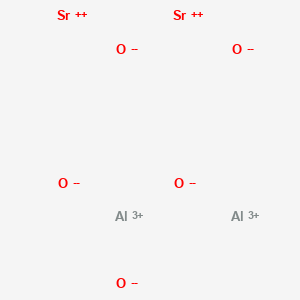
Aluminum strontium oxide (Al2SrO4)
Strontium aluminate is a chemical compound of strontium and aluminum. When activated with a suitable dopant, it acts as a photoluminescent phosphor with long persistence of phosphorescence. Aluminum is the most abundant metal in the earth's crust and is always found combined with other elements such as oxygen, silicon, and fluorine. (L739, L740, L787) — Toxin and Toxin Target Database (T3DB)
- Nom IUPAC
- dialuminum;distrontium;pentakis(oxygen(2-))
- Formule moléculaire
- Al2O5Sr2
- Masse moléculaire
- 309.2 g/mol
- Masse exacte
- 309.748874 Da
- Surface polaire topologique
- 5,0 Ų
- Donneurs de liaisons hydrogène
- 0
- Accepteurs de liaisons hydrogène
- 5
- Unités covalentes
- 9
- Stéréocentres définis
- 0
Également connu sous le nom de
Preuves issues de bases de données scientifiques complémentaires
NIH PubChem PUG-View
Attributed physical-property, hazard, environmental and use annotations.
- Carcinogen Classification: Not listed by IARC. IARC classified aluminum production as carcinogenic to humans (Group 1), but did not implicate aluminum itself as a human carcinogen. (L135) A link between use of aluminum-containing antiperspirants and increased risk of breast cancer has been proposed (A235), but studies have not been able to establish a clear link (A15468). Source: Toxin and Toxin Target Database (T3DB)
- Exposure Routes: Oral (L739) ; inhalation (L739) Source: Toxin and Toxin Target Database (T3DB)
- Note: This chemical does not meet GHS hazard criteria for 5.1% (10 of 195) of reports. Source: European Chemicals Agency (ECHA)
- Signal: Warning Source: European Chemicals Agency (ECHA)
- GHS Hazard Statements: H315 (94.9%): Causes skin irritation [Warning Skin corrosion/irritation]; H319 (94.9%): Causes serious eye irritation [Warning Serious eye damage/eye irritation]; H335 (94.9%): May cause respiratory irritation [Warning Specific target organ toxicity, single exposure; Respiratory tract irritation] Source: European Chemicals Agency (ECHA)
- Precautionary Statement Codes: P261, P264, P264+P265, P271, P280, P302+P352, P304+P340, P305+P351+P338, P319, P321, P332+P317, P337+P317, P362+P364, P403+P233, P405, and P501 (click each P-code to see the statement) Source: European Chemicals Agency (ECHA)
- ECHA C&L Notifications Summary: Aggregated GHS information provided per 195 reports by companies from 7 notifications to the ECHA C&L Inventory. Each notification may be associated with multiple companies.; Reported as not meeting GHS hazard criteria per 10 of 195 reports by companies.; There are 6 notifications provided by 185 of 195 reports by companies with hazard statement code(s).; Information may vary between notifications depending on impurities, additives, and other factors. The percentage value in parenthesis indicates the notified classification ratio from companies that provide hazard codes. Only hazard codes with percentage values above 10% are shown. For more detailed information, please visit ECHA C&L website. Source: European Chemicals Agency (ECHA)
- Health Effects: Aluminum targets the nervous system and causes decreased nervous system performance and is associated with altered function of the blood-brain barrier. The accumulation of aluminum in the body may cause bone or brain diseases. High levels of aluminum have been linked to Alzheimer's disease. A small percentage of people are allergic to aluminium and experience contact dermatitis, digestive disorders, vomiting or other symptoms upon contact or ingestion of products containing aluminium. (L739, L740) Source: Toxin and Toxin Target Database (T3DB)
- Toxicity Summary: The main target organs of aluminum are the central nervous system and bone. Aluminum binds with dietary phosphorus and impairs gastrointestinal absorption of phosphorus. The decreased phosphate body burden results in osteomalacia (softening of the bones due to defective bone mineralization) and rickets. Aluminum's neurotoxicity is believed to involve several mechanisms. Changes in cytoskeletal protein functions as a results of altered phosphorylation, proteolysis, transport, and synthesis are believed to be one cause. Aluminum may induce neurobehavioral effects by affecting permeability of the blood-brain barrier, cholinergic activity, signal transduction pathways, lipid peroxidation, and impair neuronal glutamate nitric oxide-cyclic GMP pathway, as well as interfere with metabolism of essential trace elements because of similar coordination chemistries and consequent competitive interactions. It has been suggested that aluminum's interaction with estrogen receptors increases the expression of estrogen-related genes and thereby contributes to the progression of breast cancer (A235), but studies have not been able to establish a clear link between aluminum and increased risk of brea Source: Toxin and Toxin Target Database (T3DB)
- Uses: When activated with a suitable dopant, strontium aluminate acts as a photoluminescent phosphor with long persistence of phosphorescence. (L787) Source: Toxin and Toxin Target Database (T3DB)
Mis en correspondance par: Existing checksum-valid CAS to unique PubChem CID match. Récupéré le: 2026-08-31. Ouvrir la fiche source
Les classifications scientifiques et les annotations de danger apportent du contexte et ne remplacent pas la décision réglementaire propre au marché indiquée ci-dessus.
Couverture des sources complémentaires et état des correspondances
| Source | Résultat | Vérifié |
|---|---|---|
| NIH PubChem PUG-View | Correspondance exacte | 2026-08-31 |
Une absence de correspondance enregistrée est une preuve utile que la source a été vérifiée ; ce n’est pas l’affirmation que la substance n’existe pas ailleurs.
Récupéré depuis NIH PubChem le 2026-08-31 par correspondance CAS à somme de contrôle valide. Les propriétés chimiques ne remplacent pas la décision réglementaire de cette page.
Ce qu’indique le nom INCI officiel
The official label is a composite INCI name with 4 named source-material segments. Each segment must be reconciled with the supplier specification.
- Type d’identité selon la formulation
- composite
- Segments sources nommés
- 4
Examiner les segments analysés du nom source
- ALUMINUM
- DYSPROSIUM
- EUROPIUM
- STRONTIUM OXIDE
This structure is derived only from the official label wording. It does not establish composition, concentration, chemical equivalence, safety or regulatory permission.
Preuves officielles sur le nom d’ingrédient de l’UE
Le nom de l’ingrédient correspond exactement au glossaire officiel 2025 de l’UE des dénominations communes d’ingrédients.
Preuves d’inventaire associées
Ingrédients ayant des fonctions de formulation communes
Sources officielles et scientifiques complémentaires
11 bases de données externes pour vérifier cette identité
Chaque lien lance une recherche de cette identité dans la source concernée. Ce qu’est chaque source et sa valeur juridique
Comment ALUMINUM/DYSPROSIUM/EUROPIUM/STRONTIUM OXIDE apparaît dans l’inventaire CosIng
L’inventaire CosIng répertorie ALUMINUM/DYSPROSIUM/EUROPIUM/STRONTIUM OXIDE comme ingrédient cosmétique et cette page l’associe à 0 fiche d’annexe. L’entrée d’inventaire reprend les noms et identifiants, tandis que la fiche d’annexe indique où la substance est interdite, soumise à restrictions ou inscrite sur une liste positive dans le droit de l’UE sur les cosmétiques.
ALUMINUM/DYSPROSIUM/EUROPIUM/STRONTIUM OXIDE est aussi associé à 1 fonction cosmétique dans les données officielles. Les désignations de fonction décrivent l’usage prévu, mais ne remplacent pas l’examen réglementaire des fiches d’annexe associées avant un travail de formulation ou d’étiquetage.
Questions fréquentes
Note de source pour ALUMINUM/DYSPROSIUM/EUROPIUM/STRONTIUM OXIDE
Cette page reproduit l’entrée d’inventaire CosIng de ALUMINUM/DYSPROSIUM/EUROPIUM/STRONTIUM OXIDE issue de documents publics de la Commission européenne sur les ingrédients cosmétiques et affiche les identifiants associés, même si aucune correspondance directe avec une annexe n’est actuellement rattachée.
Utilisez cette page d’inventaire pour étudier ALUMINUM/DYSPROSIUM/EUROPIUM/STRONTIUM OXIDE et comparer les fiches associées, mais vérifiez les restrictions et le statut juridique auprès du texte officiel en vigueur et de la législation avant toute décision réglementaire.
Outils et étapes suivantes
Vérifiez votre formule
Analysez une liste INCI complète pour détecter ALUMINUM/DYSPROSIUM/EUROPIUM/STRONTIUM OXIDE et les éventuelles restrictions d’annexes de l’UE ou signalements d’allergènes associés.
Vérificateur INCIRechercher des ingrédients similaires
Trouvez d’autres ingrédients de l’inventaire et entrées d’annexe liés à ALUMINUM/DYSPROSIUM/EUROPIUM/STRONTIUM OXIDE, à ses identifiants ou à des variantes de nom proches.
Rechercher