
METHYL DIETHANOLAMINE
N-Methyldiethanolamine
METHYL DIETHANOLAMINE est lié à 1 fiche d’annexe de l’UE sur cette page.
En un coup d’œil
- Fonction
- Film forming
- CAS
- 105-59-9
- EC
- 203-312-7
- Annexes de l’UE
- Annexe II/411
- Annexe II/411: interdit dans les produits cosmétiques
Base scientifique : 2 avis du CSSC
Le comité scientifique européen pour la sécurité des consommateurs (CSSC) a évalué cette substance. Ses avis sont la base scientifique de l’entrée de l’annexe.
Preuves réglementaires par marché
Cette matrice distingue les règles d’ingrédients vérifiées des sources cartographiées mais pas encore importées. L’absence de règle importée ne signifie pas que l’ingrédient est autorisé.
Balayez ou faites défiler horizontalement pour voir toutes les colonnes.
| Marché | Statut des preuves | Fiches | Langue de la source |
|---|---|---|---|
| European Union | Preuves associées Prohibited entry found Ouvrir cette preuve | 1 | English and EU languages |
| Great Britain | Source cartographiée Official source mapped; ingredient rule not imported | 0 | English |
| Canada | Source cartographiée Official source mapped; ingredient rule not imported | 0 | English and French |
| New Zealand | Source cartographiée Official source mapped; ingredient rule not imported | 0 | English |
| ASEAN | Source cartographiée Official source mapped; ingredient rule not imported | 0 | English and national languages |
| China | Source cartographiée Official source mapped; ingredient rule not imported | 0 | Chinese with selected English material |
| Japan | Source cartographiée Official source mapped; ingredient rule not imported | 0 | Japanese; official English translation available |
| South Korea | Source cartographiée Official source mapped; ingredient rule not imported | 0 | Korean with some English names |
| United States | Source cartographiée Official source mapped; ingredient rule not imported | 0 | English |
| Australia | Source cartographiée Official source mapped; ingredient rule not imported | 0 | English |
| Brazil | Source cartographiée Official source mapped; ingredient rule not imported | 0 | Portuguese with INCI crosswalks |
| India | Source cartographiée Official source mapped; ingredient rule not imported | 0 | English and Hindi |
| Saudi Arabia | Source cartographiée Official source mapped; ingredient rule not imported | 0 | Arabic and English |
Détails d’inventaire pour METHYL DIETHANOLAMINE
Nom INCI
METHYL DIETHANOLAMINE
Description
N-Methyldiethanolamine
Provenance de la fiche
- Référence d’inventaire
- 88437
- Identité importée
- METHYL DIETHANOLAMINE
- Mise à jour de la source
- 26/03/2019
Fiches d’annexe pour METHYL DIETHANOLAMINE
Secondary alkyl- and alkanolamines and their salts
Données clés
- FILM FORMING
Producing (upon application) a continuous film on the skin, hair or nails.
Identité et propriétés chimiques
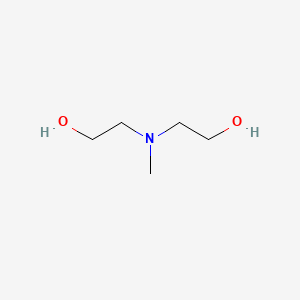
N-Methyldiethanolamine
Methyldiethanolamine is a colorless liquid. (USCG, 1999) — CAMEO Chemicals
- Nom IUPAC
- 2-[2-hydroxyethyl(methyl)amino]ethanol
- Formule moléculaire
- C5H13NO2
- Masse moléculaire
- 119.16 g/mol
- Masse exacte
- 119.094628657 Da
- XLogP3
- -1,1
- Surface polaire topologique
- 43,7 Ų
- Donneurs de liaisons hydrogène
- 2
- Accepteurs de liaisons hydrogène
- 3
- Unités covalentes
- 1
- Stéréocentres définis
- 0
Également connu sous le nom de
16 autres noms signalés
Identifiants de bases de données externes
- ChEMBL:CHEMBL3185149
- EPA DTXSID:DTXSID8025591
- PubMed:21925703
- PubMed:21421256
- PubMed:18703098
- PubMed:18661123
- PubMed:18602156
- PubMed:16767730
Preuves issues de bases de données scientifiques complémentaires
NIH PubChem PUG-View
Attributed physical-property, hazard, environmental and use annotations.
- Autoignition Temperature: 265 °C Source: ILO-WHO International Chemical Safety Cards (ICSCs)
- Boiling Point: 477 °F at 760 mmHg (NTP, 1992) Source: CAMEO Chemicals
- Boiling Point: 245 °C Source: Hazardous Substances Data Bank (HSDB)
- Boiling Point: 247 °C Source: ILO-WHO International Chemical Safety Cards (ICSCs)
- Color/Form: Colorless liquid Source: Hazardous Substances Data Bank (HSDB)
- Color/Form: Liquid Source: Hazardous Substances Data Bank (HSDB)
- Density: 1.0377 at 68 °F (USCG, 1999) - Denser than water; will sink Source: CAMEO Chemicals
- Density: 1.043 g/cu cm at 25 °C Source: Hazardous Substances Data Bank (HSDB)
- Density: Bulk density: 8.7 lb/gal, vapor pressure less than 0.01 mm Hg at 20 °C Source: Hazardous Substances Data Bank (HSDB)
- Density: Relative density (water = 1): 1.04 Source: ILO-WHO International Chemical Safety Cards (ICSCs)
- Dissociation Constants: pKa = 8.52 (conjugate acid) Source: Hazardous Substances Data Bank (HSDB)
- Flash Point: 260 °F (NTP, 1992) Source: CAMEO Chemicals
- Flash Point: 127 °C (261 °F) - closed cup Source: Hazardous Substances Data Bank (HSDB)
- Flash Point: 260 °F (127 °C) (Open Cup) Source: Hazardous Substances Data Bank (HSDB)
- Flash Point: 136 °C c.c. Source: ILO-WHO International Chemical Safety Cards (ICSCs)
- LogP: -1.08 Source: ILO-WHO International Chemical Safety Cards (ICSCs)
- Melting Point: -6 °F (NTP, 1992) Source: CAMEO Chemicals
- Melting Point: -21 °C Source: Hazardous Substances Data Bank (HSDB)
- Melting Point: -21 °C Source: ILO-WHO International Chemical Safety Cards (ICSCs)
- Odor: Amine-like odor Source: Hazardous Substances Data Bank (HSDB)
- Physical Description: Methyldiethanolamine is a colorless liquid. (USCG, 1999) Source: CAMEO Chemicals
- Physical Description: Liquid Source: EPA Chemical Data Reporting (CDR)
- Physical Description: Colorless liquid; [ICSC] Clear light yellow liquid; [Sigma-Aldrich MSDS] Source: Haz-Map, Information on Hazardous Chemicals and Occupational Diseases
- Physical Description: COLOURLESS LIQUID WITH CHARACTERISTIC ODOUR. Source: ILO-WHO International Chemical Safety Cards (ICSCs)
- Refractive Index: Index of refraction = 1.4685 at 20 °C Source: Hazardous Substances Data Bank (HSDB)
- Solubility: Very soluble (NTP, 1992) Source: CAMEO Chemicals
- Solubility: In water, 1.0X10+6 mg/L, temp not specified (miscible) Source: Hazardous Substances Data Bank (HSDB)
- Solubility: Miscible with water Source: Hazardous Substances Data Bank (HSDB)
- Solubility: Very soluble in water Source: Hazardous Substances Data Bank (HSDB)
- Solubility: Miscible with benzene Source: Hazardous Substances Data Bank (HSDB)
- Solubility: Solubility in water, g/100ml at 25 °C: 100 Source: ILO-WHO International Chemical Safety Cards (ICSCs)
- Vapor Pressure: less than 0.01 mmHg at 68 °F (NTP, 1992) Source: CAMEO Chemicals
- Vapor Pressure: 0.0002 [mmHg] Source: Haz-Map, Information on Hazardous Chemicals and Occupational Diseases
- Vapor Pressure: 2.0X10⁻⁴ mm Hg at 25 °C Source: Hazardous Substances Data Bank (HSDB)
- Vapor Pressure: Vapor pressure, Pa at 25 °C: 0.03 Source: ILO-WHO International Chemical Safety Cards (ICSCs)
- Viscosity: 101 mPa-sec at 20 °C Source: Hazardous Substances Data Bank (HSDB)
- Exposure Routes: The substance can be absorbed into the body by ingestion. Source: ILO-WHO International Chemical Safety Cards (ICSCs)
- First Aid: EYES: First check the victim for contact lenses and remove if present. Flush victim's eyes with water or normal saline solution for 20 to 30 minutes while simultaneously calling a hospital or poison control center. Do not put any ointments, oils, or medication in the victim's eyes without specific instructions from a physician. IMMEDIATELY transport the victim after flushing eyes to a hospital even if no symptoms (such as redness or irritation) develop.; SKIN: IMMEDIATELY flood affected skin with water while removing and isolating all contaminated clothing. Gently wash all affected skin areas thoroughly with soap and water. If symptoms such as redness or irritation develop, IMMEDIATELY call a physician and be prepared to transport the victim to a hospital for treatment.; INHALATION: IMMEDIATELY leave the contaminated area; take deep breaths of fresh air. If symptoms (such as wheezing, coughing, shortness of breath, or burning in the mouth, throat, or chest) develop, call a physician and be prepared to transport the victim to a hospital. Provide proper respiratory protection to rescuers entering an unknown atmosphere. Whenever possible, Self-Contained Breathing Apparatus (SCBA) shou Source: CAMEO Chemicals
- Signal: Warning Source: Regulation (EC) No 1272/2008 of the European Parliament and of the Council
- GHS Hazard Statements: H319: Causes serious eye irritation [Warning Serious eye damage/eye irritation] Source: Regulation (EC) No 1272/2008 of the European Parliament and of the Council
- Precautionary Statement Codes: P264+P265, P280, P305+P351+P338, and P337+P317 (click each P-code to see the statement) Source: Regulation (EC) No 1272/2008 of the European Parliament and of the Council
- Note: This chemical does not meet GHS hazard criteria for < 0.1% (1 of 1451) of reports. Source: European Chemicals Agency (ECHA)
- Signal: Warning Source: European Chemicals Agency (ECHA)
- GHS Hazard Statements: H319 (> 99.9%): Causes serious eye irritation [Warning Serious eye damage/eye irritation] Source: European Chemicals Agency (ECHA)
- Precautionary Statement Codes: P264+P265, P280, P305+P351+P338, and P337+P317 (click each P-code to see the statement) Source: European Chemicals Agency (ECHA)
- ECHA C&L Notifications Summary: Aggregated GHS information provided per 1451 reports by companies from 5 notifications to the ECHA C&L Inventory.; Reported as not meeting GHS hazard criteria per 1 of 1451 reports by companies.; There are 4 notifications provided by 1450 of 1451 reports by companies with hazard statement code(s).; Information may vary between notifications depending on impurities, additives, and other factors. The percentage value in parenthesis indicates the notified classification ratio from companies that provide hazard codes. Only hazard codes with percentage values above 10% are shown. For more detailed information, please visit ECHA C&L website. Source: European Chemicals Agency (ECHA)
- Signal: Warning Source: NITE-CMC
- GHS Hazard Statements: H320: Causes eye irritation [Warning Serious eye damage/eye irritation]; H361: Suspected of damaging fertility or the unborn child [Warning Reproductive toxicity] Source: NITE-CMC
- Precautionary Statement Codes: P203, P264+P265, P280, P305+P351+P338, P318, P337+P317, P405, and P501 (click each P-code to see the statement) Source: NITE-CMC
- Signal: Warning Source: Hazardous Chemical Information System (HCIS), Safe Work Australia
- NFPA Health Rating: 1 - Materials that, under emergency conditions, can cause significant irritation. Source: Hazardous Substances Data Bank (HSDB)
- NFPA Fire Rating: 1 - Materials that must be preheated before ignition can occur. Materials require considerable preheating, under all ambient temperature conditions, before ignition and combustion can occur. Source: Hazardous Substances Data Bank (HSDB)
- NFPA Instability Rating: 0 - Materials that in themselves are normally stable, even under fire conditions. Source: Hazardous Substances Data Bank (HSDB)
- Toxicity Summary: IDENTIFICATION AND USE: N-Methyldiethanolamine (MDEA) is a colorless liquid. MDEA is used as an intermediate, in absorption of acidic gases, as a catalyst for polyurethane foams, and pH control agent. HUMAN STUDIES: There are no data available. ANIMAL STUDIES: MDEA was irritating to the guinea pig skin, and showed potential to induce allergic contact dermatitis. MDEA caused slight eye irritation. In rats, recurrent skin application of MDEA produced a dose-related irritant effect, but there was no evidence for systemic cumulative or specific target organ or tissue toxicity. Rat dams showed dose-dependent skin irritation following repeated cutaneous application of MDEA during pregnancy. In addition, maternal toxicity was also present as anemia in dams receiving 1000 mg/kg/day. Despite maternal toxicity, there was no evidence of developmental effects. MDEA was not genotoxic when tested in the Salmonella/microsome reverse gene mutation test, the CHO/HGPRT forward gene mutation test, a sister chromatid exchange test in cultured CHO cells, and an in vivo peripheral blood micronucleus test in mice. Source: Hazardous Substances Data Bank (HSDB)
- Environmental Bioconcentration: An estimated BCF of 3 was calculated in fish for N-methyldiethanolamine(SRC), using an estimated log Kow of -1.50(1) and a regression-derived equation(1). According to a classification scheme(2), this BCF suggests the potential for bioconcentration in aquatic organisms is low. Source: Hazardous Substances Data Bank (HSDB)
- Environmental Fate: TERRESTRIAL FATE: Based on a classification scheme(1), an estimated Koc value of 1(SRC), determined from a structure estimation method(2), indicates that N-methyldiethanolamine is expected to have very high mobility in soil(SRC). The pKa of N-methyldiethanolamine is 8.52(3), indicating that this compound will exist partially in the cation form in the environment and cations generally adsorb more strongly to soils containing organic carbon and clay than their neutral counterparts(4). Volatilization of the cation from moist soil is not expected because cations do not volatilize(SRC). Volatilization of neutral N-methyldiethanolamine from moist soil surfaces is not expected to be an important fate process(SRC) given an estimated Henry's Law constant of 3.1X10⁻¹¹ atm-cu m/mole(SRC) based upon its vapor pressure, 2.0X10⁻⁴ mm Hg(5), and assigned value for water solubility of 1X10+6 mg/L (miscible)(6). N-Methyldiethanolamine is not expected to volatilize from dry soil surfaces(SRC) based upon its vapor pressure(5). N-Methyldiethanolamine did not biodegrade after 28 days in activated sludge, but degraded >96% after 40 days in a continuous-flow experiment where the inoculum had time to accli Source: Hazardous Substances Data Bank (HSDB)
- Environmental Fate: AQUATIC FATE: Based on a classification scheme(1), an estimated Koc value of 1(SRC), determined from a structure estimation method(2), indicates that N-methyldiethanolamine is not expected to adsorb to suspended solids and sediment(SRC). A pKa of 8.52(3) indicates N-methyldiethanolamine will exist partially in the cation form at pH values of 5 to 9 and, therefore, volatilization of the cation from water surfaces is not expected to be an important fate process(SRC). Volatilization of neutral N-methyldiethanolamine from water surfaces is not expected(4) based upon an estimated Henry's Law constant of 3.1X10⁻¹¹ atm-cu m/mole(SRC) derived from its vapor pressure, 2.0X10⁻⁴ mm Hg(5), and assigned value for water solubility of 1X10+6 mg/L (miscible)(6). N-Methyldiethanolamine is not expected to undergo hydrolysis in the environment due to the lack of functional groups that hydrolyze under environmental conditions(4). According to a classification scheme(7), an estimated BCF of 3(SRC), from an estimated log Kow of -1.50(2) and a regression-derived equation(2), suggests the potential for bioconcentration in aquatic organisms is low. N-Methyldiethanolamine did not biodegrade after 28 days in Source: Hazardous Substances Data Bank (HSDB)
- Environmental Fate: ATMOSPHERIC FATE: According to a model of gas/particle partitioning of semivolatile organic compounds in the atmosphere(1), N-methyldiethanolamine, which has a vapor pressure of 2.0X10⁻⁴ mm Hg at 25 °C(2), is expected to exist solely as a vapor in the ambient atmosphere. Vapor-phase N-methyldiethanolamine is degraded in the atmosphere by reaction with photochemically-produced hydroxyl radicals(SRC); the half-life for this reaction in air is estimated to be 4 hours(SRC), calculated from its rate constant of 9.7X10⁻¹¹ cu cm/molecule-sec at 25 °C(SRC) that was derived using a structure estimation method(3). N-Methyldiethanolamine does not contain chromophores that absorb at wavelengths >290 nm(4) and, therefore, is not expected to be susceptible to direct photolysis by sunlight(SRC). Source: Hazardous Substances Data Bank (HSDB)
- Consumer Uses: Other; Processing aids, specific to petroleum production Source: EPA Chemical Data Reporting (CDR)
- Industry Uses: Processing aids, specific to petroleum production; Intermediate; Absorbent; pH regulating agent; Solvent; Other Source: EPA Chemical Data Reporting (CDR)
- Sources/Uses: Used as an intermediate, to absorb acidic gases, as catalyst for polyurethane foams, and pH control agent; [HSDB] Used in chemical syntheses (i.e. pharmaceuticals and cationic surfactants), as a cleaning-washing agent, pH regulator (coating manufacture), and solvent (removal of acid gases in oil refineries); [IUCLID] Used to make fine and large scale chemicals, as a catalyst in polymerization reactions, laboratory reagent, additive in coatings and concrete-cement, in gas treatment, and lubricants and metalworking fluids; [ExPub: ECHA REACH Registrations] Permitted for use as an inert ingredient in non-food pesticide products; [EPA] Source: Haz-Map, Information on Hazardous Chemicals and Occupational Diseases
- Industrial Processes with risk of exposure: Metal Machining [Category: Heat or Machine]; Petroleum Production and Refining [Category: Industry]; Painting (Pigments, Binders, and Biocides) [Category: Paint]; Cement Producing [Category: Industry] Source: Haz-Map, Information on Hazardous Chemicals and Occupational Diseases
- Uses: For N-methyldiethanolamine (USEPA/OPP Pesticide Code: 011600) there are 0 labels match. /SRP: Not registered for current use in the USA, but approved pesticide uses may change periodically and so federal, state and local authorities must be consulted for currently approved uses./ Source: Hazardous Substances Data Bank (HSDB)
- Uses: Surfactant intermediate Source: Hazardous Substances Data Bank (HSDB)
- Uses: Intermediate, absorption of acidic gases, catalyst for polyurethane foams, pH control agent. Source: Hazardous Substances Data Bank (HSDB)
- Uses: Methyldiethanolamine (MDEA) and solutions of MDEA have increased in use for gas treating. Additional gas treating capacity can often be obtained with the same working equipment, because of the higher amine concentrations that can be used. Source: Hazardous Substances Data Bank (HSDB)
- Uses: /SRP: Chemical Weapons Convention/ Schedule 3B Precursor to HN2 (Bis(2-chloroethyl)methylamine). Source: Hazardous Substances Data Bank (HSDB)
Mis en correspondance par: Existing checksum-valid CAS to unique PubChem CID match. Récupéré le: 2026-08-31. Ouvrir la fiche source
Les classifications scientifiques et les annotations de danger apportent du contexte et ne remplacent pas la décision réglementaire propre au marché indiquée ci-dessus.
Couverture des sources complémentaires et état des correspondances
| Source | Résultat | Vérifié |
|---|---|---|
| EMBL-EBI ChEBI | Aucune fiche exacte | 2026-08-31 |
| NIH PubChem PUG-View | Correspondance exacte | 2026-08-31 |
Une absence de correspondance enregistrée est une preuve utile que la source a été vérifiée ; ce n’est pas l’affirmation que la substance n’existe pas ailleurs.
Récupéré depuis NIH PubChem le 2026-08-31 par correspondance CAS à somme de contrôle valide. Les propriétés chimiques ne remplacent pas la décision réglementaire de cette page.
Preuves officielles sur le nom d’ingrédient de l’UE
Le nom de l’ingrédient correspond exactement au glossaire officiel 2025 de l’UE des dénominations communes d’ingrédients.
Preuves d’inventaire associées
Ingrédients ayant des fonctions de formulation communes
Sources officielles et scientifiques complémentaires
11 bases de données externes pour vérifier cette identité
Chaque lien lance une recherche de cette identité dans la source concernée. Ce qu’est chaque source et sa valeur juridique
Comment METHYL DIETHANOLAMINE apparaît dans l’inventaire CosIng
L’inventaire CosIng répertorie METHYL DIETHANOLAMINE comme ingrédient cosmétique et cette page l’associe à 1 fiche d’annexe. L’entrée d’inventaire reprend les noms et identifiants, tandis que la fiche d’annexe indique où la substance est interdite, soumise à restrictions ou inscrite sur une liste positive dans le droit de l’UE sur les cosmétiques.
METHYL DIETHANOLAMINE est aussi associé à 1 fonction cosmétique dans les données officielles. Les désignations de fonction décrivent l’usage prévu, mais ne remplacent pas l’examen réglementaire des fiches d’annexe associées avant un travail de formulation ou d’étiquetage.
Questions fréquentes
Note de source pour METHYL DIETHANOLAMINE
Cette page associe l’entrée d’inventaire CosIng de METHYL DIETHANOLAMINE à 1 fiche liée des annexes II à VI de notre jeu de données, construit à partir de documents publics de la Commission européenne sur les ingrédients cosmétiques.
Utilisez cette page d’inventaire pour étudier METHYL DIETHANOLAMINE et comparer les fiches associées, mais vérifiez les restrictions et le statut juridique auprès du texte officiel en vigueur et de la législation avant toute décision réglementaire.
Outils et étapes suivantes
Vérifiez votre formule
Analysez une liste INCI complète pour détecter METHYL DIETHANOLAMINE et les éventuelles restrictions d’annexes de l’UE ou signalements d’allergènes associés.
Vérificateur INCIRechercher des ingrédients similaires
Trouvez d’autres ingrédients de l’inventaire et entrées d’annexe liés à METHYL DIETHANOLAMINE, à ses identifiants ou à des variantes de nom proches.
Rechercher