
PYRIDOXINE HCL
3,4-Pyridinedimethanol, 5-hydroxy-6-methyl-, hydrochloride
PYRIDOXINE HCL figure dans l’inventaire CosIng de l’UE, mais aucune fiche d’annexe directe n’est encore associée sur cette page.
En un coup d’œil
- Fonction
- Antistatic, hair conditioning, skin conditioning
- CAS
- 58-56-0 / 12001-77-3
- EC
- 200-386-2 / -
- Annexes de l’UE
- Non répertoriéAucune fiche d’annexe de l’UE n’est associée. Ce n’est pas une autorisation.
Preuves réglementaires par marché
Aucune règle pour cet ingrédient n’a été importée pour aucun des 13 marchés suivis ici.
Cela décrit cet inventaire, et non le droit. L’absence de règle importée n’est pas la preuve qu’un ingrédient est autorisé : une règle peut exister sous un autre nom ou identifiant, ou dans un jeu de données pas encore importé ici.
Détails d’inventaire pour PYRIDOXINE HCL
Nom INCI
PYRIDOXINE HCL
Nom DCI
pyridoxine hydrochloride
Nom Ph. Eur.
pyridoxini hydrchloridum
Description
3,4-Pyridinedimethanol, 5-hydroxy-6-methyl-, hydrochloride
Provenance de la fiche
- Référence d’inventaire
- 37388
- Identité importée
- PYRIDOXINE HCL
- Mise à jour de la source
- 15/10/2010
Fiches d’annexe pour PYRIDOXINE HCL
Données clés
- ANTISTATIC
Preventing and/or reducing static electricity by neutralising electrical charge on surfaces.
- HAIR CONDITIONING
Enhancing the appearance and feel of hair. Leaving the hair easy to comb, supple, soft and shiny and/or imparting volume, lightness, gloss, texture, etc.
- SKIN CONDITIONING
Maintaining the skin in good condition.
Identité et propriétés chimiques
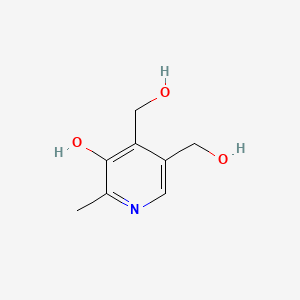
Pyridoxine
Pyridoxine is the 4-methanol form of vitamin B6, an important water-soluble vitamin that is naturally present in many foods. As its classification as a vitamin implies, Vitamin B6 (and pyridoxine) are essential nutrients required for normal functioning of many biological systems within the body. While many plants and microorganisms are able to synthesize pyridoxine through endogenous biological processes, animals must obtain it through their diet. More specifically, pyridoxine is converted to pyridoxal 5-phosphate in the body, which is an important coenzyme for synthesis of amino acids, neurotransmitters (serotonin, norepinephrine), sphingolipids, and aminolevulinic acid. It's important to note that Vitamin B6 is the collective term for a group of three related compounds, pyridoxine, pyridoxal, and pyridoxamine, and their phosphorylated derivatives, pyridoxine 5'-phosphate, pyridoxal 5'-phosphate and pyridoxamine 5'-phosphate. Although all six of these compounds should technically be referred to as vitamin B6, the term vitamin B6 is commonly used interchangeably with just one of them, pyridoxine. Vitamin B6, principally in its biologically active coenzyme form pyridoxal 5'-phosphate, is involved in a wide range of biochemical reactions, including the metabolism of amino acids and glycogen, the synthesis of nucleic acids, hemogloblin, sphingomyelin and other sphingolipids, and the synthesis of the neurotransmitters serotonin, dopamine, norepinephrine and gamma-aminobutyric acid (GABA). Pyridoxine is used medically for the treatment of vitamin B6 deficiency and for the prophylaxis of isoniazid-induced peripheral neuropathy (due to [DB00951]'s mechanism of action which competitively inhibits the action of pyridoxine in the above-mentioned metabolic functions). It is also used in combination with [DB00366] (as the commercially available product Diclectin) for the treatment of nausea and vomiting in pregnancy. — DrugBank
- Nom IUPAC
- 4,5-bis(hydroxymethyl)-2-methylpyridin-3-ol
- Formule moléculaire
- C8H11NO3
- Masse moléculaire
- 169.18 g/mol
- Masse exacte
- 169.07389321 Da
- XLogP3
- -0,8
- Surface polaire topologique
- 73,6 Ų
- Donneurs de liaisons hydrogène
- 3
- Accepteurs de liaisons hydrogène
- 4
- Unités covalentes
- 1
- Stéréocentres définis
- 0
Également connu sous le nom de
16 autres noms signalés
Identifiants de bases de données externes
- ChEBI:CHEBI:16709
- ChEMBL:CHEMBL1364
- EPA DTXSID:DTXSID4023541
- PubMed:23112434
- PubMed:23105553
- PubMed:23056755
- PubMed:23022904
- PubMed:23022070
- PubMed:23001013
- PubMed:22980867
- PubMed:22972088
- PubMed:22970527
- PubMed:22956877
- PubMed:22938800
- PubMed:22908773
Preuves issues de bases de données scientifiques complémentaires
NIH PubChem PUG-View
Attributed physical-property, hazard, environmental and use annotations.
- LogP: -0.77 Source: DrugBank
- LogP: -0.77 Source: Human Metabolome Database (HMDB)
- Melting Point: 159-162 °C Source: DrugBank
- Melting Point: 159 - 162 °C Source: Human Metabolome Database (HMDB)
- Physical Description: Dry Powder Source: EPA Chemical Data Reporting (CDR)
- Physical Description: White powder; [Alfa Aesar MSDS] Source: Haz-Map, Information on Hazardous Chemicals and Occupational Diseases
- Physical Description: Solid Source: Human Metabolome Database (HMDB)
- Solubility: 220000 mg/L Source: DrugBank
- Solubility: 79 mg/mL Source: Human Metabolome Database (HMDB)
- Vapor Pressure: 0.00000028 [mmHg] Source: Haz-Map, Information on Hazardous Chemicals and Occupational Diseases
- Carcinogen Classification: No indication of carcinogenicity to humans (not listed by IARC). Source: Toxin and Toxin Target Database (T3DB)
- Exposure Routes: Oral; parenteral (intramuscular). The B vitamins are readily absorbed from the gastrointestinal tract, except in malabsorption syndromes. Pyridoxine is absorbed mainly in the jejunum. Source: Toxin and Toxin Target Database (T3DB)
- Note: This chemical does not meet GHS hazard criteria for 3.8% (2 of 52) of reports. Source: European Chemicals Agency (ECHA)
- Signal: Warning Source: European Chemicals Agency (ECHA)
- GHS Hazard Statements: H315 (96.2%): Causes skin irritation [Warning Skin corrosion/irritation]; H319 (96.2%): Causes serious eye irritation [Warning Serious eye damage/eye irritation]; H335 (94.2%): May cause respiratory irritation [Warning Specific target organ toxicity, single exposure; Respiratory tract irritation] Source: European Chemicals Agency (ECHA)
- Precautionary Statement Codes: P261, P264, P264+P265, P271, P280, P302+P352, P304+P340, P305+P351+P338, P319, P321, P332+P317, P337+P317, P362+P364, P403+P233, P405, and P501 (click each P-code to see the statement) Source: European Chemicals Agency (ECHA)
- ECHA C&L Notifications Summary: Aggregated GHS information provided per 52 reports by companies from 8 notifications to the ECHA C&L Inventory. Each notification may be associated with multiple companies.; Reported as not meeting GHS hazard criteria per 2 of 52 reports by companies.; There are 7 notifications provided by 50 of 52 reports by companies with hazard statement code(s).; Information may vary between notifications depending on impurities, additives, and other factors. The percentage value in parenthesis indicates the notified classification ratio from companies that provide hazard codes. Only hazard codes with percentage values above 10% are shown. For more detailed information, please visit ECHA C&L website. Source: European Chemicals Agency (ECHA)
- Toxicity Summary: Vitamin B6 is the collective term for a group of three related compounds, pyridoxine (PN), pyridoxal (PL) and pyridoxamine (PM), and their phosphorylated derivatives, pyridoxine 5'-phosphate (PNP), pyridoxal 5'-phosphate (PLP) and pyridoxamine 5'-phosphate (PMP). Although all six of these compounds should technically be referred to as vitamin B6, the term vitamin B6 is commonly used interchangeably with just one of them, pyridoxine. Vitamin B6, principally in its biologically active coenzyme form pyridoxal 5'-phosphate, is involved in a wide range of biochemical reactions, including the metabolism of amino acids and glycogen, the synthesis of nucleic acids, hemogloblin, sphingomyelin and other sphingolipids, and the synthesis of the neurotransmitters serotonin, dopamine, norepinephrine and gamma-aminobutyric acid (GABA). Source: Toxin and Toxin Target Database (T3DB)
- Consumer Uses: Other Source: EPA Chemical Data Reporting (CDR)
- Industry Uses: Other Source: EPA Chemical Data Reporting (CDR)
- Sources/Uses: The 4-methanol form of vitamin B6 that is converted to the coenzyme pyridoxal phosphate; [ChemIDplus] Permitted for use as an inert ingredient in non-food pesticide products; [EPA] Source: Haz-Map, Information on Hazardous Chemicals and Occupational Diseases
- Uses: Use (kg; approx.) in Germany (2009): >7500; Consumption (g per capita; approx.) in Germany (2009): 0.0916; Excretion rate: 1; Calculated removal (%): 92.1 Source: NORMAN Suspect List Exchange
- Uses: For the treatment of vitamin B6 deficiency and for the prophylaxis of isoniazid-induced peripheral neuropathy. Source: Toxin and Toxin Target Database (T3DB)
Mis en correspondance par: Existing checksum-valid CAS to unique PubChem CID match. Récupéré le: 2026-08-31. Ouvrir la fiche source
Les classifications scientifiques et les annotations de danger apportent du contexte et ne remplacent pas la décision réglementaire propre au marché indiquée ci-dessus.
Couverture des sources complémentaires et état des correspondances
| Source | Résultat | Vérifié |
|---|---|---|
| NIH PubChem PUG-View | Correspondance exacte | 2026-08-31 |
Une absence de correspondance enregistrée est une preuve utile que la source a été vérifiée ; ce n’est pas l’affirmation que la substance n’existe pas ailleurs.
Récupéré depuis NIH PubChem le 2026-08-31 par correspondance CAS à somme de contrôle valide. Les propriétés chimiques ne remplacent pas la décision réglementaire de cette page.
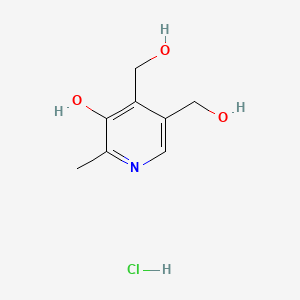
Pyridoxine Hydrochloride
Pyridoxine hydrochloride is the hydrochloride salt of pyridoxine. It is a vitamin B6 and a hydrochloride. It contains a pyridoxine. — ChEBI
- Nom IUPAC
- 4,5-bis(hydroxymethyl)-2-methylpyridin-3-ol;hydrochloride
- Formule moléculaire
- C8H12ClNO3
- Masse moléculaire
- 205.64 g/mol
- Masse exacte
- 205.0505709 Da
- Surface polaire topologique
- 73,6 Ų
- Donneurs de liaisons hydrogène
- 4
- Accepteurs de liaisons hydrogène
- 4
- Unités covalentes
- 2
- Stéréocentres définis
- 0
Également connu sous le nom de
16 autres noms signalés
Identifiants de bases de données externes
- ChEBI:CHEBI:30961
- ChEMBL:CHEMBL1200756
- EPA DTXSID:DTXSID1040792
- PubMed:1325
Récupéré depuis NIH PubChem le 2026-08-31 par correspondance CAS à somme de contrôle valide. Les propriétés chimiques ne remplacent pas la décision réglementaire de cette page.
Preuves officielles sur le nom d’ingrédient de l’UE
Le nom de l’ingrédient correspond exactement au glossaire officiel 2025 de l’UE des dénominations communes d’ingrédients.
Preuves d’inventaire associées
Ingrédients ayant des fonctions de formulation communes
Sources officielles et scientifiques complémentaires
11 bases de données externes pour vérifier cette identité
Chaque lien lance une recherche de cette identité dans la source concernée. Ce qu’est chaque source et sa valeur juridique
Comment PYRIDOXINE HCL apparaît dans l’inventaire CosIng
L’inventaire CosIng répertorie PYRIDOXINE HCL comme ingrédient cosmétique et cette page l’associe à 0 fiche d’annexe. L’entrée d’inventaire reprend les noms et identifiants, tandis que la fiche d’annexe indique où la substance est interdite, soumise à restrictions ou inscrite sur une liste positive dans le droit de l’UE sur les cosmétiques.
PYRIDOXINE HCL est aussi associé à 3 fonctions cosmétiques dans les données officielles. Les désignations de fonction décrivent l’usage prévu, mais ne remplacent pas l’examen réglementaire des fiches d’annexe associées avant un travail de formulation ou d’étiquetage.
Questions fréquentes
Note de source pour PYRIDOXINE HCL
Cette page reproduit l’entrée d’inventaire CosIng de PYRIDOXINE HCL issue de documents publics de la Commission européenne sur les ingrédients cosmétiques et affiche les identifiants associés, même si aucune correspondance directe avec une annexe n’est actuellement rattachée.
Utilisez cette page d’inventaire pour étudier PYRIDOXINE HCL et comparer les fiches associées, mais vérifiez les restrictions et le statut juridique auprès du texte officiel en vigueur et de la législation avant toute décision réglementaire.
Outils et étapes suivantes
Vérifiez votre formule
Analysez une liste INCI complète pour détecter PYRIDOXINE HCL et les éventuelles restrictions d’annexes de l’UE ou signalements d’allergènes associés.
Vérificateur INCIRechercher des ingrédients similaires
Trouvez d’autres ingrédients de l’inventaire et entrées d’annexe liés à PYRIDOXINE HCL, à ses identifiants ou à des variantes de nom proches.
Rechercher