
PYRIDOXINE HCL
3,4-Pyridinedimethanol, 5-hydroxy-6-methyl-, hydrochloride
PYRIDOXINE HCL ist im EU-CosIng-Verzeichnis aufgeführt, aber auf dieser Seite sind noch keine direkten Anhangseinträge verknüpft.
Auf einen Blick
- Funktion
- Antistatic, hair conditioning, skin conditioning
- CAS
- 58-56-0 / 12001-77-3
- EC
- 200-386-2 / -
- EU-Anhänge
- Nicht aufgeführtEs ist kein EU-Anhangseintrag verknüpft. Das ist keine Zulassung.
Regulatorische Belege nach Markt
Für keinen der hier erfassten 13 Märkte wurde eine Vorschrift zu diesem Inhaltsstoff importiert.
Das beschreibt dieses Verzeichnis, nicht das Recht. Eine fehlende importierte Vorschrift ist kein Beleg dafür, dass ein Inhaltsstoff zulässig ist: Eine Vorschrift kann unter einem anderen Namen oder einer anderen Kennung oder in einem hier noch nicht importierten Datensatz existieren.
Verzeichnisangaben zu PYRIDOXINE HCL
INCI-Name
PYRIDOXINE HCL
INN-Name
pyridoxine hydrochloride
Ph.-Eur.-Name
pyridoxini hydrchloridum
Beschreibung
3,4-Pyridinedimethanol, 5-hydroxy-6-methyl-, hydrochloride
Herkunft des Eintrags
- Verzeichnisverweis
- 37388
- Importierte Identität
- PYRIDOXINE HCL
- Quellenaktualisierung
- 15/10/2010
Anhangseinträge für PYRIDOXINE HCL
Kerndaten
- ANTISTATIC
Preventing and/or reducing static electricity by neutralising electrical charge on surfaces.
- HAIR CONDITIONING
Enhancing the appearance and feel of hair. Leaving the hair easy to comb, supple, soft and shiny and/or imparting volume, lightness, gloss, texture, etc.
- SKIN CONDITIONING
Maintaining the skin in good condition.
Chemische Identität und Eigenschaften
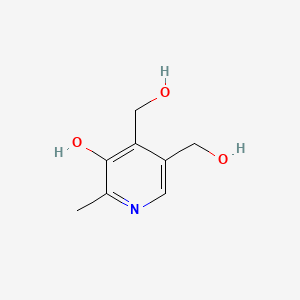
Pyridoxine
Pyridoxine is the 4-methanol form of vitamin B6, an important water-soluble vitamin that is naturally present in many foods. As its classification as a vitamin implies, Vitamin B6 (and pyridoxine) are essential nutrients required for normal functioning of many biological systems within the body. While many plants and microorganisms are able to synthesize pyridoxine through endogenous biological processes, animals must obtain it through their diet. More specifically, pyridoxine is converted to pyridoxal 5-phosphate in the body, which is an important coenzyme for synthesis of amino acids, neurotransmitters (serotonin, norepinephrine), sphingolipids, and aminolevulinic acid. It's important to note that Vitamin B6 is the collective term for a group of three related compounds, pyridoxine, pyridoxal, and pyridoxamine, and their phosphorylated derivatives, pyridoxine 5'-phosphate, pyridoxal 5'-phosphate and pyridoxamine 5'-phosphate. Although all six of these compounds should technically be referred to as vitamin B6, the term vitamin B6 is commonly used interchangeably with just one of them, pyridoxine. Vitamin B6, principally in its biologically active coenzyme form pyridoxal 5'-phosphate, is involved in a wide range of biochemical reactions, including the metabolism of amino acids and glycogen, the synthesis of nucleic acids, hemogloblin, sphingomyelin and other sphingolipids, and the synthesis of the neurotransmitters serotonin, dopamine, norepinephrine and gamma-aminobutyric acid (GABA). Pyridoxine is used medically for the treatment of vitamin B6 deficiency and for the prophylaxis of isoniazid-induced peripheral neuropathy (due to [DB00951]'s mechanism of action which competitively inhibits the action of pyridoxine in the above-mentioned metabolic functions). It is also used in combination with [DB00366] (as the commercially available product Diclectin) for the treatment of nausea and vomiting in pregnancy. — DrugBank
- IUPAC-Name
- 4,5-bis(hydroxymethyl)-2-methylpyridin-3-ol
- Summenformel
- C8H11NO3
- Molekulargewicht
- 169.18 g/mol
- Exakte Masse
- 169.07389321 Da
- XLogP3
- -0,8
- Topologische polare Oberfläche
- 73,6 Ų
- Wasserstoffbrücken-Donoren
- 3
- Wasserstoffbrücken-Akzeptoren
- 4
- Kovalente Einheiten
- 1
- Definierte Stereozentren
- 0
Auch bekannt als
16 weitere gemeldete Namen
Kennungen in externen Datenbanken
- ChEBI:CHEBI:16709
- ChEMBL:CHEMBL1364
- EPA DTXSID:DTXSID4023541
- PubMed:23112434
- PubMed:23105553
- PubMed:23056755
- PubMed:23022904
- PubMed:23022070
- PubMed:23001013
- PubMed:22980867
- PubMed:22972088
- PubMed:22970527
- PubMed:22956877
- PubMed:22938800
- PubMed:22908773
Belege aus weiteren wissenschaftlichen Datenbanken
NIH PubChem PUG-View
Attributed physical-property, hazard, environmental and use annotations.
- LogP: -0.77 Quelle: DrugBank
- LogP: -0.77 Quelle: Human Metabolome Database (HMDB)
- Melting Point: 159-162 °C Quelle: DrugBank
- Melting Point: 159 - 162 °C Quelle: Human Metabolome Database (HMDB)
- Physical Description: Dry Powder Quelle: EPA Chemical Data Reporting (CDR)
- Physical Description: White powder; [Alfa Aesar MSDS] Quelle: Haz-Map, Information on Hazardous Chemicals and Occupational Diseases
- Physical Description: Solid Quelle: Human Metabolome Database (HMDB)
- Solubility: 220000 mg/L Quelle: DrugBank
- Solubility: 79 mg/mL Quelle: Human Metabolome Database (HMDB)
- Vapor Pressure: 0.00000028 [mmHg] Quelle: Haz-Map, Information on Hazardous Chemicals and Occupational Diseases
- Carcinogen Classification: No indication of carcinogenicity to humans (not listed by IARC). Quelle: Toxin and Toxin Target Database (T3DB)
- Exposure Routes: Oral; parenteral (intramuscular). The B vitamins are readily absorbed from the gastrointestinal tract, except in malabsorption syndromes. Pyridoxine is absorbed mainly in the jejunum. Quelle: Toxin and Toxin Target Database (T3DB)
- Note: This chemical does not meet GHS hazard criteria for 3.8% (2 of 52) of reports. Quelle: European Chemicals Agency (ECHA)
- Signal: Warning Quelle: European Chemicals Agency (ECHA)
- GHS Hazard Statements: H315 (96.2%): Causes skin irritation [Warning Skin corrosion/irritation]; H319 (96.2%): Causes serious eye irritation [Warning Serious eye damage/eye irritation]; H335 (94.2%): May cause respiratory irritation [Warning Specific target organ toxicity, single exposure; Respiratory tract irritation] Quelle: European Chemicals Agency (ECHA)
- Precautionary Statement Codes: P261, P264, P264+P265, P271, P280, P302+P352, P304+P340, P305+P351+P338, P319, P321, P332+P317, P337+P317, P362+P364, P403+P233, P405, and P501 (click each P-code to see the statement) Quelle: European Chemicals Agency (ECHA)
- ECHA C&L Notifications Summary: Aggregated GHS information provided per 52 reports by companies from 8 notifications to the ECHA C&L Inventory. Each notification may be associated with multiple companies.; Reported as not meeting GHS hazard criteria per 2 of 52 reports by companies.; There are 7 notifications provided by 50 of 52 reports by companies with hazard statement code(s).; Information may vary between notifications depending on impurities, additives, and other factors. The percentage value in parenthesis indicates the notified classification ratio from companies that provide hazard codes. Only hazard codes with percentage values above 10% are shown. For more detailed information, please visit ECHA C&L website. Quelle: European Chemicals Agency (ECHA)
- Toxicity Summary: Vitamin B6 is the collective term for a group of three related compounds, pyridoxine (PN), pyridoxal (PL) and pyridoxamine (PM), and their phosphorylated derivatives, pyridoxine 5'-phosphate (PNP), pyridoxal 5'-phosphate (PLP) and pyridoxamine 5'-phosphate (PMP). Although all six of these compounds should technically be referred to as vitamin B6, the term vitamin B6 is commonly used interchangeably with just one of them, pyridoxine. Vitamin B6, principally in its biologically active coenzyme form pyridoxal 5'-phosphate, is involved in a wide range of biochemical reactions, including the metabolism of amino acids and glycogen, the synthesis of nucleic acids, hemogloblin, sphingomyelin and other sphingolipids, and the synthesis of the neurotransmitters serotonin, dopamine, norepinephrine and gamma-aminobutyric acid (GABA). Quelle: Toxin and Toxin Target Database (T3DB)
- Consumer Uses: Other Quelle: EPA Chemical Data Reporting (CDR)
- Industry Uses: Other Quelle: EPA Chemical Data Reporting (CDR)
- Sources/Uses: The 4-methanol form of vitamin B6 that is converted to the coenzyme pyridoxal phosphate; [ChemIDplus] Permitted for use as an inert ingredient in non-food pesticide products; [EPA] Quelle: Haz-Map, Information on Hazardous Chemicals and Occupational Diseases
- Uses: Use (kg; approx.) in Germany (2009): >7500; Consumption (g per capita; approx.) in Germany (2009): 0.0916; Excretion rate: 1; Calculated removal (%): 92.1 Quelle: NORMAN Suspect List Exchange
- Uses: For the treatment of vitamin B6 deficiency and for the prophylaxis of isoniazid-induced peripheral neuropathy. Quelle: Toxin and Toxin Target Database (T3DB)
Zugeordnet durch: Existing checksum-valid CAS to unique PubChem CID match. Abgerufen: 2026-08-31. Quelleneintrag öffnen
Wissenschaftliche Klassifizierungen und Gefahrenannotationen liefern Kontext und ersetzen nicht die oben gezeigte marktspezifische regulatorische Entscheidung.
Weitere Quellenabdeckung und Trefferstatus
| Quelle | Ergebnis | Geprüft |
|---|---|---|
| NIH PubChem PUG-View | Exakter Treffer | 2026-08-31 |
Ein erfasster Nicht-Treffer ist ein nützlicher Beleg dafür, dass die Quelle geprüft wurde; er ist keine Behauptung, dass der Stoff anderswo nicht existiert.
Am 2026-08-31 von NIH PubChem durch prüfsummengültigen CAS-Abgleich abgerufen. Chemische Eigenschaften ersetzen nicht die regulatorische Entscheidung auf dieser Seite.
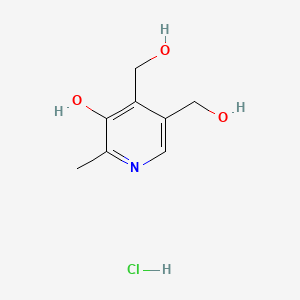
Pyridoxine Hydrochloride
Pyridoxine hydrochloride is the hydrochloride salt of pyridoxine. It is a vitamin B6 and a hydrochloride. It contains a pyridoxine. — ChEBI
- IUPAC-Name
- 4,5-bis(hydroxymethyl)-2-methylpyridin-3-ol;hydrochloride
- Summenformel
- C8H12ClNO3
- Molekulargewicht
- 205.64 g/mol
- Exakte Masse
- 205.0505709 Da
- Topologische polare Oberfläche
- 73,6 Ų
- Wasserstoffbrücken-Donoren
- 4
- Wasserstoffbrücken-Akzeptoren
- 4
- Kovalente Einheiten
- 2
- Definierte Stereozentren
- 0
Auch bekannt als
16 weitere gemeldete Namen
Kennungen in externen Datenbanken
- ChEBI:CHEBI:30961
- ChEMBL:CHEMBL1200756
- EPA DTXSID:DTXSID1040792
- PubMed:1325
Am 2026-08-31 von NIH PubChem durch prüfsummengültigen CAS-Abgleich abgerufen. Chemische Eigenschaften ersetzen nicht die regulatorische Entscheidung auf dieser Seite.
Belege zum amtlichen EU-Inhaltsstoffnamen
Der Inhaltsstoffname stimmt exakt mit dem amtlichen EU-Glossar 2025 der gebräuchlichen Inhaltsstoffnamen überein.
Verwandte Belege aus dem Verzeichnis
Inhaltsstoffe mit sich überschneidenden Rezepturfunktionen
Weitere amtliche und wissenschaftliche Quellen
11 externe Datenbanken zur Prüfung dieser Identität
Jeder Link durchsucht die jeweilige Quelle nach dieser Identität. Was jede Quelle ist und welches rechtliche Gewicht sie hat
Wie PYRIDOXINE HCL im CosIng-Verzeichnis erscheint
Das CosIng-Verzeichnis führt PYRIDOXINE HCL als kosmetischen Inhaltsstoff, und diese Seite verknüpft ihn mit 0 Anhangseinträgen. Der Verzeichniseintrag erfasst Namen und Kennungen, während die Anhangseinträge zeigen, wo der Stoff im EU-Kosmetikrecht verboten, beschränkt oder positiv gelistet ist.
PYRIDOXINE HCL ist in den amtlichen Daten außerdem mit 3 kosmetischen Funktionen gekennzeichnet. Funktionsbezeichnungen beschreiben die beabsichtigte Verwendung, ersetzen aber nicht die regulatorische Prüfung verknüpfter Anhangseinträge vor der Rezeptierung oder Kennzeichnung.
Häufig gestellte Fragen
Quellenhinweis zu PYRIDOXINE HCL
Diese Seite gibt den CosIng-Verzeichniseintrag für PYRIDOXINE HCL aus öffentlichen Materialien der Europäischen Kommission zu kosmetischen Inhaltsstoffen wieder und zeigt verknüpfte Kennungen auch dann, wenn derzeit kein direkter Anhangstreffer zugeordnet ist.
Nutzen Sie diese Verzeichnisseite, um PYRIDOXINE HCL zu recherchieren und verknüpfte Einträge zu vergleichen; verifizieren Sie Beschränkungen und Rechtsstatus jedoch anhand des aktuellen amtlichen Quellentextes und Rechts, bevor Sie regulatorische Entscheidungen treffen.
Werkzeuge und nächste Schritte
Rezeptur prüfen
Eine vollständige INCI-Liste prüfen, um PYRIDOXINE HCL und etwaige verknüpfte EU-Anhangsbeschränkungen oder Allergenmarkierungen zu erkennen.
INCI-CheckerÄhnliche Inhaltsstoffe suchen
Weitere Inhaltsstoffe aus dem Verzeichnis und Anhangseinträge finden, die mit PYRIDOXINE HCL, seinen Kennungen oder nahen Namensvarianten zusammenhängen.
Suche