
BENZOPHENONE-8
2,2'-Dihydroxy-4-methoxybenzophenone
BENZOPHENONE-8 figure dans l’inventaire CosIng de l’UE, mais aucune fiche d’annexe directe n’est encore associée sur cette page.
En un coup d’œil
- Fonction
- Uv absorber
- CAS
- 131-53-3
- EC
- 205-026-8
- Annexes de l’UE
- Non répertoriéAucune fiche d’annexe de l’UE n’est associée. Ce n’est pas une autorisation.
Preuves réglementaires par marché
Cette matrice distingue les règles d’ingrédients vérifiées des sources cartographiées mais pas encore importées. L’absence de règle importée ne signifie pas que l’ingrédient est autorisé.
Balayez ou faites défiler horizontalement pour voir toutes les colonnes.
| Marché | Statut des preuves | Fiches | Langue de la source |
|---|---|---|---|
| European Union | Source cartographiée Inventory entry; no linked annex rule | 0 | English and EU languages |
| Great Britain | Source cartographiée Official source mapped; ingredient rule not imported | 0 | English |
| Canada | Source cartographiée Official source mapped; ingredient rule not imported | 0 | English and French |
| New Zealand | Preuves associées Permitted list with conditions Ouvrir cette preuve | 1 | English |
| ASEAN | Source cartographiée Official source mapped; ingredient rule not imported | 0 | English and national languages |
| China | Source cartographiée Official source mapped; ingredient rule not imported | 0 | Chinese with selected English material |
| Japan | Source cartographiée Official source mapped; ingredient rule not imported | 0 | Japanese; official English translation available |
| South Korea | Preuves associées Restricted Ouvrir cette preuve | 1 | Korean with some English names |
| United States | Source cartographiée Official source mapped; ingredient rule not imported | 0 | English |
| Australia | Source cartographiée Official source mapped; ingredient rule not imported | 0 | English |
| Brazil | Source cartographiée Official source mapped; ingredient rule not imported | 0 | Portuguese with INCI crosswalks |
| India | Source cartographiée Official source mapped; ingredient rule not imported | 0 | English and Hindi |
| Saudi Arabia | Source cartographiée Official source mapped; ingredient rule not imported | 0 | Arabic and English |
Détails d’inventaire pour BENZOPHENONE-8
Nom INCI
BENZOPHENONE-8
Nom DCI
dioxybenzone
Description
2,2'-Dihydroxy-4-methoxybenzophenone
Provenance de la fiche
- Référence d’inventaire
- 32147
- Identité importée
- BENZOPHENONE-8
- Mise à jour de la source
- 15/10/2010
Fiches d’annexe pour BENZOPHENONE-8
Données clés
Identité et propriétés chimiques
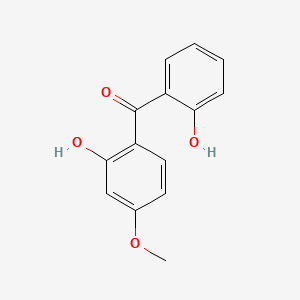
2,2'-Dihydroxy-4-methoxybenzophenone
2,2'-Dihydroxy-4-methoxybenzophenone is a member of benzophenones. — ChEBI
- Nom IUPAC
- (2-hydroxy-4-methoxyphenyl)-(2-hydroxyphenyl)methanone
- Formule moléculaire
- C14H12O4
- Masse moléculaire
- 244.24 g/mol
- Masse exacte
- 244.07355886 Da
- XLogP3
- 3,3
- Surface polaire topologique
- 66,8 Ų
- Donneurs de liaisons hydrogène
- 2
- Accepteurs de liaisons hydrogène
- 4
- Unités covalentes
- 1
- Stéréocentres définis
- 0
Également connu sous le nom de
16 autres noms signalés
Identifiants de bases de données externes
- ChEBI:CHEBI:34208
- ChEMBL:CHEMBL1326877
- EPA DTXSID:DTXSID3022403
- PubMed:37217011
- PubMed:32407875
- PubMed:28959646
- PubMed:28927721
- PubMed:27690075
- PubMed:25349334
- PubMed:23749905
- PubMed:23013281
- PubMed:22346740
- PubMed:21250822
- PubMed:20557889
- PubMed:19298877
Preuves issues de bases de données scientifiques complémentaires
NIH PubChem PUG-View
Attributed physical-property, hazard, environmental and use annotations.
- Boiling Point: 338 to 347 °F at 1 mmHg (NTP, 1992) Source: CAMEO Chemicals
- Boiling Point: 172.5 Source: DrugBank
- Boiling Point: BP: 172 °C at 1 mm Hg Source: Hazardous Substances Data Bank (HSDB)
- Color/Form: Yellow powder Source: Hazardous Substances Data Bank (HSDB)
- Density: 1.39 g/cu cm at 22.7 °C Source: Hazardous Substances Data Bank (HSDB)
- Melting Point: 74 Source: DrugBank
- Melting Point: 68 °C Source: Hazardous Substances Data Bank (HSDB)
- Melting Point: MP: 70.6-77.2 °C Source: Hazardous Substances Data Bank (HSDB)
- Physical Description: 2,2'-dihydroxy-4-methoxybenzophenone is a yellow powder. (NTP, 1992) Source: CAMEO Chemicals
- Physical Description: Dry Powder Source: EPA Chemical Data Reporting (CDR)
- Solubility: Practically insoluble in water Source: Hazardous Substances Data Bank (HSDB)
- Solubility: Solubility in g/100 mL at 25 °C: ethanol 21.8; isopropanol 17; propylene glycol6.2; ethylene glycol 3.0; n-hexane 1.5 Source: Hazardous Substances Data Bank (HSDB)
- Solubility: Freely soluble in alcohol, toluene Source: Hazardous Substances Data Bank (HSDB)
- First Aid: EYES: First check the victim for contact lenses and remove if present. Flush victim's eyes with water or normal saline solution for 20 to 30 minutes while simultaneously calling a hospital or poison control center. Do not put any ointments, oils, or medication in the victim's eyes without specific instructions from a physician. IMMEDIATELY transport the victim after flushing eyes to a hospital even if no symptoms (such as redness or irritation) develop.; SKIN: IMMEDIATELY flood affected skin with water while removing and isolating all contaminated clothing. Gently wash all affected skin areas thoroughly with soap and water. If symptoms such as redness or irritation develop, IMMEDIATELY call a physician and be prepared to transport the victim to a hospital for treatment.; INHALATION: IMMEDIATELY leave the contaminated area; take deep breaths of fresh air. If symptoms (such as wheezing, coughing, shortness of breath, or burning in the mouth, throat, or chest) develop, call a physician and be prepared to transport the victim to a hospital. Provide proper respiratory protection to rescuers entering an unknown atmosphere. Whenever possible, Self-Contained Breathing Apparatus (SCBA) shou Source: CAMEO Chemicals
- Note: This chemical does not meet GHS hazard criteria for 9.8% (5 of 51) of reports. Source: European Chemicals Agency (ECHA)
- Signal: Warning Source: European Chemicals Agency (ECHA)
- GHS Hazard Statements: H315 (84.3%): Causes skin irritation [Warning Skin corrosion/irritation]; H319 (84.3%): Causes serious eye irritation [Warning Serious eye damage/eye irritation]; H335 (80.4%): May cause respiratory irritation [Warning Specific target organ toxicity, single exposure; Respiratory tract irritation] Source: European Chemicals Agency (ECHA)
- Precautionary Statement Codes: P261, P264, P264+P265, P271, P280, P302+P352, P304+P340, P305+P351+P338, P319, P321, P332+P317, P337+P317, P362+P364, P403+P233, P405, and P501 (click each P-code to see the statement) Source: European Chemicals Agency (ECHA)
- ECHA C&L Notifications Summary: Aggregated GHS information provided per 51 reports by companies from 8 notifications to the ECHA C&L Inventory. Each notification may be associated with multiple companies.; Reported as not meeting GHS hazard criteria per 5 of 51 reports by companies.; There are 7 notifications provided by 46 of 51 reports by companies with hazard statement code(s).; Information may vary between notifications depending on impurities, additives, and other factors. The percentage value in parenthesis indicates the notified classification ratio from companies that provide hazard codes. Only hazard codes with percentage values above 10% are shown. For more detailed information, please visit ECHA C&L website. Source: European Chemicals Agency (ECHA)
- Signal: Warning Source: Hazardous Substances Data Bank (HSDB)
- GHS Hazard Statements: H315: Causes skin irritation [Warning Skin corrosion/irritation]; H319: Causes serious eye irritation [Warning Serious eye damage/eye irritation]; H335: May cause respiratory irritation [Warning Specific target organ toxicity, single exposure; Respiratory tract irritation] Source: Hazardous Substances Data Bank (HSDB)
- Precautionary Statement Codes: P261, P264, P264+P265, P271, P280, P302+P352, P304+P340, P305+P351+P338, P319, P321, P332+P317, P337+P317, P362+P364, P403+P233, P405, and P501 (click each P-code to see the statement) Source: Hazardous Substances Data Bank (HSDB)
- Cosmetic Ingredient Review Finding(s): Safe in the present practices of use and concentration. Ingredient, concentration, and use information are available in documents discoverable at https://cir-reports.cir-safety.org Source: Cosmetic Ingredient Review (CIR)
- Toxicity Summary: IDENTIFICATION AND USE: 2,2'-Dihydroxy-4-methoxybenzophenone (dioxybenzone) is a solid, which is used as a benzophenone sunscreen agent. Many sunscreens contain UVA-absorbing avobenzone or a benzophenone (such as dioxybenzone, oxybenzone, or sulisobenzone), in addition to UVB-absorbing chemical ingredients (some of which also contribute to UVA protection). HUMAN STUDIES: There are no human toxicity studies available. Although it has been suggested that benzophenone derivatives may protect against photosensitivity reactions to photosensitizing drugs (e.g., chlordiazepoxide, chlorpromazine, demeclocycline, hydrochlorothiazide, nalidixic acid, nystatin, sulfisoxazole), most clinicians agree that these sunscreens provide, at most, only limited protection for patients who are sensitive to these drugs. ANIMAL STUDIES: Dioxybenzone was nonmutagenic when assayed directly and was weakly mutagenic with metabolic activation in Salmonella strain TA1537. Dioxybenzone was not mutagenic in vivo in the mouse micronucleus test. In mice, signs of toxicity including decreased activity, piloerection, and exophthalmus were observed at doses of 166-5000 mg/kg. Dioxybenzone given orally delayed skin tumo Source: Hazardous Substances Data Bank (HSDB)
- Environmental Bioconcentration: An estimated BCF of 40 was calculated in fish for 2,2'-dihydroxy-4-methoxybenzophenone(SRC), using an estimated log Kow of 3.82(1) and a regression-derived equation(1). According to a classification scheme(2), this BCF suggests the potential for bioconcentration in aquatic organisms is moderate(SRC). Source: Hazardous Substances Data Bank (HSDB)
- Environmental Fate: TERRESTRIAL FATE: Based on a classification scheme(1), an estimated Koc value of 1300(SRC), determined from a structure estimation method(2), indicates that 2,2'-dihydroxy-4-methoxybenzophenone is expected to have low mobility in soil(SRC). Volatilization of 2,2'-dihydroxy-4-methoxybenzophenone from moist soil surfaces is not expected to be an important fate process(SRC) given an estimated Henry's Law constant of 2.0X10⁻⁹ atm-cu m/mole(SRC), developed using a fragment constant estimation method(2). 2,2'-Dihydroxy-4-methoxybenzophenone is not expected to volatilize from dry soil surfaces(SRC) based upon an estimated vapor pressure of 2.0X10⁻⁷ mm Hg at 25 °C(SRC), determined from a fragment constant method(2). Utilizing the CO2 Evolution Test, 0% CO2 Evolution was reached in 28 days(3) indicating that biodegradation is not an important environmental fate process in soil(SRC). Source: Hazardous Substances Data Bank (HSDB)
- Environmental Fate: AQUATIC FATE: Based on a classification scheme(1), an estimated Koc value of 1300(SRC), determined from a structure estimation method(2), indicates that 2,2'-dihydroxy-4-methoxybenzophenone is expected to adsorb to suspended solids and sediment(SRC). Volatilization from water surfaces is not expected(3) based upon an estimated Henry's Law constant of 2.0X10⁻⁹ atm-cu m/mole(SRC), developed using a fragment constant estimation method(2). According to a classification scheme(4), an estimated BCF of 40(SRC), from an estimated log Kow of 3.82(2) and a regression-derived equation(2), suggests the potential for bioconcentration in aquatic organisms is moderate(SRC). Utilizing the CO2 Evolution Test, 0% CO2 Evolution was reached in 28 days(5) indicating that biodegradation is not an important environmental fate process in water(SRC). Source: Hazardous Substances Data Bank (HSDB)
- Environmental Fate: ATMOSPHERIC FATE: According to a model of gas/particle partitioning of semivolatile organic compounds in the atmosphere(1), 2,2'-dihydroxy-4-methoxybenzophenone, which has an estimated vapor pressure of 2.0X10⁻⁷ mm Hg at 25 °C(SRC), determined from a fragment constant method(2), will exist in both the vapor and particulate phases in the ambient atmosphere. Vapor-phase 2,2'-dihydroxy-4-methoxybenzophenone is degraded in the atmosphere by reaction with photochemically-produced hydroxyl radicals(SRC); the half-life for this reaction in air is estimated to be 2 hours(SRC), calculated from its rate constant of 2.0X10⁻¹⁰ cu cm/molecule-sec at 25 °C(SRC) that was derived using a structure estimation method(2). Particulate-phase 2,2'-dihydroxy-4-methoxybenzophenone may be removed from the air by wet and dry deposition(SRC). UV light absorbing substances, such as 2,2'-dihydroxy-4-methoxybenzophenone, accepted as a means of protecting skin against UV radiation damage, absorb UV light in the range of 285-400 nm(2) suggesting that this compound may be susceptible to direct photolysis by sunlight(SRC). Source: Hazardous Substances Data Bank (HSDB)
- Industry Uses: UV stabilizer Source: EPA Chemical Data Reporting (CDR)
- Cosmetic Ingredient Review Link: CIR ingredient: Benzophenone-8 Source: Cosmetic Ingredient Review (CIR)
- Uses: Broad-spectrum sunscreens often contain a number of chemical ingredients that absorb UVA and UVB radiation. Many sunscreens contain UVA-absorbing avobenzone or a benzophenone (such as dioxybenzone, oxybenzone, or sulisobenzone), in addition to UVB-absorbing chemical ingredients (some of which also contribute to UVA protection). Source: Hazardous Substances Data Bank (HSDB)
- Uses: Cosmetic Ultraviolet Absorber: benzophenone-8. /From table/ Source: Hazardous Substances Data Bank (HSDB)
- Uses: MEDICATION Source: Hazardous Substances Data Bank (HSDB)
Mis en correspondance par: Existing checksum-valid CAS to unique PubChem CID match. Récupéré le: 2026-08-31. Ouvrir la fiche source
Les classifications scientifiques et les annotations de danger apportent du contexte et ne remplacent pas la décision réglementaire propre au marché indiquée ci-dessus.
Couverture des sources complémentaires et état des correspondances
| Source | Résultat | Vérifié |
|---|---|---|
| NIH PubChem PUG-View | Correspondance exacte | 2026-08-31 |
Une absence de correspondance enregistrée est une preuve utile que la source a été vérifiée ; ce n’est pas l’affirmation que la substance n’existe pas ailleurs.
Récupéré depuis NIH PubChem le 2026-09-02 par correspondance CAS à somme de contrôle valide. Les propriétés chimiques ne remplacent pas la décision réglementaire de cette page.
Preuves officielles sur le nom d’ingrédient de l’UE
Le nom de l’ingrédient correspond exactement au glossaire officiel 2025 de l’UE des dénominations communes d’ingrédients.
Les 2 marchés qui détiennent une règle pour cette substance ne la classent pas de la même façon.
- soumise à restrictions
- South Korea
- autorisée sur une liste positive
- New Zealand
Voir toutes les substances sur lesquelles les marchés divergent
Preuves d’inventaire associées
Ingrédients ayant des fonctions de formulation communes
Sources officielles et scientifiques complémentaires
11 bases de données externes pour vérifier cette identité
Chaque lien lance une recherche de cette identité dans la source concernée. Ce qu’est chaque source et sa valeur juridique
Comment BENZOPHENONE-8 apparaît dans l’inventaire CosIng
L’inventaire CosIng répertorie BENZOPHENONE-8 comme ingrédient cosmétique et cette page l’associe à 0 fiche d’annexe. L’entrée d’inventaire reprend les noms et identifiants, tandis que la fiche d’annexe indique où la substance est interdite, soumise à restrictions ou inscrite sur une liste positive dans le droit de l’UE sur les cosmétiques.
BENZOPHENONE-8 est aussi associé à 1 fonction cosmétique dans les données officielles. Les désignations de fonction décrivent l’usage prévu, mais ne remplacent pas l’examen réglementaire des fiches d’annexe associées avant un travail de formulation ou d’étiquetage.
Questions fréquentes
Note de source pour BENZOPHENONE-8
Cette page reproduit l’entrée d’inventaire CosIng de BENZOPHENONE-8 issue de documents publics de la Commission européenne sur les ingrédients cosmétiques et affiche les identifiants associés, même si aucune correspondance directe avec une annexe n’est actuellement rattachée.
Utilisez cette page d’inventaire pour étudier BENZOPHENONE-8 et comparer les fiches associées, mais vérifiez les restrictions et le statut juridique auprès du texte officiel en vigueur et de la législation avant toute décision réglementaire.
Outils et étapes suivantes
Vérifiez votre formule
Analysez une liste INCI complète pour détecter BENZOPHENONE-8 et les éventuelles restrictions d’annexes de l’UE ou signalements d’allergènes associés.
Vérificateur INCIRechercher des ingrédients similaires
Trouvez d’autres ingrédients de l’inventaire et entrées d’annexe liés à BENZOPHENONE-8, à ses identifiants ou à des variantes de nom proches.
Rechercher